

A diet break on a GLP-1 is a planned stretch, usually about a week, when you eat closer to maintenance calories while you stay on your prescribed medication and your care plan. It is not a pause in treatment. The best way to do it is with your prescribing clinician and a dietitian, so protein, hydration and muscle protection stay on track. That is how we build care at Dayla: doctor-led GLP-1 treatment with free dietitian visits and care coaching included.
TL;DR
- A diet break means eating at maintenance for a planned period, about one week. It does not mean skipping or stopping your medication.
- A 2024 systematic review of 796 participants found planned pauses of at least a week worked about as well for weight loss as continuous dieting.
- Protein, fluids and strength training matter more during a break, not less. Aim for the targets your clinician or dietitian sets.
- Talk to your prescribing clinician before you change how you eat or how you take your medication.
Table of Contents
- What a diet break means when you take a GLP-1
- What the research shows about diet breaks
- When a break is worth discussing with your clinician
- How to plan a diet break step by step
- Common mistakes during a break
- What Dayla includes for this
- Our perspective
- FAQ
- Sources
What a diet break means when you take a GLP-1
A GLP-1 medication lowers appetite, so most people eat less without trying. A diet break is a deliberate decision to raise your food intake to roughly the level that keeps your weight steady, for a set number of days, and then return to your plan.
Researchers define it narrowly. In the 2024 review published in the journal Obesity, a planned pause was an interval of at least one week during a weight-loss program, followed by a return to broadly the same program.
Two things are easy to confuse:
- A diet break changes your eating for a short, planned time. Your medication, check-ins and routines continue as prescribed.
- A medication pause or stop changes your treatment. That is a clinical decision for your prescriber, with its own follow-up plan.
This article is about the first. If you are thinking about the second, bring it to your clinician before you act.
What the research shows about diet breaks
Most diet-break trials were run in people dieting without medication. They still tell you what a short break does to fat loss, muscle and appetite, which is what most GLP-1 users want to know.
Weight loss is about the same
The 2024 Obesity review pooled nine intervention arms and 796 participants. Average weight change was −7.09 kg with planned pauses versus −7.0 kg with continuous restriction at the end of the active intervention, a median of 26 weeks. The mean difference was −0.09 kg, which is statistically no difference. Dropout rates were also similar.
The same review noted something practical. Programs that guided people to keep their weight stable during the pause, rather than going back to their previous diet, were associated with better weight loss. A break works best when it is structured, not when it turns into an open-ended return to old habits.
Body composition and metabolism hold steady
In a 2023 randomized trial of 38 resistance-trained women, one-week diet breaks after every two dieting weeks produced no significant differences in body composition or resting metabolic rate compared with dieting continuously. Everyone ate a 25% energy deficit with 1.8 g of protein per kilogram of body weight daily and trained with weights three times a week.
The group that took breaks did show lower disinhibition scores, a measure of how easily eating control slips. That points to better adherence, not fat regain.
Hunger and energy can improve
A 2021 analysis of the ICECAP trial in 26 resistance-trained athletes found that a one-week break at maintenance intake caused no significant change in fat mass. Body weight rose by 0.6 kg and fat-free mass by 0.7 kg, likely reflecting glycogen (stored carbohydrate) refilling rather than true muscle gain. Leg muscle endurance improved, and participants reported less hunger and irritability.
The authors suggest timing a break for the later part of a weight-loss phase, when appetite and fatigue can threaten adherence.
What this means for you
If you are losing weight steadily on a GLP-1, a short, planned break is unlikely to undo your progress, and it may make the plan easier to stick to. A small scale increase after a week at maintenance is expected, since extra food and glycogen carry water. It is not fat gain.
The evidence also says breaks are an option, not a requirement. Continuous plans worked as well in the pooled data. Whether a break suits you depends on how you feel, how your progress looks and what your clinician advises.
When a break is worth discussing with your clinician
The cases below are the ones to raise at your next check-in or through your care team:
- You feel worn down by a long stretch of low intake and food has become a daily struggle.
- A vacation, holiday or busy work period is coming and you want a plan instead of improvising.
- Your weight loss has slowed and you are unsure whether to adjust food, training or treatment. Our guide to overcoming a weight loss stall on GLP-1 covers that decision.
- You are losing weight faster than expected, or you are struggling to eat enough protein.
The 2025 expert consensus on GLP-1-based therapy recommends monitoring hydration, excessive weight loss and gastrointestinal effects during treatment. It defines a rate above 1.5 kg per week as worth watching. These checks apply during a break too. If you notice persistent nausea, vomiting, dizziness, or very low intake, contact your clinician. For severe or sudden symptoms, seek urgent medical care.
How to plan a diet break step by step
This is a framework to take to your care team, not a personal prescription. Your clinician decides what is right for your health, dose and goals.
1. Pick the timing and the length
The research uses breaks of about one week. Choose a week you can predict: a trip, a holiday, or the point where fatigue is building. Avoid choosing a break in reaction to a bad day or a short plateau, since weight swings of a pound or two within a week are normal.
At Dayla, you can use your clinician access to confirm timing, especially if your dose is changing around the same time.
2. Keep your treatment as prescribed
A diet break is about food. Keep your medication schedule and your check-ins as your clinician directs. Changing a dose or skipping injections is a separate medical decision. If you are thinking about maintenance dosing, read how to transition to a GLP-1 maintenance dose safely and talk to your prescriber first.
3. Eat at maintenance, not at "anything goes"
The 2024 review linked better results to holding weight stable during the pause. In practice that means regular meals of adequate size, built around protein, vegetables, fiber and carbohydrates you enjoy. Your appetite may still be low, so a plan helps. Setting meal times and portions ahead of time keeps you from under-eating by accident, which defeats the purpose of the break.
Your dietitian can estimate a maintenance range for your body and activity level. Our guide to diet on GLP-1 treatment explains the building blocks.
4. Protect protein and muscle
GLP-1 weight loss includes some lean mass. A 2025 expert consensus notes that approximately 30% of total weight loss with GLP-1-based therapy is lean mass, about 1 in 4 kg lost. That is why muscle protection is the part of a break you should not relax.
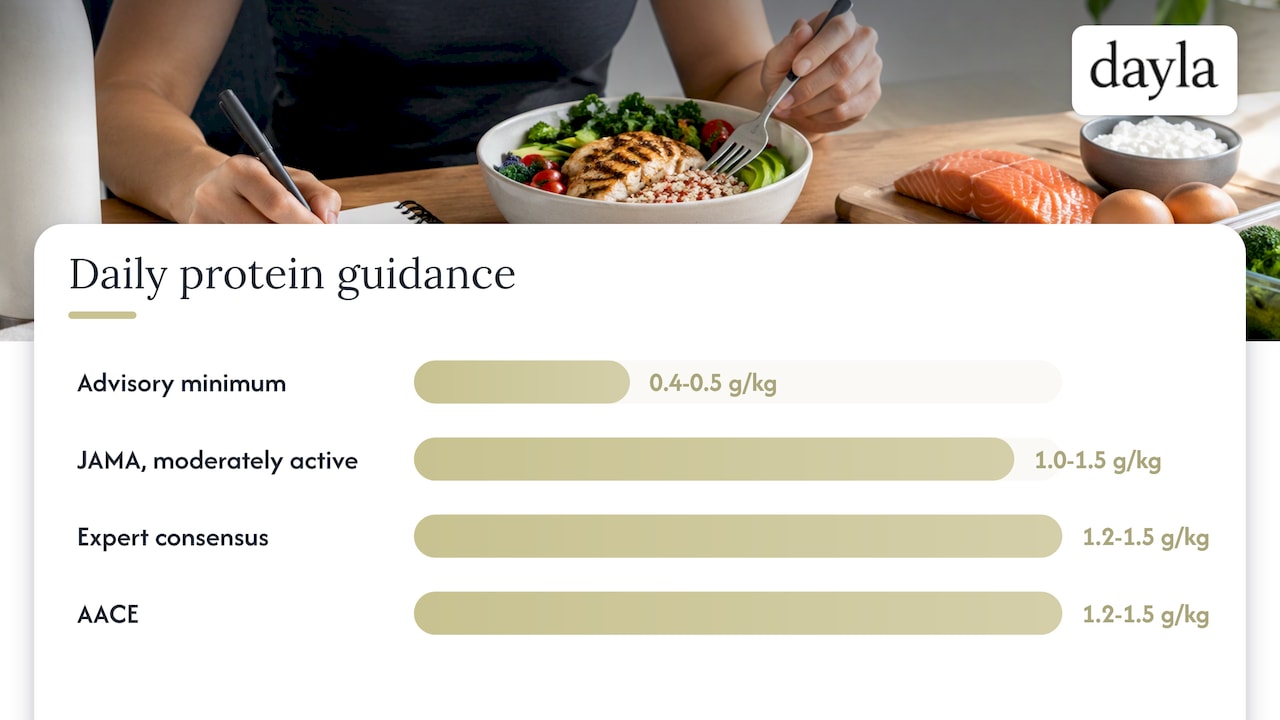
Published targets vary a little by group:
| Source | Protein guidance | Other guidance |
|---|---|---|
| JAMA Internal Medicine, July 2025 | 20 to 30 g at the start of each meal; 1.0 to 1.5 g/kg daily if moderately active | 2 to 3 liters of fluid daily; 150 minutes of moderate activity weekly; strength training 2 to 3 times weekly |
| Expert consensus, 2025 | 1.2 to 1.5 g/kg actual body weight daily during weight loss | Calorie floor of 1,000 to 1,200 kcal per day; watch for loss above 1.5 kg per week |
| AACE, 2025 | 1.2 to 1.5 g/kg daily, from lean sources such as poultry, fish, legumes and low-fat dairy | Daily multivitamin with iron and calcium; monitor B12, vitamin D and folate |
The joint advisory from four U.S. obesity and nutrition societies adds that protein intake should not fall below 0.4 to 0.5 g/kg per day, that prolonged intake at or above 2 g/kg per day should be avoided, and that structured strength training at least three times weekly is part of preserving muscle. For a full walk-through on numbers, see our guide to protein targets in a calorie deficit on GLP-1.
5. Keep lifting
The same advisory stresses that protein alone is likely not enough to preserve muscle without resistance training. It also cites a randomized trial in which one year of GLP-1 plus exercise preserved bone mineral density, while GLP-1 alone reduced it. A diet break is a good week to keep the training schedule exactly as it is. If you are new to it, start with resistance training on GLP-1, and see how to prevent muscle loss during GLP-1 therapy.
6. Hydrate and watch how you feel
JAMA Internal Medicine advises 2 to 3 liters of fluid a day for people on these medications. Eating more food, including fiber, makes fluids matter more. Increase fiber gradually, as the AACE guidance recommends, so your stomach adjusts.
7. Return to your plan and track it
When the break ends, go back to your regular calorie and protein targets. Expect the scale to settle over several days as water and glycogen shift. Use a weekly average instead of a single morning number. Our guide to tracking GLP-1 progress shows which measures to follow: weight trend, waist, strength, and how you feel.
Common mistakes during a break
- Treating the break as a medication holiday. The research defines a diet break as an eating change with the program continuing. Treatment changes belong to your prescriber.
- Letting intake fall too low. Reduced appetite can leave you under-eating, and the break loses its purpose. Eat on a schedule.
- Skipping protein and training. These are the habits that protect muscle, and they matter most when everything else is loosening.
- Making it open-ended. The studies used planned intervals with a clear return date. Write down the end date before you start.
- Reading the scale on day three. Water and glycogen can add weight fast. It is not a verdict on your progress.
What Dayla includes for this
A break goes better with people to ask. Dayla's GLP-1 plans pair your prescription with ongoing clinical oversight, free dietitian visits and care coaching, so the questions in this article (timing, maintenance calories, protein targets, how to resume) have a place to go. Plans are paid in cash with no insurance requirements and no membership fees, and cancellation is flexible.
Current published plans: GLP-1 Injection from $179 per month, GLP-1 Microdose from $159 per month, Oral GLP · Liposomal from $149 per month, and the dayla GLP-1 program at $299 per month. Your clinician confirms which option fits after an online intake. See Dayla's GLP-1 plans.
If you are already on a semaglutide plan and thinking about a later step down, our Semaglutide Injection maintenance dose page describes that option.
Our perspective
We see a diet break as part of a long-term plan, not a way out of one. People do best when the medication, the food plan and the training work together, and when someone with clinical training is available to adjust any of them.
That is why Dayla bundles doctor-led care with dietitian visits and care coaching. A break is easier to plan when you can ask a clinician about timing, ask a dietitian what maintenance looks like for you, and have a coach hold you to the return date.
Our approach is built on personalized GLP-1 care: injection, microdose or needle-free oral options, with transparent cash pricing and no insurance hurdles. The goal is steady, supervised progress you can sustain, with muscle protected and your routine intact.
Flexible
FAQ
Is it okay to take breaks from GLP-1?
Any change to how you take your medication should be decided with your prescribing clinician. A diet break is different: it changes food intake for a planned period while treatment continues. If you want to pause or adjust treatment itself, your clinician can plan the follow-up that goes with it.
Will a diet break make me gain weight?
You may see a small rise on the scale. In a one-week break at maintenance intake, body weight rose 0.6 kg with no significant change in fat mass. That reflects extra food and stored glycogen, and it usually settles once you resume your plan.
How long should a diet break last?
The studies define it as at least one week, and the trials above used one-week breaks. Your clinician or dietitian can help you choose a length and a return date that fit your health and goals.
What happens if I overeat during a break?
A short rise in intake on a GLP-1 can cause fullness, nausea or reflux, because the medication slows digestion. Eat smaller, regular meals and drink fluids. If symptoms are persistent or severe, contact your clinician.
Sources
- Effect of planned pauses versus continuous energy restriction, Obesity systematic review (2024)
- The Effects of Intermittent Diet Breaks during 25% Energy Restriction (2023)
- A 1-week diet break improves muscle endurance during an energy deficit, PLOS One (2021)
- I Am Taking a GLP-1 Weight-Loss Medication, JAMA Internal Medicine (2025)
- Nutritional priorities to support GLP-1 therapy for obesity (2025)
- Nutritional and lifestyle supportive care recommendations for GLP-1-based therapy (2025)
- Nutritional Considerations for Patients on Obesity Medication, AACE (2025)