

Effective GLP-1 progress tracking is defined as the consistent monitoring of medication adherence, body composition, side effects, and laboratory markers to assess both treatment safety and weight loss outcomes. If you are using semaglutide, tirzepatide, or another GLP-1 receptor agonist, structured tracking gives you and your clinician the data needed to make confident dose titration decisions. Apps like Shotsy and Pep, smart scales, and lab panels from providers like Personalabs form the core toolkit. This guide covers exactly what to log, how to read the numbers, and which tools make the process sustainable long term.
How to track GLP-1 progress effectively from day one
The foundation of effective GLP-1 tracking is a minimal viable log. According to six core fields per injection, you need to record the date, time, medication name, dose, injection site, and any side effects or symptoms. That is it for the base log. This structure keeps the habit light enough to maintain every week without feeling like a second job.
The rationale for keeping it minimal is clinical, not just practical. Starting with too many fields causes tracking burnout, and many users quit logging entirely after trying to capture 15 or more data points. A stable six-field log maintained consistently over months delivers far more value to your clinician than a detailed log abandoned after three weeks.

Beyond the base log, a separate short symptom window covering the first 48 hours after each injection captures the most clinically relevant side effect data. Splitting these two logs reduces total workload while preserving the timing information your provider needs for dose titration decisions. Think of the dose log as always on and the symptom window as a brief, focused check-in after each injection.
Appetite level and energy are worth adding once the base habit is established. These two subjective markers give context to weight data and help you recognize when the medication is working at the behavioral level, not just the scale level.
Pro Tip: Record missed or late injections honestly in your log. An accurate exportable history supports your clinician's titration decisions far better than a clean but incomplete record.
How to monitor weight loss beyond just the scale
Weight on a scale is a single data point. What matters on GLP-1 therapy is whether you are losing fat while preserving muscle. A 2024 systematic review confirmed that daily self-monitoring is the most effective approach for weight loss and maintenance on GLP-1 therapy. That finding matters because it validates the habit, but the type of monitoring is what separates useful data from noise.
Here is a practical four-step system for monitoring weight loss with real accuracy:
- Weigh daily, report weekly. Daily weigh-ins capture the trend. Use a seven-day average rather than comparing single days, which removes the distortion from water retention, sodium intake, and hormonal shifts.
- Add a body composition scale. Devices like the Withings Body+ or Garmin Index S2 measure body fat percentage and muscle mass alongside weight. This lets you see fat loss even during weeks when the scale does not move.
- Track protein intake and hydration. Tracking body composition trends alongside hydration and protein intake helps you distinguish a true plateau from normal fluctuation. Low protein intake on GLP-1 therapy accelerates muscle loss, which is a real risk given the appetite suppression these medications produce.
- Run a simple monthly function test. A timed walk, a set of bodyweight squats, or a grip strength measurement takes five minutes and tells you whether your functional capacity is holding steady as weight drops.
Apps like MyFitnessPal sync dietary data with weight trends automatically. Shotsy and Pep are purpose-built for GLP-1 users and include injection logs alongside weight and symptom tracking in one interface. The GLP-1 and body composition relationship is more complex than simple calorie math, and your tracking system should reflect that.
| Tracking method | What it measures | Best tool |
|---|---|---|
| Daily scale weight | Total body mass trend | Withings Body+, Garmin Index S2 |
| Body fat percentage | Fat vs. muscle ratio | Smart scale with bioimpedance |
| Dietary protein and hydration | Nutrition context for weight changes | MyFitnessPal, Cronometer |
| Monthly functional test | Preserved physical capacity | Manual log or notes app |
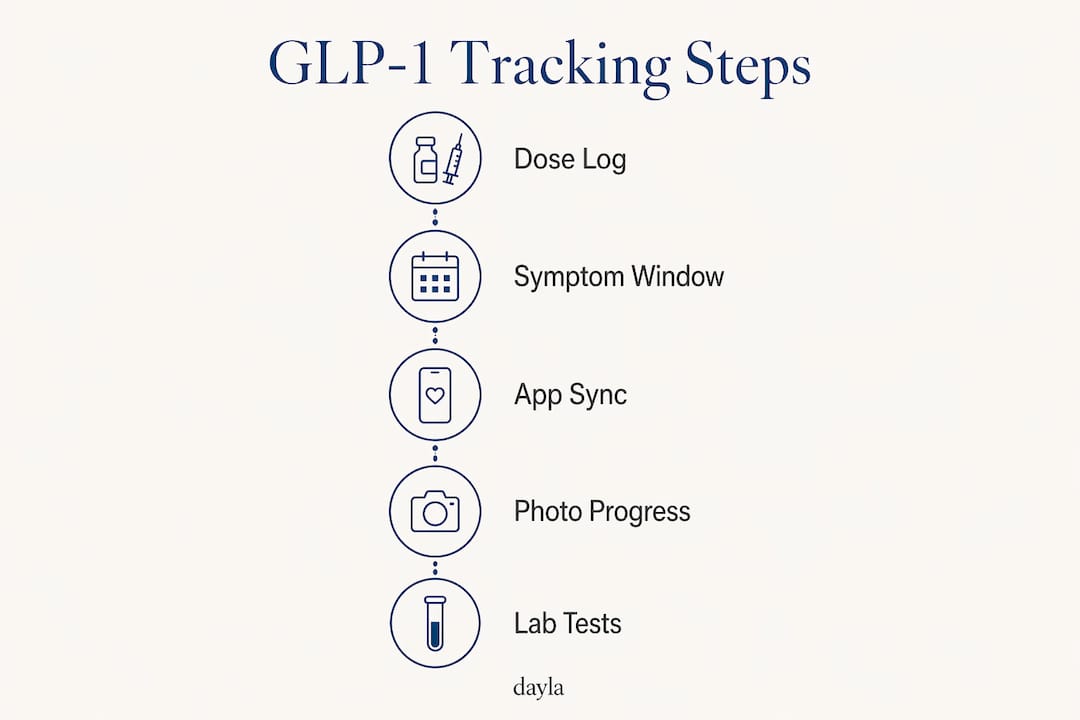
Pro Tip: Photograph your progress monthly using consistent lighting and angles. Visual records capture body recomposition that the scale misses entirely. Daylahealth has a detailed photo tracking guide that walks you through the exact method.
Which lab tests matter for monitoring GLP-1 therapy
Lab monitoring is the part of GLP-1 progress measurement most users underestimate. Key labs for GLP-1 users include HbA1c for glycemic control, creatinine and eGFR for kidney function, liver enzymes (ALT and AST), and a full lipid panel. These are not optional extras. They document whether the medication is producing the metabolic outcomes it is designed for and whether your organs are tolerating the treatment.
Timing matters as much as the tests themselves. The standard schedule runs as follows:
- Baseline: Before starting or immediately after beginning therapy. This establishes your reference point for every future comparison.
- Three months: HbA1c is the priority here. It reflects average blood glucose over the prior two to three months, making three months the earliest point at which a meaningful glycemic response can be measured.
- Six months: Full panel including kidney function, liver enzymes, and lipids. This is when broader metabolic changes become visible.
- As needed: B12, vitamin D, and a complete blood count (CBC) if you are experiencing fatigue, numbness, or other symptoms that suggest nutritional gaps from reduced food intake.
One point that surprises many users: lab monitoring focuses on glycemic control and organ safety rather than direct measurement of GLP-1 levels in the blood. You are not testing whether the drug is present. You are testing whether it is producing the intended biological effects and whether the body is handling it safely.
Labs are benchmarks, not daily indicators. Checking HbA1c at six weeks and feeling discouraged by minimal change misreads the biology. The marker needs time to reflect real change, and repeat testing aligned with medication biology is what produces interpretable data.
What safety symptoms should you track and how to respond
Symptom tracking serves two distinct purposes: it identifies tolerability issues that can be managed with dose adjustments, and it flags rare but serious adverse events that require immediate medical attention. Conflating the two is a clinical mistake.
The following symptoms require urgent clinician contact and should never be managed at home:
- Severe or persistent stomach pain, especially if it radiates to the back
- Stomach pain combined with chills, nausea, vomiting, fever, or lightheadedness (these are signs of pancreatitis and require emergency evaluation)
- Sudden vision changes or signs of hypoglycemia if you are also using insulin or sulfonylureas
- Rapid heart rate at rest
Common GI side effects, including nausea, constipation, and mild bloating, are a different category entirely. These typically peak during the first two to four weeks at a new dose and improve as your body adjusts. Logging their severity on a simple one-to-ten scale across the 48-hour post-injection window gives your clinician the pattern data needed to decide whether to hold the current dose longer before titrating up.
Your symptom log is a clinical communication tool. Bring it to every appointment, share it digitally if your provider accepts that format, and use it to ask specific questions rather than relying on memory.
A clear action plan prevents the most common tracking failure: logging symptoms but not acting on them. Daylahealth's side effects management guide outlines exactly when to call, when to wait, and how to document what you are experiencing for maximum clinical utility.
Tools and techniques to sustain GLP-1 tracking long term
The best tracking system is the one you actually use six months from now. That means starting with the minimum and adding layers only when the base habit is solid.
Apps worth using:
- Shotsy: Purpose-built for GLP-1 injection tracking. Logs dose, site, and symptoms with reminders. Exports data in a format clinicians can review.
- Pep: Combines GLP-1 medication tracking with weight trends and side effect logging in a single interface.
- MyFitnessPal: The standard for nutrition tracking. Pairs well with either of the above for a complete picture of dietary context alongside medication data.
Digital apps like Shotsy, Pep, and MyFitnessPal simplify daily adherence and progress visualization through reminders and easy data entry. That convenience is not trivial. Friction is the primary reason tracking habits fail.
Smart scales with Bluetooth sync, such as the Withings Body+ or the Eufy Smart Scale P2 Pro, remove the manual entry step for weight and body composition data entirely. The data flows directly into Apple Health, Google Fit, or the scale's own app, where it can be reviewed as a trend chart rather than a single number.
| Tool | Primary function | Sync capability |
|---|---|---|
| Shotsy | GLP-1 injection and symptom log | Manual export |
| Pep | GLP-1 tracking with weight trends | In-app |
| MyFitnessPal | Nutrition and calorie tracking | Apple Health, Google Fit |
| Withings Body+ | Weight and body fat | Apple Health, Google Fit |
| Ares One | Protocol and health tracking | Integrated dashboard |
Pro Tip: Set a single weekly review time, five minutes on the same day each week, to look at your weight trend chart and symptom log together. Reviewing data in context is more useful than checking it daily in isolation.
Key takeaways
Consistent, minimal logging across medication adherence, body composition, symptoms, and labs gives you the most complete picture of GLP-1 treatment progress and safety.
| Point | Details |
|---|---|
| Use a six-field dose log | Record date, time, medication, dose, injection site, and side effects every week without exception. |
| Track body composition, not just weight | Use a smart scale or measurements to distinguish fat loss from muscle loss during treatment. |
| Schedule labs at baseline, 3 months, and 6 months | HbA1c at three months is the earliest reliable indicator of glycemic response. |
| Know which symptoms require urgent care | Severe stomach pain with fever, chills, or vomiting requires immediate medical evaluation, not a wait-and-see approach. |
| Start minimal and add tools gradually | Six core fields plus one app is enough to begin. Layer in nutrition and body composition tracking once the habit is stable. |
Why consistency beats perfection in GLP-1 tracking
I have seen users build elaborate tracking spreadsheets in the first two weeks of therapy and abandon them entirely by week six. The problem is never motivation. It is architecture. When a system requires too much effort on a bad day, it collapses on exactly the days when the data would be most valuable.
The insight that changed how I think about this: your log does not need to be complete to be useful. A six-field dose log with honest entries, including the weeks where you felt terrible or missed a dose, is more clinically valuable than a polished record that omits the difficult periods. Clinicians make titration decisions based on patterns, and patterns require honest data, not curated data.
Lab results deserve the same reframe. Checking your HbA1c at two months and feeling like the medication is not working misunderstands what the marker measures. It reflects the prior two to three months of average glucose. Expecting it to shift meaningfully in six weeks is like judging a renovation by looking at the foundation before the walls go up.
The most productive tracking habit I have observed combines a simple app like Shotsy for injections, a smart scale for weekly body composition, and a quarterly lab review. That combination covers medication adherence, physical outcomes, and metabolic safety without requiring daily effort. It also produces the kind of exportable, time-stamped record that makes every clinician conversation more specific and more productive.
Adapt the tools to your life, not the other way around. If a paper notebook works better for you than an app, use the notebook. What matters is that the data exists, is honest, and is reviewed regularly with your provider.
— Flexible
Start your GLP-1 journey with personalized support from Daylahealth
Tracking your progress is only as effective as the care plan behind it. Daylahealth provides doctor-led, personalized GLP-1 care that includes medication management, lab monitoring guidance, and ongoing clinical support designed around your specific goals.

Whether you are starting semaglutide or tirzepatide for the first time or looking to get more from your current regimen, Daylahealth's GLP-1 program connects you with clinicians who use your tracking data to make informed, timely decisions. For those interested in complementary therapies, Daylahealth also offers peptide protocols that support metabolic health and recovery alongside GLP-1 treatment. Personalized care means your data drives your plan. Take the next step and see what doctor-led monitoring looks like in practice.
FAQ
What are the most important things to track on GLP-1 medication?
The six core fields per injection are date, time, medication name, dose, injection site, and side effects. Add weekly weight, body composition, and quarterly lab results for a complete picture of treatment progress and safety.
How often should I get labs done while on GLP-1 therapy?
Get baseline labs before or at the start of therapy, an HbA1c at three months, and a full panel including kidney function, liver enzymes, and lipids at six months. Additional nutrition labs like B12 and vitamin D are recommended if you develop fatigue or other symptoms.
Can I track GLP-1 progress with just a regular scale?
A standard scale tracks total body weight but misses fat versus muscle changes. A body composition scale or monthly measurements provide the additional data needed to confirm you are losing fat while preserving muscle mass.
Which apps are best for tracking GLP-1 therapy?
Shotsy and Pep are purpose-built for GLP-1 users and cover injection logs, side effects, and weight trends. MyFitnessPal adds nutrition tracking. Using one GLP-1 app alongside a nutrition tracker covers the full range of relevant data points.
When should I contact my doctor based on my symptom log?
Contact your clinician immediately if you experience severe stomach pain combined with fever, chills, nausea, vomiting, or lightheadedness. These are potential signs of pancreatitis and require urgent evaluation, not home management.