

The right move when you reach your goal weight on a GLP-1 medication is to stay on the lowest dose that preserves your results, not to stop abruptly. Stopping almost always leads to regain. A GLP-1 maintenance dose transition means shifting from active, weight-loss-focused titration to a stable, lower-burden dose that holds your progress long-term, and it requires a clinician's oversight to do safely.
Before your next appointment, take these four steps:
- Confirm your stability window. You should be at or near goal weight for at least 8–12 weeks before discussing a dose reduction.
- Schedule a clinician review. Bring your 7-day rolling average weight, current dose, and any GI symptom history.
- Plan your monitoring metrics. Know your starting body weight, A1C if you have type 2 diabetes (T2D), and your GI tolerance history.
- Ask about oral or lower-cost options. If injection fatigue or cost is a concern, oral GLP-1 agents and compounded programs are worth discussing.
The STEP-4 and SURMOUNT-4 trials both showed that patients who continued GLP-1 therapy preserved their weight loss, while those who stopped regained a meaningful portion within months. That directional evidence is the clinical foundation for maintenance dosing. Daylahealth offers doctor-led GLP-1 care with ongoing clinical oversight, so you have a care team to guide this transition without navigating it alone.
Key Takeaways
The most effective GLP-1 maintenance dose transition is a single-step reduction with an 8–12 week observation window, a 7-day rolling average weight trigger of 2–3% body weight, and clinician oversight at every step.
| Point | Details |
|---|---|
| Stay on the lowest effective dose | Stopping GLP-1 therapy typically leads to regain; maintenance preserves your results long-term. |
| One step at a time | Reduce by one labeled dose level and observe for 8–12 weeks before any further change. |
| Monitor the 2–3% trigger | A 7-day rolling average weight gain of 2–3% over 8–12 weeks is the standard signal to revert to the prior dose. |
| Switching requires a full restart | Never convert mg-to-mg between molecules; always begin the new agent at its lowest labeled starting dose. |
| Daylahealth supports supervised transitions | Daylahealth provides doctor-led GLP-1 care with clinical oversight, care coaching, and shipped medication to support your maintenance plan. |
Table of Contents
- What "maintenance dose" means for GLP-1 therapy
- Who should consider maintenance dosing versus tapering or stopping
- Practical step-by-step transition protocols
- Drug-by-drug maintenance dose guidance
- Monitoring, side-effect management, and reducing GI symptoms during dose changes
- What the evidence says about weight regain and long-term maintenance
- Cost, insurance, and lower-cost strategies for maintenance
- Working with your care team: what to bring to your appointment
- Daylahealth makes supervised GLP-1 maintenance care accessible
- What a clinician would tell you in the exam room
- Sources
What "maintenance dose" means for GLP-1 therapy
In clinical practice, a maintenance dose is the lowest dose of a GLP-1 receptor agonist (GLP-1 RA) that preserves your achieved weight loss and, for T2D patients, your glycemic control, while remaining tolerable. It is not a fixed number. It is the dose where your weight is stable, your side effects are manageable, and you are not still actively losing weight.
This is distinct from three other states your clinician will consider:
- Active titration: You are still stepping up your dose to drive further weight loss.
- Tapering to stop: You are deliberately reducing your dose with the intent to discontinue, usually for a specific clinical reason such as pregnancy planning or resolved T2D.
- Abrupt discontinuation: Stopping without a taper, which carries the highest risk of rapid weight regain and GI rebound symptoms.
Maintenance dosing offers real advantages: it sustains the appetite-suppressing and metabolic effects of GLP-1 therapy without the GI burden of higher doses. The trade-off is long-term commitment and ongoing cost. One label caveat worth knowing: Wegovy's FDA label lists 2.4 mg weekly as the approved obesity maintenance dose, meaning lower maintenance options are not formally labeled for obesity on that product. For patients who cannot tolerate 2.4 mg, a clinician may consider a lower dose off-label or a switch to a different agent.
Pro Tip: If you are unsure whether you have reached a true plateau or are still losing, track your signs GLP-1 medication is working for four consecutive weeks before raising the maintenance question with your prescriber.
Who should consider maintenance dosing versus tapering or stopping
Not every patient follows the same path. Your clinical picture determines which direction makes sense.
Scenarios that favor continued maintenance dosing:
- Ongoing obesity management where BMI or weight-related comorbidities remain clinically significant
- T2D management where GLP-1 therapy is providing both glycemic and weight benefit
- Patients who have reached goal weight but whose lifestyle changes alone are unlikely to sustain it
- Patients with a history of weight cycling who need pharmacological support long-term
Scenarios where cautious tapering may be appropriate:
- Sustained goal weight for 12 or more months with strong behavioral habits in place
- Intolerable side effects at the current dose that do not resolve with dose adjustment
- Cost or access barriers that make the current agent unsustainable
Scenarios where stopping is clinically indicated:
- Pregnancy planning (most GLP-1 RAs are not recommended during pregnancy)
- Resolved T2D with sustained normal A1C off medication
- Serious adverse events requiring discontinuation
Before your appointment, run through this self-assessment checklist:
- Have you been at or within 2–3% of your goal weight for at least 8 weeks?
- Are your GI side effects well-controlled at your current dose?
- Do you have a consistent protein-forward diet and resistance training routine in place?
- Is your A1C stable (if applicable)?
- Are there any life events in the next 6 months (pregnancy, surgery, travel) that affect your medication access?
- Is cost or insurance coverage becoming a barrier?
Bringing clear answers to these questions makes your clinician visit far more productive.
Practical step-by-step transition protocols
There are four main pathways your clinician may recommend. The right one depends on your clinical picture, your current dose, and your tolerance history.
-
Continue at the current maintenance dose. If you are at goal weight, tolerating your dose well, and have stable labs, staying put is often the safest choice. No titration needed; monitoring continues on a standard schedule.
-
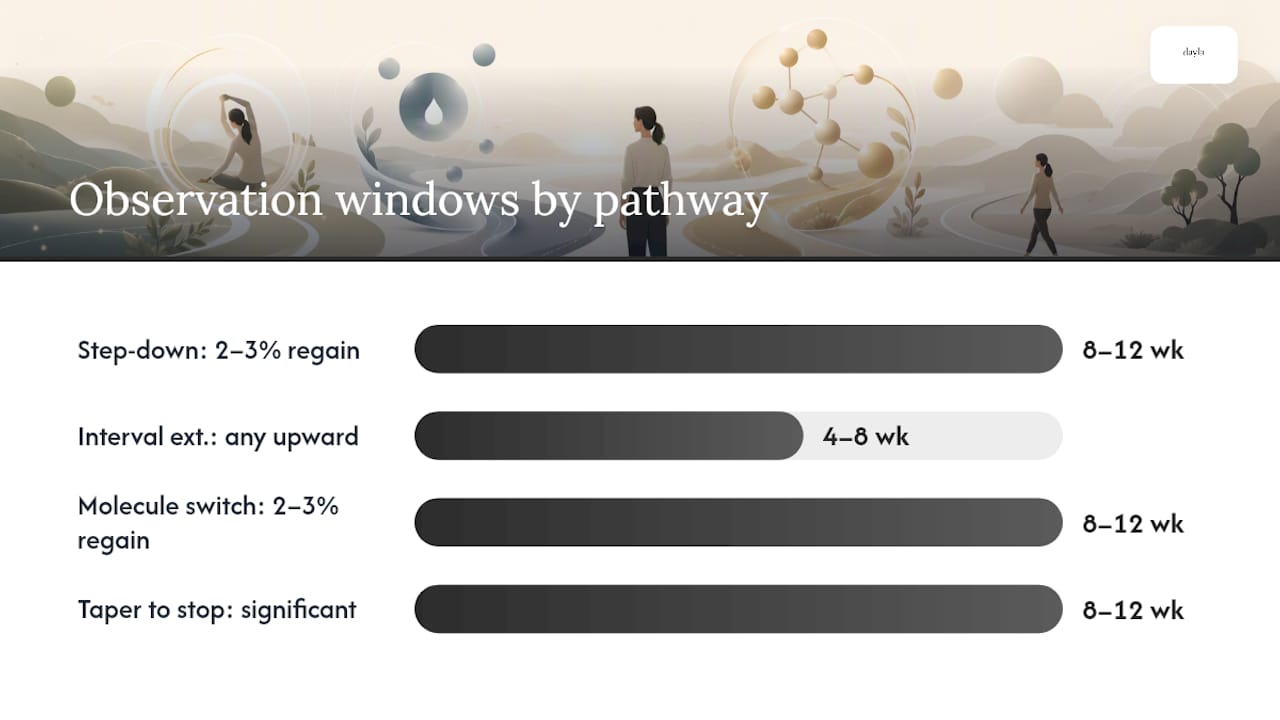
Step-down dose reduction. Reduce by one labeled dose level at a time. For semaglutide (Wegovy), that means moving from 2.4 mg to 1.7 mg weekly. For tirzepatide (Zepbound), from 15 mg to 10 mg, or 10 mg to 7.5 mg. Observe for 8–12 weeks per step before considering another reduction. Use a 7-day rolling average weight to detect regain early. A regain of 2–3% of body weight over that window is a common clinician-used threshold to revert to the prior dose.
-
Stretch the dosing interval. Some clinicians extend a weekly injection to every 10 or 14 days as an intermediate step. This is not FDA-labeled but is used in practice to reduce cost and injection burden while maintaining partial effect. Monitor weight closely during any interval extension.
-
Switch molecules. If cost, tolerability, or access drives the change, switching to a different GLP-1 RA is an option. Per clinical guidance on individualized switching, always restart the new agent at its lowest labeled starting dose, regardless of your prior dose. Tolerance to one GLP-1 does not transfer to another.
-
Taper to stop (special cases only). Reduce by one step every 8–12 weeks until the lowest available dose is reached, then discontinue. Reserve this for the clinical scenarios listed above. Have a weight-monitoring plan in place before the last dose.
Monitoring rules across all pathways: Check your 7-day rolling average weight weekly. Flag any upward trend of 2–3% body weight over 8–12 weeks. For T2D patients, recheck A1C at each step-down. Note GI symptom frequency after each change.
Pro Tip: If GI symptoms return after a dose step-up or a molecule switch, slow your titration to every 6–8 weeks instead of 4, and consider a short course of an antiemetic (ondansetron or promethazine, per your clinician's guidance) for the first 2–3 weeks at the new dose. Restarting GI side effect management strategies early prevents unnecessary discontinuation.
| Transition Path | Observation Window | Regain Trigger to Revert |
|---|---|---|
| Step-down reduction | 8–12 weeks per step | 2–3% body weight gain |
| Interval extension | 4–8 weeks | Any consistent upward trend |
| Molecule switch | 8–12 weeks post-titration | 2–3% body weight gain |
| Taper to stop | 8–12 weeks per step | Revert or restart if significant regain |
Drug-by-drug maintenance dose guidance
Maintenance dose ranges vary by molecule and by indication (obesity vs. T2D). The table below reflects labeled dosing from NCBI Bookshelf and product-specific guidance, with practical notes for each agent.
Per Medscape's semaglutide dosing reference, the standard Wegovy titration runs: 0.25 mg for 4 weeks, then 0.5 mg, 1.0 mg, 1.7 mg, and finally 2.4 mg, with a minimum of 4 weeks at each step. Tirzepatide follows a similar 4-week minimum per step per its label, with labeled maintenance options of 5–15 mg weekly.
When switching between molecules, never convert mg-to-mg. A patient moving from semaglutide 2.4 mg to tirzepatide should start at tirzepatide 2.5 mg weekly, not a dose calculated from their prior semaglutide level. The molecules are structurally different, and dose equivalence does not apply.
Key clinical principle: When a patient cannot tolerate the labeled maintenance dose, the first step is a single-level dose reduction and an extended observation window, not immediate discontinuation. If the lower dose is also intolerable, switching molecules with a full restart is preferred over stopping entirely, because stopping carries a high probability of weight regain within months.
Monitoring, side-effect management, and reducing GI symptoms during dose changes
Dose changes, whether up or down, are the moments when GI side effects are most likely to surface. A structured monitoring plan catches problems early and prevents unnecessary discontinuation.
Monitoring checklist for every dose change:
- Weight: 7-day rolling average, checked weekly
- Appetite and hunger signals: note any return of baseline hunger within 48–72 hours of a dose reduction
- Stool changes: constipation is common on GLP-1 therapy; diarrhea may signal a dose that is too high
- Nausea and vomiting frequency: log episodes per week
- Blood glucose (T2D patients): fasting glucose and A1C at each step-down visit
- Medication adherence: confirm injection technique and storage have not changed
Red flags requiring immediate contact with your care team:
- Persistent vomiting lasting more than 24 hours
- Signs of dehydration (dizziness, dark urine, inability to keep fluids down)
- Severe or worsening abdominal pain
- Rapid A1C rise in T2D patients after a dose reduction
- Any symptoms of pancreatitis (severe upper abdominal pain radiating to the back)
To reduce GI symptoms during transitions, use these tactics in order:
- Slow your titration to every 6–8 weeks if standard 4-week intervals cause symptoms.
- Eat smaller, lower-fat meals around your injection day.
- Avoid high-fat, high-sugar foods for 24–48 hours post-injection.
- Ask your clinician about a short antiemetic course for the first 2–3 weeks at a new dose.
- Stay well-hydrated and prioritize fiber to manage constipation.
Pro Tip: Patients who add resistance training (two to three sessions per week) and keep protein intake at or above 1.2 g per kg of body weight during a dose reduction are more likely to maintain lean mass and metabolic rate. This directly supports weight stability on a lower dose. See lifestyle changes that support GLP-1 results for a practical protocol.
What the evidence says about weight regain and long-term maintenance
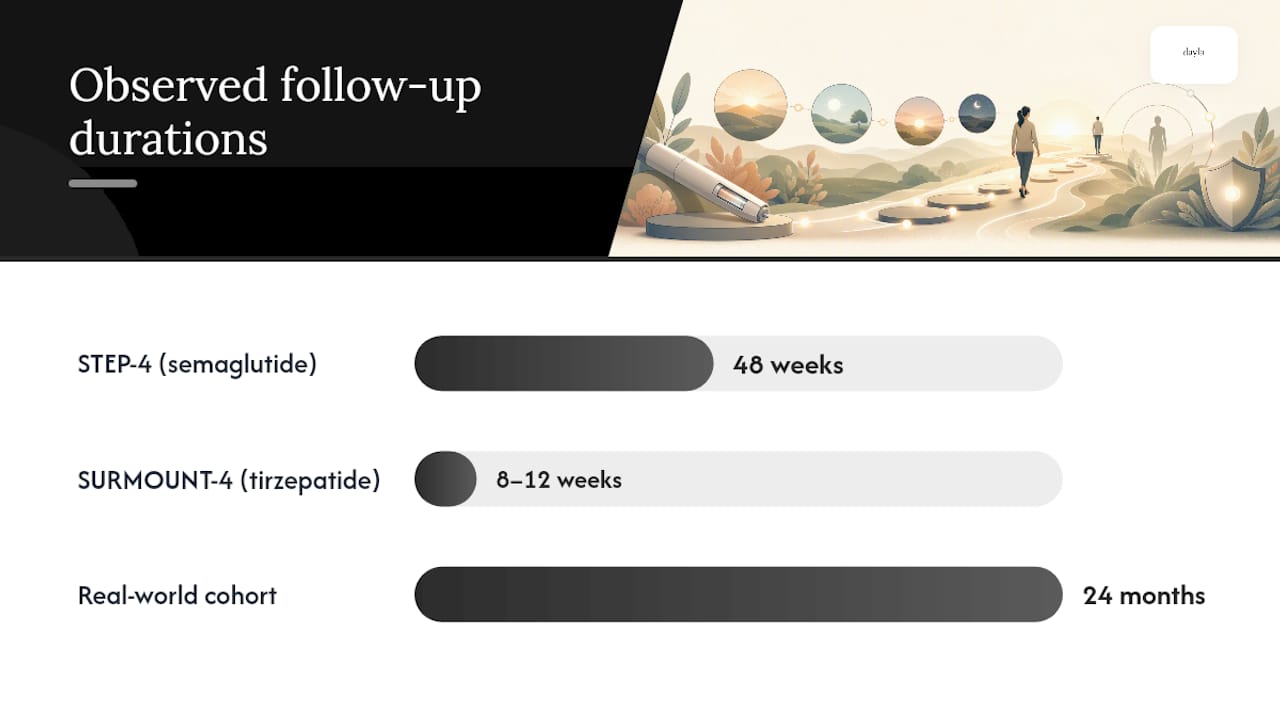
The trial data on stopping GLP-1 therapy is consistent and sobering. In the STEP-4 trial observed that participants who discontinued semaglutide after an active phase experienced measurable weight regain over the course of about a year, while those who continued therapy maintained their loss and achieved further reduction. SURMOUNT-4 showed a similar directional pattern with tirzepatide: the placebo arm experienced significant weight regain over approximately one year after stopping active therapy. Both sets of outcomes are reported in clinical synthesis sources and align with the broader mechanistic understanding that GLP-1 RAs address a chronic, relapsing condition.
Real-world data adds nuance. A real-world study on weight maintenance followed patients who transitioned from 12 months of GLP-1 RA therapy to lower-cost antiobesity medications and found that some cohorts maintained their weight for up to 24 months. Results varied by patient and strategy, and the study was observational, not randomized. Still, it suggests that a planned, supervised transition to a cost-effective agent can preserve results for select patients.
The honest evidence gap: there are very few randomized controlled trials that specifically test dose reduction as a maintenance strategy. Most clinical guidance on step-down protocols is consensus-based, drawn from trial placebo-arm data and clinical experience rather than head-to-head dose-reduction studies. Clinicians who recommend a step-down are making a reasonable, individualized judgment, not following a high-evidence protocol.
| Trial | Drug | Continuation Outcome | Stopping Outcome | Duration |
|---|---|---|---|---|
| STEP-4 | Semaglutide | Continued loss | Regain within months | 48 weeks |
| SURMOUNT-4 | Tirzepatide | Continued loss | ~14% regain | 8–12 weeks |
| Real-world cohort | Various GLP-1 RAs | Maintenance up to 24 months (some cohorts) | Variable | 24 months |
Cost, insurance, and lower-cost strategies for maintenance
Long-term GLP-1 therapy is expensive, and cost is one of the most common reasons patients consider tapering or switching. There are several practical strategies to reduce the financial burden without abandoning the clinical benefit.
Cost-reduction options to discuss with your clinician:
- Step down to a lower labeled dose if tolerated (lower doses often carry lower list prices on some agents)
- Switch to a lower-cost molecule, such as dulaglutide (Trulicity) or liraglutide (Victoza) for T2D patients
- Consider oral GLP-1 options: orforglipron, a daily oral GLP-1 agent, reached a regulatory milestone in early 2026 and may offer a lower-burden, potentially lower-cost maintenance path for eligible patients
- Explore compounded GLP-1 programs, which can significantly reduce monthly cost, though with important regulatory caveats
- Check manufacturer patient-assistance programs (Novo Nordisk and Eli Lilly both maintain assistance programs for qualifying patients)
- Use a budget GLP-1 treatment guide to map your options before your next appointment
Insurance coverage for GLP-1 medications in the United States is inconsistent. Many commercial plans cover Ozempic for T2D but not Wegovy for obesity. Formulary changes mid-year can force a switch even when your current agent is working. When coverage changes, the practical steps are: confirm the new formulary-covered agent with your pharmacist, ask your clinician for a bridge prescription if needed, and restart the new agent at its lowest labeled dose per switching guidance.
On compounded GLP-1 products: The FDA has noted that compounded semaglutide and tirzepatide products are not FDA-approved and may differ in purity, concentration, and sterility from branded products. Compounding pharmacies operating under 503A or 503B designations are subject to oversight, but the regulatory framework differs from that of approved drugs. Discuss the specific compounding pharmacy's credentials with your clinician before switching to a compounded product.
Working with your care team: what to bring to your appointment
A productive maintenance conversation with your clinician takes about 15 minutes if you arrive prepared. Here is what to bring and what to ask.
Appointment checklist:
- Your current dose, the brand name, and how long you have been on it
- Your start weight, current weight, and percent weight lost
- A 4-week log of your 7-day rolling average weight
- Most recent labs: A1C (if T2D), basic metabolic panel if available
- A list of GI symptoms and their frequency over the past 4 weeks
- Your medication access status (insurance, cost, supply)
- Any pregnancy plans or upcoming life events that affect medication use
Sample questions to ask your clinician:
- "Am I a candidate to step down one dose level and observe for 8–12 weeks?"
- "If I regain 2–3% of body weight after a reduction, what is the plan?"
- "Is there a lower-cost agent that would maintain my results?"
- "Should I restart at the lowest dose if I switch molecules?"
- "What monitoring schedule do you recommend during a transition?"
Red flags to report immediately:
- Any return of significant hunger or cravings within the first 2 weeks of a dose reduction
- Weight regain exceeding 2–3% of body weight within 8 weeks
- Severe GI symptoms that are not resolving
- Any new symptoms that could indicate pancreatitis or gallbladder issues
Per UpToDate's guidance on GLP-1 therapy interruptions, missing three or more weekly injections warrants a reduced-dose reintroduction rather than resuming at your prior dose. If you have had a supply gap, tell your clinician before resuming, and expect to retitrate.
Daylahealth makes supervised GLP-1 maintenance care accessible
Navigating a GLP-1 maintenance dose transition without a dedicated care team is harder than it needs to be. Daylahealth offers a direct-to-consumer GLP-1 program that includes clinician evaluations, personalized prescriptions, care coaching, and medication shipped nationwide, all without requiring insurance.
For patients moving into a maintenance phase, that means you have a prescriber who can review your weight logs, adjust your dose, and coordinate a molecule switch if needed, without the delays of a traditional clinic. Dietitian consults are part of the program, so the behavioral side of maintenance, protein targets, resistance training, portion strategy, gets clinical attention alongside your prescription. Compounded GLP-1 options are available for patients where cost is a barrier, with full clinical oversight built in.
If you are ready to discuss your maintenance plan with a clinician, start your Daylahealth GLP-1 intake today. The process is fully online, and your care team will review your history and current dose before making any recommendation. This article is for general informational purposes and does not replace personalized medical advice from a licensed clinician.
What a clinician would tell you in the exam room
If you were sitting across from me after reaching your goal weight on a GLP-1, here is what I would say: the goal now is stability, not more loss. The lowest dose that holds your weight is the right dose, and we find it by stepping down carefully, one level at a time, with enough time between changes to know what is actually happening.
Maintenance is usually long-term. For most people, stopping GLP-1 therapy means the weight comes back, not because of a lack of willpower, but because the medication was addressing a chronic physiological condition. There are exceptions: if your T2D resolves, if you are planning a pregnancy, or if a serious adverse event occurs, stopping is the right call. But for the majority of patients who have lost meaningful weight on a GLP-1, the evidence strongly favors staying on the lowest effective dose rather than stopping.
The most important thing you can do right now is schedule a clinician review with your current dose data and weight logs in hand. Whether that is through Daylahealth or your local provider, that conversation is the next step.
Sources
These are the primary sources used to build this guide. Review them directly for label-level detail and trial methodology.
- Pmc
- Dosing for GLP‑1 RAs (Administered Subcutaneously) — NCBI Bookshelf
- GLP-1 maintenance dose protocols by drug 2026 | GLP Chart
- Telehealthally
- Ozempic, Rybelsus, Wegovy (semaglutide) dosing, indications, interactions, adverse effects, and more — Medscape Reference
When reading product labels versus clinical experience guidance, use the label as the floor for safety and the clinical literature as the context for individualized decisions. A label tells you what is approved; a clinician tells you what fits your specific situation.
A note on using these sources: Product labels are updated periodically. Always confirm current dosing with your prescriber or pharmacist, and treat any synthesis guide (including this one) as a starting point for a clinician conversation, not a substitute for one.