
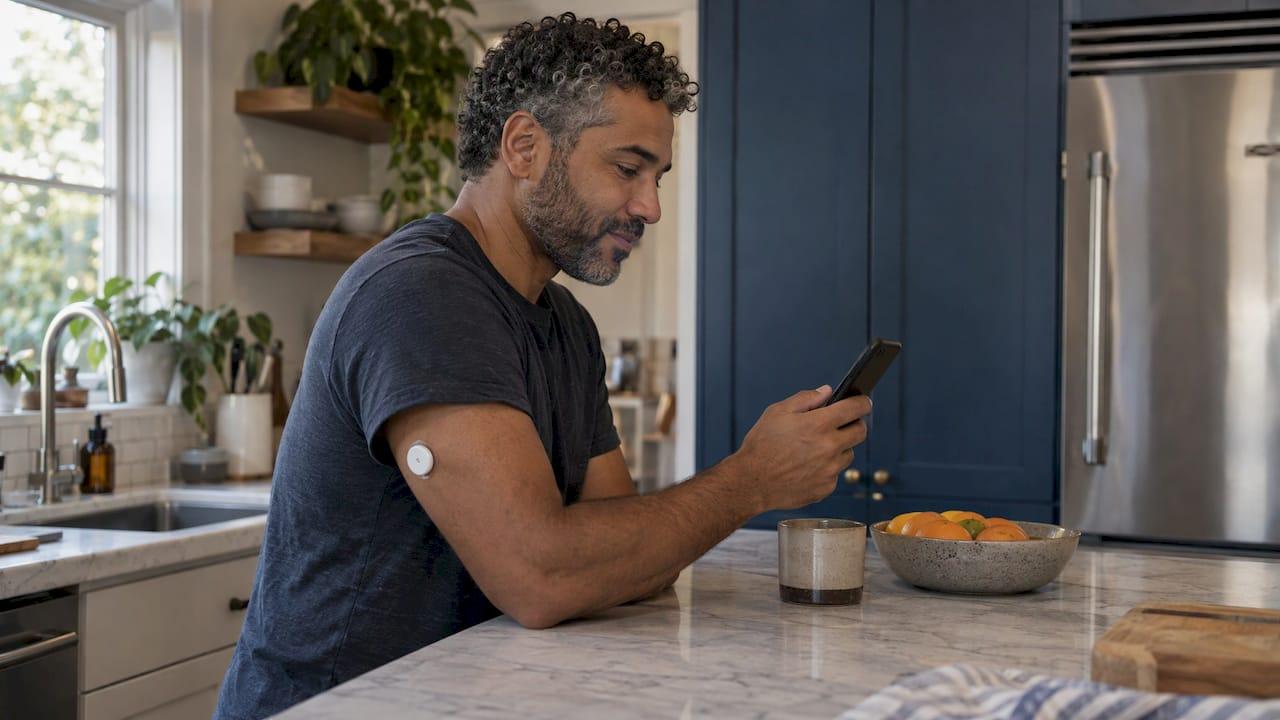
A continuous glucose monitor (CGM) can be worn alongside a GLP-1 medication, and it can show you how meals, sleep and activity move your glucose while the medication does its work. It is an optional tool, not a requirement. The medication, your clinician's oversight and steady habits drive the results. A CGM adds feedback to them. At Dayla Health, doctor-led GLP-1 care includes ongoing clinical oversight, free dietitian visits and care coaching, which gives you a structure for acting on whatever the sensor shows.
TL;DR
- A CGM is a small sensor worn on the skin that estimates glucose in the fluid under it every few minutes and sends readings to an app.
- Over-the-counter CGMs, such as the Dexcom Stelo and Abbott Lingo, can be used by anyone to see how food and exercise affect glucose. The ADA notes they have no alarms.
- Large reviews of people without diabetes show CGM alone does not reliably change weight. Its value is individual feedback, best paired with structured coaching.
- Readings are not a diagnosis. Glucose responses to identical meals vary widely from person to person.
- If you have diabetes, especially type 1, CGM use with GLP-1 therapy belongs under your treating clinician's direction.
Table of Contents
- What a continuous glucose monitor measures
- Which type of CGM you would wear
- What a GLP-1 does to your glucose curve
- How to use a CGM alongside your GLP-1: a practical routine
- What the research says about CGM and weight loss
- Reading your numbers without over-reading them
- If you have diabetes or prediabetes
- What it costs and what insurance covers
- Your GLP-1 plan, with clinicians behind it
- Our perspective
- FAQ
- Sources
What a continuous glucose monitor measures
A CGM uses a tiny sensor placed under the skin. It estimates the glucose in the fluid between your cells every few minutes. A transmitter then sends the data to a phone app, a receiver or an insulin pump, according to the National Institute of Diabetes and Digestive and Kidney Diseases. Sensors are replaced on a schedule that depends on the model.
The sensor tip carries an enzyme that reacts with glucose and produces a small electrical signal, which the device converts into a number, as NIST explains. Because the sensor reads interstitial fluid and not blood, the number trails real blood glucose. The American Diabetes Association puts that delay at roughly 5 to 15 minutes compared with a fingerstick.
What you see in the app:
- A live reading with a trend arrow showing whether glucose is rising, falling or steady.
- A daily graph that lets you see the shape of your day, including the rise after meals.
- Time in range, the share of time your glucose stays inside a target window. NIST notes that readings above 180 mg/dL are generally considered high and below 70 mg/dL low.
The CDC adds that because interstitial glucose can differ from blood glucose, an occasional fingerstick is still used to verify accuracy, particularly when you are new to a CGM.
Which type of CGM you would wear
There are two broad categories, and the difference matters when you pair a sensor with a weight-loss medication.
| Type | Examples named by the ADA | Alarms | Built for |
|---|---|---|---|
| Over-the-counter | Dexcom Stelo, Abbott Lingo | No | Anyone curious about glucose responses to food and exercise |
| Prescription real-time | Libre 2 Plus and 3 Plus, Dexcom G6 and G7, Eversense 365, Guardian 4, Simplera | Yes | Diabetes management |
This comes from the ADA Standards of Care in Diabetes, 2026. The ADA frames over-the-counter sensors as appropriate for people who do not take medications that carry a hypoglycemia risk and want to explore how food and exercise affect them. The FDA cleared the first over-the-counter CGM in March 2024, the Dexcom Stelo.
For most people using a GLP-1 for weight loss, without diabetes, an over-the-counter sensor is the relevant category. Prescription systems with alarms are designed for people managing diabetes.
What a GLP-1 does to your glucose curve
GLP-1 receptor agonists work on several fronts. They raise glucose-dependent insulin release and suppress glucagon. They slow gastric emptying, which blunts the rise in glucose after a meal. They also reduce appetite and energy intake. Subcutaneous semaglutide 2.4 mg weekly and liraglutide 3.0 mg daily are approved for chronic weight management, according to this peer-reviewed consensus review.

That is why a sensor can be interesting while you are on treatment. Slower stomach emptying and smaller meals often change the shape of your post-meal curve. A CGM lets you watch that change from week to week, rather than relying on a single lab value months later. A peer-reviewed case series from 2025 reports that CGM can show the effect of a GLP-1-based therapy over a much shorter time frame than A1C testing. The people in that series had type 2 diabetes, but the principle is the same: glucose data arrives quickly.
If you want to know what else signals progress, our guide to the signs your GLP-1 medication is working covers appetite, scale trends and more.
How to use a CGM alongside your GLP-1: a practical routine
If you decide to add a sensor, treat it as a short experiment with a clear question, not a permanent scoreboard.
1. Start with a question
Pick something specific: "How does my usual breakfast behave?" or "Does a walk after dinner change my curve?" A question keeps you from chasing every wiggle on the graph.
2. Wear a sensor for a full cycle and keep your routine normal
Over-the-counter sensors are typically worn for a set number of days before replacement, depending on the model. Eat and move as you normally would for the first stretch. You want a baseline before you change anything. If your GLP-1 dose is going up during this window, note the date. Dose changes shift appetite and meal size, so they will shift your data too.
3. Log context next to the readings
The ADA advises reviewing food, activity, medication, hydration, stress and sleep when you interpret readings outside your range. A short note in your phone after each meal is enough. Without context, a number is just a number.
4. Compare food types, not single meals
Per the ADA's CGM guidance, carbohydrates raise glucose the most. Simple carbohydrates such as candy, soda and juice raise it fastest. Starchy vegetables, beans, legumes, fruit and whole grains raise it more slowly. Protein and fat slow how quickly a meal affects glucose. Look for patterns across several days. One odd reading after a poor night of sleep tells you very little.
Our diet guide for GLP-1 treatment shows how to build plates that support the medication, and the lifestyle changes that boost GLP-1 results article covers movement and sleep.
5. Bring the findings to your care team
A week of tidy notes and screenshots makes a clinician visit more productive. With Dayla Health, your plan includes ongoing clinical oversight, free dietitian visits and care coaching, so you have people to discuss patterns with. Pair the graph with the other measures in our guide to tracking GLP-1 progress: weight, measurements, appetite and energy.
6. Stop when you have your answer
Once you know how your usual meals behave, you do not need to wear sensors indefinitely. A second short run after a major change, such as a new dose or new routine, can be enough.
What the research says about CGM and weight loss
This is where expectations should be realistic. A JAMA Internal Medicine review from August 2026 looked at 25 trials and found no statistically significant changes in weight, BMI or total energy intake from CGM use in people without diabetes. The authors conclude that evidence for metabolic, psychological or health benefits in that group is lacking. A 2025 meta-analysis of 23 studies, summarized in the same review, found modest blood-glucose improvement and better adherence to lifestyle programs, but no significant BMI effect. Its conclusion: a CGM is unlikely to drive weight loss without structured coaching.
The practical reading is straightforward. The sensor does not do the work. What you do with the information does, and structure helps. That is the reason we pair medication with dietitian guidance and coaching: data becomes useful when someone helps you turn it into a plan.
There is also a companion JAMA Internal Medicine commentary that lists practical cautions. Alerts can disrupt sleep (though over-the-counter systems typically lack built-in alerts). Constant numbers can pull attention from sustainable habits. Sensors can irritate skin, malfunction or fall off. It also notes that chasing low spikes can lead people to cut healthy foods such as fresh fruit. Those are good reasons to keep the experiment short and focused.
Reading your numbers without over-reading them
Two people can eat the same meal and see very different curves. A 2026 review in PMC describes substantial variability between individuals and cautions that, in people without diabetes, post-meal glucose rises should not automatically be treated as abnormal or as a target for diet changes. Clinically validated benchmarks for people without diabetes are still not well established. The review's perspective is that CGM is best used as individualized feedback, not as a diagnostic tool.
The JAMA review adds that accuracy may differ between people with and without diabetes. It also warns that food restrictions based on sensor data may bring risks such as poor nutrition, worsening disordered eating or more health anxiety.
A few habits keep the data useful:
- Judge trends over days, not single peaks.
- Do not cut whole food groups because of one reading. Whole grains, beans and fruit are part of the ADA's description of slower-rising carbohydrates.
- Pay attention to your protein intake and meal composition while appetite is lower on medication, and discuss it with your dietitian.
- If readings worry you, or you feel unwell, contact a clinician rather than self-diagnosing from an app.
If you are experiencing nausea, fatigue or digestive changes on treatment, those are separate topics. Our side effects management plan covers them.
If you have diabetes or prediabetes
This article is written for adults using GLP-1 care for weight loss. Readers who have diabetes should plan CGM use with the clinician who manages it.
For type 2 diabetes, prescription CGMs are standard tools, and CGM guidance for adults includes a 10 to 14 day assessment with at least 70% wear. Goals for most non-pregnant adults are time in range above 70%, time below 70 mg/dL under 4%, and time below 54 mg/dL under 1%, according to the ADA Standards of Care.
For type 1 diabetes, a 2026 consensus report states that GLP-1 and GLP-1/GIP medications are approved for type 2 diabetes, obesity, sleep apnea and a liver condition called MASH with moderate to advanced fibrosis, not for type 1. It strongly recommends CGM for anyone with type 1 diabetes who receives these therapies. It also advises monitoring ketones when glucose stays at or above 200 mg/dL for two hours or more, and during illness or reduced food intake. Insulin changes in that setting should be made with the treating endocrinology team.
If you have prediabetes, our article on GLP-1 for prediabetes reviews what trials show.
What it costs and what insurance covers
Coverage depends on why you wear the sensor. The CDC says most private plans, Medicare and Medicaid cover CGMs for type 1 diabetes, and typically for type 2 diabetes when a person uses daily insulin injections, an insulin pump or has severe low blood sugar. Medicare expanded coverage effective April 16, 2023 to people using any insulin and to non-insulin users with a history of problematic hypoglycemia, as described in a Washington State Health Care Authority evidence report.
Over-the-counter sensors are generally not covered by insurance, though a 2025 Milliman report notes HSA funds can be used. Pricing changes, so check the manufacturer's page for the current figure.
Safety data for sensors is reassuring. The same Washington State report found device-related problems were generally mild to moderate insertion-site issues such as skin irritation, bruising or pain, and across 12 randomized trials no serious adverse events were attributed to CGM use.
Your GLP-1 plan, with clinicians behind it
A sensor is a nice extra. The medication and the support around it are the foundation. Dayla Health offers online GLP-1 weight loss prescriptions with doctor-led care, shipped nationwide with no insurance requirement and no membership fees. Plans are paid in cash as a bundled package that includes clinician evaluations, medication, care coaching and shipping, and the published prices are:
- GLP-1 Injection, from $179 per month
- GLP-1 Microdose, from $159 per month
- Oral GLP, liposomal, needle-free, from $149 per month
- dayla GLP-1 program, $299 per month
Dietitian visits are free, and cancellation is flexible. You can review the options on the Dayla Health home page, or read about paying for GLP-1 without insurance first. When you reach a stable dose, our maintenance dose guide explains the transition.
Our perspective
We believe the best results come from medicine, nutrition and accountability working together. A glucose sensor can be a useful window into your own body, and we are glad when patients are curious about their data.
What the research shows is that numbers alone rarely change behavior. Structure does. That is why our care model pairs medication with clinician oversight, free dietitian visits and care coaching, so the person next to you can help turn a graph into a decision.
We also think access matters. Doctor-led GLP-1 care should be available nationwide, priced in plain cash terms, with injection and needle-free oral options and the freedom to cancel. Whether or not you add a sensor, the goal stays the same: steady, supervised progress you can maintain.
Flexible
FAQ
Can I wear a CGM while taking a GLP-1 for weight loss?
Yes. Over-the-counter sensors are designed for anyone who wants to see how food and exercise affect their glucose, according to the ADA's 2026 Standards of Care. Mention it to your clinician so they can factor your readings into your care.
Will a CGM help me lose more weight on a GLP-1?
A CGM on its own has not been shown to change weight in people without diabetes, based on a 2026 JAMA Internal Medicine review. Its benefit is personal feedback, and it works best when paired with coaching and dietitian guidance.
Do I need a prescription for a CGM?
Not for over-the-counter systems such as the Dexcom Stelo and Abbott Lingo, which the FDA and ADA describe as available without a prescription. Prescription systems with alarms are intended for diabetes management.
Can GLP-1 medicines treat type 1 diabetes?
No. Current regulatory approvals cover type 2 diabetes, obesity, sleep apnea and a form of liver disease, not type 1, per a 2026 consensus report. People with type 1 diabetes should use these medicines only under their diabetes care team's direction, with CGM monitoring.
Sources
- Continuous Glucose Monitoring, NIDDK
- How Do Glucose Monitors Measure Sugar Levels in the Blood?, NIST
- How to Use Your CGM for Better Diabetes Management, American Diabetes Association
- Using a CGM to Manage Diabetes, American Diabetes Association
- Continuous Glucose Monitors, CDC
- Standards of Care in Diabetes 2026, Section 7: Diabetes Technology
- Standards of Care 2024, Section 6: Glycemic Goals and Hypoglycemia
- Management of Hyperglycemia in Type 2 Diabetes, 2022 consensus report
- Continuous glucose monitoring guides GLP-1 therapy, case series
- Continuous Glucose Monitoring in Type 2 Diabetes and Beyond, JAMA Internal Medicine
- Continuous Glucose Monitoring for Persons With and Without Diabetes, JAMA Internal Medicine
- Continuous Glucose Monitoring for Metabolic Phenotyping, PMC review
- Adjunctive Treatment with GLP-1 and Dual GLP-1/GIP Receptor Agonists in Type 1 Diabetes
- Continuous Glucose Monitors, New Populations: Final Report, Washington State HCA
- Continuous Glucose Monitoring Systems report, Milliman, July 2025