
If you have no insurance, the fastest realistic paths to affordable GLP-1 medication are manufacturer direct cash-pay programs, compounded telehealth subscriptions, and patient assistance programs, with Medicare's GLP-1 Bridge as a fourth option for eligible beneficiaries. Monthly costs on these paths generally range within an affordable bracket compared to retail list prices that can exceed $1,000. The one rule that applies to every path: get licensed clinical oversight before you start.
- Manufacturer direct cash-pay: brand-name medication, income limits often apply
- Compounded telehealth: fastest intake, lower price, less regulatory standardization
- Patient assistance programs (PAPs): free or steeply discounted, but slower approval
- Medicare GLP-1 Bridge: $50/month copay for eligible Part D beneficiaries starting July 1, 2026
Key Takeaways
Uninsured adults can access legitimate GLP-1 treatment for $129 to $499 a month through manufacturer cash-pay programs, compounded telehealth, or patient assistance, provided a licensed clinician oversees the process.
| Point | Details |
|---|---|
| Check Medicare Bridge first | Eligible Part D beneficiaries pay a $50 flat copay under the demonstration running through 2027. |
| Compounded telehealth is fastest | Intake to first shipment often takes five to ten days, but confirm 503A pharmacy credentials. |
| PAPs take longer, cost less | Income-based approval can take two to six weeks but may provide free or discounted medication. |
| Never skip clinical oversight | Baseline labs and dose titration plans reduce risk regardless of which pathway you choose. |
| Daylahealth bundles the essentials | Clinician intake, prescription oversight, coaching, and delivery come in one monthly plan built for uninsured patients. |
This article is general information, not a substitute for advice from a qualified doctor. Consult a qualified healthcare professional about your own circumstances before acting on anything here.
Table of Contents
- How Do You Get GLP-1 Medication Without Insurance?
- What Do GLP-1 Medications Cost Without Insurance?
- Who Qualifies for Each GLP-1 Pathway?
- Is It Safe to Get GLP-1s Without Insurance?
- Steps to Start GLP-1 Treatment Without Insurance
- What Uninsured Patients Get Wrong About GLP-1 Access
- Get Supervised GLP-1 Care Without an Insurance Requirement
- Sources
How Do You Get GLP-1 Medication Without Insurance?
Four legitimate paths cover almost every uninsured patient's situation, and each trades speed against price and product type.
- Manufacturer direct cash-pay programs. Novo Nordisk and Eli Lilly both run direct-to-patient portals that sell brand-name semaglutide or tirzepatide products at reduced cash prices, often with a prescription requirement and income or dosage caps. These programs ship FDA-approved medication, which sets them apart from every compounded alternative.
- Compounded telehealth subscriptions. These platforms bundle a clinician visit, a compounded GLP-1 formulation from a 503A pharmacy, and ongoing follow-up into one monthly fee. They're usually the fastest way to start treatment, often shipping within a week of intake, but compounded drugs are not FDA-approved finished products, and quality varies by pharmacy compounding standards.
- Patient assistance and foundation grants. Manufacturer PAPs and nonprofit foundations like the PAN Foundation offer free or heavily discounted medication to patients who fall under specific income thresholds, generally 300 to 400% of the federal poverty level. Turnaround runs two to six weeks because applications require income documentation and a provider's signature.
- Medicare and Medicaid considerations. The Medicare GLP-1 Bridge offers a flat $50 monthly copay for eligible Part D beneficiaries between July 1, 2026 and December 31, 2027. Medicaid coverage for GLP-1s varies significantly by state, so check your state's formulary before assuming you're excluded.
Retail cash-pay at a standard pharmacy remains the most expensive option, and pharmacy discount cards rarely move the price much on brand-name GLP-1s since these drugs sit outside typical generic discount networks.
What Do GLP-1 Medications Cost Without Insurance?
Retail list prices for branded Wegovy and Ozempic without any discount or assistance regularly top above $900 per month, which is the worst-case number every uninsured patient should know before shopping around.
| Pathway | Monthly price range | What's typically included | Regulatory status |
|---|---|---|---|
| Retail pharmacy, no discount | above $900 | Medication only | FDA-approved |
| Manufacturer direct cash-pay | affordable bracket | Medication, sometimes shipping | FDA-approved |
| Compounded telehealth subscription | $129 to $499 | Medication, clinician visit, follow-up | Compounded (503A) |
| Medicare GLP-1 Bridge (eligible) | $50 flat copay | Covered medication under demonstration | FDA-approved |
Pricing summaries for compounded and cash-pay routes show the widest range sits in telehealth subscriptions, largely because the "all-in" price includes services that a standalone pharmacy fill does not.
Who Qualifies for Each GLP-1 Pathway?
Eligibility rules differ enough between these four paths that matching your situation to the right one saves weeks of wasted applications.
- Manufacturer programs and PAPs usually require proof of income under 300 to 400% of the federal poverty level, a valid prescription, and a provider's submission of your paperwork directly to the foundation.
- Medicare Bridge enrollment depends on Part D plan participation plus clinical criteria tied to BMI and comorbidities like type 2 diabetes; enrollment windows run alongside standard Medicare eligibility sign-up periods.
- Compounded telehealth intake typically asks for a health history, recent weight and BMI, and sometimes basic labs, with many platforms shipping a first order within five to ten days of approval.
- Federally Qualified Health Centers (FQHCs) and sliding-scale clinics can evaluate and sometimes prescribe GLP-1s at income-adjusted rates, which matters if you don't qualify for manufacturer programs but still can't afford retail.
Pro Tip: Document any related conditions, like sleep apnea, fatty liver disease, or cardiovascular risk, when you apply. Some programs and insurers approve GLP-1s for these indications even when they deny obesity-only claims.
Is It Safe to Get GLP-1s Without Insurance?
Clinical oversight is the one non-negotiable step across every cash-pay pathway. Before your first dose, a licensed provider should order baseline labs, set a titration schedule, and outline what side effects warrant a call versus a visit.
The FDA is direct about this: compounded drugs are not FDA-approved finished products and can carry additional quality risks compared to approved medications. A Yale Medicine secret-shopping study found some online sellers provide GLP-1 access with limited clinician involvement, which is exactly the shortcut to avoid.
- Confirm the compounding pharmacy holds valid 503A credentials before ordering.
- Walk away from any seller that skips a real medical evaluation.
- Be skeptical of one-time "deal" pricing that disappears after your first order.
- Ask directly: "What labs do you check, and how often will you follow up with me?"
Gastrointestinal side effects are among the most common reactions to GLP-1 medications, and Harvard Health recommends ongoing monitoring and clinical support as patients adjust to treatment, not a one-time prescription with no follow-up.
Our guide on safe telehealth intake for GLP-1 prescriptions breaks down exactly what a legitimate provider should ask before approving you.
Steps to Start GLP-1 Treatment Without Insurance
- Get a documented medical evaluation. A licensed provider should record your weight history, BMI, and any relevant labs before writing a prescription.
- Check Medicare, Medicaid, or PAP eligibility first. These are the cheapest legitimate options when you qualify, so rule them out before paying full cash price.
- Compare all-in offers, not just medication price. Weigh clinical follow-up, refill policies, and shipping into the monthly number, using a resource like our pricing guide to benchmark what's reasonable.
- Use an HSA or FSA if you have one. GLP-1 prescriptions for a diagnosed condition typically qualify as an eligible expense, and paying from these accounts stretches your budget further.
Pro Tip: Keep every receipt and prescription record. If your income changes and you later qualify for a PAP or Medicaid, that documentation speeds up reapplication.
What Uninsured Patients Get Wrong About GLP-1 Access
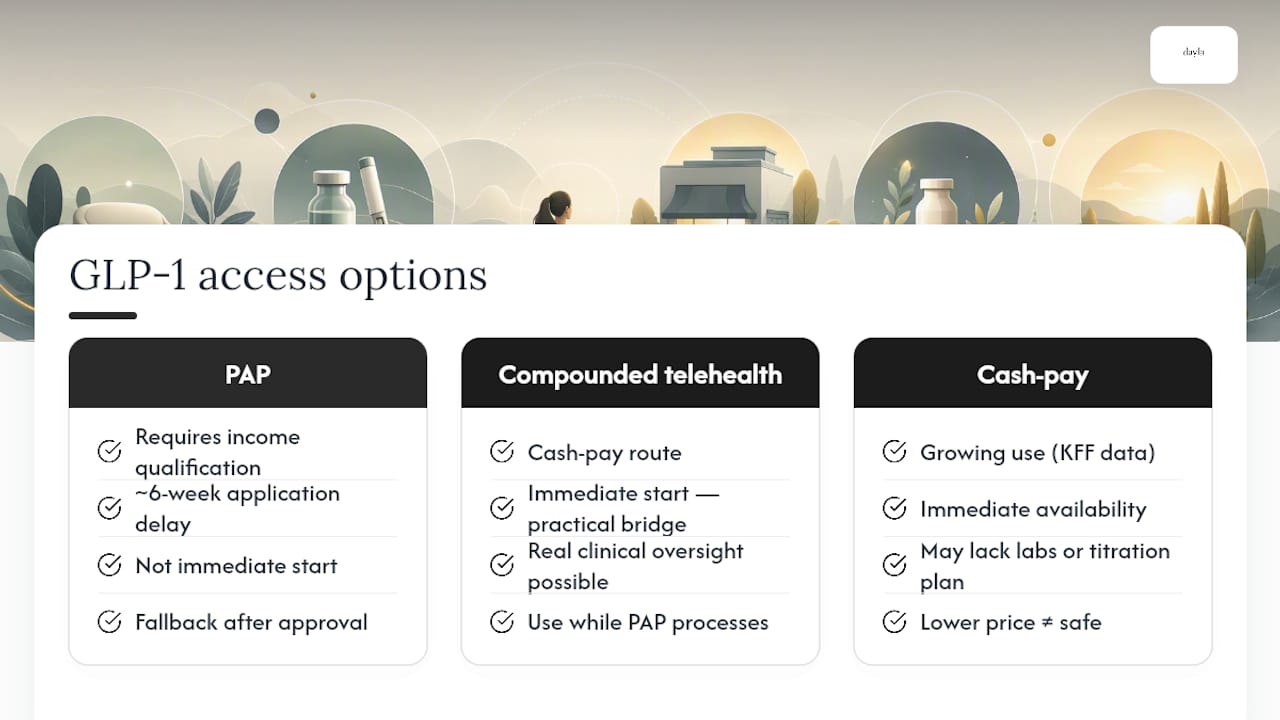
Most advice on this topic treats price as the only variable that matters, when eligibility timing is usually the bigger obstacle. A PAP application that takes six weeks doesn't help someone who needs to start this month, and that's where compounded telehealth earns its place in the conversation, not as a lesser option, but as the practical bridge while slower-moving assistance programs process paperwork.

The bigger gap I see in conventional guidance is the assumption that "cash-pay" means "unsupervised." It shouldn't. The KFF employer benefits data shows affordability pressure pushing more adults toward cash-pay routes every year, and that trend makes clinical oversight more important, not less. A lower price with no lab work and no titration plan isn't a deal. It's a liability wearing a discount.
If you're uninsured and starting today, prioritize in this order: confirm Medicare or Medicaid eligibility, apply to a PAP if your income qualifies, and treat compounded telehealth with real clinical oversight as your fallback, not your last resort.
— Flexible
Get Supervised GLP-1 Care Without an Insurance Requirement
Daylahealth built its entire model around the reader this article is written for: adults who want GLP-1 treatment without waiting on an insurance approval or gambling on an unsupervised seller. Every plan includes a clinician intake, prescription oversight, ongoing dietitian consults, and care coaching bundled into one predictable monthly price, shipped nationwide.
Intake typically takes a few minutes online, clinician review follows within a day or two, and most patients receive their first shipment within about a week of approval, with injection, microdose, and needle-free oral options depending on what your clinician recommends. If you've been comparing manufacturer programs against compounded telehealth and want both the price transparency and the clinical follow-up in one place, start your intake through Daylahealth's GLP-1 program and see what pricing tier fits your situation.
Sources
- Medicare GLP-1 Bridge
- Understanding risks of compounded drugs | FDA
- Online secret-shopping study reveals easy access to GLP‑1 prescriptions with limited clinician oversight | Yale Medicine
- GLP‑1 diabetes and weight-loss drug side effects | Harvard Health
- 2025 employer health benefits survey | KFF