

Medically supervised GLP-1 and peptide programs in the U.S. typically run at monthly cash prices varying widely across program types. The single best rule for predictable pricing: choose a clearly bundled, flat-rate monthly plan rather than a membership-plus-separate-medication model, especially when your treatment horizon is six months or longer.
Quick cost facts:
- Published all-in cash prices for GLP-1 telehealth programs in 2026 typically range from $149 to $448 per month before insurance.
- Compounded semaglutide bundles commonly advertise monthly prices covering clinician evaluation, medication, and support, often falling in the $149–$399 range.
- Branded GLP-1 retail cash prices can be substantially higher than compounded telehealth programs, impacting accessibility for cash-pay patients.
Daylahealth's Compounded GLP-1 Weight Care and Vitalia GLP programs are examples of bundled, transparent offerings that publish itemized pricing upfront. When comparing any program, always confirm whether the quoted price covers titration to your maintenance dose or whether higher doses cost more each month.
Pro Tip: Before you sign up, ask the program what the monthly fee looks like at your expected maintenance dose, not just the starting dose. Promotional entry prices can understate ongoing costs by $40–$260 per month once titration begins.
Table of Contents
- How much do different weight loss program types cost in the U.S.?
- What actually drives the price differences between programs?
- Which pricing model gives you the most predictable costs?
- What should a clinical GLP-1 program include, and what signals trust?
- How to compare program offers and what to ask before you enroll
- Sample total-cost scenarios for three realistic patient profiles
- Key Takeaways
- Why pricing transparency is the real differentiator
- Daylahealth's Compounded GLP-1 Weight Care: what's included and how to start
- Authoritative sources for pricing, safety, and clinical guidance
How much do different weight loss program types cost in the U.S.?
The gap between a basic behavioral app and a clinical GLP-1 program is wide, and it reflects what you actually receive. Medical oversight and prescription medication account for the largest share of cost differences between wellness-only apps and clinical programs.
| Program Type | Typical Monthly Range | What's Usually Included |
|---|---|---|
| Behavioral-only app | low to moderate monthly fee | Tracking, coaching, meal plans, no clinician |
| Clinical, no medication | moderate monthly fee | Clinician visits, monitoring, no Rx |
| Clinical + compounded GLP-1/peptide | $149–$448 per month | Clinician, compounded Rx, support, shipping |
| Clinical + branded GLP-1 | higher monthly cash prices (often $1,000+ per month) | Clinician, branded Rx, labs (insurance may reduce cost) |
Note: These ranges reflect published 2026 cash-pay prices. Maintenance and titration changes can shift your monthly cost. Verify current pricing directly with any program before enrolling.
The spread between the cheapest and most expensive all-in cash options is roughly 3x, and that gap widens further when branded medications are purchased without insurance. Compounded telehealth programs sit in the middle of the market and offer the clearest value for patients who want medical supervision without insurance complexity.
What actually drives the price differences between programs?
Price differences between programs are not random. Specific, identifiable factors determine where a program lands on the cost spectrum.
- Medication type and sourcing. Compounded semaglutide and tirzepatide cost far less than branded equivalents. Branded retail cash prices are often 3–5x higher than compounded telehealth prices.
- Medical oversight level. Programs staffed by MD/DO prescribers with structured follow-up visits cost more than those offering minimal async check-ins. More oversight usually means better safety monitoring.
- Lab testing and follow-ups. Required baseline labs, metabolic panels, and periodic monitoring add to total cost. Some programs include labs in the monthly fee; others bill separately.
- Shipping and fulfillment. Compounded medications ship directly to your door. Some programs include shipping; others charge $10–$30 per delivery.
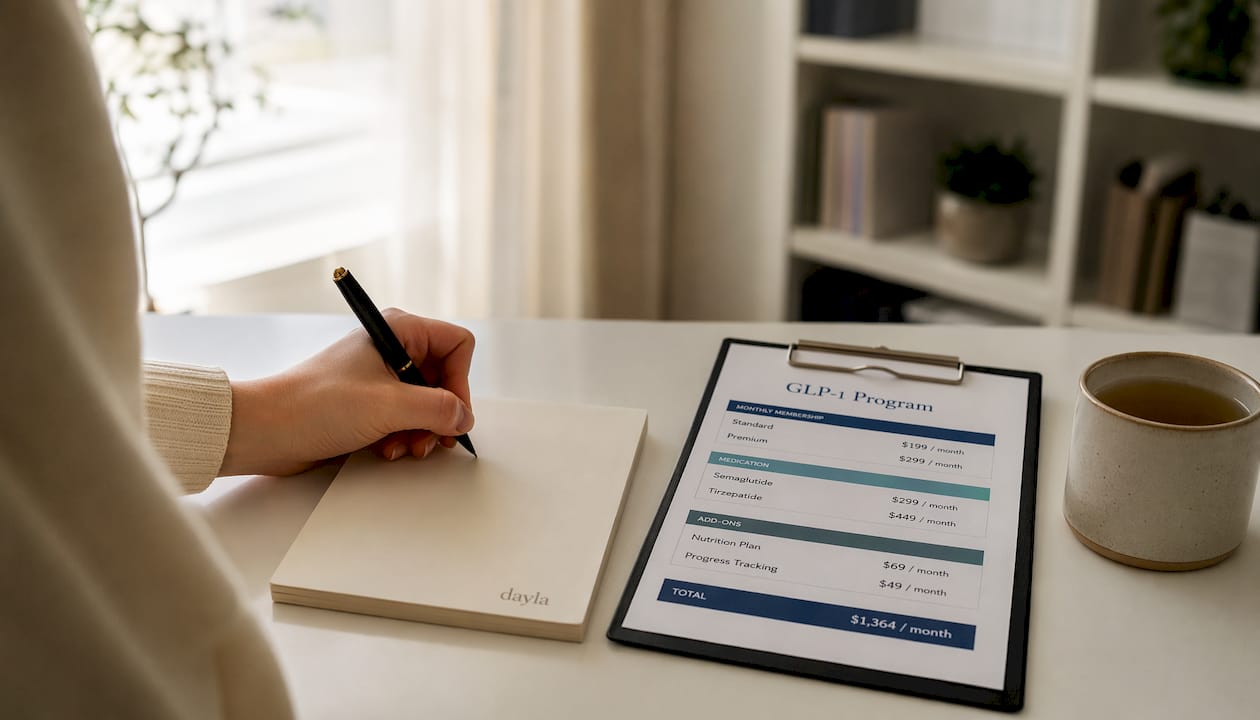
- Dose titration pricing. Tiered programs charge more as your dose increases. A program priced at $149/mo at the starting dose may cost $299/mo at maintenance.
- Insurance and prior authorization. Prior authorization for branded GLP-1s can take two or more weeks and is often denied. Compounded cash-pay programs bypass this entirely, providing predictable access without approval delays.
- Program lock-ins and prepaid discounts. Multi-month prepay can reduce per-month cost but increases upfront commitment. Confirm the refund policy before prepaying.
For a detailed breakdown of out-of-pocket GLP-1 costs, including what each line item typically covers, Daylahealth's pricing guide is a useful reference.
Pro Tip: Calculate your total cost of ownership (TCO) for your planned treatment length, not just month one. Tiered pricing and titration commonly increase monthly cost as you move to maintenance doses, so a program that looks cheaper at entry may cost more at month six.
Which pricing model gives you the most predictable costs?
Three main pricing structures dominate the direct-to-consumer GLP-1 market, and each behaves differently over a 3–12 month treatment horizon.
| Pricing Model | Predictability | Upfront Cost | Best Fit |
|---|---|---|---|
| Flat bundled monthly subscription | High | Low to moderate | Patients expecting to titrate to higher doses |
| Tiered/dose-step pricing | Medium | Low | Patients staying at low starting doses |
| Membership + separate Rx billing | Low | Low | Patients with insurance covering medication |
| Per-visit/episodic billing | Low | Very low | Short-term or evaluation-only needs |
| Insurance-first (prior auth required) | Very low | Variable | Patients with strong insurance coverage |
Bundled pricing structures are consistently rated more transparent than models that separate membership and medication charges. Flat-rate programs can be more cost-effective over 6–12 months even when their entry price appears higher, because tiered programs raise the monthly total as patients titrate up.
Key trade-offs to weigh:
- Flat-rate plans offer cost certainty but may feel expensive at month one before titration begins.
- Tiered plans look cheaper upfront but can exceed flat-rate costs by month three or four.
- Membership-plus-Rx models require you to track two separate billing streams and can produce surprise charges at refill.
- Insurance-first models introduce timing uncertainty; a denial resets your timeline and may leave you without medication for weeks.
What should a clinical GLP-1 program include, and what signals trust?
Not all programs list the same line items, which makes direct price comparisons misleading without a clear inclusion map. A complete clinical GLP-1 or peptide program should cover:
- Clinician evaluation. An initial visit with a licensed MD, DO, NP, or PA, with stated credentials and follow-up cadence.
- Prescription medication. Compounded or branded GLP-1, with transparent sourcing (pharmacy name, compounding standards).
- Lab monitoring plan. Baseline labs and a stated schedule for follow-up panels, not just an initial draw.
- Coaching or dietitian access. Behavioral support alongside medication improves outcomes. Check whether this is included or billed separately.
- Shipping. Confirm whether medication ships to your state and whether shipping is included in the monthly fee.
- Cancellation and refund policy. A clear, written policy for pausing, canceling, or returning unused medication.
"Always verify whether a program's quoted price is truly all-in. Many platforms advertise a low monthly fee but bill medication, shipping, or required labs as separate recurring charges." — GLP Chart, 2026
Programs like Daylahealth's Compounded GLP-1 Weight Care and Vitalia GLP publish itemized inclusion lists and state their prescriber credentials upfront. That level of transparency is the baseline standard to require from any program you consider.
Watch for programs that advertise very low entry prices but separate titration costs, lab fees, or shipping as add-ons. These structures can look affordable at sign-up but cost significantly more over a full treatment course. Understanding clinical eligibility for GLP-1 prescriptions before you compare programs also helps you evaluate which inclusions are clinically necessary for your situation.
How to compare program offers and what to ask before you enroll
Use this checklist when evaluating any medically supervised weight management program:
- Confirm what's included. Ask for a written list: clinician visits, medication, labs, shipping, coaching. Anything not listed is likely billed separately.
- Request maintenance pricing. Ask what the monthly fee looks like at your expected maintenance dose, not just the starting dose.
- Verify medication sourcing. Ask which compounding pharmacy fulfills the prescription and what quality standards they follow.
- Confirm prescriber credentials. Ask for the license type (MD/DO/NP/PA) and whether a licensed clinician reviews your case before each refill.
- Get the lab monitoring schedule in writing. A program without a stated lab plan is not providing full medical oversight.
- Review the cancellation and refund policy. Confirm whether you can pause, cancel, or receive a refund on unused medication.
- Ask about auto-renewal and price changes. Some programs lock in pricing for the first term, then increase at renewal.
- Clarify insurance. If you want to use insurance for branded GLP-1s, ask about the prior authorization process, typical approval timelines, and what happens if coverage is denied.
Red flags: no published itemized pricing, vague medication sourcing, no lab monitoring promised, aggressive multi-month lock-ins without a clear refund policy.
Pro Tip: Build a simple spreadsheet with columns for month, dose, program fee, medication surcharge, labs, shipping, and cumulative total. Running the numbers for months 3, 6, and 12 often reveals that a flat-rate plan saves money versus a tiered plan by month four or five.
Sample total-cost scenarios for three realistic patient profiles
These examples use published price ranges and realistic titration assumptions. Actual costs depend on the specific program you choose.
-
Conservative titration on a tiered plan. A patient who stays at the starting dose for six months on a $149/mo entry plan pays roughly $894 over six months. If titration to a $249/mo maintenance dose begins at month four, the six-month total rises to approximately $1,094. At 12 months on maintenance, total cost reaches roughly $2,094.
-
Steady up-titration on a flat-rate compounded program. A patient on a $299/mo flat-rate plan that covers all doses pays $1,794 over six months and $3,588 over 12 months, with no titration surcharges. This model becomes cost-competitive with tiered plans by month four and cheaper by month six. For a detailed budget GLP-1 treatment plan, Daylahealth's 2026 guide walks through similar scenarios.
-
Insurance-approval path for branded GLP-1. A patient pursuing a branded GLP-1 through insurance may pay $0–$50/mo in copay if prior authorization is approved, but approval can take two or more weeks and is sometimes denied. During the approval period, the patient either waits without medication or pays full cash price. If approved, 12-month costs can be low; if denied, the patient often pivots to a compounded cash-pay program, adding weeks of delay and potential out-of-pocket costs for the approval process itself. For context on how sustained medical therapy costs accumulate over time, realistic long-term cost planning for prescription programs follows similar principles regardless of the specific medication.
Key Takeaways
Medically supervised GLP-1 programs in the U.S. run at varying monthly cash prices for patients, and flat-rate bundled plans often offer the most predictable total cost over a typical treatment horizon.
| Point | Details |
|---|---|
| Monthly cash range | Published all-in prices span $149–$448/mo; compounded bundles typically fall in the $149–$399/mo range. |
| Flat-rate plans win long-term | Flat-rate programs often cost less than tiered plans by month four or five once titration begins. |
| Verify all inclusions | Always confirm whether medication, labs, shipping, and coaching are included or billed separately. |
| Insurance adds uncertainty | Prior authorization for branded GLP-1s can take weeks and is often denied; compounded cash-pay programs provide immediate, predictable access. |
| Daylahealth's offering | Daylahealth's Compounded GLP-1 Weight Care bundles clinician oversight, compounded medication, and shipping with published, itemized pricing. |
Why pricing transparency is the real differentiator
The most common mistake people make when comparing GLP-1 programs is treating the advertised monthly price as the total cost. It rarely is. Titration, labs, shipping, and coaching can each add meaningful charges that never appear in the headline number. The programs worth trusting are the ones that publish a complete inclusion list before you hand over a credit card, state their prescriber credentials clearly, and give you a written cancellation policy. Medical oversight is not a luxury add-on in this category. It is the clinical mechanism that makes GLP-1 therapy safe and effective, and a program that obscures its pricing is usually obscuring something else too. Demand transparency on both.
Daylahealth's Compounded GLP-1 Weight Care: what's included and how to start
Daylahealth offers a direct-to-consumer compounded GLP-1 weight care program that bundles everything the checklist above requires: licensed clinician evaluation, compounded GLP-1 or peptide prescription, ongoing clinical oversight, care coaching, and nationwide shipping, all at published pricing with no insurance required.
The program covers injection, microdose, and needle-free oral delivery options, so your format fits your preference, not a one-size-fits-all protocol. Prescribers review your intake and approve your prescription before anything ships. Lab monitoring and dietitian consults are part of the care model, not separate line items to negotiate. If you are ready to compare your options with a program that publishes what it includes, visit the GLP-1 weight loss program page or complete your online intake at Daylahealth to get started.
Authoritative sources for pricing, safety, and clinical guidance
Verify current program pricing and clinical standards directly from primary sources before enrolling in any medically supervised weight management program.
- FDA guidance on GLP-1 medications: FDA.gov for approved indications, safety updates, and compounding policy.
- Obesity medicine clinical guidance: The Obesity Medicine Association and the Endocrine Society publish evidence-based prescribing standards.
- Published program price trackers: GLP Chart 2026 Price Report and the GLP Chart comparison tool track published all-in cash prices across telehealth programs.
- Peer-reviewed clinical evidence: PMC/NIH research on GLP-1 pharmacotherapy outcomes and safety monitoring.
- Daylahealth program details: daylahealth.com/pages/weight-care for current inclusions, pricing, and intake process.