

Out-of-pocket GLP-1 costs in the USA range from as low as $25 to more than $1,350 per month, depending entirely on your insurance status and how you access the medication. The term "out-of-pocket cost" refers to what you actually pay after insurance, discounts, or assistance programs apply. That number is almost never the retail list price. Brand-name GLP-1 drugs like Wegovy and Zepbound carry list prices of $997 to $1,349 monthly, but most patients pay far less through the right access channel. Understanding which channel applies to you is the single most important step in managing your GLP-1 medication expenses.
What factors determine your out of pocket GLP-1 costs?
The retail list price is largely irrelevant to what you will actually pay. Wholesale acquisition cost serves manufacturer-to-PBM negotiations, not consumer pricing. Your real cost depends on four primary factors: your insurance type, your access channel, your eligibility for manufacturer programs, and whether you qualify for government assistance.
The key drivers of your final monthly cost include:
- Insurance type. Commercial insurance, Medicare Part D, Medicaid, and uninsured status each produce very different copay structures. A commercially insured patient with a savings card may pay $25 per month. An uninsured patient paying retail cash price may pay over $1,000.
- Access channel. Retail pharmacy, manufacturer direct-to-consumer programs, and compounding telehealth providers each price the same drug category at very different levels.
- Manufacturer savings cards. These are available to commercially insured patients and can reduce monthly costs to $25–$150. They do not apply to Medicare or Medicaid patients.
- Patient assistance programs. Uninsured patients who fall below 400% of the federal poverty level may qualify for free medication through manufacturer programs.
- CMS Medicare demonstration. Starting July 1, 2026, Medicare Part D beneficiaries with a BMI of 30 or higher can access certain GLP-1 drugs for $50 per month through a new Centers for Medicare and Medicaid Services program.
Pro Tip: Before calling your pharmacy, call your insurance's member services line and ask specifically whether your plan covers GLP-1 medications for weight management versus type 2 diabetes. Many plans cover the diabetes indication but exclude the obesity indication, even for the same drug.
How much do specific GLP-1 medications cost out of pocket?

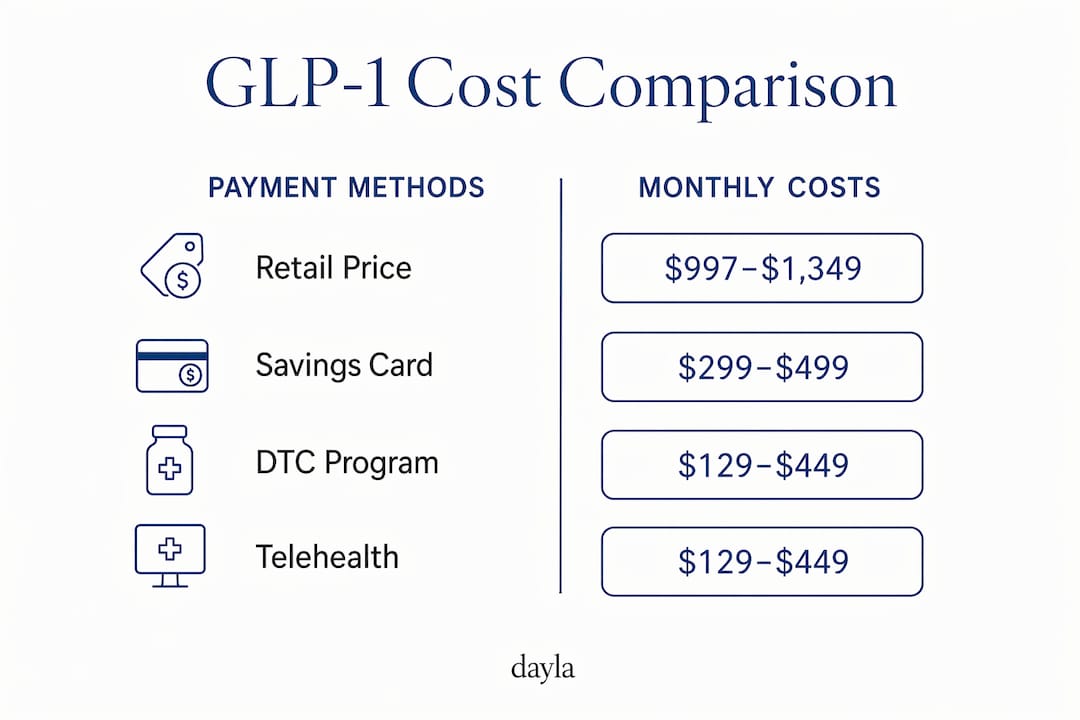
The costs of GLP-1 drugs vary significantly by drug name, dosage, and payment method. The table below reflects 2026 pricing across the most common access channels.
| Medication | Retail list price | With savings card | DTC program | Compounded telehealth |
|---|---|---|---|---|
| Wegovy (semaglutide) | ~$1,349/month | $25–$150/month | $299–$499/month | $129–$199/month |
| Ozempic (semaglutide) | ~$997/month | $25–$150/month | $299–$449/month | $129–$199/month |
| Zepbound (tirzepatide) | ~$1,086/month | $25–$150/month | $299–$449/month | $129–$199/month |
| Mounjaro (tirzepatide) | ~$1,069/month | $25–$150/month | $299–$449/month | $129–$199/month |
Cash-pay patients using manufacturer-direct programs or compounding telehealth typically pay $129 to $449 monthly. That is a dramatic reduction from retail list prices and represents the realistic range for most uninsured or underinsured patients. Compounded semaglutide or tirzepatide through telehealth providers sits at the lowest end, typically $129 to $199 per month. These compounded versions are not FDA-approved branded medications, which is an important distinction covered in the strategies section below.
Direct-to-consumer manufacturer programs like LillyDirect and NovoCare offer branded GLP-1s at $299 to $499 per month without requiring insurance. These programs bypass the retail pharmacy entirely and ship directly to your door. They represent a middle ground between the lowest-cost compounded options and the full retail list price.
Pro Tip: If you are starting GLP-1 therapy for the first time, check whether the manufacturer offers an introductory or trial pricing period. Some programs offer the first month at a reduced rate, which gives you time to assess tolerability before committing to a longer payment plan.
What practical strategies can patients use to lower GLP-1 medication expenses?
Reducing your costs of GLP-1 drugs requires a layered approach. No single strategy works for every patient, but combining two or three of the options below produces the best results.
-
Verify your insurance coverage first. Log into your plan's formulary tool or call member services. Ask whether your specific drug is covered for your diagnosis code, and at which tier. Tier placement directly determines your copay.
-
Apply for a manufacturer savings card. If you have commercial insurance, savings cards from the drug manufacturer can bring monthly costs down to as little as $25. Apply directly through the manufacturer's website before filling your first prescription.
-
Check manufacturer direct-to-consumer programs. LillyDirect and NovoCare both offer branded medications at cash prices well below retail pharmacy rates. These programs are particularly useful if your insurance excludes obesity medications but you want a branded, FDA-approved product.
-
Explore compounded GLP-1 options through telehealth. Compounded semaglutide and tirzepatide are the most affordable entry point. Compounded GLP-1s require careful verification of the telehealth provider's licensing and state-specific pharmacy credentials to confirm safety and legitimacy. Do not skip this step.
-
Apply for patient assistance if you are uninsured. Manufacturer patient assistance programs provide free medication to qualifying patients. Eligibility typically requires income below 400% of the federal poverty level. Applications are available directly through each manufacturer's website.
-
Check Medicare Part D eligibility for the new CMS program. If you are on Medicare, the July 2026 CMS demonstration program caps your monthly cost at $50 for qualifying GLP-1 medications. Confirm eligibility with your Part D plan administrator.
-
Reassess annually. Formularies change every January 1. A drug covered this year may move to a higher tier or be excluded next year. Set a calendar reminder to review your plan during open enrollment each fall.
Pro Tip: Pairing your medication with lifestyle changes that boost GLP-1 results can improve your outcomes per dollar spent. Better results at the same dose means you may stay at a lower, less expensive dose tier for longer.
How does insurance coverage affect your GLP-1 out-of-pocket expenses?
Insurance type is the single biggest variable in your final monthly cost. The difference between a commercially insured patient with a savings card and an uninsured patient paying retail cash price can exceed $1,200 per month for the same drug.
Key distinctions by insurance type:
- Commercial insurance. Copays typically fall between $0 and $100 per month for patients whose plan covers GLP-1 medications. Coverage depends heavily on whether the plan includes obesity medications, which many employer-sponsored plans still exclude. Prior authorization is almost always required.
- Medicare Part D. Historically, Medicare excluded weight loss drugs. The new CMS demonstration starting July 1, 2026, changes this for qualifying beneficiaries, capping costs at $50 per month. Manufacturer savings cards cannot be used with Medicare.
- Medicaid. Coverage varies by state. Some states cover GLP-1 medications for obesity; others restrict coverage to type 2 diabetes only. Contact your state Medicaid office directly for current formulary details.
- Uninsured. Retail cash prices are prohibitive for most patients. The realistic options are manufacturer direct-to-consumer programs ($299–$499/month), patient assistance programs (free for qualifying patients), or compounded telehealth options ($129–$199/month).
- High-deductible health plans (HDHPs). Patients with HDHPs pay full cost until they meet their deductible, which can mean several months at near-retail prices. Manufacturer savings cards can offset this significantly during the deductible phase.
Prior authorization is a consistent barrier across all insurance types. Your prescriber must document medical necessity, typically including BMI criteria and prior treatment history. Working with a doctor-led program that handles prior authorization on your behalf saves significant time and reduces the risk of denial.
Nearly every patient has some form of discount or assistance available. The challenge is knowing which pathway applies to your specific situation. Reviewing your options before your first prescription fill prevents paying more than necessary from the start.
Key Takeaways
Your actual out-of-pocket GLP-1 cost depends on your insurance type and access channel, not the retail list price, and most patients can access meaningful discounts through manufacturer programs, CMS initiatives, or compounded telehealth options.
| Point | Details |
|---|---|
| List price vs. real cost | Retail list prices of $997–$1,349/month rarely reflect what patients actually pay. |
| Insurance is the biggest variable | Commercially insured patients with savings cards may pay as little as $25/month. |
| Medicare now has a $50 cap | The CMS 2026 demonstration program caps GLP-1 costs at $50/month for qualifying Part D beneficiaries. |
| Compounded options are the lowest cost | Compounded semaglutide or tirzepatide via telehealth typically costs $129–$199/month. |
| Verify provider credentials | Always confirm telehealth provider licensing before using compounded GLP-1 medications. |
The cost conversation nobody is having clearly enough
Most people I speak with about GLP-1 medications start from the wrong number. They see the $1,300 list price and either assume they cannot afford it or assume their insurance will cover most of it. Both assumptions are frequently wrong.
The honest reality is that the market has shifted toward more diverse pricing pathways, and the patients who pay the most are almost always those who did not ask the right questions before filling their first prescription. Calling your insurer, checking the manufacturer's website, and comparing a direct-to-consumer program against your pharmacy copay takes about 30 minutes. That 30 minutes can save you hundreds of dollars every month.
Compounded options deserve a direct word of caution. They are genuinely the most affordable entry point, and for many patients they are a reasonable choice. But "affordable" and "safe" are not the same thing. Verifying the compounding pharmacy's state license and the telehealth provider's credentials is not optional. It is the minimum due diligence before putting any medication in your body.
My strongest advice: treat your GLP-1 cost management as an ongoing process, not a one-time decision. Formularies change, programs expire, and new options like the CMS Medicare demonstration emerge. Patients who track their GLP-1 progress and stay engaged with their care team are better positioned to catch these changes and adapt quickly.
— Flexible
How Daylahealth supports affordable GLP-1 access
Daylahealth offers doctor-led, personalized GLP-1 care through a direct-to-consumer telehealth model designed to make weight loss medication accessible without the complexity of traditional pharmacy channels.
Through Daylahealth, you get a licensed clinician review, a prescription where appropriate, and transparent pricing on GLP-1 weight loss medications without the guesswork of navigating insurance formularies alone. The program is built for patients who want quality care at a predictable monthly cost. If you are ready to understand your options and get started with a program that fits your budget, visit the Daylahealth GLP-1 page to review current pricing and begin your consultation.
FAQ
What is the average out-of-pocket cost for GLP-1 medications?
The average out-of-pocket cost ranges from $25 to over $1,000 per month depending on insurance coverage and access method. Commercially insured patients with savings cards often pay $25–$150, while uninsured patients using telehealth compounding programs typically pay $129–$199.
Can I use a manufacturer savings card with Medicare?
No. Manufacturer savings cards are not eligible for use with Medicare or Medicaid. Medicare Part D patients should instead check eligibility for the CMS 2026 demonstration program, which caps costs at $50 per month for qualifying beneficiaries.
Are compounded GLP-1 medications safe?
Compounded GLP-1 medications can be safe when sourced from a licensed, state-regulated compounding pharmacy through a credentialed telehealth provider. They are not FDA-approved branded products, so verifying provider and pharmacy credentials before ordering is required.
What is the cheapest way to get a GLP-1 medication?
The lowest-cost option for most patients is compounded semaglutide or tirzepatide through a licensed telehealth provider, typically priced at $129–$199 per month. Uninsured patients who meet income requirements may qualify for free medication through manufacturer patient assistance programs.
Does insurance always cover GLP-1 medications for weight loss?
No. Many commercial insurance plans and Medicare historically excluded GLP-1 medications prescribed specifically for obesity. Coverage is more common when the drug is prescribed for type 2 diabetes. Always confirm your plan's specific coverage for your diagnosis before filling a prescription.