

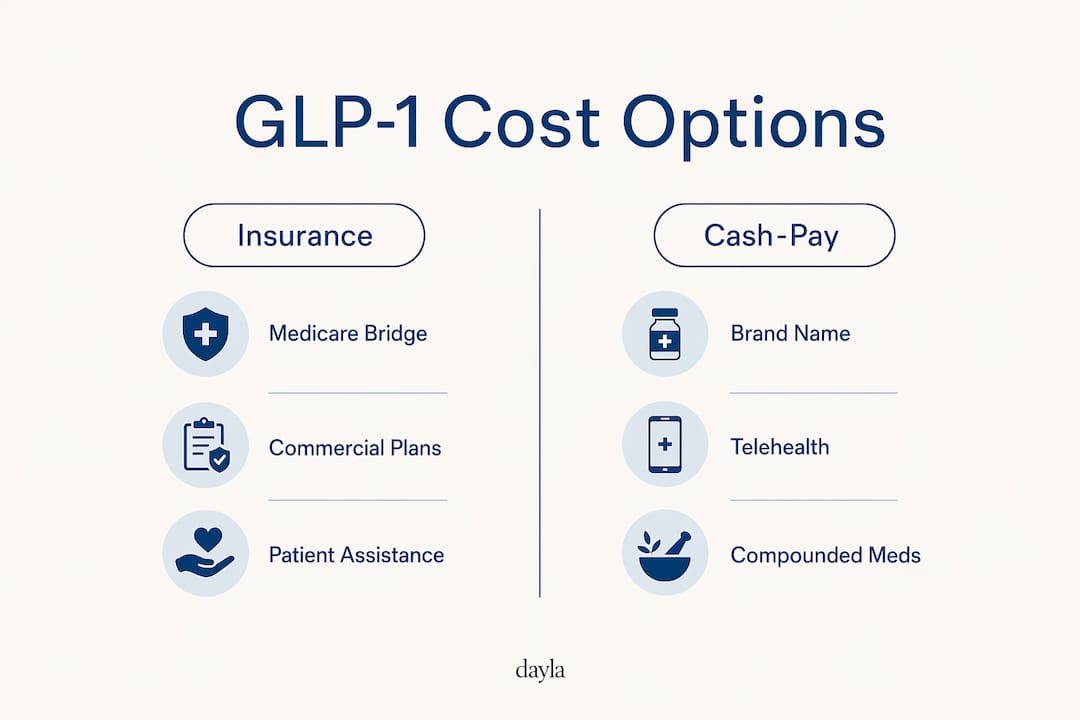
A budget GLP-1 treatment plan in the USA is defined as a structured approach that combines insurance benefits, manufacturer savings cards, patient assistance programs, and telehealth options to make GLP-1 medications affordable on a monthly basis. GLP-1 receptor agonists like semaglutide and tirzepatide are the most clinically proven tools for weight management available today, but their list prices can exceed $1,000 per month without assistance. The good news: the actual cost patients pay rarely reflects that list price. Programs like the 2026 Medicare GLP-1 Bridge, Wegovy and Zepbound savings cards, and patient assistance programs from Novo Nordisk and Eli Lilly each create real pathways to affordable GLP-1 medication. This guide covers every major option, ranked by accessibility and cost.
What is a budget GLP-1 treatment plan in the USA?
A budget GLP-1 treatment plan is not a single program. It is a combination of coverage sources, savings tools, and provider channels that together bring your monthly cost to a manageable level. The right combination depends on your insurance status, income, and the specific medication your doctor prescribes.
Understanding how GLP-1 medications work for weight loss is the first step. These drugs mimic a natural gut hormone that reduces appetite and slows digestion. They require ongoing use to maintain results, which means affordability must be sustainable, not just a one-time discount.

Three categories of patients face different cost challenges. Commercially insured patients often hit prior authorization walls. Medicare enrollees have historically had no coverage for weight loss drugs. Uninsured patients face the full cash price. Each group has specific tools available, and knowing which category you fall into shapes your entire cost strategy.
What are the Medicare GLP-1 Bridge program benefits and eligibility?
Starting july 1, 2026, the Medicare GLP-1 Bridge program offers eligible Part D enrollees access to GLP-1 medications at a $50 monthly copay. This is a landmark shift. Before this program, Medicare covered GLP-1s only for diabetes, not for weight loss.
The program runs through december 2026 and serves as a bridge to the BALANCE Model, a permanent coverage framework expected to launch in 2027. Patients who qualify now should enroll immediately to lock in the $50 rate before the transition.
Eligibility requirements include:
- Active Medicare Part D enrollment
- A BMI of 30 or higher, or 27 or higher with a weight-related comorbidity such as hypertension or sleep apnea
- A valid prescription from a licensed provider
- Clinical documentation supporting medical necessity
The $50 copay is a significant reduction compared to typical out-of-pocket costs, which can reach several hundred dollars monthly without assistance. One important limitation: this program is temporary, and the $50 copay does not count toward your Part D deductible or out-of-pocket cap in the same way a standard covered drug does.
Pro Tip: Contact your Part D plan directly in june 2026 to confirm your medication is included in the Bridge program formulary. Not every GLP-1 brand may be covered under every plan.
Planning for 2027 matters now. The BALANCE Model will likely require prior authorization and clinical criteria similar to the Bridge program. Patients who build a documented treatment history in 2026 will have stronger evidence for 2027 coverage approvals.
How can commercially insured patients lower GLP-1 costs?
Manufacturer savings cards are the most direct tool for commercially insured patients. Savings cards for Wegovy and Zepbound can reduce monthly copays to as little as $25 for eligible patients. These cards are not valid for anyone on Medicare, Medicaid, or other government insurance programs.
Here is how to use them effectively:
- Confirm insurance coverage first. Check whether your plan covers your prescribed GLP-1 under the pharmacy benefit or the medical benefit. This affects which savings card applies.
- Download the savings card from the manufacturer's website. Novo Nordisk offers one for Wegovy; Eli Lilly offers one for Zepbound. Both require you to be commercially insured.
- Present the card at the pharmacy alongside your insurance card. The card acts as secondary coverage, reducing your copay after insurance processes the claim.
- Track your savings card balance. Most cards have an annual cap. Once you hit it, your copay reverts to the standard insurance rate.
- Request a prior authorization if your plan requires one. Your prescribing doctor submits clinical documentation to your insurer. Approval rates improve significantly when the submission includes documented comorbidities like type 2 diabetes, hypertension, or obstructive sleep apnea.
Step therapy is a common insurance barrier. Many plans require patients to try and fail on older, cheaper medications before approving a GLP-1. If your insurer requires this, ask your doctor to document why step therapy is medically inappropriate for your situation. A formulary exception request citing specific comorbidities often succeeds where a standard prior authorization does not.
Healthcare experts recommend prioritizing insurance coverage and appeals before moving to cash-pay options. Insurance coverage provides better long-term affordability and protects against future cost increases.
Pro Tip: Ask your doctor's office if they have a dedicated insurance navigator or prior authorization specialist. Practices that prescribe GLP-1s frequently often have staff who know exactly which documentation language gets approvals.
What are the best cash-pay and telehealth options for affordable GLP-1 treatment?
Uninsured and underinsured patients have more options than most people realize. The cost range is wide, and the right choice depends on your income, risk tolerance, and how long you plan to stay on therapy.
Brand-name self-pay pricing
Zepbound's transparent cash pricing ranges from $299 to $449 monthly depending on dose. This is a real option for patients who want an FDA-approved medication without insurance complexity. Wegovy's self-pay price is higher and less transparent, making Zepbound the clearer choice for cash-pay patients at this time.
Novo Nordisk announced list price reductions for Ozempic, Wegovy, and Rybelsus effective january 2027, lowering the list price to $675 per month. Out-of-pocket costs will still depend on individual insurance design, but the reduction signals a broader affordability trend.
Telehealth membership programs
Telehealth insurance navigation memberships start as low as $17 per month and typically include prior authorization support, with plan copays around $30 for covered patients. These programs are best suited for patients who have insurance but struggle with the administrative burden of getting GLP-1s approved.
Compounded GLP-1 medications
Compounded GLP-1 products can start at around $49 monthly, making them the lowest-cost entry point. The FDA advises caution: compounded drugs are not FDA-approved and are not interchangeable with brand-name medications. Dosing accuracy and sterility standards vary by compounding pharmacy.
Compounded GLP-1s may widen access for patients who cannot afford approved brands, but they carry real safety risks and should be treated as a secondary option. If you pursue this route, use only pharmacies accredited by the Pharmacy Compounding Accreditation Board (PCAB).
Patient assistance programs offer another path. These programs may provide GLP-1 medications for free or at reduced cost for uninsured, low-income patients who meet income criteria. Eligibility is narrow, but the benefit is substantial for those who qualify.
How to build a sustainable GLP-1 treatment budget
GLP-1 therapy is a long-term commitment, not a short-term fix. Less than 15% of patients remain on therapy at two years, and cost is the primary reason people stop. Stopping treatment often leads to weight regain, which means the financial investment made in earlier months is lost.
Treat your monthly GLP-1 cost the way you treat a utility bill. It is a recurring, non-negotiable expense if you want sustained results. Budget for it before you start, not after your first prescription runs out.
Strategies to keep costs manageable over time:
- Buy a 90-day supply when possible. Many pharmacies and mail-order programs offer a discount on larger supplies compared to monthly fills.
- Review your savings card balance quarterly. Adjust your plan before the annual cap resets so you are not caught off guard.
- Ask your doctor about dose optimization. Some patients maintain results on a lower maintenance dose after reaching their target weight, which reduces monthly cost.
- Track secondary savings. Patients on GLP-1 therapy often reduce or eliminate medications for blood pressure, cholesterol, and blood sugar management. Those savings offset the GLP-1 cost directly.
"GLP-1 therapy is a chronic treatment requiring budgeting akin to other essential monthly expenses. Assessing sustainability before starting prevents treatment lapses and the weight regain that follows."
Ongoing provider communication is not optional. Your doctor needs to know if cost is becoming a barrier. Many providers can switch you to a more affordable formulation, adjust your dose, or submit updated documentation to support a new insurance appeal. Silence on cost leads to treatment gaps. Transparency leads to solutions.
Key Takeaways
A budget GLP-1 treatment plan in the USA works best when you layer insurance coverage, manufacturer savings cards, and patient assistance programs rather than relying on any single source.
| Point | Details |
|---|---|
| Medicare Bridge program | Eligible Part D enrollees pay $50/month for GLP-1s from july through december 2026. |
| Manufacturer savings cards | Commercially insured patients can reduce copays to $25/month with Wegovy or Zepbound cards. |
| Cash-pay brand pricing | Zepbound self-pay costs $299–$449/month; a clear option for uninsured patients wanting FDA-approved medication. |
| Compounded GLP-1 caution | Compounded options start at $49/month but lack FDA approval; use only PCAB-accredited pharmacies. |
| Long-term budgeting | Fewer than 15% of patients stay on therapy at two years; plan costs as a recurring monthly expense from day one. |
The real cost of stopping too soon
The most common mistake I see patients make is treating GLP-1 therapy like a short-term diet. They find a savings card, get started, and then abandon the medication the moment the card hits its annual cap or insurance denies a renewal. The weight comes back, often faster than it came off, and the months of adherence and investment are wasted.
The insurance appeals process feels intimidating, but persistence pays off. I have seen patients get denied three times and approved on the fourth attempt after their doctor submitted updated lab work and a letter citing cardiovascular risk. The documentation matters more than most patients realize.
Combining a manufacturer savings card with insurance coverage is the single most effective cost-reduction strategy for commercially insured patients. The card covers what insurance does not, and together they can bring monthly costs below $50. That combination is worth every phone call it takes to set up.
My strongest warning is about unverified compounded products sold online without a prescription or pharmacy accreditation. The price looks attractive. The risk is real. Dosing errors with injectable medications are not minor inconveniences. Stick to PCAB-accredited compounding pharmacies or FDA-approved brands, and prioritize long-term adherence over short-term savings that compromise your safety.
— Flexible
Daylahealth makes affordable GLP-1 care accessible
Affordable GLP-1 treatment starts with having the right provider in your corner. Daylahealth offers doctor-led, personalized GLP-1 care designed for patients who want transparent pricing, prescription support, and reliable medication delivery without the administrative burden of navigating insurance alone.
Daylahealth's GLP-1 weight loss programs connect you with licensed providers who understand the savings landscape and can help you access the right medication at the right cost. Whether you are starting treatment for the first time or looking to reduce what you currently pay, Daylahealth provides the clinical support and product access to keep your plan on track. For patients interested in complementary wellness support, Daylahealth also offers a full range of peptide therapies for recovery, longevity, and metabolic health.
FAQ
What is the cheapest way to get GLP-1 medication in the USA?
The cheapest path depends on your insurance status. Commercially insured patients using a manufacturer savings card can pay as little as $25/month, while Medicare Part D enrollees qualify for the $50/month Bridge program starting july 2026.
Are compounded GLP-1 medications safe?
Compounded GLP-1 products are not FDA-approved and carry safety risks related to dosing accuracy and sterility. The FDA advises using only PCAB-accredited compounding pharmacies and treating compounded options as a secondary choice after approved brands.
Can I get GLP-1 medications for free if I have no insurance?
Patient assistance programs from manufacturers like Novo Nordisk and Eli Lilly may provide GLP-1 medications for free or at reduced cost for uninsured, low-income patients who meet income eligibility criteria.
How do I get my insurance to cover a GLP-1 for weight loss?
Submit a prior authorization request through your doctor with documentation of your BMI and any weight-related comorbidities. If denied, request a formulary exception and ask your doctor to include clinical notes citing cardiovascular or metabolic risk factors.
What happens if I stop taking GLP-1 medication?
Stopping GLP-1 therapy typically results in weight regain. Long-term adherence is necessary to maintain results, which is why building a sustainable monthly cost plan before starting treatment is critical.