

A properly sequenced transition process, typically lasting about two to three weeks, where you enroll with the new provider before canceling the old one, preserves dosing continuity for most patients. Here is what to do first:
- Gather proof of dose. Photograph your pen label and screenshot your current portal showing dose history.
- Enroll with the new provider. Complete intake and upload your dosing documentation before touching your existing subscription.
- Confirm prescription approval and shipment. Get written confirmation and a tracking number from the new provider.
- Time your first new dose. Plan for the new shipment to arrive at least 5 days before your current supply runs out.
- Cancel the old provider only after new supply is in hand. Never cancel first.
The 14-day threshold is commonly used by prescribers as a clinical soft limit. Gaps under two weeks rarely require re-titration. Gaps of three weeks or more often trigger a dose restart, meaning weeks of rebuilding progress you already earned. Sequencing is not just a logistical preference; it is a clinical and financial decision.
Key Takeaways
A properly sequenced 2–3 week transition, with enrollment before cancellation and documentation at every step, is what separates a smooth GLP-1 provider change from a forced re-titration.
| Point | Details |
|---|---|
| Enroll first, cancel second | Confirm prescription approval and shipment tracking before canceling your old provider. |
| Keep the gap under 14 days | Gaps under 14 days rarely require re-titration; gaps of 21 days or more commonly trigger a dose restart. |
| Bring proof of dose to intake | Dosing history, pen label photo, and pharmacy receipts give the new prescriber what they need to continue your current dose. |
| Cross-molecule switches take longer | Switching to a different GLP-1 molecule typically requires re-titration and can take several weeks to reach a comparable maintenance dose. |
| Daylahealth accepts dosing history at intake | The online intake collects prior titration records so clinicians can review your dose before approving your prescription. |
Table of Contents
- Why are people switching GLP-1 providers right now?
- Seven steps to take before you cancel anything
- What are the timing rules for weekly vs. daily GLP-1 injections?
- What safety issues should you monitor during the transition?
- What does the clinical evidence say about switching GLP-1 medications?
- How do you handle insurance, prior authorizations, and pharmacy logistics?
- Practical tips for managing side effects day by day
- How can you reduce costs during a provider switch?
- Your printable switch checklist and timeline
- Managing the emotional side of switching providers
- Daylahealth makes your GLP-1 transition straightforward
- Sources
Why are people switching GLP-1 providers right now?
People change GLP-1 providers for medical and nonmedical reasons, and the reason you are switching should directly shape which type of provider you move toward.
Medical triggers include plateaued weight loss, unmet HbA1c targets, intolerable gastrointestinal side effects, or escalating cardiovascular or chronic kidney disease risk that calls for a specific agent with proven CV benefit. If your current medication is simply not delivering results, understanding what clinical indicators signal effectiveness can help you evaluate whether the drug or the provider is the real issue.
Nonmedical triggers are just as common. Formulary changes, insurance denials, shipping delays, poor clinical responsiveness, and cost are among the most frequent reasons patients seek a GLP-1 provider change. Experts note that switching is often a strategic decision driven by cost or access, not a sign of treatment failure.
The reason matters because it determines what to prioritize in your next provider:
- Plateaued results or adverse effects: Look for a provider with clinical oversight, dietitian access, and the ability to prescribe multiple GLP-1 formulations.
- Cost or formulary issues: A direct-to-consumer or compounding-friendly program may offer more pricing flexibility.
- Shipping or service problems: Confirm the new provider's average intake-to-shipment timeline before committing.
- Insurance-driven switch: Verify network participation and prior authorization policies before starting intake.
Pro Tip: Ask the new provider directly: "What is your average time from intake approval to first shipment?" A provider who cannot answer that question clearly is a red flag.
Seven steps to take before you cancel anything
This is the exact sequence that protects your treatment continuity. Do not skip steps or reorder them. A structured transition process minimizes medication interruptions for most patients when followed in order.
-
Inventory your current supply and document your dose. Note the date of your last injection, your current dose in milligrams, and how many doses remain. Take a photo of the pen label. This single step is what allows a new prescriber to continue your dose rather than restart titration.
-
Research 2–3 candidate providers. Evaluate each on clinical oversight quality, formulary options, intake-to-shipment timeline, and pricing transparency. Do not choose based on price alone.
-
Verify insurance and prior authorization requirements. Call your insurer before starting intake with the new provider. Confirm whether the new provider is in-network and whether the specific formulation you need requires prior authorization. Document the representative's name and the date of the call.
-
Start the new provider's intake and upload your dosing proof. Complete the intake form and attach your dose history documentation before you cancel or pause anything with your current provider. Do not cancel first.
-
Get written confirmation of prescription approval and shipment. A verbal assurance is not enough. Wait for a confirmation email or portal notification that includes a tracking number or estimated ship date.
-
Time the first new shipment to arrive at least 5 days before you run out. If the new provider's timeline is tight, ask about a bridge prescription from your current prescriber to cover any gap. Planning intake-to-shipment timing is one of the most underestimated steps in a smooth GLP-1 transition.
-
Request a treatment summary from your old provider and keep a transition journal. Ask for a written summary of your dosing history, titration dates, and any adverse events. Keep a personal log for 4–6 weeks after the switch to track side effects, weight, and how you feel at each dose.
What are the timing rules for weekly vs. daily GLP-1 injections?
Timing your switch correctly depends on the pharmacokinetics of your current medication and the FDA prescribing information for both agents, which contains product-specific missed-dose guidance clinicians use to plan safe transitions.
The 14-day and 21-day thresholds
For weekly injectable GLP-1 agents (semaglutide, tirzepatide), the half-life is long enough that a short gap acts as a buffer, not a license to wait. Most prescribers use these clinical thresholds:
- Under 14 days: Generally safe to continue at your current dose with the new provider. Re-titration is usually not required.
- 14–21 days: A gray zone. Some prescribers will continue the current dose; others will step back one dose level. This depends on your prior titration tolerance and the new provider's clinical judgment.
- 21 days or more: Most clinicians will restart titration from the beginning or from a lower dose. Progress is not lost permanently, but rebuilding to your maintenance dose can take weeks.
Keeping gaps under 14 days is the clearest way to avoid re-titration and protect the progress you have already made.
Same-molecule vs. cross-molecule switches
The type of switch you are making changes the timeline significantly.
| Switch Type | Typical Dose Continuation | Re-titration Timeline |
|---|---|---|
| Same molecule, same formulation | Usually continues at current dose | Not required |
| Same molecule, different formulation | Usually continues at current dose | Minimal or none |
| Cross-molecule (e.g., semaglutide to tirzepatide) | Re-titration typically required | 8–16 weeks to reach comparable maintenance dose |

Cross-molecule switches commonly require re-titration and can take 8–16 weeks to reach a comparable maintenance dose. There is no validated direct dose-conversion chart between some molecules, which is why clinical oversight during a cross-molecule transition is not optional.
For daily or short-acting agents, the buffer is shorter. Missing even one or two doses can produce more noticeable glycemic or appetite effects, so the timing window is tighter and the case for a bridge prescription is stronger.
What safety issues should you monitor during the transition?
Clinical safety during a GLP-1 provider change comes down to three things: managing expected side effects, maintaining appropriate monitoring, and knowing when a symptom requires urgent attention.
Expected side effects and why slow up-titration helps
GI adverse effects, primarily nausea, vomiting, and diarrhea, are common during any dose change or re-titration. Expert consensus confirms these effects are usually transient and can be reduced by slow up-titration and portion-size or fat reduction. Starting at a lower dose and moving up gradually is not a setback; it is the clinically recommended approach.
Your GLP-1 side effects management plan during a transition should include:
- Eating smaller, lower-fat meals on injection days.
- Staying well hydrated throughout the titration period.
- Logging symptoms daily so you can report accurately to your new clinician.
- Avoiding alcohol and high-fat foods in the 24–48 hours after each dose.
Monitoring recommendations
- Weight: Track weekly, at the same time of day.
- Symptoms: Keep a daily log for at least 4 weeks after the switch.
- Labs: If you have diabetes, confirm with your new provider when to recheck HbA1c and renal function. Most clinicians recommend a check at 3 months post-switch.
- Follow-up: Schedule a check-in with your new provider within 2–4 weeks of your first dose.
Red flags that require urgent contact
Contact your clinician or seek urgent care immediately if you experience:
- Severe or persistent vomiting that prevents you from keeping fluids down.
- Signs of dehydration: extreme thirst, dark urine, dizziness, or rapid heart rate.
- Severe abdominal pain, especially if it radiates to the back (a potential sign of pancreatitis).
- Acute allergic reaction: hives, swelling of the face or throat, or difficulty breathing.
- Sudden vision changes or severe hypoglycemia symptoms if you also take insulin or a sulfonylurea.
Pro Tip: Save your new provider's clinical contact number in your phone before your first dose arrives. Knowing exactly who to call at 10 PM on a Saturday removes a critical delay if a side effect escalates.
What does the clinical evidence say about switching GLP-1 medications?
Switching between GLP-1 receptor agonists can be clinically beneficial in selected patients and may delay the need to intensify to injectable insulin. The decision should be individualized based on the patient's prior titration history, current clinical status, and the reason for switching.
Medical triggers that commonly justify a switch include:
- HbA1c target not met after an adequate trial at maximum tolerated dose.
- Intolerable adverse effects that persist beyond the typical 4–8 week adjustment period.
- New cardiovascular or chronic kidney disease risk that favors a specific agent with proven organ-protective benefit.
- Formulary removal or cost that makes the current agent unsustainable.
The individualized approach also accounts for how long you have been on the prior drug, how well you tolerated prior titration steps, and whether you take concomitant medications that interact with GLP-1 agents. A patient who tolerated rapid titration on one agent may still need a slower ramp on a new molecule. Pharmacokinetic differences across GLP-1 agents affect side-effect profiles in ways that are not always predictable from prior experience.
How do you handle insurance, prior authorizations, and pharmacy logistics?
Administrative steps are where most GLP-1 provider changes stall. Prior authorization delays alone can add 7–21 days to your overall timeline, which is why you need to start this process in parallel with your provider research, not after.
Confirming coverage and authorization
- Call your insurer before starting intake with the new provider. Ask specifically: Is this provider in-network? Does this formulation require prior authorization? What is the expected copay or deductible impact?
- Document every call: write down the representative's name, the date, and the reference number for the call.
- Ask the new provider's intake team whether they handle prior authorization on your behalf or whether you need to initiate it.
Pharmacy network and formulary issues
A provider change often means a pharmacy change, and formulary mismatches are common. Your current GLP-1 formulation may not be covered at the new provider's preferred pharmacy, or the new provider may use a compounding pharmacy that operates outside standard insurance networks.
Pro Tip: Before you transfer, ask the new provider: "Which pharmacy do you use, and does my insurance cover it?" If the answer is a compounding pharmacy, confirm whether your insurer covers compounded GLP-1 products. Most do not, which means you will be paying out of pocket.
Practical solutions for pharmacy network problems:
- Bridge prescription: Ask your current prescriber for a short bridge supply (typically 1–4 weeks) to cover the gap while the new provider's prior authorization clears.
- Same-pharmacy transfer: If both providers can use the same pharmacy, a direct transfer avoids a formulary gap entirely.
- Emergency supply: In genuine emergencies, most states allow pharmacists to dispense a limited emergency supply. This is a last resort, not a plan.
Practical tips for managing side effects day by day
Re-titration or a dose change almost always brings a temporary increase in GI side effects. The strategies below are what clinicians commonly recommend to reduce that burden.
Diet and timing tactics:
- Eat smaller portions on injection day and the day after. Oversized meals are the most common trigger for nausea during GLP-1 therapy.
- Reduce dietary fat at meals near your injection. High-fat foods slow gastric emptying further and compound the drug's own effect on the stomach.
- Avoid eating within 2–3 hours of bedtime on injection days.
- Stay hydrated consistently, not just when you feel thirsty.
For a detailed breakdown of dietary strategies that support GLP-1 dosing, the evidence points clearly toward smaller, lower-fat meals as the single most effective behavioral lever.
Medication strategies clinicians sometimes use:
- Slow up-titration: staying at a lower dose for an additional 2–4 weeks before advancing.
- Intermediary doses: some compounding providers can prepare doses between standard increments, which allows a more gradual ramp.
- Short antiemetic course: a brief course of an antiemetic (such as ondansetron) prescribed by your clinician for the first 1–2 weeks of a new dose. This is not a standard protocol for all patients and requires clinician judgment.
Side effects that appear in the first 1–2 weeks at a new dose are usually transient. Side effects that persist beyond 4 weeks, worsen over time, or include any of the red-flag symptoms listed in the safety section above warrant a call to your clinician, not a wait-and-see approach.
What to tell your new provider at intake
The information you bring to your first intake appointment directly determines whether the new prescriber continues your current dose or restarts titration. Bring everything on this list.
Essential documents and information:
- Current medication name and formulation (brand name and generic, if applicable).
- Current dose in milligrams and the frequency (weekly, daily).
- Date of your last injection.
- Full titration history: dates and doses from the beginning of treatment.
- Pharmacy fill receipts showing dispensed doses and quantities.
- Recent labs: HbA1c, renal function panel, and any other relevant results from the past 6 months.
Suggested uploads for telehealth intake:
- Photo of your current pen label showing the medication name and dose.
- Screenshot from your old provider's portal showing your dose history.
- Pharmacy fill receipts as PDF or photo.
- Lab results as PDF from your patient portal or ordering provider.
Questions to ask the new provider at intake:
- "Will you honor my current dose based on the documentation I provide, or do you require re-titration?"
- "What is your typical intake-to-shipment timeline after approval?"
- "What is your policy if I experience significant side effects during the first month?"
How can you reduce costs during a provider switch?
Cost is one of the most common reasons for a GLP-1 provider change, and the transition period itself can create temporary cost exposure if you are not prepared.
Types of financial support available:
- Manufacturer copay cards: Available for branded GLP-1 agents (semaglutide, tirzepatide) through the manufacturer's patient support programs. Eligibility typically requires commercial insurance and excludes Medicare and Medicaid. Check the manufacturer's website directly for current terms.
- Patient assistance programs: For patients without insurance or with income below a certain threshold, manufacturer patient assistance programs can provide medication at no or low cost. Enrollment takes time, so apply early.
- Pharmacy discount programs: GoodRx and similar platforms can reduce out-of-pocket costs at retail pharmacies for some GLP-1 formulations, though branded injectables are often excluded or minimally discounted.
- Direct-to-consumer programs: Cash-pay telehealth providers that include compounded GLP-1 options often offer lower monthly costs than branded agents through insurance, particularly for patients who do not meet prior authorization criteria. For a detailed breakdown of out-of-pocket GLP-1 pricing, current self-pay options vary widely by formulation and provider.
Coverage can change mid-switch if your insurer updates its formulary or if the new provider uses a different pharmacy. Save all prior receipts, confirm manufacturer card eligibility rules before you switch pharmacies, and ask the new provider's billing team whether any assistance programs apply to your specific formulation.
Your printable switch checklist and timeline
Use this checklist in the correct order. Start the process 10–14 days before your current supply runs out.
- Days 10–14 before running out: Photograph pen label, screenshot dose history, pull pharmacy receipts and recent labs.
- Days 10–14 before running out: Research and select new provider. Confirm formulary, pricing, and intake-to-shipment timeline.
- Days 10–14 before running out: Call insurer. Confirm network participation, prior authorization requirements, and expected copay.
- Days 8–10 before running out: Complete new provider intake. Upload all dosing documentation.
- Days 5–7 before running out: Confirm written prescription approval and shipment tracking from new provider.
- Day of new supply arrival: Cancel or pause old provider subscription.
- Ongoing (weeks 1–6): Keep a daily transition journal. Log dose dates, side effects, weight, and any symptoms.
Pro Tip: Store all transition documents in one place: a dedicated folder in your email, a phone photo album labeled "GLP-1 Switch," or a secure cloud folder. You may need these records months later for insurance appeals or a future provider change.
The soft threshold is 14 days off medication. Treat that as your hard deadline for having new supply in hand, not as a deadline for starting the process. A 5–7 day buffer between new supply arrival and running out is the practical target.
Managing the emotional side of switching providers
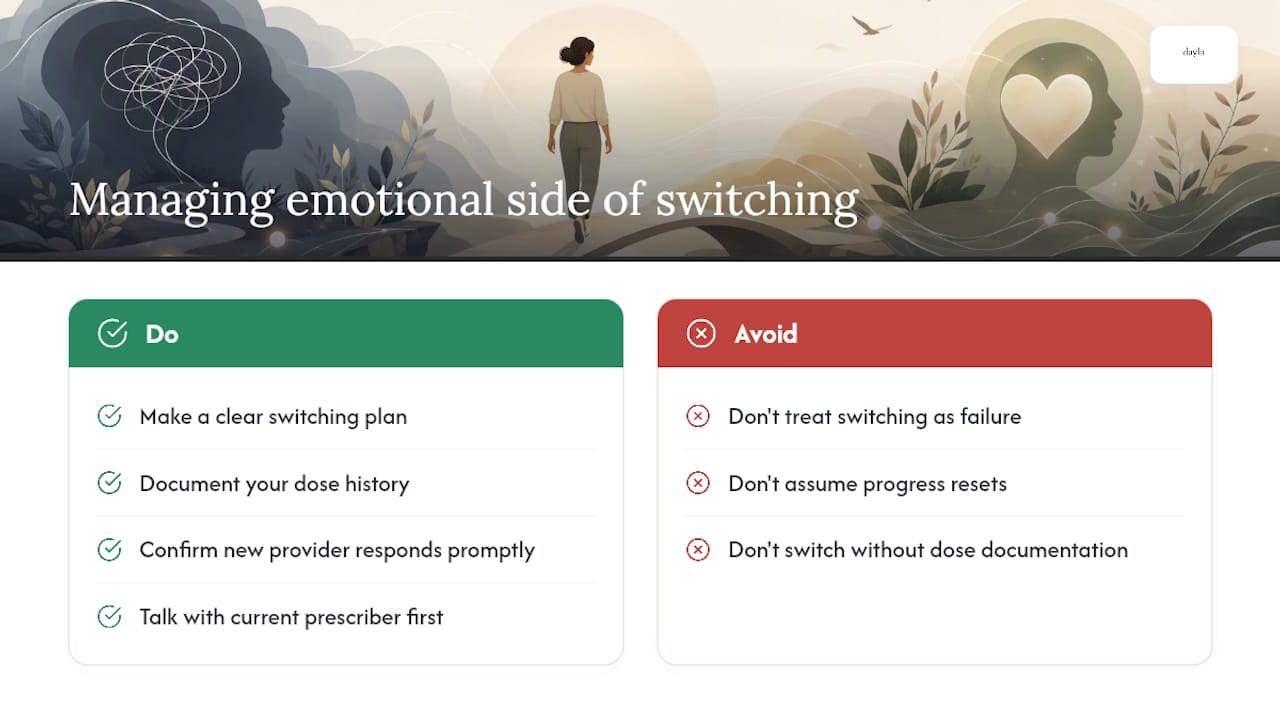
Changing providers can feel unsettling, even when the decision is clearly the right one. You may have built trust with your current prescriber, feel uncertain about whether the new provider will understand your history, or worry about losing progress you worked hard to achieve. These concerns are normal and worth acknowledging directly.
Switching is not a failure. Experts consistently frame it as a strategic decision driven by clinical or nonclinical triggers, and a high-quality provider treats the handoff as a continuation of your care, not a fresh start. The anxiety around switching often comes from uncertainty about the process itself. A clear plan, documented dose history, and a provider who responds to clinical questions promptly can resolve most of that uncertainty before your first new dose arrives.
If you feel reluctant to leave your current provider despite valid reasons for switching, consider whether the hesitation is about the provider relationship or about the process. If it is the process, the checklist above addresses it directly. If it is the relationship, it is worth a direct conversation with your current prescriber about what is not working before you make the move.
Progress on GLP-1 therapy is not erased by a provider change. Your body's response to the medication, the habits you have built, and the weight you have lost do not reset when you switch providers. What can reset is your dose, and that is exactly what careful sequencing and documentation are designed to prevent.
Why careful switching matters more than most patients realize
Switching providers is not a bureaucratic inconvenience. It is a clinical handoff, and how it is managed determines whether you continue your treatment at the dose you earned or spend weeks rebuilding from a lower starting point.
The patients who navigate this well share one habit: they treat the switch as a planned process, not a reaction. They document before they act, they enroll before they cancel, and they give themselves enough time to absorb delays without running out of medication. That discipline is not complicated, but it requires treating your GLP-1 therapy with the same seriousness you would give any other prescribed medical regimen.
A provider with clear transfer policies, rapid intake-to-shipment timelines, and ongoing clinical oversight reduces the risk that a switch becomes a disruption. The right provider does not just write a prescription; they review your history, confirm your dose, and stay available when questions arise. That standard of care is what makes the difference between a smooth transition and a forced restart.
Whatever your reason for switching, consult your clinician before making any changes to your dosing schedule. The guidance here is general; your clinical situation is specific.
Daylahealth makes your GLP-1 transition straightforward
If cost, shipping delays, or limited clinical access are driving your provider change, Daylahealth offers a direct path forward. The online intake collects your full dosing history upfront, so the clinical team reviews your prior titration before approving your prescription. There is no insurance requirement, no prior authorization wait, and no formulary gatekeeping.

Daylahealth ships GLP-1 weight loss prescriptions and compounded peptides nationwide, with options for injection, microdose, and needle-free oral delivery. Ongoing clinician oversight, dietitian consults, and care coaching are included in the subscription, not billed separately. For patients mid-treatment, the intake process is designed to accept dosing documentation so your prescriber can make an informed decision about continuing your current dose.
To evaluate whether Daylahealth is the right fit for your switch, verify that the service is licensed in your state, then complete the online intake and upload your dose history. Your clinician will review your records and confirm the plan before your first shipment leaves. Start your evaluation at the Daylahealth GLP-1 service page.
This article provides general information and does not substitute for personalized medical advice. Confirm all dosing and timing decisions with a licensed clinician.
Sources
The following sources informed the clinical and practical guidance in this article:
- Switching between GLP‐1 receptor agonists in clinical practice: Expert consensus and practical guidance - PMC
- How to switch GLP-1 programs without losing prescription continuity
- How to Switch GLP-1 Providers Mid-Treatment (2026)
- How to Switch GLP-1 Providers: Complete Guide 2026 | Telehealth Ally
This article is general information, not a substitute for advice from a qualified doctor. Consult a qualified healthcare professional about your own circumstances before acting on anything here.