

Getting a GLP-1 prescription online in the USA means completing a licensed clinical evaluation through a telehealth provider, then receiving your medication shipped directly to your door. GLP-1 receptor agonists, the formal term for this drug class, are FDA-approved treatments for chronic weight management and type 2 diabetes. You do not need an in-person doctor visit. You do need a real prescriber, a real medical review, and a legitimate pharmacy. This guide walks you through every step, from eligibility to delivery, so you know exactly what to expect before you start.
What do you need before getting a GLP-1 prescription online?
The single most important prerequisite is being physically located in a state where your telehealth provider holds an active license. That requirement is non-negotiable under federal and state law. Beyond that, a few practical items will make your intake process faster and more accurate.
What to have ready before your consultation:
- Medical history summary: Your current medications, known diagnoses, allergies, and any prior weight loss treatments
- BMI or recent weight measurements: Most GLP-1 programs require a BMI of 27 or higher with a weight-related condition, or 30 or higher without one
- Recent lab results (if available): Blood glucose, HbA1c, kidney function, and lipid panels help the clinician assess your baseline
- A reliable device and internet connection: Telehealth consultations are conducted via video or asynchronous questionnaire, so a smartphone, tablet, or computer works fine
- Payment method: Insurance is not required to get GLP-1 medication online; many patients pay cash or use bundled membership pricing
Some providers offer at-home lab testing kits if you do not have recent bloodwork. That option adds a few days to the process but removes the need for a separate lab visit.
Pro Tip: Gather your medication list and any chronic condition diagnoses before filling out the intake form. Incomplete health histories are the most common reason for delays in the prescription review process.
How does the online GLP-1 prescription process work?
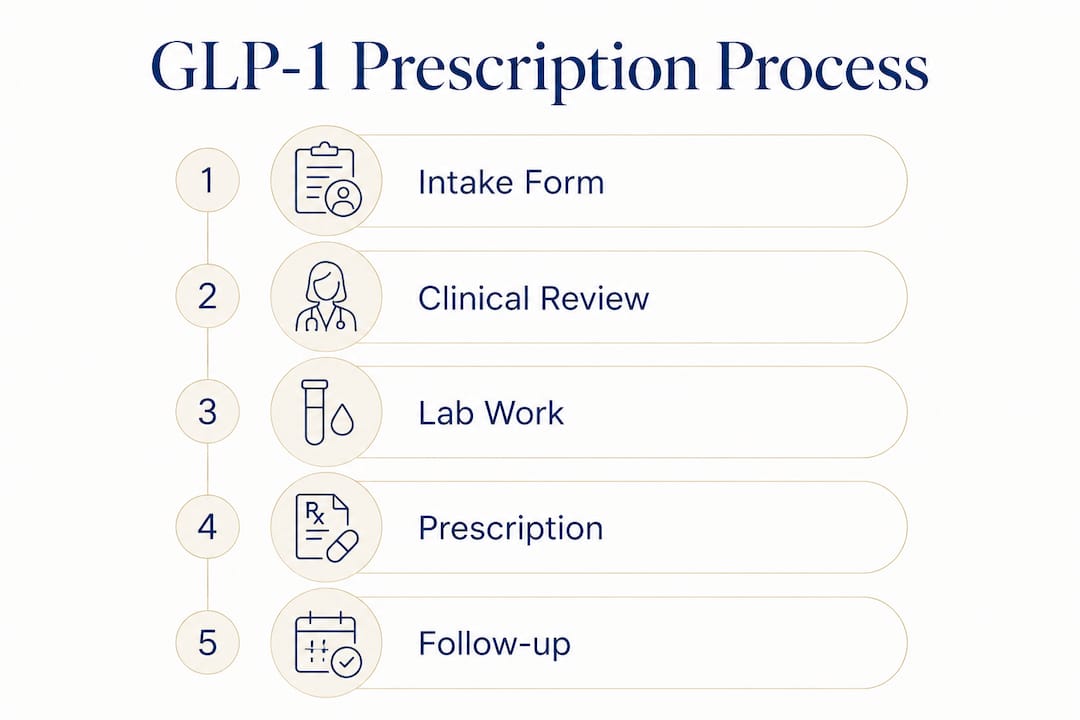
The process follows a clear clinical sequence. Skipping any step is a red flag that a provider is not operating legitimately.

Step 1: Complete the health intake questionnaire
You fill out a detailed online form covering your weight history, current health conditions, medications, and treatment goals. This is not a one-line sign-up form. A thorough intake covers your cardiovascular history, thyroid status, and any prior GI conditions, since GLP-1 medications carry contraindications for certain diagnoses.
Step 2: Clinical review by a licensed prescriber
A licensed clinician reviews your intake. Both asynchronous and synchronous consultations are legitimate when conducted by a licensed prescriber. Asynchronous means the clinician reviews your questionnaire and responds without a live call. Synchronous means a scheduled video appointment. Some providers use both, depending on your health complexity.
Step 3: Lab work (if required)
Your clinician may request labs before issuing a prescription. Common tests include fasting glucose, HbA1c, and a basic metabolic panel. If you already have recent results, you can upload them directly. If not, the provider may send an at-home kit or direct you to a local lab.
Step 4: Prescription issuance and pharmacy fulfillment
If approved, your prescription goes to a licensed pharmacy. Medication ships in cold-chain packaging that maintains temperature integrity during transit. Your package label includes the drug name, dose, lot number, and expiration date. That level of labeling is a standard quality marker.
Step 5: Ongoing follow-up and dose management
GLP-1 therapy is not a one-time prescription. Clinicians adjust your dose over weeks or months based on your response and side effects. A GLP-1 side effects management plan is part of responsible ongoing care. Providers who disappear after the first shipment are not providing adequate medical oversight.
Pro Tip: Ask your provider upfront how dose adjustments are handled and what the protocol is if you experience nausea or other side effects. That answer tells you a lot about the quality of care you will receive.
What are the GLP-1 medication options and costs?
GLP-1 medications fall into two categories: FDA-approved brand-name drugs and compounded alternatives. Each has distinct cost profiles and regulatory considerations.
FDA-approved brand-name medications
The FDA has approved several GLP-1 drugs for weight management and diabetes in the USA. In 2026, the FDA approved Foundayo and Wegovy HD, expanding the options available to patients. Foundayo is notable as an oral GLP-1 pill, removing the need for injections entirely. That approval is a meaningful shift for patients who are needle-averse.
Brand-name GLP-1 medications typically cost $400–$550 per month without insurance. That price reflects the manufacturer's list price before any discount programs or insurance negotiation.
Compounded GLP-1 medications
Compounded semaglutide and tirzepatide are prepared by licensed 503A or 503B pharmacies. They cost significantly less, typically $150–$350 per month. The tradeoff is that compounded medications are not FDA-approved, and quality varies by pharmacy. Availability has also narrowed since the FDA removed the drug shortage designation for semaglutide and tirzepatide.
What to watch for when evaluating cost:
- Telehealth consultation fees run $50–$150 per visit as a standalone charge
- Some providers bundle consultation fees into a monthly membership
- Prices that seem dramatically below market range often signal poor quality or fraudulent sourcing
- Check the 2026 GLP-1 pricing guide for a full breakdown of out-of-pocket costs by medication type
How do state laws affect your access to online GLP-1 prescriptions?
State licensing is the primary reason why GLP-1 telehealth access varies across the country. A prescriber must hold an active license in the exact state where you are physically located at the time of your consultation. That rule applies even if the provider's headquarters is in another state.
Most established telehealth GLP-1 providers are licensed in 40 or more states. However, states like Alaska and Hawaii have notably limited provider options due to lower provider density and stricter telehealth regulations. Major population states including California, Texas, Florida, and New York have full provider availability.
Key points on state access:
- Check provider availability for your specific state before completing an intake form
- Some states impose additional requirements on compounding pharmacies, which may limit your medication options even if a prescriber is available
- No federal law requires an in-person visit for a GLP-1 prescription, but individual states may require a live video consultation rather than an asynchronous review
- State-level licensing is the single biggest variable in whether you can access a particular provider
Rural residents in covered states generally have the same access as urban residents, since telehealth removes geographic distance as a barrier within state lines.
What are the red flags of an illegitimate GLP-1 online provider?
Illegitimate providers are a real risk in the GLP-1 market. The demand for these medications has created a market for services that skip clinical safeguards entirely.
Prescriptions guaranteed without a thorough clinical evaluation are not just low quality. They are illegal. A licensed prescriber cannot issue a controlled or prescription-only medication without conducting a proper medical assessment. Any service that promises approval before reviewing your health history is operating outside the law.
Red flags to watch for:
- No medical intake form, or a form so brief it cannot support a real clinical decision
- Guaranteed approval language before any clinician has reviewed your information
- Unnamed or unlicensed pharmacies with no ingredient transparency or third-party testing
- Prices far below the $150 floor for compounded medications
- No follow-up care, dose adjustment protocol, or clinician contact after the first shipment
Clinical rigor is non-negotiable in legitimate telehealth. Providers who name their compounding pharmacies, publish ingredient testing results, and offer ongoing clinical support are operating to the standard you should expect.
Key Takeaways
Getting a GLP-1 prescription online in the USA requires a licensed clinical evaluation, state-compliant prescribing, and pharmacy fulfillment through a verified, quality-controlled source.
| Point | Details |
|---|---|
| Telehealth is fully legitimate | Both asynchronous and synchronous consultations are valid when conducted by a licensed prescriber. |
| State licensing controls access | Your provider must be licensed in the state where you are physically located during the consultation. |
| Costs vary by medication type | Brand-name GLP-1 drugs run $400–$550/month; compounded alternatives cost $150–$350/month. |
| New FDA approvals expand options | Foundayo, an oral GLP-1 pill, and Wegovy HD received FDA approval in 2026, adding new choices. |
| Red flags signal real risk | Guaranteed approvals, unnamed pharmacies, and prices below market range indicate unsafe providers. |
Why I think most people underestimate the follow-up care requirement
The conversation around GLP-1 prescriptions online focuses almost entirely on access. Can you get one? How fast? How much? Those are fair questions, but they miss the part that actually determines whether the treatment works: what happens after the first shipment arrives.
GLP-1 therapy involves a titration schedule, meaning your dose increases gradually over weeks. That process requires clinical oversight because side effects like nausea, vomiting, and fatigue are common at dose transitions. Patients who get a prescription from a provider with no follow-up infrastructure often stop the medication early because they have no guidance when symptoms appear.
The providers worth your time are the ones who build follow-up into the program from day one. That means scheduled check-ins, a clear protocol for dose adjustments, and a way to reach a clinician when something feels off. The GLP-1 weight loss process is a months-long clinical commitment, not a one-time transaction. Treat it like one, and choose a provider who does the same.
— Flexible
Personalized GLP-1 care, delivered to your door by Daylahealth
Daylahealth connects you with licensed providers who conduct real clinical evaluations before issuing any prescription. The process covers your full medical history, eligibility review, and medication selection, whether that means an FDA-approved brand or a compounded therapy from a verified 503A or 503B pharmacy.
Medication ships with temperature-controlled packaging, and your care does not stop at delivery. Daylahealth's clinical team manages dose adjustments and side-effect support throughout your treatment. No insurance is required, and self-pay pricing is transparent from the start. If you are ready to get started with GLP-1 under proper medical supervision, Daylahealth provides the doctor-led, personalized GLP-1 care that makes the process safe and straightforward.
FAQ
Do I need insurance to get a GLP-1 prescription online?
Insurance is not required. Most patients pay out of pocket, and many providers offer bundled membership pricing that includes consultations and medication.
How long does it take to get a GLP-1 prescription online?
Most patients receive a clinical decision within 24–72 hours of completing their intake. Shipping typically adds 2–5 business days depending on your location and the pharmacy used.
What GLP-1 medications are FDA-approved in the USA in 2026?
The FDA approved Foundayo, an oral GLP-1 pill, and Wegovy HD in 2026 for chronic weight management in adults, adding to existing approvals like Wegovy and Ozempic.
Can a telehealth provider prescribe GLP-1 in every state?
No. A prescriber must hold an active license in your state. Most major providers cover 40 or more states, but Alaska and Hawaii have limited availability due to lower provider density.
What is the difference between compounded and brand-name GLP-1 medications?
Brand-name GLP-1 drugs are FDA-approved and cost $400–$550 per month. Compounded versions cost $150–$350 per month but are not FDA-approved, and quality depends on the pharmacy's standards and testing practices.