

A weight loss plateau is defined as a period when your body stops losing weight despite maintaining a consistent calorie deficit and exercise routine. This stall is not a sign of failure. It is your body's biological response to sustained calorie restriction, driven primarily by metabolic adaptation and a reduction in resting metabolic rate (RMR). Research shows 85% of dieters experience a plateau around the six-month mark. That statistic tells you one thing clearly: hitting a wall is the rule, not the exception.
What is a weight loss plateau and why does it happen?
A weight loss plateau occurs when your body adapts to a lower calorie intake by reducing the number of calories it burns at rest. This process is called metabolic adaptation, and it is the central mechanism behind most stalls in progress. Your body treats a prolonged calorie deficit as a threat and responds by becoming more efficient, burning fewer calories to perform the same functions.

Metabolic adaptation reduces RMR by 10–15% during active dieting. That means a person who previously burned 2,000 calories per day at rest may now burn only 1,700 to 1,800. The calorie deficit that once produced steady weight loss has effectively closed.
This is not a malfunction. It is your body doing exactly what it evolved to do: protect you from starvation. Understanding this mechanism is the first step toward addressing it with the right tools rather than simply eating less.
What are the most common causes of a weight loss plateau?
Several physiological and behavioral factors drive a stall in weight loss. They rarely act alone. Most plateaus involve two or three of these causes working together.
- Metabolic adaptation. Your RMR drops as you lose weight, meaning your body burns fewer calories at rest. This is the most common cause of a plateau.
- Calorie creep. Portion sizes gradually increase over time without you noticing. Studies consistently show that people underestimate their calorie intake, sometimes by several hundred calories per day.
- Reduced NEAT. Non-Exercise Activity Thermogenesis accounts for 15–30% of your total daily calorie burn. NEAT includes all movement outside of formal exercise: walking, fidgeting, standing. When you diet, NEAT drops automatically as your body conserves energy.
- Muscle loss. Losing muscle mass during a calorie deficit lowers your metabolic rate further, since muscle tissue burns more calories than fat at rest.
- Hormonal shifts. Leptin, the hormone that signals fullness, decreases during weight loss. Ghrelin, the hunger hormone, increases. This combination drives appetite up and energy expenditure down.
- Poor sleep and chronic stress. Sleep deprivation and high cortisol disrupt hunger hormones and promote fat storage, particularly around the abdomen. Many people focus entirely on food and exercise while ignoring these two factors.
Pro Tip: Track your daily step count for one week. If it has dropped since you started dieting, your NEAT has likely declined. Aim to restore it before cutting calories further.
Is it a true plateau or just normal weight fluctuation?
A true weight loss plateau is not the same as a bad week on the scale. Your weight fluctuates daily based on water retention, food volume in your digestive system, glycogen storage, and hormonal cycles. These swings can range from one to five pounds in a single day without any change in actual body fat.
A genuine plateau requires 4–6 weeks of no downward trend in weight before you should consider making changes. Reacting to a two-week stall by slashing calories is one of the most common mistakes people make.
| Situation | What it likely means |
|---|---|
| Weight up 2–3 lbs after a salty meal | Water retention, not fat gain |
| No change for 2 weeks | Normal fluctuation, monitor closely |
| No downward trend for 4–6 weeks | True plateau, time to adjust |
| Scale stable but clothes fitting looser | Body recomposition, fat loss is occurring |
| Weight stable despite consistent deficit | Metabolic adaptation is likely active |
The most reliable way to track progress is to record your weight daily and calculate a weekly average. Comparing weekly averages over four to six weeks gives you a true trend line. Waist measurements and clothing fit can also reveal fat loss that the scale misses entirely, especially when muscle gain is occurring alongside fat loss.
Pro Tip: Use a free app like Happy Scale or Libra to track rolling weight averages. These apps filter out daily noise and show your actual trend, which is the only number that matters.
How to overcome a weight loss plateau: proven strategies
Breaking through a plateau requires a targeted response, not just more willpower. The right approach depends on which cause is driving your stall.
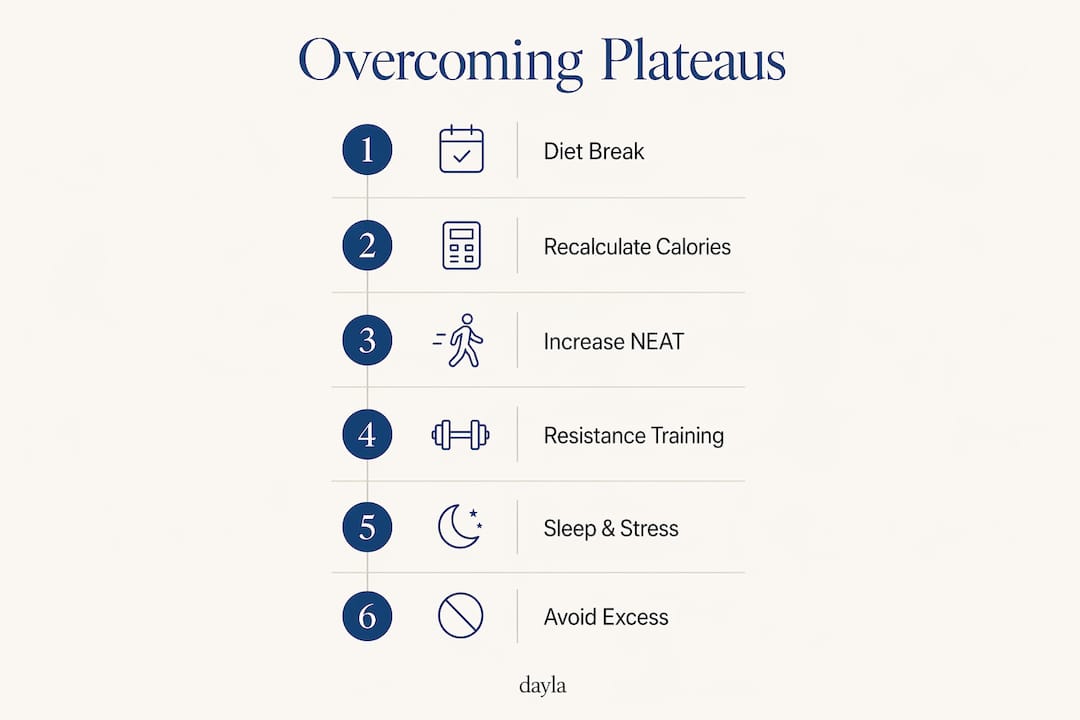
1. Take a structured diet break
Planned diet breaks at maintenance calories for one to two weeks are the most effective intervention for metabolic adaptation. Eating at maintenance temporarily restores leptin levels, reduces cortisol, and signals to your body that the famine is over. This resets the hormonal environment for renewed fat loss.
2. Recalculate your calorie target
Your calorie needs decrease as your body weight drops. A calorie target that created a deficit at 200 pounds may now be maintenance at 180 pounds. Recalculate your total daily energy expenditure using your current weight, not your starting weight.
3. Increase your NEAT deliberately
Add 2,000 to 3,000 extra steps per day through walking, taking stairs, or standing at your desk. Since NEAT accounts for up to 30% of daily calorie burn, even modest increases in daily movement can reopen a calorie deficit without touching your food intake.
4. Add resistance training
Resistance training preserves and builds muscle mass, which keeps your RMR higher during a deficit. If you are only doing cardio, adding two to three strength sessions per week can meaningfully shift your body composition and metabolic rate.
5. Prioritize sleep and stress management
Sleep quality and stress management are as critical as nutrition for breaking a plateau. Aim for seven to nine hours of sleep per night. Chronic sleep deprivation elevates cortisol, which promotes fat storage and increases hunger. Practices like consistent sleep schedules, limiting screen time before bed, and managing workload stress all contribute directly to weight loss outcomes. For a deeper look at the science, Daylahealth covers sleep and weight loss in detail.
6. Avoid excessive calorie restriction
Cutting calories too aggressively worsens metabolic adaptation and can stall progress further. A deficit of 500 calories per day is generally the upper limit for sustainable fat loss without triggering significant metabolic slowdown. Going lower often produces the opposite of the intended result.
Pro Tip: If you have been in a deficit for more than 12 weeks without a break, a structured diet break is likely more effective than any other single change you can make.
How to prevent future plateaus and maintain progress
Prevention is more effective than recovery. Building plateau-avoidance strategies into your plan from the start reduces the frequency and severity of stalls.
- Schedule diet breaks every 8–12 weeks. Planned breaks every 8–12 weeks prevent metabolic adaptation from progressing to a full plateau. These breaks also reduce psychological burnout, which is one of the leading causes of diet abandonment.
- Update your calorie targets regularly. Recalculate your needs every 10–15 pounds of weight lost. Your body's energy requirements change as your weight changes.
- Track more than the scale. Monitor waist circumference, body fat percentage, energy levels, and strength in the gym. These metrics often show progress when the scale does not.
- Maintain muscle mass consistently. Resistance training should be a permanent fixture in your routine, not something you add only when progress stalls. Muscle is metabolically active tissue that protects your RMR over time.
- Monitor sleep and stress as data points. Track your average sleep hours and subjective stress levels weekly. When these metrics decline, your risk of a plateau increases. Daylahealth's guide on maintaining weight loss results covers long-term adherence strategies in practical detail.
- Set realistic timeline expectations. Weight loss is not linear. Understanding that plateaus are a normal phase of the process, not a sign that your plan has failed, keeps you consistent when progress slows.
Key takeaways
A weight loss plateau is a predictable biological response to sustained calorie restriction, driven by metabolic adaptation, reduced NEAT, and hormonal shifts, and it requires targeted adjustments rather than simply eating less.
| Point | Details |
|---|---|
| Plateaus are physiological, not personal | Metabolic adaptation reduces RMR by 10–15%, making your old deficit ineffective. |
| True plateau requires 4–6 weeks | Do not react to short-term fluctuations; track weekly averages before changing your plan. |
| Structured diet breaks work | Eating at maintenance for 1–2 weeks resets hormones and restores metabolic rate. |
| NEAT is a powerful lever | Increasing daily movement can reopen a calorie deficit without cutting food further. |
| Sleep and stress are non-negotiable | Poor sleep and high cortisol directly stall fat loss by disrupting hunger hormones. |
Plateaus are signals, not setbacks
Most people I have seen struggle with plateaus share one common pattern: they interpret the stall as evidence that their plan is broken. They cut calories further, add more cardio, and push harder. That response almost always makes things worse.
What a plateau actually signals is that your body has caught up to your strategy. It is not a failure of effort. It is a prompt to adapt. The people who break through plateaus fastest are the ones who treat them analytically, look at what has changed in their sleep, stress, movement, and food tracking, and make one targeted adjustment at a time.
The counterintuitive truth is that eating more, through a planned diet break, is often the most effective move you can make. I have seen this work repeatedly when every other approach has stalled. The physiology is clear: prolonged restriction without breaks drives metabolic adaptation deeper. A two-week reset at maintenance is not a setback. It is a calculated investment in the next phase of fat loss.
The other factor I cannot emphasize enough is sleep. People will spend hours researching the perfect macro split and ignore the fact that they are sleeping five hours a night. Sleep deprivation alone can stall fat loss entirely, regardless of how clean your diet is. Fix sleep first. Then reassess everything else.
Plateaus are a normal, expected part of the weight loss process. The goal is not to avoid them entirely but to recognize them accurately and respond with precision.
— Flexible
Daylahealth's doctor-led GLP-1 support for weight loss plateaus
When lifestyle adjustments are not enough to move the needle, medical support can make a meaningful difference. GLP-1 medications work by reducing appetite, slowing gastric emptying, and supporting metabolic function, addressing several of the core drivers of a plateau simultaneously.

Daylahealth provides telehealth-based access to personalized GLP-1 treatments through a doctor-led process, so you get a plan built around your specific situation, not a generic protocol. If you are stuck and want to understand whether prescription support is the right next step, Daylahealth's clinical team can assess your needs and guide you toward the most appropriate option. You can also review GLP-1 weight loss options directly to see what is available.
FAQ
What is a weight loss plateau?
A weight loss plateau is a period of four to six weeks during which your weight remains stable despite maintaining a calorie deficit and exercise routine. It is caused primarily by metabolic adaptation, where your body reduces its resting metabolic rate in response to sustained calorie restriction.
Is a weight loss plateau normal?
Yes. 85% of people attempting weight loss experience a plateau, most commonly around the six-month mark. It is a predictable biological response, not a sign that your approach has failed.
How long does a weight loss plateau last?
A plateau can last anywhere from a few weeks to several months if no adjustments are made. Taking a structured diet break, recalculating your calorie target, and increasing daily movement are the most effective ways to shorten its duration.
Should I cut more calories when I hit a plateau?
No. Excessive calorie restriction worsens metabolic adaptation and can deepen a plateau. A structured diet break at maintenance calories is typically more effective than cutting further.
Can I still be losing fat even when the scale does not move?
Yes. Body composition can improve during a plateau as fat is replaced by muscle. Waist circumference and clothing fit are more reliable indicators of fat loss than scale weight alone during these periods.