

A weight loss timeline is defined as the structured progression of fat loss, body composition changes, and metabolic adaptation that occurs from the start of a calorie deficit through long-term weight maintenance. The standard clinical rate is 1 to 2 pounds per week, achieved by reducing daily intake by 500 to 750 calories. This pace preserves muscle mass, supports proper nutrition, and gives your body time to adapt without triggering the hormonal backlash that derails faster approaches. The NIDDK recommends an initial target of 5 to 10% of your starting body weight within six months, a goal that delivers measurable health benefits while remaining achievable for most people. Understanding your weight loss timeline from the start sets realistic expectations, reduces frustration, and dramatically improves your odds of keeping the weight off.
What is the weight loss timeline, week by week and month by month?
The weight loss journey timeline follows predictable stages, and knowing what to expect at each one prevents you from misreading normal progress as failure.
Weeks 1 to 2: The rapid drop phase. Your body sheds water weight and depletes glycogen stores in the liver and muscles before it begins burning significant fat. This early drop can be 3 to 5 pounds or more, which feels motivating but does not reflect true fat loss. Expect this pace to slow considerably once glycogen is depleted.

Weeks 3 to 6: Steady fat loss begins. This is where the 1 to 2 pounds per week rate becomes your baseline. Fat loss is now the primary driver of the scale moving down. Many people notice clothes fitting differently before they see dramatic scale changes, because fat loss and muscle retention shift body composition even when the number moves slowly.
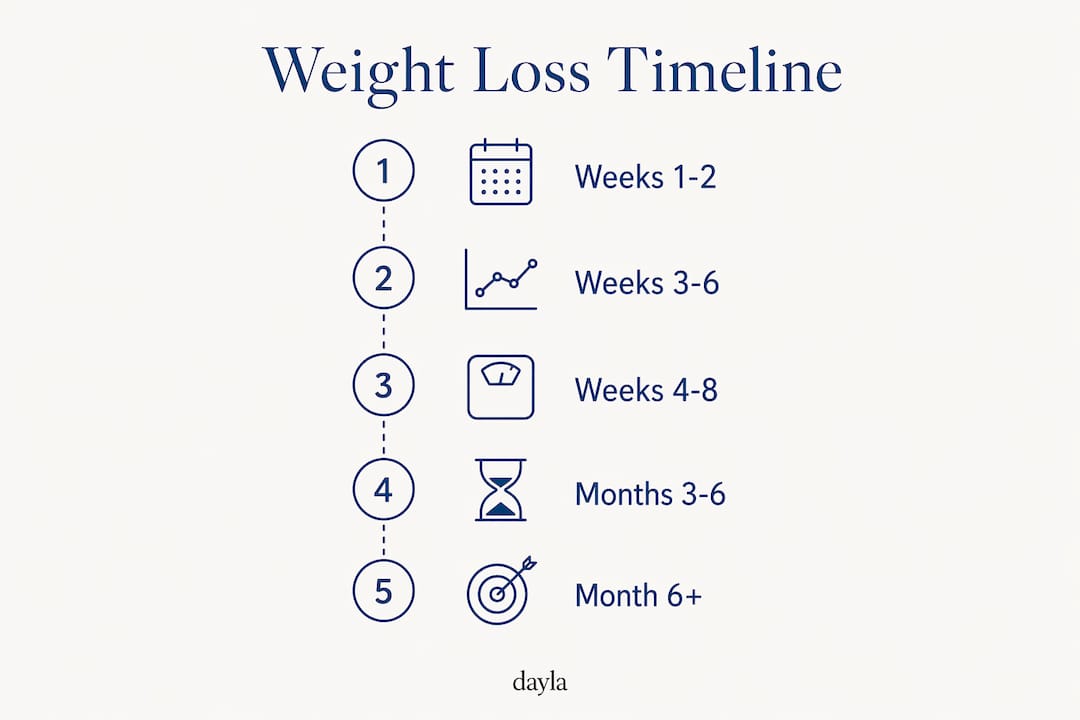
Weeks 4 to 8: Noticeable physical changes. Most people report visible changes in the mirror between weeks four and eight, depending on starting weight and consistency. A person starting at 200 pounds targeting the 5 to 10% goal is aiming for 10 to 20 pounds in six months, which is both clinically meaningful and realistic.
Months 3 to 6: The consolidation phase. Progress often slows here as metabolism adapts. This is normal physiology, not a sign that your plan has stopped working. Reassessing your calorie targets every four to six weeks keeps the weight loss progress schedule on track.
Month 6 and beyond: Transition to maintenance. Once you reach your initial goal, the focus shifts from losing to preserving. This transition requires deliberate planning because the habits that got you here are not identical to the habits that keep you there.
Pro Tip: Track your weight loss progress using photos and body measurements alongside the scale. The scale alone misses muscle gain and fat redistribution. A before and after tracking guide can show you progress the scale never will.
What factors affect how long weight loss takes?
The ideal weight loss timeframe varies significantly from person to person. Several concrete variables determine whether you lose weight faster or slower than the clinical average.
- Starting weight. People with higher starting weights tend to lose more pounds per week in absolute terms early on, because a larger calorie deficit is proportionally easier to create. A 300-pound person cutting 750 calories per day loses a larger percentage of body weight per week than a 160-pound person doing the same.
- Calorie deficit size. A 500-calorie daily deficit produces roughly 1 pound of fat loss per week. A 750-calorie deficit produces closer to 1.5 pounds. Going beyond 1,000 calories per day increases the risk of muscle loss and nutrient deficiency without proportionally improving fat loss outcomes.
- Exercise habits. Resistance training preserves lean muscle mass during a deficit, which keeps your metabolic rate higher over time. Protein intake works alongside resistance training to protect muscle, making both non-negotiable for an effective timeline for fat loss.
- Age and sex. Men typically lose weight faster than women in the early weeks due to higher baseline muscle mass and testosterone levels. Older adults experience more significant metabolic slowdowns during weight loss, requiring more frequent plan adjustments.
- Hormones and genetics. Thyroid function, insulin sensitivity, cortisol levels, and genetic predispositions all influence how efficiently your body mobilizes stored fat. These factors do not make weight loss impossible, but they do make personalized timelines more accurate than generic ones.
- Consistency and adherence. The most underrated factor in any weight loss duration estimate is how consistently you execute your plan. A 90% adherence rate over six months outperforms a perfect two-week sprint followed by two weeks off.
Rapid vs. gradual weight loss: what does the evidence say?
The debate between rapid and gradual weight loss has a more nuanced answer than most people expect.
| Approach | Rate | Key benefit | Key risk |
|---|---|---|---|
| Gradual weight loss | 1 to 2 lbs per week | Preserves muscle, supports nutrition | Slower results, requires sustained motivation |
| Rapid weight loss | More than 2 lbs per week | Faster initial results, higher short-term motivation | Muscle loss, nutrient deficiency, harder to sustain |
A 2026 randomized trial found that adults with obesity on a rapid weight loss program using very low calories for 16 weeks lost 14.4% of body weight at one year, compared to 10.5% for those on a gradual program. This is a meaningful difference. The critical detail is that the rapid group received a structured 36-week weight regain prevention phase immediately after the intensive period, meaning the result was not rapid loss alone but rapid loss plus structured transition support.
Rapid loss over 2 pounds per week risks muscle loss, nutrient deficiencies, and reduced metabolic rate, all of which make long-term maintenance harder. Registered dietitians consistently note that slower loss preserves lean mass and supports the metabolic conditions needed for lasting results. The 2026 trial does not contradict this. It confirms that rapid loss can work when it is medically supervised and followed by a deliberate maintenance protocol.
Pro Tip: If you are considering a very low-calorie approach, do it under medical supervision with a structured transition plan. Rapid loss without a maintenance phase is where most regain happens. Explore how GLP-1 changing weight loss protocols handle this transition with clinical support.
How to maintain weight loss and prevent regain over time
Reaching your goal weight is the beginning of a new phase, not the finish line. Metabolism slows as weight drops, lowering your daily calorie needs and raising the risk of regain if your plan stays static. This is not a personal failure. It is a physiological response that every person experiences, and it requires a deliberate response.
- Increase physical activity progressively. The NIDDK recommends at least 150 minutes per week of moderate aerobic exercise during weight loss, and at least 300 minutes per week once you reach your goal weight to prevent regain. Muscle-strengthening activities twice weekly are also recommended.
- Reassess your calorie targets every four to six weeks. As your weight drops, your maintenance calories drop with it. Eating the same amount you did at 220 pounds when you now weigh 185 pounds will stall progress or cause regain.
- Set lifestyle goals, not just weight goals. Aiming to cook four meals at home per week, walk 8,000 steps daily, or sleep seven hours per night creates the behavioral infrastructure that sustains weight loss. These habits are more durable than calorie counting alone.
- Track progress and treat plateaus as data. Plateaus signal the need to modify diet or activity, not to abandon the plan. A two-week stall after consistent progress means your body has adapted. Adjusting your deficit by 100 to 200 calories or adding one strength session per week is often enough to restart progress.
- Build a support structure. Long-term adherence improves significantly with accountability, whether that comes from a clinician, a coach, a community, or a structured program. Incorporating lifestyle changes that reinforce your habits makes the maintenance phase far more manageable.
Key takeaways
A realistic weight loss timeline requires 1 to 2 pounds of fat loss per week, a 5 to 10% body weight goal within six months, and a structured maintenance phase to prevent regain.
| Point | Details |
|---|---|
| Standard rate of loss | Losing 1 to 2 pounds per week is the clinically supported pace for fat loss with muscle preservation. |
| Six-month milestone | Targeting 5 to 10% of starting body weight in six months delivers measurable health benefits. |
| Rapid loss requires structure | A 2026 trial showed rapid loss outperforms gradual loss only when paired with a 36-week maintenance phase. |
| Metabolism adapts | Calorie needs decrease as weight drops, requiring regular plan adjustments to avoid regain. |
| Activity targets change | Maintenance requires at least 300 minutes of moderate exercise per week, double the loss-phase minimum. |
What I've learned about timelines after working with weight loss programs
The most common mistake I see is treating the weight loss timeline as a single phase with a clear end date. People set a goal, reach it, and then stop the behaviors that got them there. Within months, the weight returns. The clinical term for this is weight cycling, and it is far more common than most people realize.
The 2026 rapid loss trial is instructive here. The group that lost more weight at one year did not just follow a stricter diet. They had a structured 36-week transition built into their program. That transition is what most self-directed plans skip entirely. The loss phase gets all the attention. The maintenance phase gets none.
My honest view is that the ideal weight loss timeframe is less about the number on the scale and more about how long you can sustain the behaviors. Personalizing your goals every four to six weeks based on actual progress, rather than sticking rigidly to a plan set on day one, produces better adherence and better outcomes. A plateau is not failure. It is your body telling you the current stimulus is no longer sufficient. Adjust and continue.
The combination of a modest calorie deficit, adequate protein, consistent resistance training, and a clear maintenance protocol is not glamorous. It is, however, what the evidence consistently supports. Speed matters far less than structure.
— Flexible
Start your weight loss plan with doctor-led support
Knowing your weight loss timeline is one thing. Having the clinical support to execute it is another.

Daylahealth offers personalized GLP-1 care and peptide therapies designed to support appetite control, fat loss, and metabolic health under medical supervision. These are not generic supplement programs. They are doctor-led protocols built around your starting weight, health history, and goals, with structured transition support to protect your results long term. If you are ready to move from information to action, explore Daylahealth's GLP-1 weight loss programs or review peptide therapy options that complement your weight loss plan. Personalized care produces better timelines and better outcomes.
FAQ
What is a realistic weight loss timeline for most people?
A realistic weight loss timeline is 1 to 2 pounds per week, translating to roughly 4 to 8 pounds per month. Most clinicians recommend targeting 5 to 10% of your starting body weight within the first six months.
How long does it take to see noticeable weight loss results?
Most people notice visible physical changes between weeks four and eight, depending on starting weight and consistency. Clothing fit often changes before the scale reflects significant progress.
What is the difference between rapid and gradual weight loss?
Gradual weight loss at 1 to 2 pounds per week preserves muscle and supports nutrition. Rapid loss exceeding 2 pounds per week can produce faster short-term results but carries higher risks of muscle loss and nutrient deficiency without structured medical supervision.
Why does weight loss slow down over time?
Metabolism slows as body weight decreases, reducing daily calorie needs. This is a normal physiological adaptation that requires adjusting your calorie targets and increasing physical activity to maintain progress.
How much exercise is needed to maintain weight loss?
The NIDDK recommends at least 300 minutes per week of moderate-intensity aerobic activity to prevent weight regain, along with muscle-strengthening exercises twice weekly.