

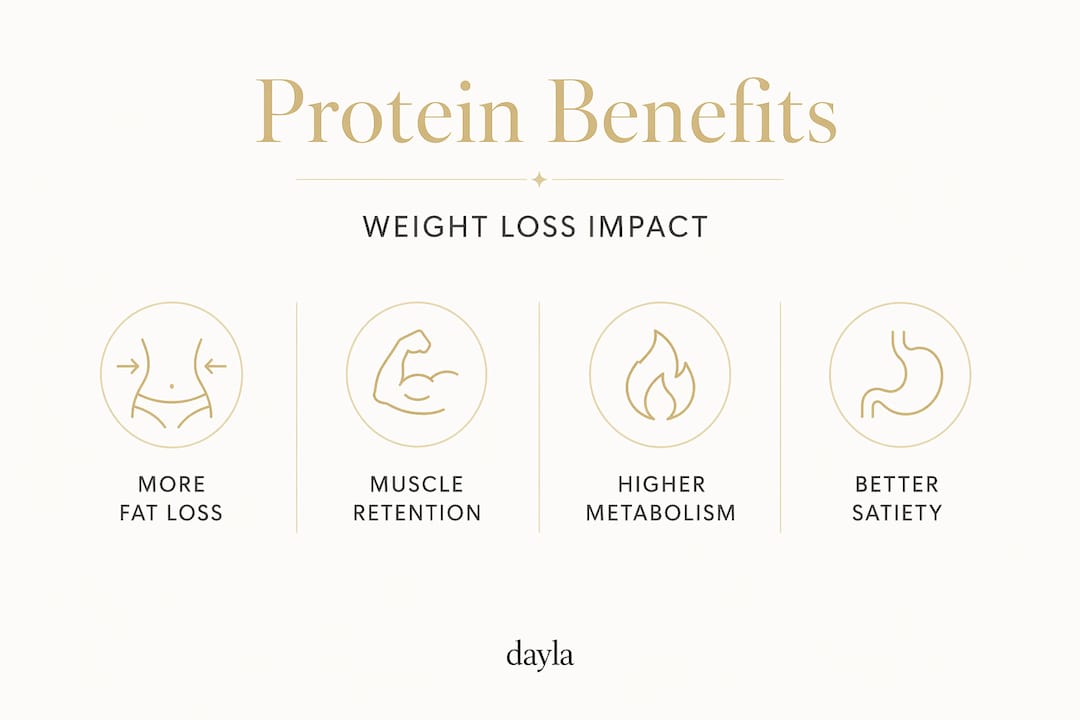
Most people assume protein's job is simple: eat more of it, lose more weight. The reality is more specific, and more useful. Research now shows that the primary role of protein in weight loss is not dramatically moving the scale downward. It's changing what you lose. High protein intake during a calorie deficit preserves muscle while accelerating fat loss, a distinction that matters enormously for how your body looks, functions, and performs long after the diet ends. This guide covers the mechanisms, the evidence, and the practical strategies that actually work.
Table of Contents
- Key Takeaways
- How protein shapes body composition during weight loss
- Why protein makes calorie control easier
- Protein needs by age and activity level
- Putting it into practice: building a high-protein diet
- My take on what most people get wrong about protein
- How Daylahealth supports your weight loss strategy
- FAQ
Key Takeaways
| Point | Details |
|---|---|
| Protein reshapes body composition | High protein intake produces more fat loss and more muscle preservation than standard protein at the same calories. |
| Satiety hormones do the heavy lifting | Protein stimulates CCK, GLP-1, and PYY while suppressing ghrelin, making calorie control significantly easier. |
| Dose matters more than food source | Research points to roughly 1.2 to 1.3 g/kg/day as the effective threshold for body composition benefits. |
| Older adults need more, not less | Adults over 50 require higher protein intake and should aim for 35 to 40 grams per meal to counter anabolic resistance. |
| Protein alone is not the full answer | Combining adequate protein with resistance training and total calorie awareness produces the strongest results. |
How protein shapes body composition during weight loss
When researchers measure the outcomes of high protein diets, they find something that surprises most people. The total weight lost is often similar to lower protein diets at the same calorie level. What differs is the composition of that weight. A meta-analysis of 24 randomized controlled trials involving 1,063 participants found that higher protein diets produced 0.87 kg more fat loss and 0.43 kg more muscle preservation compared to standard protein diets at identical calorie intakes.
That gap may sound modest, but it compounds over time. Losing fat while keeping muscle means your resting metabolism stays higher, your strength is maintained, and the physical results of your diet are far more visible. Losing muscle alongside fat, which is common on lower protein diets, leads to the "skinny fat" outcome many dieters experience: lighter on the scale, but softer and weaker in practice.
The effective protein dose identified across these trials was approximately 1.2 to 1.3 grams per kilogram of body weight per day. For a 170-pound person, that translates to roughly 93 to 100 grams of protein daily. This is meaningfully higher than the standard recommended dietary allowance of 0.8 g/kg/day, which was designed to prevent deficiency, not to optimize body composition during a calorie deficit.
Duration also matters. The muscle preservation benefits of higher protein intake become more pronounced the longer a diet continues. Short interventions of four to six weeks show smaller differences. Studies running twelve weeks or longer show clearer separation between high and standard protein groups, particularly in lean mass retention.
Pro Tip: Track body composition, not just scale weight. A DEXA scan or even consistent circumference measurements will reveal fat loss and muscle retention that the scale completely misses.
| Outcome | Standard protein (~0.8 g/kg/day) | High protein (~1.25 g/kg/day) |
|---|---|---|
| Total weight loss | Similar | Similar |
| Fat mass lost | Baseline | +0.87 kg more |
| Lean mass preserved | Baseline | +0.43 kg more |
| Triglyceride reduction | Minimal | Significant |
Notably, triglycerides decreased by 0.23 mmol/L with high protein energy-restricted diets, adding a cardiometabolic benefit beyond body composition alone.
Why protein makes calorie control easier
The biological mechanisms behind protein's satiety effects are well documented, and they explain why higher protein diets tend to produce better adherence. Protein does not just fill your stomach. It actively signals your brain to stop eating through multiple hormonal pathways.
Here is what happens after a protein-rich meal:
- Gut hormones increase. Eating 25 to 30% of calories from protein stimulates the release of cholecystokinin (CCK), glucagon-like peptide-1 (GLP-1), and peptide YY (PYY). These hormones travel through the gut-brain axis and reduce appetite for hours.
- Ghrelin drops. Ghrelin is the primary hunger hormone. Protein suppresses it more effectively than carbohydrates or fat, which is why a high protein breakfast reduces cravings throughout the morning far better than a carb-heavy one.
- Metabolism gets a small but real boost. The thermic effect of protein digestion is 20 to 30%, compared to 5 to 10% for carbohydrates and 0 to 3% for fat. This means your body burns roughly one quarter of protein's calories just processing it. At 100 grams of protein per day, that is a meaningful daily energy expenditure advantage.
- Total calorie intake drops naturally. The protein leverage hypothesis proposes that humans eat until a protein target is satisfied. Observational and controlled studies show a consistent negative relationship between dietary protein concentration and total energy intake. When protein is diluted by ultra-processed, low-protein foods, people unconsciously eat more to compensate.
This last point has real-world implications. It explains why diets heavy in processed snacks, fast food, and refined carbohydrates drive overconsumption. Those foods are protein-poor by design, and your body keeps seeking the protein it needs, pulling in excess calories along the way.
Protein needs by age and activity level
Protein's benefits are not uniform across all populations. Two groups in particular need to approach protein intake differently: adults over 50 and people who combine dieting with regular resistance training.
Older adults and anabolic resistance
Muscle loss accelerates after age 50 through a phenomenon called anabolic resistance. The muscle protein synthesis response to a given dose of protein becomes blunted, meaning older adults need more protein to achieve the same muscle-building signal that a younger person gets from a smaller amount. Higher protein intakes are linked to improved lean mass maintenance in adults over 50 during calorie restriction, with intakes above 0.8 g/kg/day showing clear advantages.

Research also highlights the importance of per-meal protein distribution. Consuming 35 to 40 grams of protein per meal maximizes the anabolic response in older adults, compared to the 20 to 25 grams that may suffice for younger individuals. Spreading protein across three to four meals, rather than concentrating it at dinner, produces better muscle preservation outcomes.
Pro Tip: If you are over 50 and dieting, aim for at least 35 grams of protein at breakfast. Most older adults undereat protein in the morning and overconcentrate it at dinner, which is the least effective distribution pattern.
Active individuals and resistance training
For people combining calorie restriction with resistance training, protein needs rise to 1.6 to 2.0 g/kg/day to support both muscle retention and repair. The 24 RCTs in the meta-analysis mentioned earlier actually excluded exercise, meaning the body composition benefits observed were achieved through diet alone. Adding structured resistance training to adequate protein intake produces additive benefits beyond what either intervention achieves separately.
| Population | Recommended protein intake | Key priority |
|---|---|---|
| General adult dieter | 1.2 to 1.3 g/kg/day | Fat loss with muscle preservation |
| Adults over 50 | >1.3 g/kg/day, 35-40g per meal | Countering anabolic resistance |
| Active dieters with resistance training | 1.6 to 2.0 g/kg/day | Muscle retention during deficit |
Putting it into practice: building a high-protein diet
Understanding the science is one thing. Translating it into daily eating is another. Here is a structured approach that reflects what the research actually supports.
-
Anchor each meal around a protein source. Target 30 to 40 grams per meal across three meals. This is more effective than trying to hit your daily target in one or two sittings. Good animal-based sources include chicken breast, salmon, Greek yogurt, cottage cheese, and eggs. Strong plant-based options include tempeh, edamame, lentils, and high-protein tofu.
-
Do not rely primarily on protein supplements. Whole food protein sources come with micronutrients, satiety fiber, and food volume that supplements lack. Protein shakes are useful for convenience, but they should supplement a whole food foundation, not replace it.
-
Account for total calories. Protein does not override a calorie surplus. Higher protein intake works within a calorie deficit, not instead of one. Tracking both protein grams and total calories, at least initially, builds the awareness needed to hit both targets consistently.
-
Spread intake across the day. Muscle protein synthesis is a meal-by-meal process. Eating 120 grams of protein in one meal does not produce the same result as distributing it across four meals. Your body can only use so much protein for anabolic purposes at one time.
-
Pair protein with resistance training. Even two sessions per week of compound movements, squats, rows, presses, significantly enhance the muscle preservation benefits of higher protein intake. The combination of diet and resistance training produces outcomes that neither achieves alone.
-
Choose quality over quantity when possible. Lean proteins support fat loss goals without adding excessive saturated fat. Fatty cuts and processed meats can meet protein targets but bring caloric and cardiovascular trade-offs worth considering.
My take on what most people get wrong about protein
I've seen the same pattern repeat constantly in how people approach protein and weight loss. They treat it as a magic lever. Add more protein, lose more weight, done. When the scale does not move dramatically, they conclude protein is overrated and move on to the next approach.
The problem is the metric, not the protein. Calorie-matched high-protein diets produce changes that are mostly invisible on a standard bathroom scale. You need body composition data to see what is actually happening. When people measure properly, the results are consistent and meaningful.
What I find most underappreciated is protein's role in making a diet psychologically sustainable. Hunger is the primary reason diets fail. Protein's ability to engage the gut-brain axis through multiple hormonal signals means you are not fighting willpower alone. You are working with your biology. That is a fundamentally different experience than white-knuckling a calorie deficit on a low-protein diet.
My honest recommendation: focus on hitting your protein target before worrying about any other dietary variable. Get that right consistently, add resistance training two to three times per week, and then fine-tune from there. The long-term weight loss journey is not about finding the perfect diet. It is about finding the sustainable one.
— Daylahealth
How Daylahealth supports your weight loss strategy
Protein optimization is one piece of a larger metabolic picture. For many people, appetite regulation and fat loss require more than dietary adjustments alone, particularly when hormonal or metabolic factors are working against them.

Daylahealth offers doctor-led GLP-1 therapy that directly supports the same appetite-regulating hormones protein activates, including GLP-1 itself. For individuals who need additional metabolic support, Daylahealth's peptide therapies complement nutrition-focused weight loss strategies with clinically guided options. Every plan is personalized, medically supervised, and designed to work alongside the dietary habits you are building. If you are ready to take a more structured approach to fat loss and body composition, Daylahealth's team is equipped to support you with precision care that goes beyond generic advice.
FAQ
Does protein actually help you lose more weight?
Protein does not dramatically increase total weight loss compared to lower protein diets at the same calorie level. It does produce significantly more fat loss and better muscle preservation, which is a more meaningful outcome for body composition and long-term metabolic health.
How much protein should I eat per day for fat loss?
Research supports approximately 1.2 to 1.3 grams per kilogram of body weight per day for general dieters. Active individuals combining calorie restriction with resistance training benefit from 1.6 to 2.0 g/kg/day for optimal muscle retention.
Does protein help with hunger during a diet?
Yes. Protein stimulates satiety hormones including GLP-1, CCK, and PYY while suppressing ghrelin, the primary hunger hormone. Eating 25 to 30% of daily calories from protein consistently reduces appetite and overall calorie intake.
What are the best protein sources for weight loss?
Lean animal proteins such as chicken breast, salmon, Greek yogurt, and eggs are highly effective. Strong plant-based options include tempeh, edamame, lentils, and high-protein tofu. Whole food sources are preferable to supplements as the primary protein foundation.
Do older adults need more protein when dieting?
Yes. Adults over 50 experience anabolic resistance, meaning the muscle-building response to protein is reduced. Research recommends targeting 35 to 40 grams of protein per meal and maintaining intakes above 1.3 g/kg/day to effectively preserve lean mass during calorie restriction.