

Sleep is a direct regulator of weight loss, controlling the hormones, metabolic rhythms, and calorie consumption patterns that determine whether your body burns fat or holds onto it. Most weight loss plans focus on diet and exercise while ignoring sleep entirely. That oversight is costly. Clinical research now shows that sleep duration, quality, and timing each independently influence how much fat you lose, how hungry you feel, and how efficiently your metabolism operates. Understanding how sleep affects weight loss gives you a lever that works around the clock, even when you are not at the gym or tracking macros.
How does sleep affect weight loss? The science explained
The relationship between sleep and fat loss is not indirect or theoretical. A randomized crossover study published in the Journal of Clinical Investigation found that short-term sleep restriction altered the rhythms of 90 circulating metabolites in adults, even when calorie intake and meal timing were held constant. That finding matters because it proves sleep changes your internal metabolic environment independent of what you eat.
The most striking evidence on sleep and fat loss comes from a controlled clinical trial reviewed by NutritionFacts.org. Overweight adults sleeping 8.5 hours lost more than double the fat compared to those sleeping 5.5 hours, despite consuming identical calories. The sleep-deprived group did not just lose less fat. They lost significantly more lean muscle mass instead. That shift in body composition is a serious problem for anyone trying to lose weight, because lean mass drives your resting metabolic rate.

A real-world sleep extension study referenced in JAMA Internal Medicine added another dimension. Overweight adults who increased sleep by 1.2 hours naturally reduced their daily calorie intake by an average of 270 kcal with no dietary intervention. That reduction is roughly equivalent to cutting out a small snack or a sugary drink every single day, achieved purely through better sleep.
| Sleep Duration | Fat Loss Outcome | Lean Mass Outcome |
|---|---|---|
| 8.5 hours per night | More than double fat loss | Lean mass preserved |
| 5.5 hours per night | Significantly less fat lost | Greater lean mass loss |
| Extended by 1.2 hours | Weight loss observed | 270 kcal/day intake reduction |
Pro Tip: If you are tracking calories but sleeping fewer than 7 hours, you are working against your own metabolism. Prioritize sleep before adding more dietary restrictions.
The JCI study also found that disrupted metabolite rhythmicity included compounds derived from the gut microbiome, suggesting sleep extension's benefits extend beyond calorie reduction to include improved gut-metabolic interactions. Your microbiome does not just respond to what you eat. It responds to when and how long you sleep.
How do sleep hormones drive hunger and cravings?
Sleep deprivation creates a hormonal environment that makes overeating almost inevitable. Two hormones sit at the center of this mechanism: leptin and ghrelin. Leptin decreases with poor sleep, reducing your sense of fullness after meals. Ghrelin increases, actively stimulating hunger even when your calorie needs are already met. The result is a biological push toward eating more, not a lack of willpower.
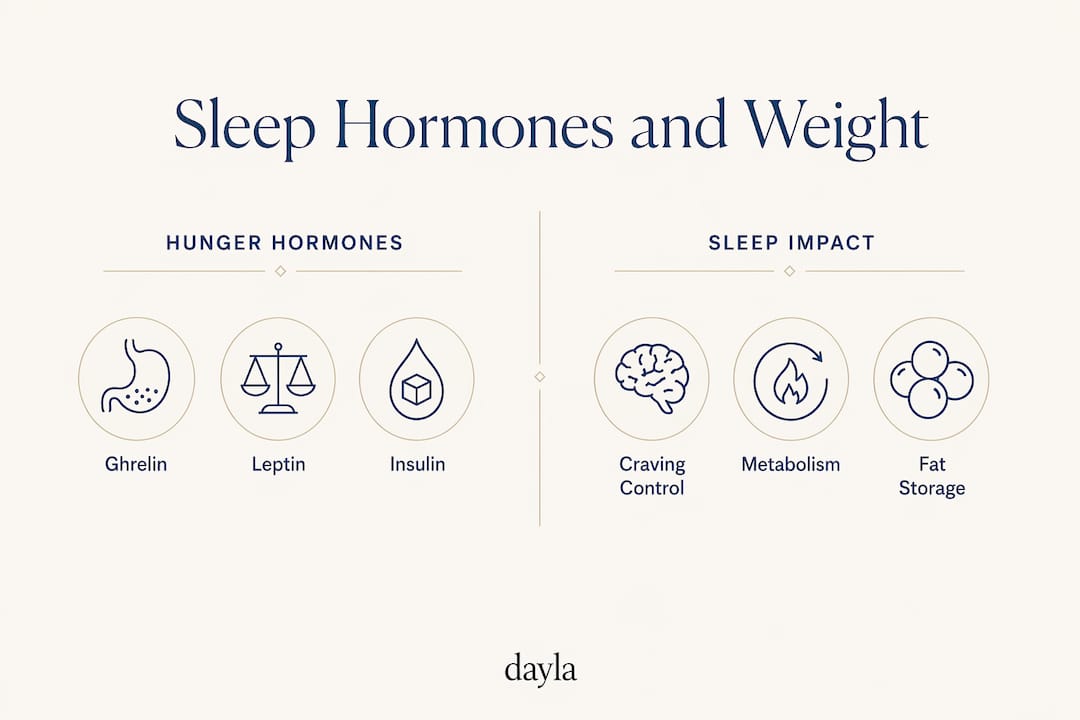
The hormonal disruption does not stop at hunger signals. Sleep loss activates the brain's reward centers, increasing your preference for high-calorie, high-fat, and high-carbohydrate foods specifically. This is why a bad night's sleep tends to produce cravings for pizza or chips rather than salad. Your brain is seeking fast energy to compensate for the fatigue, and it overrides rational food choices to get it.
Here is what the hormonal cascade looks like in practice:
- Leptin drops, so you feel less satisfied after eating the same meal you normally would
- Ghrelin rises, so you feel hungry earlier and more intensely throughout the day
- Brain reward circuits activate, increasing the appeal of calorie-dense foods
- Calorie intake increases, particularly from fats and refined carbohydrates
- Cravings for sugar intensify, driven by disrupted brain reward regulation
"Increasing sleep duration reduces cravings and sugar intake, possibly by restoring brain reward regulation disrupted by sleep deprivation." — The Standard, citing sleep extension research
Understanding the role of sleep in dieting means recognizing that hunger is not purely a function of calories consumed. It is also a function of how well you slept the night before. Pairing sleep improvement with appetite-focused strategies, like those covered in GLP-1 meal planning, addresses both sides of the hunger equation.
Does sleep quality matter as much as sleep duration?
Duration is only one part of the picture. Researchers at the University of Colorado Anschutz Medical Campus found that sleep efficiency, onset latency, and wake after sleep onset each independently predict weight loss outcomes. In other words, how quickly you fall asleep, how little time you spend awake during the night, and how consistently you stay asleep all matter for fat loss, separate from total hours logged.
Circadian alignment adds another layer. Circadian misalignment worsens glucose control and disrupts appetite hormone regulation, creating an energy imbalance that works against weight loss even in people who sleep adequate hours. Shift workers and people with irregular sleep schedules face this challenge chronically, which partly explains why irregular sleep patterns correlate with higher body weight in population studies.
Time-restricted eating offers a practical way to address both sleep quality and weight simultaneously. A 12-week randomized controlled trial in obese adults with obstructive sleep apnea found that an 8-hour eating window improved sleep efficiency, reduced sleep onset latency, and produced measurable weight loss. The eating window aligned food intake with the body's natural circadian rhythm, improving both metabolic and sleep outcomes together.
To improve sleep quality beyond just duration, consider these steps:
- Set a fixed wake time every day, including weekends, to anchor your circadian rhythm
- Reduce blue light exposure at least 60 minutes before bed to support melatonin production
- Keep your bedroom below 68°F since core body temperature drop is a key sleep onset trigger
- Limit caffeine after noon to prevent disruption of deep sleep stages
- Track sleep onset latency using a wearable device like a Garmin, Oura Ring, or Fitbit to identify patterns affecting your sleep quality
Pro Tip: CU Anschutz researchers recommend monitoring sleep onset latency and wake after sleep onset, not just total hours. These metrics give a more accurate picture of whether your sleep is actually supporting your weight loss goals.
What practical strategies optimize sleep for weight loss?
The most direct strategy is sleep extension. The evidence is clear: adding even one hour of sleep per night can reduce daily calorie intake by 270 kcal without any conscious dietary effort. For someone in a weight loss program, that reduction compounds over weeks into meaningful fat loss. The key is making sleep a non-negotiable part of your routine rather than a variable you sacrifice for productivity.
Sleep environment matters more than most people realize. Darkness is critical. Even low-level light exposure during sleep suppresses melatonin and disrupts sleep architecture. Blackout curtains, removing LED standby lights, and avoiding screen use in bed are all low-cost changes with measurable impact on sleep quality. Consistent sleep and wake times reinforce your circadian rhythm, which in turn stabilizes appetite hormones throughout the day.
Behavioral interventions targeting sleep efficiency are particularly relevant for people who spend adequate time in bed but still feel unrested. Cognitive behavioral therapy for insomnia, known as CBT-I, is the most evidence-supported non-pharmacological approach for improving sleep efficiency and reducing wake after sleep onset. It addresses the mental patterns that keep people awake, not just the environmental factors.
Behavioral weight loss programs that address multiple sleep health dimensions simultaneously show greater effectiveness than those targeting diet or exercise alone. This means the most effective approach to weight management integrates sleep as a primary variable, not an afterthought. Tracking your progress, including body composition changes, alongside sleep data gives you a clearer picture of what is working. A structured weight loss tracking approach helps you connect sleep improvements to visible results over time.
Key takeaways
Sleep is the most underutilized metabolic lever in weight loss, directly controlling fat versus lean mass loss, daily calorie intake, and appetite hormone balance.
| Point | Details |
|---|---|
| Sleep duration changes body composition | Sleeping 8.5 hours produces more than double the fat loss compared to 5.5 hours on the same calorie intake. |
| Extra sleep reduces calorie intake naturally | Adding 1.2 hours of sleep cuts an average of 270 kcal per day without dietary changes. |
| Leptin and ghrelin drive hunger after poor sleep | Sleep deprivation lowers leptin and raises ghrelin, making overeating a biological response, not a willpower failure. |
| Sleep quality metrics predict weight loss | Sleep efficiency, onset latency, and wake after sleep onset each independently influence fat loss outcomes. |
| Circadian alignment improves metabolic outcomes | Time-restricted eating aligned with circadian rhythms improves both sleep quality and weight loss simultaneously. |
Why sleep is the weight loss variable most programs ignore
I have reviewed a significant amount of weight loss research, and the pattern that stands out most is how consistently sleep gets treated as a background variable rather than an active intervention. Programs prescribe calorie deficits and exercise protocols in detail, then add "get enough sleep" as a footnote. The clinical evidence does not support that hierarchy.
What the JCI metabolite study revealed is particularly striking to me. Sleep restriction altered metabolic rhythms even when researchers controlled for every dietary variable. That means the metabolic disruption from poor sleep is not just about eating more. It is a direct biological effect on how your body processes energy. Most people trying to lose weight have no idea this mechanism exists, and their programs do not account for it.
The CU Anschutz research on sleep dimensions is also underappreciated. Measuring only total sleep hours misses the picture. Two people can both sleep 7 hours and have completely different weight loss trajectories based on their sleep efficiency and onset latency. That level of personalization is where sleep health is heading, and it aligns with how Daylahealth approaches weight management more broadly: treating the individual, not just the average.
My honest view is that if you are using GLP-1 therapy, peptides, or any structured weight loss program and you are not actively managing your sleep quality, you are leaving results on the table. Sleep is not passive recovery. It is active metabolic work, and it deserves the same attention you give to your diet.
— Flexible
Ready to take your weight loss further?
Sleep optimization is a powerful foundation, but some individuals need additional clinical support to reach their goals. Daylahealth offers doctor-led, personalized GLP-1 care and peptide therapies designed to work alongside lifestyle strategies like sleep improvement, nutrition, and exercise.

If you are already working on your sleep and diet but want to accelerate your results, Daylahealth's GLP-1 weight loss program provides medically guided prescriptions tailored to your specific needs. For those interested in metabolic support beyond GLP-1, peptide therapies offer an additional layer of personalized care. Getting started is straightforward, with a streamlined intake process and clinical oversight at every step.
FAQ
How much does sleep affect weight loss?
Sleep directly determines whether you lose fat or lean mass, and how much you eat. Adults sleeping 8.5 hours lose more than double the fat compared to those sleeping 5.5 hours on the same calorie intake.
Can sleeping more help you lose weight without dieting?
Yes. A real-world study found that extending sleep by 1.2 hours reduced daily calorie intake by an average of 270 kcal with no dietary changes, leading to measurable weight loss over two weeks.
What hormones connect sleep deprivation and weight gain?
Sleep deprivation lowers leptin, which reduces satiety, and raises ghrelin, which stimulates hunger. This hormonal shift increases calorie intake and intensifies cravings for high-fat, high-carbohydrate foods.
Does sleep quality matter as much as sleep duration for weight loss?
Yes. CU Anschutz researchers found that sleep efficiency, onset latency, and wake after sleep onset each predict weight loss outcomes independently of total sleep hours.
Does sleep timing affect metabolism and weight?
Circadian misalignment worsens glucose control and appetite hormone regulation even in people sleeping adequate hours. Aligning sleep and eating patterns with your circadian rhythm improves both metabolic function and weight outcomes.