

Tirzepatide leads every evidence-based ranking of fat-burning peptides, with SURMOUNT-1 reporting substantial total body weight loss at the 15 mg dose over an extended period. Semaglutide follows with clinically meaningful weight loss in STEP-1 at 2.4 mg over a comparable duration. Retatrutide shows a strong phase 2 signal of efficacy but remains investigational. Foundayo (orforglipron) is the first oral option with FDA approval. Liraglutide rounds out the approved incretin class with a longer track record and lower average magnitude.
Every peptide on this list requires medical supervision, baseline labs, and a titration plan. Sourcing peptides through grey-market channels, research-lab vendors, or unverified compounders carries real safety risks, including incorrect dosing, contamination, and no clinical oversight if something goes wrong.
The ranked shortlist at a glance:
- #1 Tirzepatide (Zepbound/Mounjaro) — FDA-approved, highest trial-proven weight loss, dual GLP-1/GIP
- #2 Semaglutide (Wegovy/Ozempic/Rybelsus) — FDA-approved, strong phase 3 evidence, cardiovascular outcome data
- #3 Retatrutide — Investigational triple agonist, highest phase 2 signal, phase 3 pending
- #4 Foundayo (orforglipron) — FDA-approved as of April 2026, oral once-daily pill
- #5 Liraglutide (Saxenda/Victoza) — FDA-approved, daily injectable, established safety record
- #6 Tesamorelin — FDA-approved for visceral fat in HIV-associated lipodystrophy specifically
- GH-axis and recovery peptides (CJC-1295/Ipamorelin, Sermorelin, AOD-9604, MK-677, BPC-157, TB-500) — support recomposition or recovery, not appetite-driven weight loss
- Investigational pipeline (Survodutide, MOTS-c, VK2735, Eloralintide) — early clinical data only
Safety callout: No peptide on this list should be self-prescribed. Baseline labs (A1c, CMP, thyroid, lipid panel) and clinician oversight are the standard of care before starting any of these agents.
Table of Contents
- How do the top fat-burning peptides compare side by side?
- How do fat-burning peptides actually work in your body?
- Why does tirzepatide outperform semaglutide, and what does that mean for you?
- What safety monitoring does peptide therapy require?
- What are the risks of grey-market and compounded peptides?
- How do you choose the right peptide for your goals and budget?
- What are the next steps after reviewing this ranking?
- Key Takeaways
- The case for ranking by evidence, not by hype
- Supervised GLP-1 and peptide care through Daylahealth
- Useful sources and further reading
How do the top fat-burning peptides compare side by side?
The table below ranks each agent by trial-proven weight-loss magnitude, FDA status, and evidence grade. Dayla Health's supervised program appears first as the recommended access pathway for U.S. adults seeking clinician-led GLP-1 or peptide prescriptions.
| Agent | Effectiveness (headline trial result) | Best for | FDA/Regulatory status (U.S.) | Typical side effects | Route & dosing | Availability & typical cash cost | Evidence level |
|---|---|---|---|---|---|---|---|
| Daylahealth supervised program | Depends on prescribed agent (tirzepatide or semaglutide protocols) | Patients wanting supervised access, monitoring, and bundled care | Prescribes FDA-approved and compounded agents under clinician oversight | Varies by agent; managed with titration support | Injectable, microdose, or oral options | Subscription; nationwide U.S. shipping | Clinical program |
| Tirzepatide (Zepbound/Mounjaro) | significant body weight reduction observed in SURMOUNT-1 at 15 mg dose over 72 weeks | Maximum average weight loss | FDA-approved (Zepbound for obesity; Mounjaro for T2D) | Nausea, vomiting, diarrhea, constipation; rare pancreatitis signal | Weekly subcutaneous injection | Prescription required; ~$500/mo cash (brand); compounded options lower | Phase 3 (SURMOUNT program) |
| Semaglutide (Wegovy/Ozempic/Rybelsus) | notable body weight reduction reported in STEP-1 with 2.4 mg dose over 68 weeks | Strong appetite suppression with CV outcome data | FDA-approved (Wegovy for obesity; Ozempic for T2D; Rybelsus oral T2D) | Nausea, GI upset, rare pancreatitis; thyroid C-cell caution | Weekly injection (Wegovy/Ozempic); daily oral (Rybelsus) | Prescription required; ~$1,000/mo brand; compounded options available | Phase 3 (STEP program) |
| Retatrutide (triple agonist) | a strong weight loss signal reported in phase 2 at 12 mg dose over 48 weeks | Highest efficacy potential; investigational | Investigational; phase 3 (TRIUMPH) ongoing | Unknown long-term profile; GI effects expected | Weekly injection (trial) | Not commercially available; clinical trial access only | Phase 2 complete; phase 3 ongoing |
| Foundayo (orforglipron) | measurable body weight loss reported in ATTAIN-1 with 24 mg dose over comparable duration | Patients preferring oral over injection | FDA-approved as of April 2026 | GI side effects; long-term data still accumulating | Once-daily oral pill | Prescription required; pricing not yet widely published | Phase 3 (ATTAIN-1) |
| Liraglutide (Saxenda/Victoza) | moderate weight loss observed versus placebo in SCALE trials | Daily injectable with long track record | FDA-approved (Saxenda for obesity; Victoza for T2D) | Nausea, injection-site reactions, rare pancreatitis | Daily subcutaneous injection | Prescription required; ~$1,000/mo brand; generics emerging | Phase 3 (SCALE program) |
| Tesamorelin | Significant VAT reduction in HIV lipodystrophy trials | Visceral fat reduction in defined population | FDA-approved for HIV-associated lipodystrophy only | Edema, arthralgia, glucose changes | Daily subcutaneous injection | Prescription required; limited off-label use | Phase 3 (specific indication) |
| Survodutide | Phase 2 data; weight loss signal reported | Metabolic dysfunction-associated steatohepatitis (MASH) and obesity | Investigational | GI effects; long-term unknown | Weekly injection (trial) | Not commercially available | Phase 2/3 trials ongoing |
| MOTS-c | Preclinical/early human data only | Metabolic regulation, insulin sensitivity research | Investigational | Unknown | Injection (research) | Research/compounded only | Preclinical/early phase |
| VK2735 | Early clinical data | Pipeline metabolic agent | Investigational | Unknown | Injection/oral (trial) | Not commercially available | Phase 1/2 |
| AOD-9604 | Modest/inconsistent human trial results | GH-adjacent metabolic support; experimental | Not FDA-approved for weight loss | Injection-site reactions; limited safety data | Subcutaneous injection | Compounded/research only | Limited phase 2 human data |
| CJC-1295 + Ipamorelin | Body recomposition; no large RCT weight-loss data | Lean mass preservation, recomposition | Not FDA-approved for weight loss | Edema, glucose changes, injection-site reactions | Subcutaneous injection (daily or pulsed) | Compounded; — | Limited clinical evidence |
| BPC-157 | Indirect (recovery support) | Training recovery, exercise capacity | Not FDA-approved | Limited human safety data | Subcutaneous injection or oral | Compounded/research only | Preclinical; limited human data |
| TB-500 | Indirect (recovery support) | Tissue repair, training recovery | Not FDA-approved | Limited human safety data | Subcutaneous injection | Compounded/research only | Preclinical; limited human data |
| MK-677 (Ibutamoren) | Lean mass and GH/IGF-1 elevation; not appetite-driven weight loss | Lean mass preservation, recomposition | Investigational; not FDA-approved | Edema, increased appetite, glucose changes | Oral (daily) | Compounded/research channels | Phase 2; investigational |
| Sermorelin | Body composition support; limited direct weight-loss RCTs | GH-axis modulation, recomposition | Not FDA-approved for weight loss | Injection-site reactions, flushing, edema | Subcutaneous injection (nightly) | Compounded; — | Limited clinical evidence |
| Eloralintide | Early investigational data | Research/pilot use | Investigational | Unknown | Injection (trial) | Not commercially available | Phase 1/2 |
| HCG | No robust RCT evidence for sustained weight loss | Supplemental/community protocols | Not FDA-approved for weight loss | Headache, edema, mood changes | Injection or sublingual | Compounded; widely available off-label | Limited; no large RCT support |
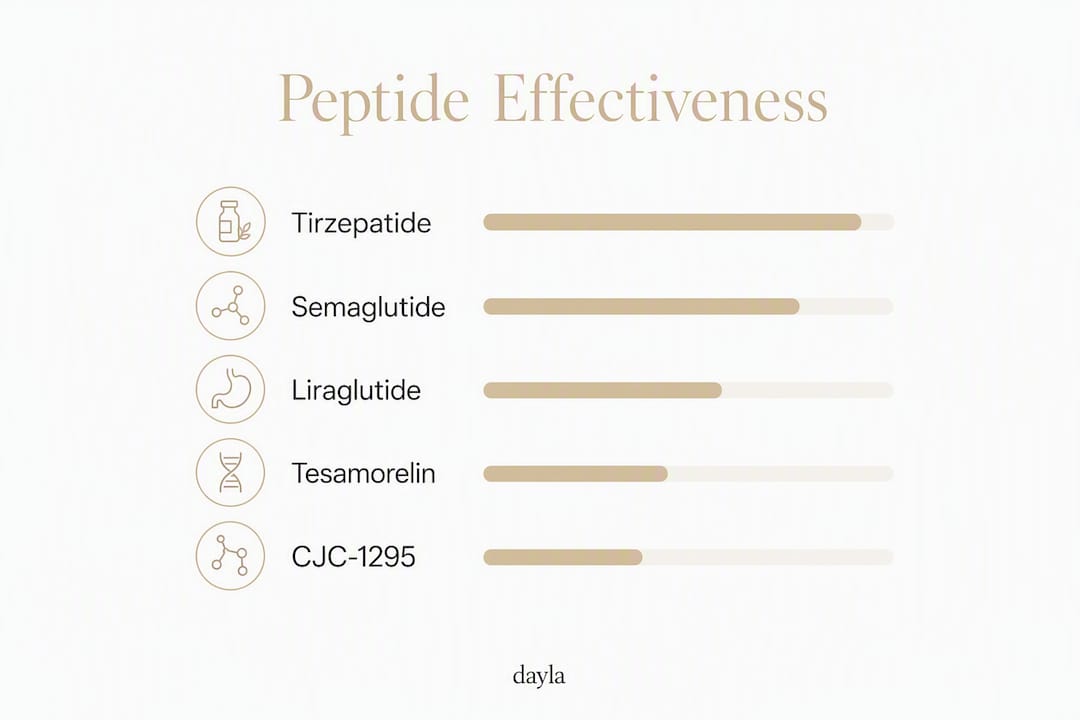
Key trial numbers at a glance
| Trial | Agent | Dose | Duration | Mean weight loss |
|---|---|---|---|---|
| SURMOUNT-1 | Tirzepatide | 15 mg | 72 weeks | −22.5% body weight |
| STEP-1 | Semaglutide | 2.4 mg | 68 weeks | −14.9% body weight |
| ATTAIN-1 | Orforglipron (Foundayo) | 36 mg | 72 weeks | −12.4% body weight |
| SCALE (Obesity) | Liraglutide | 3.0 mg | 56 weeks | −8.0% body weight vs placebo |
| Phase 2 (retatrutide) | Retatrutide | 12 mg | 48 weeks | ~−24% body weight |
How do fat-burning peptides actually work in your body?

The term "fat-burning peptide" is informal. Clinicians use the more precise term incretin mimetics for the GLP-1 class and growth-hormone secretagogues for the GH-axis agents. Understanding the distinction tells you exactly what to expect from each.
GLP-1 receptor agonism: the appetite pathway
GLP-1 (glucagon-like peptide-1) is a gut hormone released after eating. When a GLP-1 receptor agonist like semaglutide or liraglutide binds to GLP-1 receptors in the brain and gut, it slows gastric emptying, reduces appetite signaling in the hypothalamus, and improves insulin sensitivity. The result is a sustained caloric deficit driven by reduced hunger, not willpower. GLP-1 receptor agonists have the deepest evidence base for sustained, appetite-driven weight loss across large phase 3 trials.
Dual and triple agonism: why more targets mean more weight loss

Tirzepatide adds GIP (glucose-dependent insulinotropic polypeptide) receptor activation to GLP-1 agonism. GIP activation enhances metabolic effects beyond appetite suppression alone, which explains why tirzepatide consistently produces larger average weight loss than semaglutide in head-to-head comparisons. Retatrutide extends this further by adding glucagon receptor agonism, which increases energy expenditure and fat mobilization. Each added receptor target has tracked with higher mean weight loss in trials, though long-term safety data for triple agonists are still maturing.
The conceptual flow: receptor binding → appetite suppression and/or energy expenditure increase → sustained caloric deficit → fat mass reduction.
Growth-hormone axis peptides: recomposition, not appetite suppression
Tesamorelin, CJC-1295, Ipamorelin, Sermorelin, and AOD-9604 all work through the GH axis rather than the incretin system. Tesamorelin is a GHRH analog that stimulates GH release, which in turn reduces visceral adipose tissue in people with HIV-associated lipodystrophy. CJC-1295 and Ipamorelin are used together to amplify GH pulsatility, supporting lean mass preservation and body recomposition. Clinicians consistently note that GH-axis peptides improve lean mass or recovery but do not match GLP-1s in appetite-driven weight loss. Patients who expect GH secretagogues to produce the same percent body-weight reductions seen with incretins will be disappointed.
AOD-9604 is a fragment of the GH molecule with historical animal data but modest, inconsistent results in human trials. It is not FDA-approved for weight loss and is available primarily as a compounded research product.
Key mechanism differences:
- GLP-1/GIP/glucagon agonists: appetite suppression, slowed gastric emptying, improved insulin sensitivity, increased energy expenditure (triple agonists)
- GHRH analogs (tesamorelin, sermorelin, CJC-1295): GH pulsatility stimulation, visceral fat reduction (tesamorelin in specific population), lean mass support
- GH secretagogues (MK-677/Ibutamoren): oral GH/IGF-1 elevation, lean mass preservation, not primary fat loss
- Recovery peptides (BPC-157, TB-500): tissue repair, training recovery, indirect fat-loss support via improved exercise capacity
- Mitochondrial peptides (MOTS-c): metabolic regulation and insulin sensitivity, early investigational stage
Pro Tip: Mechanism guides patient selection. A patient with T2D and cardiovascular risk is a strong candidate for a GLP-1/GIP agonist. A patient focused on body recomposition after significant weight loss may benefit from a GH-axis protocol. These are not interchangeable goals.
Why does tirzepatide outperform semaglutide, and what does that mean for you?
Tirzepatide's advantage is mechanistic, not incidental. Single GLP-1 agonism (semaglutide, liraglutide) suppresses appetite and slows gastric emptying. Adding GIP receptor activation with tirzepatide amplifies metabolic effects, including enhanced insulin secretion, improved adipose tissue metabolism, and greater energy expenditure. The clinical result is a consistent gap in mean weight loss across trials.
SURMOUNT-1 reported up to −22.5% total body weight at the 15 mg dose over 72 weeks. STEP-1 reported notable weight loss at semaglutide 2.4 mg over 68 weeks. That is a meaningful difference in expected outcomes for patients who tolerate either agent.
What this means clinically:
- Tirzepatide's higher average efficacy comes with a similar GI side-effect profile to semaglutide; tolerability is comparable when both are titrated gradually.
- Semaglutide has completed cardiovascular outcomes trials (SELECT) in people with obesity and established cardiovascular disease, showing a reduction in major adverse cardiovascular events. Tirzepatide's cardiovascular outcomes trial is ongoing.
- For patients where CV risk reduction is a primary goal alongside weight loss, semaglutide's completed outcomes data currently give it a specific clinical advantage in that population.
- Retatrutide's phase 2 signal shows a strong weight loss trend at 12 mg over 48 weeks suggests the triple-agonist approach may push efficacy further, but phase 3 confirmation is required before clinical recommendations can be made.
- Survodutide is another investigational dual agonist (GLP-1/glucagon) showing promise in MASH and obesity trials, but it is not yet approved.
Statistic to know: The difference between tirzepatide and semaglutide in pivotal trials represents a clinically meaningful additional body weight loss at the highest doses, a clinically meaningful difference for patients with significant weight-loss goals.
What safety monitoring does peptide therapy require?
Peptide therapy is not a supplement purchase. Every FDA-approved incretin requires a prescribing clinician, baseline evaluation, and a structured monitoring plan. Medication works best as one component of a supervised program that includes nutrition guidance and regular follow-up, not as a standalone intervention.
Baseline labs and assessments
Before starting any GLP-1, GIP, or GH-axis peptide, a clinician should review:
- HbA1c (to assess glycemic status and T2D risk)
- Comprehensive metabolic panel (CMP) (liver and kidney function, electrolytes)
- Thyroid panel (TSH at minimum; GLP-1 analogs carry a label warning for medullary thyroid carcinoma in those with personal or family history of MTC or MEN2)
- Lipid panel
- Blood pressure and heart rate
- Pregnancy test where clinically indicated (GLP-1 analogs are not recommended during pregnancy)
- Medication review (drug interactions, particularly with oral medications affected by slowed gastric emptying)
For GH-axis peptides, add fasting glucose and IGF-1 to the baseline panel, as GH stimulation can affect glucose metabolism.
You can review how to interpret these results with Daylahealth's lab results guide for peptide therapy.
Side effects by class
GLP-1/GIP agonists (tirzepatide, semaglutide, liraglutide, orforglipron): Nausea, vomiting, diarrhea, and constipation are the most common, especially during dose titration. These typically improve after the first 4–8 weeks. Rare but serious signals include pancreatitis, gallbladder disease, and the thyroid C-cell caution noted above.
GH-axis peptides (tesamorelin, CJC-1295/Ipamorelin, sermorelin, MK-677): Fluid retention (edema), joint discomfort (arthralgia), and transient glucose elevation are the most reported effects. MK-677 specifically can increase appetite, which works against weight-loss goals.
Investigational agents (retatrutide, survodutide, MOTS-c, VK2735, eloralintide): Long-term safety profiles are unknown. These agents are available only through clinical trials or, in some cases, compounded research channels with no regulatory oversight.
Contraindications
- Personal or family history of medullary thyroid carcinoma or Multiple Endocrine Neoplasia type 2 (MEN2) — contraindicated for all GLP-1 analogs
- Active or recent pancreatitis
- Pregnancy or planned pregnancy
- Uncontrolled psychiatric illness or active eating disorder (requires careful clinical assessment)
- Severe renal or hepatic impairment (dose adjustments or contraindications vary by agent)
Monitoring schedule
- Baseline labs and clinical evaluation before starting
- Check-in at 4 weeks (tolerability, dose titration decision)
- Follow-up at 8–12 weeks (weight, labs if indicated, side-effect review)
- Quarterly assessments once on a stable dose (weight, A1c, metabolic panel, blood pressure)
- Annual comprehensive review including thyroid and lipid panels
Titration matters. Gradual dose increases materially reduce early GI intolerance for GLP-1 and GIP agents and improve retention in clinical programs. Skipping titration to reach a higher dose faster is one of the most common reasons patients discontinue early.
What are the risks of grey-market and compounded peptides?
The U.S. peptide market has a significant grey-market problem. Many agents on this list, including CJC-1295, Ipamorelin, BPC-157, TB-500, AOD-9604, and MK-677, are sold online as "research chemicals" or through unverified compounding pharmacies with no clinical oversight.
Common grey-market behaviors to recognize:
- Products labeled "for research use only, not for human use" sold with implied human-use dosing guides
- Certificates of Analysis (COAs) from unaccredited labs or with no verifiable chain of custody
- Dosing protocols sourced from online forums, social media, or influencer content rather than clinical guidance
- No prescribing clinician, no baseline labs, and no follow-up monitoring
- Packaging that mimics pharmaceutical products without FDA registration
U.S. regulatory snapshot
- Investigational (clinical trials only): — Retatrutide, Survodutide, MOTS-c, VK2735, Eloralintide
Compounded versions of FDA-approved agents (semaglutide, tirzepatide) were permitted during shortage periods under specific FDA guidance. That regulatory window has been narrowing, and the legal status of compounded GLP-1s is subject to ongoing FDA review. Purchasing compounded peptides outside a licensed, clinician-supervised program carries both safety and legal uncertainty.
Consumer warning: Cheaply sourced peptides frequently carry higher medical risk than their marketing suggests. Incorrect concentration, microbial contamination, and undisclosed additives are documented problems in unregulated compounded products. Adverse events should be reported to FDA MedWatch.
For a deeper look at common myths around grey-market sourcing, Daylahealth's peptide therapy misconceptions guide addresses the most frequent misunderstandings directly.
How do you choose the right peptide for your goals and budget?
The right peptide depends on your primary goal, your health history, your route preference, and what you can realistically afford and sustain. This is a clinical decision, not a consumer choice, but you can prepare for a more productive clinician conversation with a clear framework.
Decision checklist
- Primary goal: Maximum percent weight loss (incretin class) vs. visceral fat reduction (tesamorelin in specific population) vs. body recomposition (GH-axis peptides) vs. recovery support (BPC-157, TB-500)
- Comorbidities: T2D or prediabetes (GLP-1/GIP agonists have direct glycemic benefit); cardiovascular disease (semaglutide SELECT data relevant); HIV-associated lipodystrophy (tesamorelin indication)
- Route preference: Weekly injection (tirzepatide, semaglutide), daily injection (liraglutide, tesamorelin), or once-daily oral pill (orforglipron/Foundayo)
- Tolerance concerns: History of GI sensitivity may favor a slower titration plan or the oral route
- Budget: Brand-name GLP-1s run $500–$1,300+ per month cash; compounded options through supervised programs are lower; GH-axis peptides through compounding typically run $100–$400 per month
Questions to ask your clinician
- What percent weight loss is realistic for me at this dose and duration?
- What is the titration schedule, and how will we manage GI side effects?
- Which baseline labs do you need before prescribing?
- How often will we follow up, and what triggers a dose adjustment?
- What is the total monthly cost, including the clinician visit and medication?
Representative cost and route reference
| Agent class | Typical route | Dosing frequency | Approximate monthly cash cost |
|---|---|---|---|
| Tirzepatide (brand Zepbound) | Subcutaneous injection | Weekly | $500 |
| Semaglutide (brand Wegovy) | Subcutaneous injection | Weekly | $1,000 |
| Orforglipron/Foundayo | Oral pill | Once daily | Not yet widely published |
| Liraglutide (brand Saxenda) | Subcutaneous injection | Daily | $1,000 |
| Compounded GLP-1 (supervised) | Injection or microdose | Weekly or daily | Varies; typically lower than brand |
| CJC-1295 + Ipamorelin (compounded) | Subcutaneous injection | Daily or pulsed | — |
| Sermorelin (compounded) | Subcutaneous injection | Nightly | — |
Costs vary by pharmacy, program, and insurance status. None of the above figures include clinician fees, which vary by program structure. Peptide therapy use cases and realistic outcome expectations are worth reviewing before your first consultation.
What are the next steps after reviewing this ranking?
The evidence is clear on the hierarchy: FDA-approved incretins produce the largest, most reliable fat loss in clinical trials. GH-axis peptides serve different goals. Investigational agents show promise but are not ready for routine clinical use.
Your three-step action plan:
- Step 1: Confirm eligibility with a clinician. A BMI of 27+ with a weight-related condition, or 30+ without, is the standard threshold for FDA-approved obesity medications. Your clinician will also screen for contraindications and order baseline labs.
- Step 2: Consider a supervised program like Daylahealth. Daylahealth's online intake connects you with a clinician who evaluates your eligibility, prescribes the appropriate GLP-1 or peptide protocol, and ships medication directly to you, with dietitian support and ongoing monitoring included. Avoid DIY sourcing entirely.
- Step 3: Prioritize FDA-approved incretins first. Unless your clinician has a specific clinical reason to recommend otherwise, tirzepatide or semaglutide are the evidence-backed first choices for appetite-driven weight loss. GH-axis protocols are adjuncts, not substitutes.
Key Takeaways
Tirzepatide leads the evidence-based ranking of fat-burning peptides, with FDA-approved incretins producing the largest, most clinically validated weight loss, while GH-axis and investigational peptides serve distinct recomposition or research roles.
| Point | Details |
|---|---|
| Tirzepatide leads the ranking | SURMOUNT-1 reported substantial body weight loss at 15 mg over 72 weeks, the highest result among approved agents. |
| FDA approval is the safety floor | Only tirzepatide, semaglutide, liraglutide, and orforglipron are FDA-approved for weight loss in the U.S. |
| GH-axis peptides serve a different goal | CJC-1295/Ipamorelin, sermorelin, and AOD-9604 support recomposition, not appetite-driven fat loss. |
| Grey-market sourcing carries real risk | Unverified compounded peptides may contain incorrect doses or contaminants; supervised programs reduce this risk. |
| Daylahealth offers supervised access | Daylahealth's program provides clinician evaluation, GLP-1 or peptide prescriptions, and nationwide delivery with monitoring included. |
The case for ranking by evidence, not by hype
The peptide space has a credibility problem. Dozens of compounds circulate in wellness communities with claims that outrun their evidence by years, sometimes by decades. The ranking in this article follows a single principle: trial-proven magnitude first, FDA status second, evidence grade third. Compounds with no large randomized controlled trial data, regardless of how compelling their mechanism sounds, belong at the bottom of any honest list.
What most rankings get wrong is treating GH-axis peptides and GLP-1 agonists as competing options for the same goal. They are not. A patient asking "which peptide will help me lose 20 pounds?" and a patient asking "how do I preserve lean mass during a caloric deficit?" need different answers. Conflating these categories is how people end up spending months on CJC-1295/Ipamorelin wondering why the scale is not moving the way semaglutide would have moved it.
Retatrutide deserves a specific note. Its phase 2 signal of approximately −24% at 12 mg is genuinely striking, and the TRIUMPH phase 3 program will be one of the most important obesity trials to watch. But phase 2 results have disappointed before, and recommending an investigational agent to a patient who has access to tirzepatide today is not evidence-based practice. The right answer is to note the pipeline honestly, as this article does, and let phase 3 data determine where retatrutide ultimately lands.
Daylahealth publishes this article as the operator of a supervised GLP-1 and peptide prescribing program. The ranking was built on trial data and FDA status, not on which agents Daylahealth prescribes. Where Daylahealth's program appears in the comparison, it does so as a supervised access pathway, not as a peptide agent itself. Investigational compounds including retatrutide, survodutide, and MOTS-c show real promise but lack the long-term safety data needed to recommend them outside of clinical trial settings.
Supervised GLP-1 and peptide care through Daylahealth
The difference between a successful peptide protocol and a frustrating one usually comes down to one thing: whether a clinician is managing the titration, monitoring the labs, and adjusting the plan when something is not working.
Daylahealth's GLP-1 program gives you online clinician evaluation, a prescription for the appropriate FDA-approved or compounded agent, and medication shipped directly to your door, with dietitian support and care coaching built into the subscription. Injectable, microdose, and oral delivery options are available depending on your clinical profile and preferences.

You complete an intake online, a clinician reviews your health history and baseline labs, and you receive a personalized prescription plan with a clear titration schedule. There are no insurance requirements, no in-person appointments, and no guesswork about whether your protocol is clinically appropriate.
This is not a supplement program. It is a medical subscription with real oversight, designed for U.S. adults who want access to evidence-backed weight-loss medications without the friction of traditional healthcare. Complete your intake at Daylahealth to find out which protocol fits your goals.
This article provides general health information, not personalized medical advice. Consult a qualified clinician before starting any prescription medication or peptide protocol, and verify current FDA guidance at FDA.gov.
Useful sources and further reading
The sources below are the primary references behind the clinical claims in this article. They are listed in recommended reading order for clinicians and motivated readers who want to verify the evidence directly.
| Source | Why it matters | Best for |
|---|---|---|
| PMC: GLP-1 receptor agonists in obesity management | Peer-reviewed review of GLP-1 mechanism and clinical outcomes | Mechanism and evidence base |
| PMC: Tirzepatide and dual incretin action | Covers dual GLP-1/GIP mechanism and SURMOUNT trial context | Tirzepatide mechanism and efficacy |
| PMC: Semaglutide and cardiovascular outcomes | Reviews semaglutide's CV outcome data and STEP program | Semaglutide safety and CV evidence |
| ClinicalTrials.gov: SURMOUNT-5 (NCT05929066) | Head-to-head tirzepatide vs semaglutide trial registration | Comparative efficacy reference |
| ClinicalTrials.gov: Retatrutide TRIUMPH (NCT06662383) | Phase 3 retatrutide trial registration | Investigational pipeline tracking |
| ClinicalTrials.gov: Orforglipron obesity trial (NCT06077864) | ATTAIN-1 trial registration for oral GLP-1 | Foundayo/orforglipron evidence |
| PMC: Tesamorelin and visceral adipose tissue | Reviews tesamorelin's mechanism and VAT reduction evidence | Tesamorelin indication and limits |
| PMC: Peptide therapeutics overview | Broad review of peptide classes and therapeutic applications | Background on peptide categories |
| PubMed: AOD-9604 human trial data | Human trial results for AOD-9604 weight-loss claims | GH fragment evidence assessment |
| Genome.gov: What is a peptide? | NIH definition of peptides for foundational clarity | Readers new to peptide terminology |
Additional reading from Daylahealth:
- How peptides help weight loss: what the evidence shows
- Visceral fat reduction guide: GLP-1 strategies for 2026
- Benefits of medically supervised weight loss