

The most critical lab markers in peptide and GLP-1 therapy are ALT/AST (liver enzymes), lipase/amylase, fasting glucose, HbA1c, IGF-1 (for GH-axis peptides), eGFR/creatinine, and hematocrit. If any of these cross a clinical threshold, the single action is: pause your medication and contact your clinician the same day.
Absolute stop signals to know before your next draw:
- ALT or AST > 3× the upper limit of normal (ULN) on your lab report: pause therapy, contact clinician
- Lipase > 3× ULN with severe abdominal pain: stop medication and seek emergency evaluation for pancreatitis
- Fasting glucose ≥ 126 mg/dL or HbA1c ≥ 6.5% during GH-axis monitoring: clinician review before continuing
- IGF-1 > 400 ng/mL: dose reduction or pause required
- Hematocrit > 54%: pause GH-axis compounds, evaluate for polycythemia
- eGFR < 60 mL/min/1.73m²: renal function review before next dose
Daylahealth and Vitalia GLP build these stop signals into their clinical workflows so patients are never reading results in isolation. MedlinePlus recommends always using the reference ranges printed on your specific lab report, not generic online values, because methods and populations differ by lab.
Table of Contents
- Which lab tests are commonly ordered for peptide and GLP-1 therapy
- Stop signals and urgent red flags that require immediate action
- How to read your lab report correctly and think in trends
- What monitoring schedule to expect and who orders your labs
- What to do when a lab result is abnormal
- How Daylahealth and Vitalia GLP manage lab monitoring
- Key Takeaways
- Why serial lab monitoring changes the risk profile of peptide therapy
- Daylahealth's medically supervised care includes lab monitoring from day one
- Useful sources and references
Which lab tests are commonly ordered for peptide and GLP-1 therapy
Every panel serves one of two purposes: safety monitoring or efficacy tracking. Knowing which is which helps you ask the right questions at follow-up.
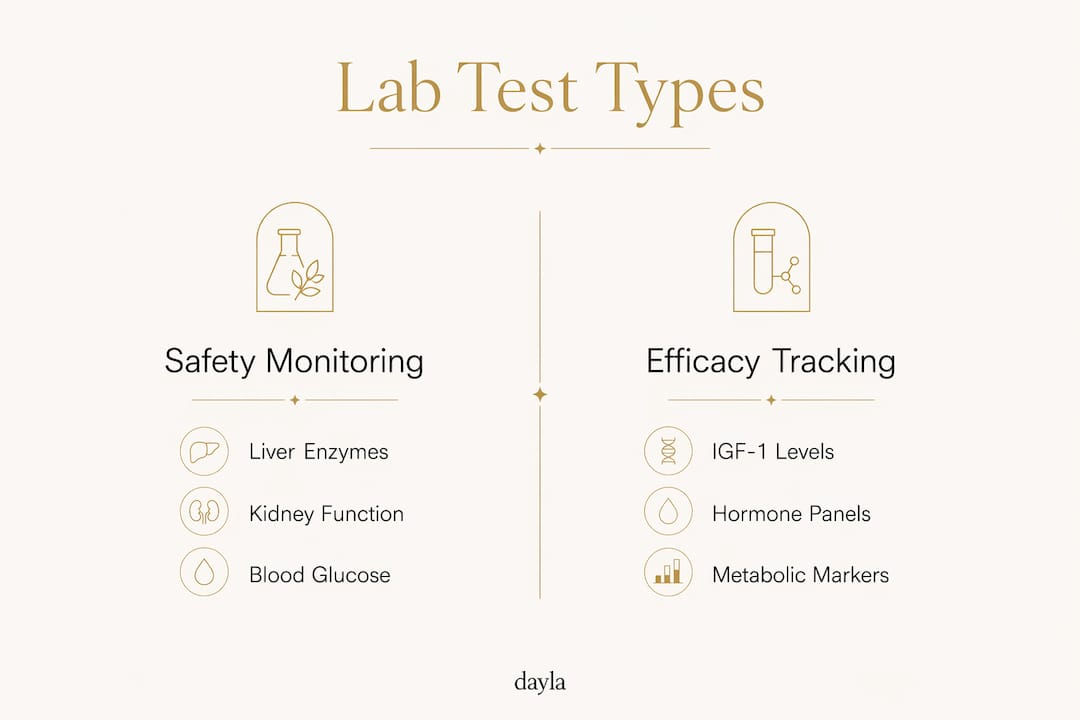
| Test | Why It's Ordered | Relevant Therapy |
|---|---|---|
| CMP (ALT, AST, bilirubin, electrolytes, creatinine, eGFR) | Liver and kidney safety net | All peptide and GLP-1 protocols |
| Lipase / Amylase | Pancreatic stress screening | GLP-1 agents (semaglutide, tirzepatide) |
| Fasting glucose + HbA1c | Metabolic safety and efficacy | GH-axis peptides, GLP-1s |
| Lipid panel (LDL, HDL, triglycerides, ApoB) | Cardiovascular monitoring | GLP-1s, GH-axis peptides |
| CBC (hematocrit, WBC) | Polycythemia risk, immune response | GH-axis compounds |
| IGF-1 | GH output and dose calibration | CJC-1295, Ipamorelin, Sermorelin |
| TSH (+ free T4, free T3) | Thyroid function; GH-axis can mask hypothyroidism | GH-axis peptides, GLP-1s |
| hs-CRP | Inflammation tracking | Healing and longevity peptides |
A few clinical notes worth keeping in mind:
- HbA1c reflects a long-term glucose average, typically becoming meaningful after several months of therapy.
- IGF-1 is the primary efficacy marker for GH secretagogues like CJC-1295 and Ipamorelin. Age-adjusted interpretation matters, as optimal levels vary with age.
- GLP-1 agents may reduce triglycerides, while GH-axis peptides can temporarily raise LDL levels as the body adjusts; interpreting trends over time is important.
- Healing peptides such as BPC-157 require a lighter panel, typically a baseline CMP and CBC, with less frequent follow-up.
Pro Tip: Draw IGF-1 fasted, in the morning, 24–36 hours after your last GH-peptide dose. Drawing it within hours of a dose inflates the number and is the single most common timing mistake in GH-axis monitoring.
Stop signals and urgent red flags that require immediate action
Some lab findings, especially when paired with symptoms, move from "worth a closer look" to "stop and call today."
| Lab Finding | Threshold | Paired Symptom That Escalates Urgency |
|---|---|---|
| ALT or AST | > 3× ULN | Jaundice, right-upper-quadrant pain, fatigue |
| Lipase / Amylase | > 3× ULN | Severe abdominal pain, nausea, vomiting |
| Fasting glucose | ≥ 126 mg/dL (GH-axis context) | Excessive thirst, frequent urination, blurred vision |
| IGF-1 | > 400 ng/mL | Joint pain, fluid retention, carpal tunnel symptoms |
| Hematocrit | > 54% | Headache, flushing, shortness of breath |
| eGFR | < 60 mL/min/1.73m² | Swelling, decreased urine output, fatigue |
Stepwise action for any stop-signal result:
- Stop the medication immediately if the threshold above is met or your clinician has pre-specified a pause condition.
- Contact your clinician through the patient portal or by phone the same day. Do not wait for a scheduled follow-up.
- If severe symptoms accompany the abnormal result (intense abdominal pain, chest tightness, confusion), go to the emergency department.
- Do not restart medication until your clinician explicitly clears you.
For context on managing side effects that may accompany these findings, Daylahealth's GLP-1 side effects guide outlines when symptoms alone warrant escalation.
How to read your lab report correctly and think in trends
Reading a lab report well is a skill, and it starts before you look at a single number.
- Check the report header first. Confirm the specimen type, collection date and time, fasting status, and ordering clinician. A non-fasting glucose draw compared to a fasting baseline is not a valid comparison.
- Use the reference ranges on your report. Lab-specific ranges are set by the equipment and population that lab uses. Ranges from another lab or a Google search do not apply to your result.
- Look at the flag, then look at the distance. An "H" or "L" flag means the value is outside the range, not that something is wrong. A value 2% above the upper limit is different from one that is 3× the upper limit.
- Compare to your prior result, not just the range. A trend across two or three draws tells you far more than any single value. Serial testing is how clinicians actually make decisions.
- Account for confounders before reacting. Intense exercise within 48 hours of a draw can elevate AST and creatine kinase and mimic liver or muscle injury. Dehydration skews creatinine and eGFR. Biotin supplements interfere with IGF-1 and many hormone immunoassays; stop biotin at least 72 hours before a draw.
Common confounders to flag for your clinician:
- Recent illness, stress, or poor sleep
- New supplements, including high-dose biotin or vitamin D
- Significant change in hydration or diet in the 24 hours before the draw
- Timing of the draw relative to your last peptide dose
Pro Tip: Keep your lab reports as PDFs and store them in one folder. When you contact your clinician about an abnormal result, you can attach the current and prior report side by side, which cuts response time significantly.
What monitoring schedule to expect and who orders your labs
The cadence below reflects standard practice for medically supervised peptide and GLP-1 protocols in the U.S.
| Timepoint | Timing | Focus |
|---|---|---|
| Baseline | Within 30 days before first dose | CBC, CMP, lipids, HbA1c, fasting glucose, IGF-1, TSH |
| First follow-up | 6–8 weeks after starting | Safety markers: ALT/AST, fasting glucose, IGF-1 (GH-axis) |
| Second check | ~3 months | HbA1c trend, lipids, renal function, IGF-1 |
| Ongoing | Every 3 months during active therapy | Full panel or targeted based on protocol |
| Post-cycle | 4–6 weeks after last dose | Confirm reversibility of any changes |
How this works in a direct-to-consumer subscription model:
- Your clinician orders labs as part of the intake and follow-up process. You typically use Quest Diagnostics or LabCorp at a location near you.
- Use the same lab vendor for every draw. Methods and reference ranges vary between labs, so switching vendors mid-protocol makes trend comparison unreliable.
- GH-axis protocols (CJC-1295, Ipamorelin, Sermorelin) center on IGF-1 and glucose monitoring. GLP-1 protocols (semaglutide, tirzepatide) center on HbA1c, lipase, eGFR, and lipids. Healing peptides like BPC-157 require a lighter panel.
- Post-cycle labs at 4–6 weeks are high-value for confirming that any changes in liver enzymes, hematocrit, or glucose have returned to baseline after a cycle ends.
For a practical look at how GLP-1 progress tracking integrates with lab cadence, Daylahealth's monitoring guide covers glucose and HbA1c milestones in detail.
What to do when a lab result is abnormal
A clear, focused message to your clinician gets a faster, better response than a panicked call with incomplete information.
- Verify the draw conditions. Were you fasting? Did you exercise hard in the 48 hours before? Were you dehydrated or ill? These details change the interpretation.
- Pull your prior result. Compare the current value to your last draw, not just the reference range. Note whether the value is moving up, down, or stable.
- Pause medication only if a threshold is met or your clinician has pre-specified a stop condition. Do not stop based on a mildly flagged value alone without guidance.
- Send a focused portal message or call. Include: test name, current value with units, reference range, collection date, your symptoms (if any), and your current medications and supplements.
- Request explicit follow-up timing. Ask when to repeat the test and what result would clear you to restart.
- Go to the ED if severe symptoms accompany the abnormal result. Do not wait for a portal response.
What to include in your clinician message:
- Test name and value (e.g., "Lipase: 320 U/L, reference range 13–60 U/L")
- Collection date and fasting status
- Any symptoms present in the past 48 hours
- Current peptide or GLP-1 dose and last administration date
- Any new supplements or medications started recently
How Daylahealth and Vitalia GLP manage lab monitoring
Daylahealth's clinical model is built around the principle that lab results should drive dosing decisions, not follow them.
What the workflow looks like from intake to ongoing care:
- Baseline intake includes a clinician evaluation and lab panel ordered before your first dose. No medication ships until labs are reviewed.
- At 6–8 weeks, your clinician reviews early safety markers. For GH-axis protocols, IGF-1 is the primary check. For GLP-1s, fasting glucose and any GI symptoms are the focus.
- Refills are tied to clinician approval, which includes lab trend review. You are not auto-shipped medication without a clinical checkpoint.
- Care coaching and dietitian access are included, so lifestyle factors that affect your labs (diet, exercise timing, hydration) are addressed as part of your plan.
- If a stop-signal threshold is reached, the escalation pathway is clear: clinician contact same day, medication hold, and ED referral if symptoms are severe.
How to share results with your Daylahealth clinician:
- Upload PDFs directly through the patient portal after each draw.
- Note the draw date, fasting status, and lab vendor in your message.
- Flag any values with an "H" or "L" marker and include your current symptoms.
Daylahealth clinicians look first at liver enzymes, fasting glucose, and IGF-1 (where applicable) because these are the markers most likely to require a dosing adjustment in the first 8 weeks. Hematocrit is reviewed for all GH-axis patients given the polycythemia risk associated with GH-releasing compounds.
Pro Tip: Ask your clinician at each follow-up: "What result would change my dose or pause my protocol?" Having that number in writing before your next draw removes ambiguity entirely.
Key Takeaways
Consistent lab monitoring, interpreted as trends rather than single values, is the foundation of safe peptide and GLP-1 therapy.
| Point | Details |
|---|---|
| Top labs to watch | ALT/AST, lipase, fasting glucose, HbA1c, IGF-1, hematocrit, and eGFR cover the core safety and efficacy picture. |
| Definitive stop signals | Pause and call your clinician if ALT/AST exceeds 3× ULN, lipase exceeds 3× ULN with abdominal pain, hematocrit exceeds 54%, or fasting glucose is ≥ 126 mg/dL (for GH-axis patients) or HbA1c is ≥ 6.5%. |
| Monitoring cadence | Baseline before first dose, first follow-up at 6–8 weeks, second check at 3 months, then every 3 months during active therapy. |
| Trends over single values | One flagged result is an alert; a direction across two or three draws is the signal clinicians act on. |
| Daylahealth's approach | Daylahealth ties refills to clinician lab review and includes care coaching, dietitian access, and a clear escalation pathway for stop-signal findings. |
Why serial lab monitoring changes the risk profile of peptide therapy
The conventional framing around peptide and GLP-1 therapy tends to focus on what the medications do. The more important question is what the labs reveal about how your body is responding. A single abnormal value, viewed in isolation, is almost always less informative than two values pointing in the same direction. That directional signal is what separates a clinician making a confident dosing decision from one guessing.
What gets underestimated in direct-to-consumer models is how much the monitoring structure itself determines safety. A subscription service that ships medication without a lab checkpoint is a fundamentally different product from one that gates refills on clinician review. Daylahealth's model, with baseline labs before the first dose and scheduled follow-ups tied to refill approval, reflects how medically supervised care should work. Early detection of liver enzyme elevation or rising hematocrit means a dose adjustment, not a crisis. That reversibility is the whole point of monitoring.
Daylahealth's medically supervised care includes lab monitoring from day one
If you are ready to start peptide or GLP-1 therapy with clinical oversight built in, Daylahealth offers a subscription model that includes clinician evaluation, baseline lab ordering, scheduled follow-ups, care coaching, and medication shipped nationwide without insurance requirements.
What's included from the start:
- Clinician-reviewed intake and lab panel before your first dose
- Scheduled follow-ups at 6–8 weeks and 3 months with lab trend review
- Dietitian access and care coaching to address lifestyle factors that affect your results
- Clear escalation pathways if a stop-signal threshold is reached
Whether you are exploring GLP-1 weight loss prescriptions or peptide therapy options, the intake process starts with a clinician evaluation and a lab panel, so your first result already has a baseline to compare against. Complete your online intake today and have your baseline labs ready within 30 days of starting.
Useful sources and references
| Source | What It Supports |
|---|---|
| MedlinePlus: How to Understand Your Lab Results | Lab-specific reference ranges, how to read report headers, trend-based interpretation |
| Peppal: Blood Work for Peptides — Complete Monitoring Guide | Stop-signal thresholds, lipase/pancreatitis pairing, GLP-1 monitoring specifics |
| Peppal: Peptide Blood Work Monitoring Guide by Protocol | IGF-1 and HbA1c timing cadence, hematocrit thresholds, post-cycle lab rationale |
| Main Street Blood Lab: Lab Result Interpretation Checklist | Practical checklist for reading results before reacting |
| PatientBetter: How to Read Lab Results | Full report reading order, flag interpretation, questions to ask your clinician |
| MyProtocolStack: Peptide Blood Work Checklist | Baseline panel composition, protocol-specific add-ons, timing guidance |
This article is general health information, not medical advice. Confirm current monitoring protocols and thresholds with your clinician or a qualified healthcare professional for your specific situation.