

Peptide therapy is defined as the clinical use of short amino acid chains to trigger specific biological responses in the body, including tissue repair, metabolic regulation, and hormonal signaling. This peptide therapy benefits guide covers the most clinically relevant peptides, their documented advantages, and how to approach treatment safely. Key compounds include BPC-157 for recovery, GLP-1 agonists like semaglutide and tirzepatide for weight management, and GHK-Cu for skin remodeling. Each operates through receptor-mediated pathways rather than general supplementation, which is why dosing precision and medical oversight matter more here than with most wellness interventions. Regulatory bodies have approved select peptides while many others remain experimental, making clinical guidance the single most important factor in safe use.
What are the primary benefits of peptide therapy?
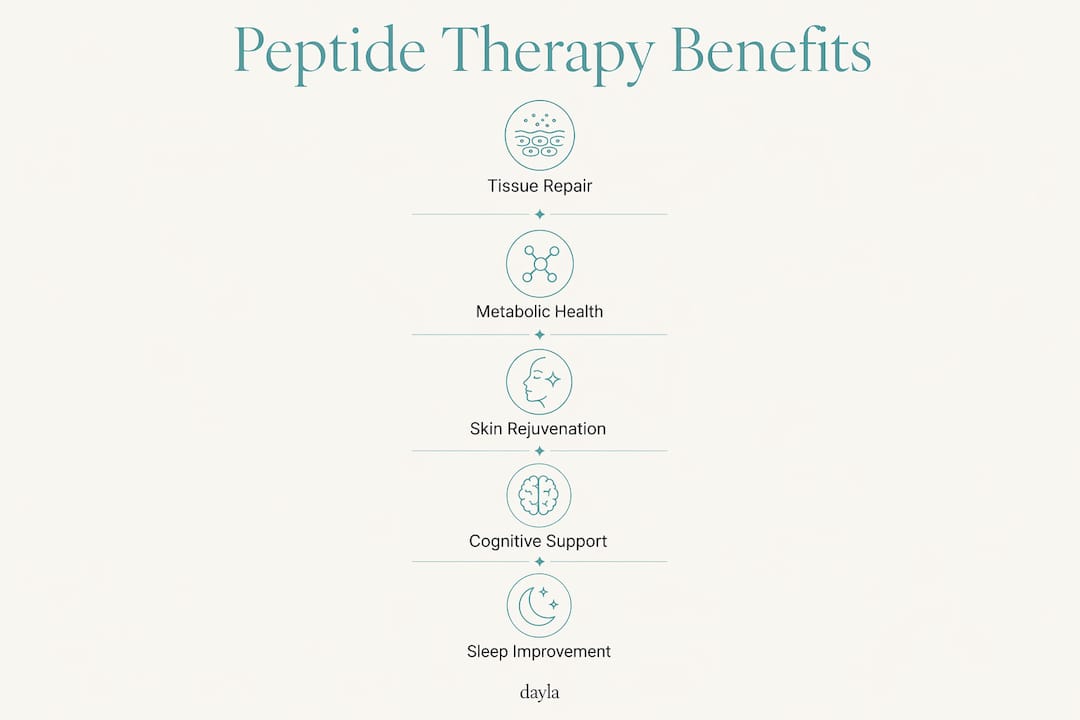
Peptide therapy advantages span several distinct health domains, each backed by a different level of clinical evidence. The strongest data supports metabolic and recovery applications.
Tissue repair and recovery represent the most well-documented benefit for active adults. BPC-157 shows functional improvement and pain reduction in tendon injuries within 6–10 weeks alongside rehabilitation. That timeline is faster than most standard physical therapy protocols alone, which is why sports medicine clinicians have taken notice. TB-500 works alongside BPC-157 by promoting cell migration and reducing inflammation at injury sites.

Metabolic health and weight management are where the clinical evidence is strongest. GLP-1 agonists including semaglutide and tirzepatide have robust trial data from SURPASS-2 and SURMOUNT-1, showing weight loss of up to 17.8% alongside meaningful metabolic improvements. That level of efficacy places GLP-1 peptides in a different category from most weight management tools. You can read more about how peptides support weight loss and the mechanisms behind these results.
Skin health and anti-aging benefits come primarily from GHK-Cu, a copper peptide with multiple studies showing improved skin quality and hair follicle support. GHK-Cu works both topically and via injection, making it one of the more flexible options in a skin-focused peptide protocol.
Additional documented benefits include:
- Cognitive support: Peptides like Semax and Selank have preliminary evidence in neuroprotection and anxiolytic effects from small randomized controlled trials and animal studies.
- Sleep improvement: Delta sleep-inducing peptide (DSIP) assists with sleep architecture and stress resilience, particularly for people with persistent sleep onset problems.
- Immune modulation: Select peptides reduce systemic inflammation, supporting recovery and general immune function.
How does peptide therapy work?
Peptides act through highly specific receptor-mediated signaling pathways, distinct from general nutrient supplementation. Each peptide binds to a targeted receptor and triggers a precise downstream response. That specificity is what makes them powerful and also what makes improper use risky.
The peptide landscape divides into two categories. FDA-approved compounds like GLP-1 agonists have passed rigorous clinical trials and carry defined dosing protocols. Experimental peptides like BPC-157 and Epithalon have a confirmed paucity of randomized controlled trials in humans, despite promising preclinical data. That gap between mechanistic plausibility and verified clinical efficacy is the central challenge in this field.
Here is how the most commonly used peptides function:
- BPC-157: Promotes tendon and ligament repair by upregulating growth factor receptors and improving blood vessel formation at injury sites.
- GLP-1 analogs (semaglutide, tirzepatide): Mimic gut hormones to regulate insulin secretion, slow gastric emptying, and reduce appetite.
- GHK-Cu: Activates genes involved in collagen synthesis and tissue remodeling, supporting both skin and wound healing.
- DSIP: Modulates stress hormones and neurotransmitter activity to improve sleep onset and maintenance.
- Epithalon: A tetrapeptide studied for its role in telomere lengthening and longevity, though human evidence remains limited.
Peptides work best when they are part of a coordinated health plan. Best outcomes occur when clinicians assess sleep, metabolic health, and lifestyle before prescribing. Peptides amplify a healthy foundation. They do not replace one.
Pro Tip: Ask your prescribing physician to run a full metabolic panel, thyroid function test, and inflammatory markers before starting any peptide protocol. These baselines let you measure real progress at your 8-week follow-up.
What should you consider when starting peptide therapy?
Starting peptide therapy without proper preparation is one of the most common mistakes health-conscious adults make. The right sequence matters as much as the right peptide.
Baseline assessments to complete first
Before selecting any peptide, complete a full health evaluation. Labs should include a metabolic panel, hormone levels, inflammatory markers, and a thyroid screen. These results help identify root causes that a peptide alone cannot fix. A physician who skips this step is not practicing evidence-based peptide medicine.
Matching peptides to your health goals
| Health Goal | Primary Peptide(s) | Evidence Level |
|---|---|---|
| Weight management | Semaglutide, tirzepatide (GLP-1 class) | FDA-approved, strong RCT data |
| Tissue and tendon recovery | BPC-157, TB-500 | Case series, 6–10 week timeline |
| Skin rejuvenation | GHK-Cu | Multiple human studies |
| Cognitive support | Semax, Selank | Preliminary RCTs and animal data |
| Sleep quality | DSIP | Clinical use, limited large RCTs |
Aligning your peptide choice with a specific, measurable goal prevents the common trap of stacking multiple compounds without a clear rationale.
Sourcing and supervision
Self-prescribing peptides and buying from unregulated sources pose risks of impurities, incorrect dosing, and unknown long-term safety. Practitioners advise sourcing exclusively from licensed compounding pharmacies under physician supervision. The quality difference between a pharmaceutical-grade compounded peptide and an unverified online product is significant and not always visible to the buyer.
Key considerations before you start:
- Confirm your provider is a licensed physician or nurse practitioner with peptide prescribing experience.
- Request a certificate of analysis for any compounded peptide.
- Set a defined treatment duration and a scheduled follow-up lab review.
- Avoid starting multiple new peptides simultaneously, since isolating effects becomes impossible.
Pro Tip: A peptide therapy assessment with a qualified clinician takes the guesswork out of protocol design. It maps your labs to your goals and produces a dosing plan you can actually track.
What results can you expect from peptide therapy?
Realistic expectations prevent early dropout and help you recognize genuine progress. Peptide therapy is not a fast-acting supplement. It works on biological timelines.
Recovery peptides like BPC-157 show measurable functional improvement within 6–10 weeks when combined with rehabilitation. Metabolic peptides like GLP-1 agonists produce visible weight changes within 4–12 weeks depending on dose titration and adherence. Skin peptides like GHK-Cu typically require 8–12 weeks of consistent use before collagen remodeling becomes visible. Cognitive and sleep peptides often show subjective improvements within 2–4 weeks, though objective measurement is harder.
Tracking your progress effectively requires more than a scale or a mirror:
- Keep a weekly symptom journal covering energy, sleep quality, recovery speed, and mood.
- Schedule lab follow-ups at 8 and 16 weeks to compare biomarkers against your baseline.
- Photograph skin or injury sites at the start and every four weeks.
- Log body composition changes, not just weight, since metabolic peptides shift fat-to-muscle ratios.
Individual responses vary based on age, baseline health, lifestyle adherence, and peptide quality. Two people on identical BPC-157 protocols can have different recovery timelines if one sleeps poorly and the other prioritizes sleep. The peptide is one variable in a multi-factor equation. Patience and consistency with lifestyle factors determine whether you reach the upper or lower end of the expected range.
What are the safety considerations and misconceptions about peptide therapy?
The biggest misconception about peptides is that they universally improve health with minimal risk. That framing ignores the precision required for safe use.
"Peptides are not general boosting substances. They are specific signaling molecules requiring precise dosing to avoid risks such as abnormal cell growth." — American Medical Association guidance on injectable peptides
Experts caution that improper use may encourage growth of pre-existing abnormal cells. That risk is not theoretical. It is the reason oncology history is a standard contraindication screen in any legitimate peptide protocol. Impurities in unregulated products add a second layer of risk that is entirely avoidable with proper sourcing.
The regulatory environment is evolving but does not currently endorse self-prescribing due to safety and efficacy uncertainties. Many peptides with strong preclinical data have not completed the human trial process required for FDA approval. That does not make them useless. It means the clinical decision to use them requires a physician who understands the evidence gap and can monitor for adverse effects.
Professional guidance is critical to avoid chasing single molecules without addressing root health issues. A physician who prescribes BPC-157 without evaluating sleep quality, nutrition, and training load is missing the context that determines whether the peptide will work. Medical supervision is not a formality. It is the mechanism that makes peptide therapy safe and effective.
Key takeaways
Peptide therapy delivers its strongest benefits when specific, evidence-matched compounds are combined with medical supervision, baseline lab assessment, and consistent lifestyle optimization.
| Point | Details |
|---|---|
| Match peptide to goal | GLP-1 agonists lead for weight loss; BPC-157 leads for recovery; GHK-Cu leads for skin. |
| Expect realistic timelines | Recovery peptides show results in 6–10 weeks; metabolic peptides in 4–12 weeks. |
| Require medical supervision | Unsupervised use risks impurities, incorrect dosing, and abnormal cell growth. |
| Assess baselines first | Run metabolic, hormonal, and inflammatory labs before starting any protocol. |
| Lifestyle is non-negotiable | Peptides amplify a healthy foundation. They do not replace sleep, nutrition, or exercise. |
What I have learned from watching patients use peptide therapy
The patients who get the most from peptide therapy share one trait: they treat it as a precision tool, not a shortcut. The ones who struggle almost always skipped the baseline work. They started a peptide because they read about it online, without a lab panel, without a clear goal, and without a physician who could interpret their response. That pattern produces frustration, not results.
The clinical evidence for GLP-1 peptides is genuinely strong. The SURPASS-2 and SURMOUNT-1 data changed how I think about metabolic medicine. But even semaglutide works better when the patient is sleeping seven or more hours, managing stress, and eating adequate protein. The peptide does not override physiology. It works with it.
The area where I think conventional wisdom gets it wrong is the idea that more peptides equal more benefit. Stacking five compounds simultaneously makes it impossible to know what is working, what is causing a side effect, or what to adjust. Start with one well-matched peptide, measure for 8–10 weeks, and then make a data-driven decision about adding anything else. That approach produces clearer outcomes and far fewer problems.
The evidence gap between preclinical and human data is real and worth respecting. Cautious optimism, grounded in labs and physician oversight, is the right posture. Peptides are among the most interesting tools in modern wellness medicine. They deserve to be used carefully.
— Flexible
Peptide therapy with clinical support from Daylahealth
Daylahealth provides doctor-led access to FDA-approved GLP-1 therapies for weight management, along with a full range of clinically supervised peptide protocols covering recovery, skin health, cognitive support, and longevity. Every plan starts with a physician evaluation and includes ongoing monitoring so your protocol adjusts as your results do.

If you are exploring weight management options, the GLP-1 weight loss program at Daylahealth pairs semaglutide or tirzepatide with personalized medical oversight through a convenient telehealth model. For recovery or skin goals, Daylahealth's BPC-157 and injectable GHK-Cu options are available under licensed physician supervision. Your health goals deserve a protocol built around your labs, not a generic stack.
FAQ
What is peptide therapy used for?
Peptide therapy is used for tissue repair, weight management, skin rejuvenation, cognitive support, and sleep improvement. The specific peptide determines the application, with GLP-1 agonists leading for metabolic health and BPC-157 leading for recovery.
How long does peptide therapy take to work?
Recovery peptides like BPC-157 show functional improvement within 6–10 weeks alongside rehabilitation. GLP-1 metabolic peptides produce measurable weight changes within 4–12 weeks depending on dose and adherence.
Are peptides safe to use without a prescription?
Self-prescribing peptides from unregulated sources carries risks of impurities, incorrect dosing, and potential abnormal cell growth. Licensed physician supervision and pharmaceutical-grade sourcing are required for safe use.
Which peptide is best for weight loss?
GLP-1 agonists including semaglutide and tirzepatide have the strongest clinical evidence for weight loss, with SURMOUNT-1 trial data showing up to 17.8% body weight reduction. These are FDA-approved and require a prescription.
Do I need lab work before starting peptide therapy?
Yes. A full metabolic panel, hormone levels, and inflammatory markers establish the baseline needed to measure progress and screen for contraindications. Clinicians use these results to match the right peptide to your specific health profile.