

Peptide therapy has moved well beyond the lab and into mainstream skincare, with thousands of products promising everything from erased wrinkles to full skin rejuvenation. The science behind the skin health benefits of peptide therapy is real, but the marketing often runs far ahead of the evidence. Peptides, technically short chains of amino acids that act as biological messengers in the body, are the recognized clinical term for what most brands simply call "skin peptides." Knowing which peptides are backed by clinical data, which delivery methods actually work, and what questions to ask before spending money is the difference between real results and expensive disappointment.
Table of Contents
- Key Takeaways
- 1. Skin health benefits of peptide therapy: what the evidence actually says
- 2. Bioactive collagen peptides and their proven skin effects
- 3. GHK-Cu: the copper peptide with serious anti-aging credentials
- 4. Matrixyl and Matrixyl 3000: fibroblast activation at the source
- 5. Palmitoyl tetrapeptide-7 and inflammation control
- 6. Melanocortin peptides and photoprotective benefits
- 7. Comparing delivery methods: oral, topical, and injectable
- 8. How to safely integrate peptide therapy into your routine
- 9. Red flags that signal a product is not worth your money
- 10. What emerging peptide research means for your skin in 2026
- My honest take on peptide therapy for skin
- Explore peptide therapy options with clinical guidance
- FAQ
Key Takeaways
| Point | Details |
|---|---|
| Match peptide to evidence | Choose products featuring specific, named peptides with clinical trial support, not generic "peptide blend" labels. |
| Delivery method matters | Oral, topical, and injectable peptides have distinct efficacy profiles; the right choice depends on your skin goals and medical history. |
| Expect an 8–12 week timeline | Measurable improvements in wrinkles and elasticity require consistent use over weeks, not days. |
| Safety information is often missing | Only 26.5% of peptide websites disclose core safety details; always verify before purchasing. |
| Consult a clinician first | A dermatologist or medical provider can match you to the right protocol and monitor for side effects. |
1. Skin health benefits of peptide therapy: what the evidence actually says
Before you evaluate any product, you need a clear framework for what "evidence" means in this space. Not all peptide research is equal. A study on collagen peptides taken orally at 10 g per day is not transferable to a 2% topical serum with a different peptide entirely.
The strongest evidence currently supports oral bioactive collagen peptides and a small group of topical peptides with named, studied compounds. Peptide claims should be peptide-specific, not generalized across the entire category. When you see a product simply labeled "peptide formula," that tells you nothing clinically useful.
Here is a practical checklist for evaluating any peptide therapy product:
- Peptide identity: Is the specific peptide named? Generic labels like "hydrolyzed protein" are not enough.
- Delivery method: Is it oral, topical, or injectable? Each has a different mechanism and evidence base.
- Clinical evidence: Is there a peer-reviewed study using that exact peptide at that dose and route?
- FDA status: The FDA has not approved peptide therapy for skin conditions; most products are dietary supplements or cosmetics.
- Risk disclosure: Does the brand disclose potential side effects, including allergic reactions?
- Medical supervision: Is a clinician involved, or is this a self-directed purchase?
Pro Tip: A consumer audit of peptide websites found that 100% mention benefits while only 26.5% mention safety details. If a website cannot tell you the peptide name, route, and regulatory status, move on.
2. Bioactive collagen peptides and their proven skin effects
Oral bioactive collagen peptides are among the most rigorously studied compounds in this category. A clinical trial in women aged 35 to 55 found that 10 g daily for 12 weeks produced statistically significant reductions in facial wrinkles, improved skin elasticity, and better hydration. These are not marketing claims. The p-values (p < 0.0002 for wrinkles, p < 0.0065 for elasticity) reflect real, measurable outcomes.
What makes collagen peptides work is their ability to act as biological signals. When you ingest hydrolyzed collagen, the resulting peptide fragments travel through the bloodstream and stimulate fibroblasts, the cells responsible for producing collagen and elastin in the dermis. The effect is systemic, which is why oral delivery shows strong results for skin hydration and firmness across the body, not just the face.
The immunomodulatory effects are an underreported benefit. The same research notes that collagen peptides reduce markers of skin inflammation, which matters for conditions like mild rosacea or chronically sensitized skin. This positions oral collagen peptides as both a structural and anti-inflammatory tool.
3. GHK-Cu: the copper peptide with serious anti-aging credentials
GHK-Cu, or copper tripeptide-1, is widely regarded as one of the most well-studied anti-aging peptide treatments available. It occurs naturally in human plasma and declines significantly with age, which is part of why skin loses regenerative capacity over time.
Topically and via injection, GHK-Cu stimulates collagen and elastin synthesis, activates antioxidant pathways, and promotes wound healing. It also supports skin firmness by increasing glycosaminoglycan production, the molecules that keep skin plump and hydrated. Copper peptides enhance regeneration and skin firmness in a way that few other compounds replicate.
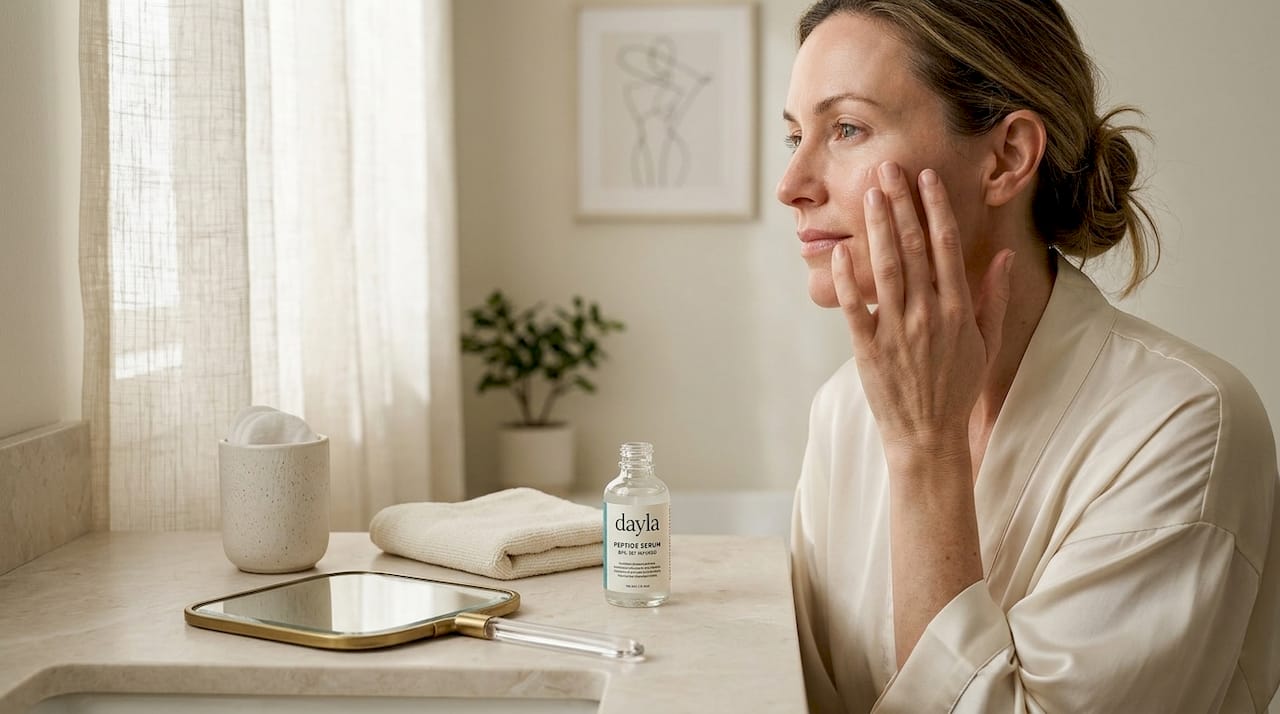
For those interested in injectable options, GHK-Cu delivered via injection allows for more direct tissue delivery than topical application, where skin penetration can be limited by molecular size. This makes it a preferred option in clinical settings for targeted skin rejuvenation.
4. Matrixyl and Matrixyl 3000: fibroblast activation at the source
Matrixyl (palmitoyl pentapeptide-4) and Matrixyl 3000 are synthetic peptides designed to mimic fragments of collagen and fibronectin, essentially tricking fibroblasts into producing more structural proteins. In a 12-week clinical trial, Matrixyl 3000 reduced wrinkles significantly by stimulating extracellular matrix production, with measurable increases in collagen I and fibrillin mRNA.
These peptides are most commonly found in topical serums and moisturizers. Their relatively small molecular size improves skin penetration compared to full-length collagen molecules, making them among the more effective topical options available without a prescription.
Matrixyl 3000 specifically combines palmitoyl tetrapeptide-7 with palmitoyl oligopeptide, and the combination appears more effective than either compound alone. If you are evaluating a topical serum for wrinkle reduction, a product that lists both components at meaningful concentrations is worth prioritizing.
5. Palmitoyl tetrapeptide-7 and inflammation control
One underappreciated skin health benefit is peptide therapy's ability to reduce chronic low-grade inflammation, which accelerates visible aging. Palmitoyl tetrapeptide-7 reduces inflammation by suppressing excess interleukin-6 production, a key driver of skin degradation over time.
This matters for anyone dealing with skin that looks dull, reactive, or aged beyond their years. Chronic inflammation breaks down collagen faster than UV exposure alone. Addressing it at the peptide level, rather than just applying antioxidants on top, targets the problem more directly.
Products combining palmitoyl tetrapeptide-7 with a collagen-stimulating peptide like Matrixyl give you both structural support and inflammation control in one formula. That combination is more clinically meaningful than a single-peptide product.
6. Melanocortin peptides and photoprotective benefits
Melanocortin peptides, particularly afamelanotide and related analogs, work through a different mechanism than collagen-focused peptides. They activate melanocortin receptors in the skin, increasing melanin production and providing a degree of photoprotection.
This category is still largely in clinical and research settings rather than consumer products. But for individuals with photosensitivity conditions or those seeking to support skin defense against UV damage, melanocortin peptides represent a developing area of skin rejuvenation with peptides that goes beyond surface-level cosmetics.
The photoprotective angle also connects to long-term skin aging prevention. UV damage is the single largest external driver of premature skin aging, so peptides that support the skin's natural defense mechanisms have compounding benefits over time.
7. Comparing delivery methods: oral, topical, and injectable
How a peptide enters your body determines where it works and how effectively. This is one of the most important distinctions most product marketing ignores entirely.
| Delivery Method | Pros | Cons | Best For |
|---|---|---|---|
| Oral | Systemic effects, strong clinical evidence for collagen peptides, convenient | Digestion may alter some peptides; not all peptides survive GI transit intact | Whole-body skin hydration, elasticity, collagen support |
| Topical | Non-invasive, widely available, good evidence for named peptides | Penetration limited by skin barrier; concentration often too low in OTC products | Targeted wrinkle reduction, surface-level firming |
| Injectable | Direct tissue delivery, higher bioavailability, used in clinical protocols | Requires medical supervision, higher cost, greater safety considerations | Targeted rejuvenation, clinical anti-aging protocols |
Different peptides and routes have distinct mechanisms and safety profiles. A clinician evaluates peptide name, route, regulatory status, supervision requirements, and safety profile before recommending any protocol. That level of scrutiny is rarely explained to consumers shopping online.
8. How to safely integrate peptide therapy into your routine
Starting peptide therapy without a plan is how people waste money and miss results. Here is how to approach it properly.
Consult before you commit. Dermatologists recommend consulting clinicians before starting any peptide protocol, particularly for injectable or high-dose oral options. A clinician can identify contraindications, recommend the right peptide for your specific skin concern, and monitor your progress.
Set realistic timelines. Most peptide protocols require 8 to 12 weeks of consistent use before you see measurable changes. This is not a product failure. It reflects how long it takes fibroblasts to produce new collagen and for that collagen to remodel the dermis.
Watch for side effects. Peptides are generally well tolerated, but side effects do occur. Topical peptides can cause contact dermatitis in sensitive skin. Oral collagen peptides occasionally cause nausea. Injectable peptides carry more significant risks and require clinical monitoring.
Key practices for safe integration:
- Start with one peptide product at a time so you can isolate reactions
- Introduce new products slowly, using every other day before daily application
- Keep a simple log of skin changes, both positive and negative
- Purchase from brands that disclose peptide names, concentrations, and sourcing
Pro Tip: Peptides pair well with vitamin C (which supports collagen synthesis) and hyaluronic acid (which amplifies hydration). Avoid layering peptides directly with strong acids like AHAs or BHAs in the same application, since low pH can destabilize some peptide structures.
9. Red flags that signal a product is not worth your money
The gap between peptide marketing and peptide science is significant. Knowing what to avoid saves you from both financial waste and potential harm.
Avoid any product that lists "peptide complex" without naming the specific peptides. Avoid brands that claim FDA approval for skin peptide therapy, since the FDA has not approved any peptide therapy specifically for cosmetic skin improvement. Be skeptical of before-and-after photos without disclosed protocols, dosages, or timeframes.
Transparency is the single best proxy for quality in this market. If a brand cannot tell you exactly what peptide you are getting, at what concentration, and what the clinical basis is, that is a clear signal to look elsewhere.
10. What emerging peptide research means for your skin in 2026
The peptide research pipeline is active. Scientists are currently investigating exosome-delivered peptides for deeper skin penetration, peptide combinations that target both collagen synthesis and senescent cell clearance, and oral peptides with more targeted tissue-specific effects.
Growth hormone peptides, which work through a different pathway than skin-specific peptides, are also being studied for their secondary effects on skin thickness and elasticity. You can explore growth hormone peptide options with clinical oversight if systemic anti-aging effects are part of your broader wellness goal.
The honest summary is that the science is advancing faster than the regulatory framework. That creates opportunity for informed consumers and risk for uninformed ones. Staying connected to clinician-guided sources rather than influencer-driven product recommendations is the most reliable way to benefit from what is coming.
My honest take on peptide therapy for skin
I've watched this category grow from a niche clinical tool into a billion-dollar marketing machine, and the gap between the two versions concerns me more than it used to.
The science on specific peptides, collagen peptides, GHK-Cu, Matrixyl 3000, is genuinely compelling. I've seen real results in clinical contexts where the right peptide was matched to the right patient with the right protocol. That part works.
What doesn't work is the consumer market's habit of treating all peptides as interchangeable. A serum with an unnamed "peptide blend" at an undisclosed concentration is not the same thing as a clinically validated oral collagen peptide at 10 g per day. Treating them as equivalent is how people spend hundreds of dollars and conclude that peptides don't work, when the real problem was product selection.
My view is that the future of peptide therapy for skin is genuinely promising, but only for people who approach it with the same rigor a clinician would. Verify the peptide name. Confirm the delivery method matches the evidence. Work with a provider who can monitor your results. The people who do that will see the benefits. The people who buy based on packaging will not.
The emerging research on peptide combinations and novel delivery systems is worth watching closely. We are likely two to three years away from topical formulations that penetrate the skin barrier as effectively as injectables do today. When that happens, the clinical gap between topical and injectable peptides will narrow considerably.
— Flexible
Explore peptide therapy options with clinical guidance
If you're ready to move from research to results, Daylahealth offers a curated selection of peptide therapies backed by medical oversight and transparent sourcing. Whether you're starting with topical options or considering a more targeted approach, the right protocol starts with the right guidance.

Browse the full peptide therapy catalog to see clinically supported options organized by goal, from skin rejuvenation to longevity support. For those specifically interested in skin-targeted injectable therapy, the injectable GHK-Cu peptide page includes full product details, sourcing information, and consultation pathways. Daylahealth's doctor-led model means you get personalized guidance, not just a product.
FAQ
What are the main skin health benefits of peptide therapy?
Peptide therapy supports skin health by stimulating collagen and elastin production, reducing inflammation, improving hydration, and strengthening the skin barrier. Clinical evidence is strongest for oral bioactive collagen peptides and named topical peptides like Matrixyl 3000 and GHK-Cu.
How long does peptide therapy take to improve skin?
Most peptide protocols require 8 to 12 weeks of consistent use before measurable improvements in wrinkles and elasticity appear. Short-term results within days are not supported by clinical evidence.
Is peptide therapy for skin FDA approved?
No. The FDA has not approved peptide therapy specifically for cosmetic skin improvement. Most oral collagen peptides are sold as dietary supplements, and topical peptide products are classified as cosmetics.
What are the best peptides for skin health?
The best-studied peptides for skin include oral bioactive collagen peptides, GHK-Cu (copper tripeptide-1), Matrixyl (palmitoyl pentapeptide-4), and Matrixyl 3000. Each works through a distinct mechanism and is supported by specific clinical evidence.
Are there side effects from peptide therapy for skin?
Side effects are generally mild but can include allergic reactions, contact dermatitis from topical products, and occasional nausea from oral collagen peptides. Injectable peptides carry greater risks and require medical supervision.