
Expect to pay several hundred dollars per month for tirzepatide without insurance if you use manufacturer direct-pay pricing, or about one thousand dollars or more per month at a retail pharmacy. The most reliable low-cost path is LillyDirect's self-pay vial program, which prices doses in tiers as long as you refill within a specified time window. Daylahealth offers a supervised, direct-to-consumer alternative for patients who want clinician oversight bundled into their cash-pay plan.
TL;DR:
- LillyDirect's self-pay vials offer the best long-term value at around $299 to $449 per month, depending on the dose, when refilled within 45 days.
- Compounded tirzepatide from telehealth clinics varies widely in quality and price, but usually costs more than LillyDirect and less than retail pharmacy prices.
- Manufacturer assistance programs like Lilly Cares are limited to uninsured patients with low income, and savings cards generally exclude Medicare, Medicaid, and VA patients.
- Daylahealth provides supervised, clinician-led access to tirzepatide for uninsured patients through a monthly subscription that includes coaching and ongoing monitoring.
Table of Contents
- How Much Does Tirzepatide Cost Without Insurance?
- How Do You Actually Buy Tirzepatide With Cash?
- Can You Get Financial Help for Tirzepatide Without Insurance?
- What Do You Need to Get a Tirzepatide Prescription Without Insurance?
- How Can You Lower Your Annual Tirzepatide Costs?
- Is Compounded Tirzepatide Safe to Use Instead of Brand-Name?
- How Daylahealth Supports Uninsured Patients Seeking Tirzepatide
- What Uninsured Patients Get Wrong About Tirzepatide Pricing
- Start Your Supervised Tirzepatide Intake With Daylahealth
- Sources
How Much Does Tirzepatide Cost Without Insurance?
The price you pay depends almost entirely on which route you choose, not just which pharmacy you happen to walk into. Three distinct pricing worlds exist for tirzepatide right now, and they can differ by hundreds of dollars a month for the exact same active ingredient.
Retail pharmacy cash price sits at the top of the range. Without insurance or a savings card, brand-name Zepbound pens routinely list above one thousand dollars per month at a standard retail pharmacy, sometimes higher depending on dose and location. This is the sticker price manufacturers set for pharmacy benefit negotiations, not the price designed for an uninsured person paying cash.
Manufacturer direct-pay (LillyDirect) vials are considerably cheaper. Eli Lilly restructured its self-pay pricing for Zepbound single-dose vials, and the published tiers break down by dose:
- 2.5 mg and 5 mg (starting doses): $299 per month
- 7.5 mg and 10 mg (mid-range doses): $349 per month
- 12.5 mg and 15 mg (maintenance doses): $449 per month
Most patients who stay on tirzepatide long enough to see meaningful weight loss eventually titrate up to higher maintenance doses, so budgeting for the top tier pricing is the realistic long-term number to plan around.
Compounded tirzepatide through telehealth clinics occupies the middle ground, and it's the most variable of the three. Prices generally range across a moderate monthly cost range depending on the clinic, dose, and membership fee inclusion. Because compounded formulations aren't FDA-approved products, pricing isn't standardized the way it is with LillyDirect, and quality and dosing accuracy can vary by pharmacy.
Beyond the headline drug price, a few line items change your actual monthly total:
- Syringes and supplies. Vials require you to draw your own dose with insulin syringes, typically adding $10 to $20 per month if you're not already sourcing them elsewhere. Low-cost syringe and supply resources built for diabetes patients on tight budgets work just as well here.
- Shipping fees. Most direct-to-consumer pharmacies either build shipping into the subscription or charge a modest flat rate per shipment.
- Clinician visit fees. Telehealth intake and follow-up visits may be free (bundled) or involve a moderate fee if billed separately.
- Enrollment or membership charges. Some compounding telehealth platforms tack on a recurring membership fee on top of the drug cost, significantly affecting total monthly expenses and worth noting beyond the advertised medication price.
Add those together, and a vial from LillyDirect at the maintenance tier with basic supplies often lands somewhere in the mid-hundreds monthly all in, still well below retail.
How Do You Actually Buy Tirzepatide With Cash?
Each of the three main cash-pay routes works differently, and picking the right one depends on your comfort level with self-injection, how quickly you need medication, and whether you might qualify for insurance help later.
- Start with LillyDirect if you want the lowest verified price. You'll need an active prescription, which LillyDirect can help facilitate through affiliated telehealth providers if you don't already have one. Vials require self-administration with a syringe, unlike pre-filled pens, so factor in a short learning curve. Refills must be placed within 45 days of your previous order to keep the discounted tier. Miss that window, and pricing can revert to standard retail rates on your next order.
- Use a telehealth-compounding clinic if you want an all-in-one virtual visit. These platforms combine an online intake, a clinician consultation, and a prescription sent to a compounding pharmacy, often with same-week shipping. The trade-off is regulatory: compounded drugs don't go through the same FDA approval process as Zepbound's prescribing information, so formulation consistency and dosing accuracy can vary between pharmacies. Membership fees on these platforms deserve a close read before you sign up.
- Treat retail pharmacy purchases as a last resort. Walking into a pharmacy with a written prescription and no insurance or savings card triggers the highest possible price. This route makes sense mainly as a stopgap, such as filling a single month while you wait for a LillyDirect order to arrive or a compounding pharmacy's next batch.
- Bridge your way toward long-term insurance coverage. If you're mid-appeal on a prior authorization denial or waiting on a new insurance plan to kick in, LillyDirect's vial pricing is a reasonable way to stay on therapy without pausing treatment while that process plays out.
None of these routes are mutually exclusive. Plenty of patients start on a LillyDirect vial, apply for manufacturer assistance in parallel, and switch to a savings card the moment they land employer coverage.
Can You Get Financial Help for Tirzepatide Without Insurance?
Manufacturer assistance exists, but the eligibility rules trip up more uninsured patients than you'd expect. Understanding who actually qualifies before you apply saves weeks of wasted effort.
Lilly Cares is Eli Lilly's income-based patient assistance program, and it's built specifically for people who lack prescription drug coverage altogether. If your household income falls under the program's threshold, Lilly Cares can cover the full medication cost, though processing typically takes several weeks and requires documentation of income and lack of insurance.
The Zepbound savings card, by contrast, is not designed for the uninsured. It requires commercial insurance as a baseline, and it explicitly excludes several large groups of patients:
- Patients enrolled in Medicaid
- Medicare Part D beneficiaries
- Individuals covered by TRICARE
- Patients using VA health system coverage
Statistic Callout: Manufacturer savings cards are structured around commercial insurance discounts, which is precisely why uninsured patients frequently discover they don't qualify after assuming the advertised savings apply to everyone.
If you're on Medicaid or think you might qualify, check your state Medicaid program directly, since coverage for GLP-1 medications varies significantly by state. Medicare beneficiaries should review CMS guidance on GLP-1 drug coverage before assuming Part D will pick up the cost.
The practical sequence: apply to Lilly Cares as early as possible given the processing lag, and use LillyDirect vial pricing as your bridge in the meantime rather than pausing treatment or overpaying at retail while you wait for approval.
What Do You Need to Get a Tirzepatide Prescription Without Insurance?
You don't need insurance to get a legitimate prescription, but you do need to complete a real clinical evaluation, whether that's through telehealth or your primary care office. Here's what speeds that process along.
- Gather your basics before your visit. Have your current height, weight, and blood pressure on hand, along with a list of current medications and any diagnosed conditions like type 2 diabetes, sleep apnea, or hypertension.
- Expect a candidacy check. Clinicians generally look for a BMI of 30 or above, or 27 and above with a weight-related condition, largely mirroring the criteria used in the pivotal tirzepatide clinical trials. Reviewing candidacy criteria in more detail can help you anticipate what a clinician will ask.
- Plan for ongoing follow-up. Most prescribers schedule check-ins every four to eight weeks during titration to track side effects, weight change, and whether a dose increase makes sense.
- Sync your refill timing with your prescriber. If you're using LillyDirect, coordinate your follow-up visit and refill request so your next order falls within that 45-day window and keeps your pricing tier intact.
Pro Tip: Photograph your home scale reading, any recent lab results, and your medication bottles before a telehealth visit. Clinicians move faster when they can verify your numbers visually instead of relying on your memory.
How Can You Lower Your Annual Tirzepatide Costs?
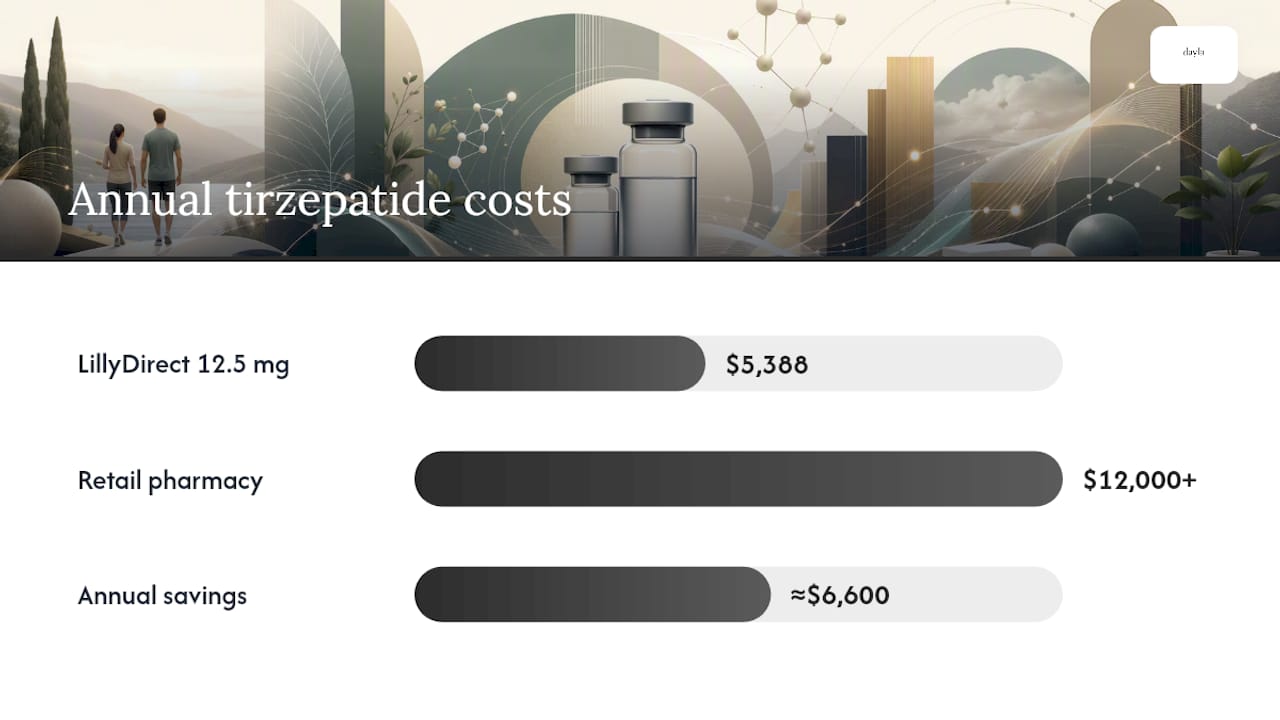
Run the math over a full year, not just a single month, and the differences between routes get dramatic. A patient on the 12.5 mg maintenance dose spends roughly $5,388 a year through LillyDirect, compared to $12,000 or more at retail pharmacy prices, a gap of nearly $6,600 annually for the identical dose.
A few tactics keep that number as low as possible:
- Set refill reminders around the 45-day window. Missing it even once can bump your next fill back to full retail pricing on that order.
- Coordinate titration timing with your budget. Since higher doses cost more, ask your clinician whether a slower titration schedule fits your treatment goals and your wallet.
- Buy syringes in bulk. Ordering supplies in three-month batches from discount diabetic supply retailers usually costs less per unit than monthly reorders.
- Weigh membership fees against the drug price. A compounding platform advertising a lower medication cost can still end up more expensive once its monthly membership fee is added in.
- Revisit prior authorization if you gain any insurance access. Even partial employer coverage or a marketplace plan with GLP-1 benefits will almost always beat cash-pay pricing long term, so an appeal is worth the paperwork if you become newly eligible.
Is Compounded Tirzepatide Safe to Use Instead of Brand-Name?
FDA-approved Zepbound goes through rigorous testing, standardized manufacturing, and the safety monitoring outlined in its official prescribing information. Compounded tirzepatide is a different regulatory category entirely. The FDA's own compounding guidance draws a clear line: compounded drugs aren't FDA-approved, and formulation consistency depends on the individual pharmacy making them.

Regulatory enforcement action against mass compounders over the past couple of years has already shrunk the compounding market considerably, which is part of why pricing and availability among compounding pharmacies has grown less predictable rather than more. Whichever route you choose, ongoing clinical monitoring matters. Talk with a licensed clinician before switching sources or adjusting your dose on your own.
How Daylahealth Supports Uninsured Patients Seeking Tirzepatide
Daylahealth runs a nationwide telehealth model built around the exact gap this article covers: how to get supervised access to GLP-1 medication without requiring insurance as a gatekeeper. Every prescription starts with a clinician evaluation, not a self-checkout form, and every subscription bundles the medication itself with ongoing coaching and dietitian support rather than leaving you to manage titration alone.
That clinical oversight matters given the trial data behind tirzepatide's efficacy. A medication this effective also carries real dosing and monitoring considerations, and Daylahealth's model is designed around keeping a clinician in the loop throughout your treatment rather than treating the prescription as a one-time transaction. For patients weighing tirzepatide against other peptide-based options or comparing it to the broader field of FDA-approved weight loss medications, that ongoing oversight is the piece that's easy to overlook when you're focused purely on price. Readers who want a deeper cost breakdown can also review Daylahealth's earlier GLP-1 cash-pay guide for additional context.
What Uninsured Patients Get Wrong About Tirzepatide Pricing
The biggest mistake uninsured patients make isn't picking the wrong pharmacy. It's assuming price and safety trade off against each other in a straight line, when the data doesn't actually support that. LillyDirect's vial pricing proves you can get the FDA-approved product at a fraction of retail cost without touching the compounding market at all, provided you're willing to self-inject from a vial and stay disciplined about the 45-day refill window.
Where conventional advice falls short is treating "cheapest option" and "compounded" as synonyms. They're not. The real hierarchy, cost and risk combined, runs LillyDirect first, telehealth-supervised compounding second only if LillyDirect genuinely isn't accessible, and retail cash-pay as a short-term bridge, never a long-term plan.
If you take one thing from this guide, prioritize clinical supervision over the sticker price alone. A slightly higher monthly cost with a clinician tracking your dose and side effects beats a cheaper option with no one checking in on how your body is actually responding.
— Flexible
Start Your Supervised Tirzepatide Intake With Daylahealth
Daylahealth gives uninsured patients a direct route to supervised GLP-1 care without the guesswork of comparing pharmacy tiers on your own. After a short online intake and clinician review, most patients receive their first shipment within about a week, with medication, dietitian consults, and care coaching bundled into one monthly subscription rather than billed as separate line items the way LillyDirect and standalone telehealth clinics often are.
The subscription cost sits above LillyDirect's lowest self-pay tier, which is worth knowing upfront, but it buys ongoing clinical oversight and coaching that a bare vial purchase doesn't include. For patients also interested in longevity or recovery peptides, Daylahealth's broader catalog covers that ground under the same clinical model. Start your intake on the compounded GLP-1 weight care page to see your candidacy and pricing before committing to anything.
This article is general information, not a substitute for advice from a qualified doctor. Consult a qualified healthcare professional about your own circumstances before acting on anything here.
Sources
- Lilly lowers the price of Zepbound single-dose vials
- Zepbound (tirzepatide) prescribing information
- Tirzepatide clinical trial evidence