

Tirzepatide costs range widely depending on how you access it: retail pen list price sits around $1,079 to $1,086 per 28-day supply, while LillyDirect self-pay tiers run $299 to $449 monthly by dose. Commercial insurance with a manufacturer savings card can lower copays to as little as $25 a month for eligible patients, and the new Medicare GLP-1 Bridge program cuts costs for qualifying Part D beneficiaries. The right path for you depends on your indication, coverage, and refill habits.
TL;DR:
- LillyDirect’s self-pay tiers for tirzepatide offer prices significantly lower than retail, ranging from $299 to $449 per month depending on dosage.
- Using insurance plus manufacturer savings cards can reduce copays to as little as $25 monthly, but coverage varies widely by plan and indication.
- A 45-day refill window is crucial for maintaining LillyDirect discounts, and missing it can significantly increase costs.
- Costs depend heavily on dosage, indication, refill timing, and additional medical supplies, so accurate coding and plan confirmation are essential.
- Online clinician-led programs can help navigate these options and secure more affordable, personalized treatment plans without insurance, often within days.
Table of Contents
- Tirzepatide Cost Without Insurance: Retail vs LillyDirect
- How Insurance and Assistance Programs Change the Price
- What Actually Determines Your Price
- Practical Steps to Lower Your Monthly Cost
- How Dayla Health Helps You Navigate These Costs
- What the Cost Conversation Usually Gets Wrong
- Start Your Path to Affordable, Clinician-Led Care
- Sources
Tirzepatide Cost Without Insurance: Retail vs LillyDirect
Paying cash for tirzepatide looks completely different depending on where you fill the prescription. Branded pens purchased at a standard retail pharmacy carry a list price near $1,079 to $1,086 for a 28-day supply, and that figure holds whether you're filling Mounjaro for diabetes or Zepbound for weight loss. Most uninsured patients paying retail land close to that range unless a coupon shaves off a modest amount.
LillyDirect changes the math entirely. Through the Zepbound Self-Pay Journey Program, Eli Lilly sells single-dose vials directly to patients at fixed tiers:
- 2.5 mg: $299 per month
- 5 mg: $399 per month
- 7.5 mg to 15 mg: $449 per month.
Those prices assume you fill within the program's rules, and they represent a significant discount off retail list price for comparable doses. GoodRx and SingleCare coupons help at the retail pharmacy counter, but they typically trim branded pen prices modestly rather than getting anywhere close to LillyDirect tiers. The tradeoff is convenience: KwikPens are ready to inject, while LillyDirect vials require reconstitution and a syringe, which asks more of the patient but rewards that effort with real savings. If you're weighing tirzepatide without insurance, understanding this gap between retail and direct pricing is the single biggest lever you control.
How Insurance and Assistance Programs Change the Price
Your out-of-pocket cost hinges less on the drug itself and more on which door you walk through: commercial insurance, Medicare, or Medicaid all play by different rules.
Commercial plans that cover tirzepatide typically allow patients to stack a manufacturer savings card on top of their benefit. Lilly's savings card can reduce monthly copays to as low as $25 for eligible patients, though it comes with real limits: annual caps apply, and the card explicitly excludes anyone enrolled in Medicare or Medicaid. Coverage itself is inconsistent. Recent analyses suggest roughly 30% of commercial plans cover tirzepatide for obesity specifically, which makes checking your formulary before you assume anything a necessary first step.
By the numbers: Medicare Part D generally covers Mounjaro for type 2 diabetes, but Zepbound coverage for obesity alone remains limited. The new Medicare GLP-1 Bridge demonstration offers eligible Part D beneficiaries Zepbound KwikPens for $50 per month starting July 1, 2026.
Medicaid coverage varies by state, and weight-loss-only prescriptions face the widest inconsistency. Prior authorization and step therapy are common across all payer types, so working closely with your prescriber on documentation, and asking specifically whether your plan requires a failed trial of another medication first, saves weeks of delay.
What Actually Determines Your Price
Two patients on the same drug can pay wildly different amounts, and the gap usually comes down to a few variables.
- Dose and pricing structure. Retail branded pens are priced largely the same regardless of dose, but LillyDirect's self-pay tiers scale up with dose, from $299 at 2.5 mg to $449 at 7.5 mg and above.
- Indication. Whether you're prescribed tirzepatide for type 2 diabetes, obesity, or sleep apnea affects formulary placement and whether Medicare or Medicaid will cover it at all.
- Refill timing. LillyDirect's higher-dose pricing tiers depend on refilling within a 45-day window. Miss it, and you may lose the discounted rate on your next fill.
- Clinical and supply costs. Telehealth or clinic visit fees, ongoing subscription charges, and supplies like needles and sharps containers add tens to low hundreds of dollars monthly on top of the medication itself.
Practical Steps to Lower Your Monthly Cost
Cutting your bill usually comes down to sequencing these steps correctly rather than doing something exotic.
- Confirm your indication and formulary status with your prescriber or pharmacist before assuming coverage either way.
- Ask about the manufacturer savings card and have your prescriber's office help with any prior authorization paperwork your plan requires.
- Compare LillyDirect pricing for your specific dose and mark your calendar for the 45-day refill window if you're on a higher maintenance dose.
- Use HSA or FSA funds for cash-pay purchases; pretax dollars effectively lower your cost by your marginal tax rate.
- If you're on Medicare, confirm your Part D plan participates in the GLP-1 Bridge program before you fill your next prescription.
Pro Tip: Set a recurring phone reminder for day 40 of your refill cycle, not day 45. LillyDirect's pricing tiers are strict about the window, and a weekend or shipping delay can bump you out of the discount entirely.
If your search for lower costs leads you toward compounded alternatives, know that FDA enforcement changes have narrowed broad compounding exceptions significantly, leaving only limited, patient-specific 503A compounding as a legal option in most cases.
How Dayla Health Helps You Navigate These Costs
Dayla Health's model starts with an online intake, moves to clinician review, and ends with medication shipped nationwide, all built around subscription transparency rather than surprise fees. Our care team helps patients evaluate whether LillyDirect pricing, manufacturer programs, or a bundled subscription makes more financial sense for their specific dose and indication.
- Clinician oversight reviews your history before any prescription moves forward.
- We help identify the documentation prior authorization requests typically need.
- Complex medical cases get referred to in-person care when that's the safer path.
- Patients curious about lower starting doses can review the evidence on microdosing tirzepatide before requesting an off-label approach.
Roughly 30% of commercial plans cover obesity treatment with tirzepatide. This means most patients need a second plan for affordability, not just a prescription.
What the Cost Conversation Usually Gets Wrong
Most cost guides treat tirzepatide pricing as a single number to hunt down, when it's really a decision tree. The conventional advice, "ask your doctor about savings cards," is fine but incomplete. It skips the part where dose selection, refill timing, and indication coding all quietly determine whether you land at $25 a month or $1,000.
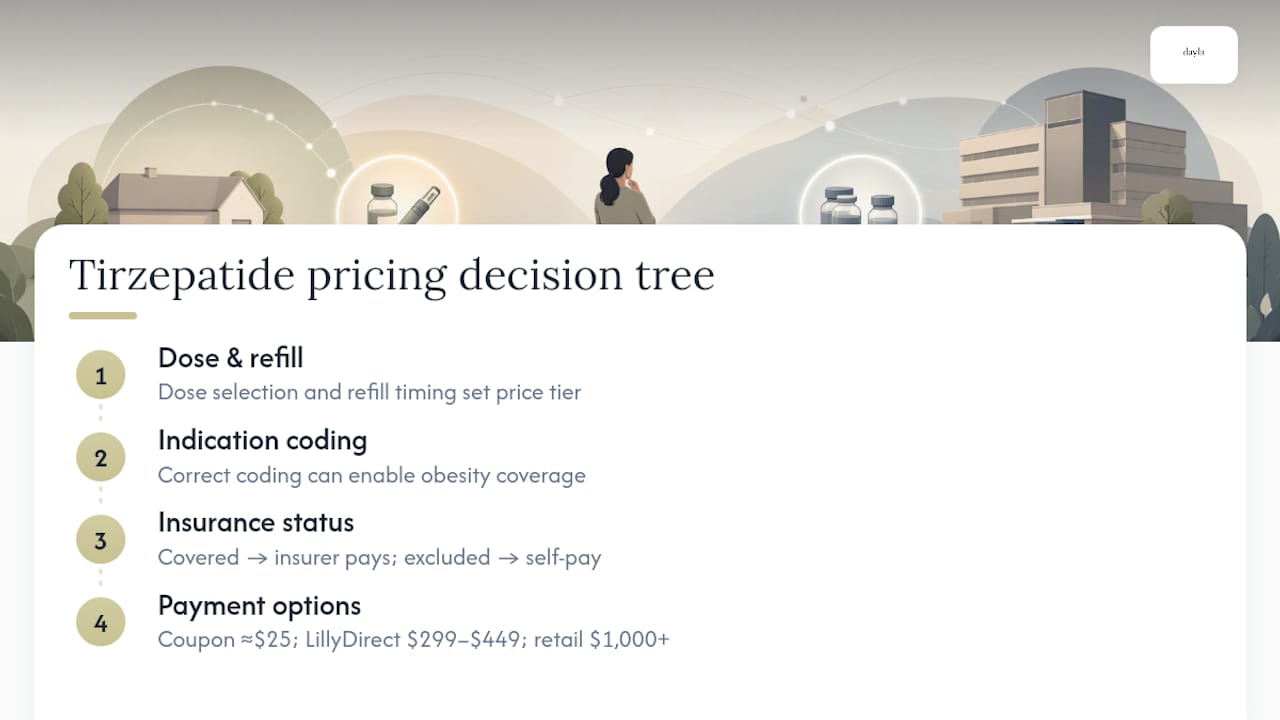
The biggest blind spot is the assumption that insurance is always the cheaper path. For patients whose plans exclude obesity treatment, LillyDirect's self-pay tiers frequently beat what an uninsured retail fill would cost, and sometimes beat a poorly covered insurance claim too. Net prices after rebates also run well below list price, which is worth remembering before sticker shock talks you out of asking your prescriber about options entirely.
What readers should prioritize first isn't finding a coupon. It's confirming their indication is coded correctly and their prescriber knows about every direct-pay option on the table, insurance or not.
— Flexible
Start Your Path to Affordable, Clinician-Led Care
An online intake followed by clinician review can help you get a prescription plan matched to your goals instead of guessing between retail and self-pay pricing on your own. After completing an intake form, a clinician evaluates your history, discusses which program fits your budget, and arranges shipment, typically within days of approval rather than weeks.
There is no insurance requirement to get started, and some subscription models bundle medication, clinical oversight, and coaching into one predictable monthly cost. If you're ready to see what compounded GLP-1 weight care looks like with a doctor guiding the plan, start your intake today and get a clear answer on pricing before you commit to anything.
This article is general information, not a substitute for advice from a qualified doctor. Consult a qualified healthcare professional about your own circumstances before acting on anything here.
Sources
- Zepbound Cost Information | With or Without Insurance
- Lilly lowers the price of Zepbound® (tirzepatide) single-dose vials | Eli Lilly and Company
- Medicare GLP-1 Bridge program (CMS)