
There is no national semaglutide shortage in the United States in 2026. The FDA declared the shortage of semaglutide injection (the active ingredient in Wegovy and Ozempic) resolved on February 21, 2025, and it has not returned to the agency's shortage list since. What you may still run into is a local stock-out at one pharmacy, which is a different problem with a different fix. If you want to start or continue GLP-1 treatment, you can do it through doctor-led care that ships nationwide, without insurance and without waiting on a pharmacy shelf. Our GLP-1 plans start at $149 per month.
This guide explains what the shortage was, what ended it, what changed for compounded semaglutide, and what to do if you cannot fill a prescription.
TL;DR
- The FDA declared the semaglutide injection shortage resolved on February 21, 2025. As of the FDA's April 1, 2026 statement, semaglutide was not on its drug shortage list.
- Brief, local supply gaps can still happen as product moves from the manufacturer to distributors to pharmacies. That is not a national shortage.
- Compounding rules tightened after the shortage ended. Compounded medication now has to meet specific legal conditions, so verifying the label and the pharmacy matters.
- If your pharmacy cannot fill your prescription, your prescriber can adjust your plan. You do not have to pause treatment.
- Dayla Health offers GLP-1 injection, microdose and needle-free oral options with clinician oversight, dietitian consults and care coaching, shipped nationwide.
Table of Contents
- What the semaglutide shortage was
- When the shortage ended
- Is semaglutide in shortage right now?
- What changed for compounded semaglutide
- How to use any GLP-1 safely
- If your pharmacy cannot fill your prescription
- Why doctor-led care beats chasing stock
- Dayla Health plans and pricing
- Our perspective
- FAQ
- Sources
What the semaglutide shortage was
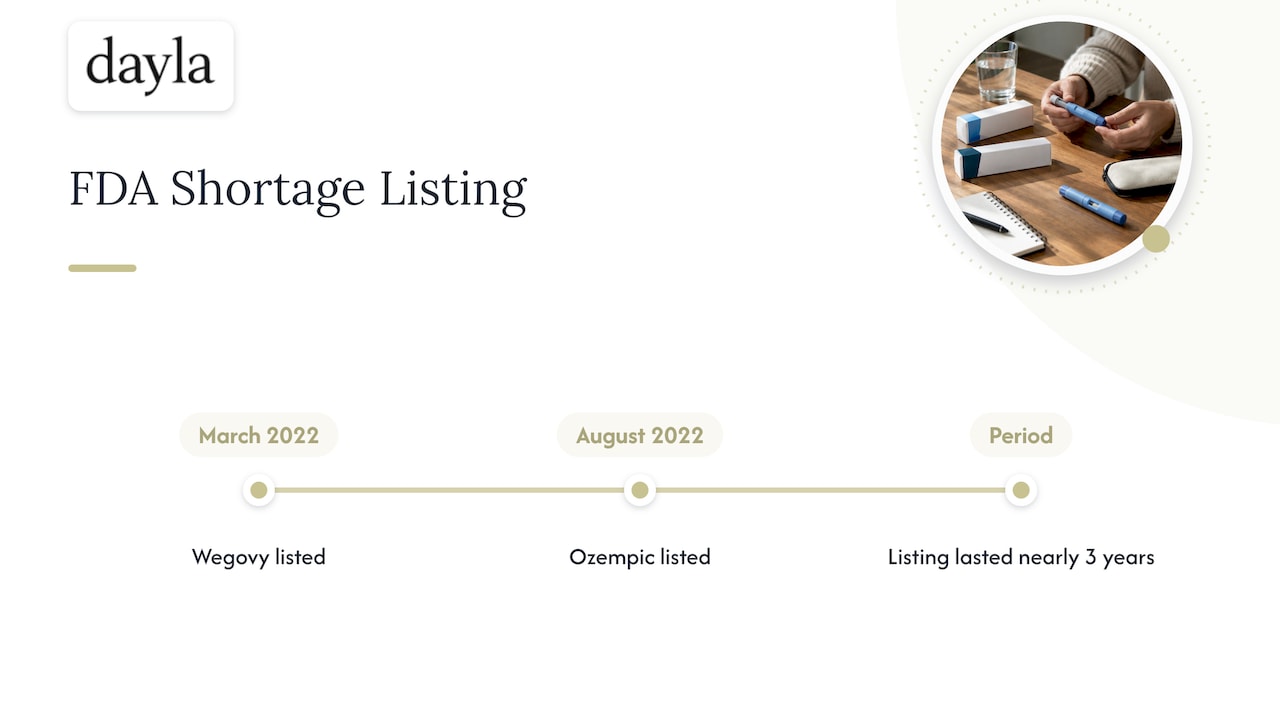
Demand for semaglutide rose sharply as people began using it for weight management. The FDA listed Wegovy as in shortage in March 2022 and Ozempic in August 2022, according to the agency's declaratory order to Novo Nordisk. The listing lasted nearly three years.
The shortage mattered for two reasons. Patients with prescriptions could not always fill them. And because the drug was on the shortage list, pharmacies were allowed to compound copies of it under looser rules than normally apply. When the shortage ended, those looser rules ended with it.
When the shortage ended
The FDA's order resolving the semaglutide injection shortage is dated February 21, 2025. The agency concluded that the manufacturer could meet current and projected demand. Its order also found that the manufacturer held finished-product reserves and significant semi-finished inventory.
Compounders received a wind-down period:
| Type of compounder | What it is | Grace period ended |
|---|---|---|
| Section 503A | State-licensed pharmacy or physician filling an individual patient's prescription | April 22, 2025 |
| Section 503B | FDA-registered outsourcing facility that compounds in bulk | May 22, 2025 |
These dates come from the same FDA order. They are history now, not deadlines you need to plan around.
Is semaglutide in shortage right now?
No. In its April 1, 2026 update for compounders, the FDA stated that semaglutide did not appear on its drug shortage list or on the 503B bulks list. The shortage list is public and updated by the FDA as conditions change, so check it directly if you want the status on the day you read this.
Two caveats explain most of the confusion you will see online:
- Old headlines stay online. Articles from 2023 and 2024 still rank for "semaglutide shortage," and some pages carry 2026 in their titles without describing a current shortage.
- Local gaps are not a national shortage. The FDA's order noted that patients and prescribers may still see intermittent, limited local supply disruptions as product moves through the supply chain from manufacturer and distributors to local pharmacies.
In plain terms, if your neighborhood pharmacy says it is out of a certain strength this week, that does not mean the country is short. It means that pharmacy's order has not arrived.
What changed for compounded semaglutide
Compounded medication is a drug prepared by a pharmacy for an individual patient, usually when a prescriber determines a patient needs something different from the commercial product. During the shortage, compounding of copies was widespread. Since it ended, the FDA has been explicit about the rules.
According to the FDA's April 1, 2026 statement:
- 503A pharmacies need an individual-patient prescription. They may not regularly or in inordinate amounts make drugs that are essentially copies of an approved product. The FDA does not intend to act when a compounder fills four or fewer copy prescriptions a month, or when the prescriber documents a significant difference for an identified patient.
- 503B outsourcing facilities may compound in bulk only if the substance is on the 503B bulks list or the drug is on the shortage list. Semaglutide is on neither.
- Combination products can still count as copies. The FDA's example is semaglutide with vitamin B12 given by the same route, with amounts within 10% of the commercial strengths.
On April 30, 2026, the FDA also proposed to exclude semaglutide, tirzepatide and liraglutide from the 503B bulks list and took comments through June 29, 2026. Rules in this area keep moving, so the practical takeaway is simple: the prescriber and the pharmacy behind your medication matter more than they did during the shortage.
What this means for you
You do not need to master the statute. You need a prescriber who evaluates you individually, documents why a given product and dose suit you, and a pharmacy that is properly licensed or registered. That is what a doctor-led program is built around.
How to use any GLP-1 safely
Whatever route you choose, a few checks protect you. The American Diabetes Association's consensus statement on compounded GLP-1 medications advises patients to:
- Confirm the compounding pharmacy is FDA-registered (503B) or licensed by its state board (503A).
- Look for a label that states the specific dose, including units, and the exact contents.
- Inspect the appearance and labeling of the product when it arrives.
- Be wary of unregulated online sellers, since counterfeit products have entered the U.S. drug supply chain.
- Report side effects to FDA MedWatch at 1-800-332-1088.
Dosing errors are the reason the label check matters. The same ADA statement describes an FDA alert from July 2024 about compounded semaglutide taken at doses 5 to 20 times higher than intended, with symptoms including nausea and vomiting, fainting, headache, dehydration, pancreatitis and gallstones, some requiring hospitalization. Measure your dose in the units your clinician gives you, and call your clinician if anything feels off.
The FDA also reports it had received 990 adverse event reports tied to compounded semaglutide by May 31, 2026, and notes the true count is probably higher because some pharmacies are not required to report. Reporting your own experience helps the agency see problems.
We have written step-by-step guides on the details: a 5-step checklist to verify compounded semaglutide, five safety checks for U.S. patients and what to know about semaglutide base versus salt.
Two medical situations need your own clinician's input before you act: planned surgery or anesthesia, and any other prescription you take. See our guides on stopping semaglutide before surgery and semaglutide with Adderall, then confirm the plan with your prescriber. Pregnant or breastfeeding women, and anyone with a history of pancreatitis or certain thyroid conditions, should raise that with a clinician before starting any GLP-1 medication.
If your pharmacy cannot fill your prescription
A local stock-out is frustrating, but it rarely requires you to stop treatment. Here is a sensible order of steps:
- Ask the pharmacy when its next delivery is due, and whether another location in the same chain has your strength.
- Call your prescriber before you skip or stretch doses. Going without semaglutide for a stretch can change how you restart, and your clinician decides whether you resume at your previous dose or step back down.
- Ask about alternatives. The American Diabetes Association's guidance is that when an incretin medication is unavailable, patients can switch to a different FDA-approved medication as clinically appropriate and reassess going back to the original once supply returns.
- Keep your pens stored correctly while you wait. Our guide to semaglutide pen storage temperatures covers the range and travel tips.
This is where a program with ongoing clinical oversight earns its keep. You have a clinician to call, not a pharmacy counter to argue with.
Why doctor-led care beats chasing stock
When semaglutide was truly scarce, people spent hours calling pharmacies, switching brands and paying whatever they were quoted. The shortage is over, but the habit of hunting for a fill is still common, and so is the cost: brand-name prescriptions often depend on insurance coverage, prior authorization and which pharmacy has the pen that week.
A direct, cash-pay program removes those steps. You complete an online intake, a clinician reviews it, and if you are approved, medication ships to you. Your plan, dose and follow-up sit with one care team, so a change in your needs is a message to your clinician, not a restart of the search.
That is also why the structure of the program matters more than the news cycle. Weight loss on a GLP-1 is a months-long process. What keeps people on track is dose adjustment, nutrition support and someone to ask when side effects appear. Our guides on foods to eat on semaglutide and semaglutide and alcohol show the kind of day-to-day questions that come up in the first weeks.
Dayla Health plans and pricing
Dayla Health is a direct-to-consumer program for GLP-1 weight loss prescriptions and peptides. You pay cash for a bundled package: clinician evaluation, medication, care coaching and shipping, with no insurance required and shipping nationwide. There are no membership fees, and cancellation is flexible. Dietitian visits are free.
Published pricing, read from our site:
| Plan | Price |
|---|---|
| GLP-1 Injection | from $179 per month |
| GLP-1 Microdose | from $159 per month |
| Oral GLP · Liposomal (needle-free) | from $149 per month |
| dayla GLP-1 program | $299 per month |
You can see the full plan lineup, read about our semaglutide offering or go straight to the semaglutide injection maintenance dose. Eligibility depends on your intake and clinician approval.
Our perspective
The headline question, "Is semaglutide in shortage?", has a clear answer: no. The more useful question is what kind of care you want around the medication.
We built Dayla Health around personalized GLP-1 care. That means a clinician evaluates you, you choose the delivery that fits your life, whether injection, microdose or needle-free oral, and you get dietitian consults and care coaching alongside your prescription. Pricing is transparent and paid in cash, with no membership fees and no insurance hurdles.
Supply news will keep changing. A care team you can reach, a clear price and a plan that adapts to you will not. That is the standard we hold ourselves to.
Flexible
FAQ
When did the semaglutide shortage end?
The FDA declared the semaglutide injection shortage resolved on February 21, 2025. The shortage had been listed since March 2022 for Wegovy and August 2022 for Ozempic. Compounders had until April 22, 2025 (503A) and May 22, 2025 (503B) to wind down shortage-based copying.
Is semaglutide still in shortage in 2026?
No. As of the FDA's April 1, 2026 statement, semaglutide was not on the agency's drug shortage list. Individual pharmacies can still have short, local delays as stock moves through the supply chain. If your pharmacy is out, ask your prescriber about your options.
Can semaglutide still be compounded?
Yes, within limits. A state-licensed pharmacy can compound for an individual patient when conditions in section 503A are met, including a prescriber's documented patient-specific need when the product would otherwise be essentially a copy of an approved drug. Verify the pharmacy and the label on anything you receive.
Do I need insurance to start a GLP-1 with Dayla Health?
No. Our plans are cash-pay and ship nationwide without insurance requirements. You complete an online intake, and a clinician decides whether a prescription is appropriate for you.
Sources
- FDA declaratory order on semaglutide injection shortage resolution
- FDA clarifies policies for compounders as national GLP-1 supply begins to stabilize
- FDA proposes to exclude semaglutide, tirzepatide and liraglutide from the 503B bulks list
- FDA's concerns with unapproved GLP-1 drugs used for weight loss
- ADA consensus statement on compounded GLP-1 and dual GIP/GLP-1 receptor agonists