
Most healthy adults can have an occasional drink on semaglutide, but "usually fine" is not the same as "safe to ignore." Alcohol tends to hit harder and faster on this medication, and side effects like nausea can intensify without warning. The risk climbs sharply if you take insulin or a sulfonylurea, or if you have a history of heavy drinking or pancreatitis. Early trial data even suggests semaglutide may reduce alcohol cravings for some people, though that evidence is still young.
TL;DR:
- The small, short-term studies suggest semaglutide may reduce alcohol cravings and consumption, but larger, long-term trials are still needed for confirmation.
- Semaglutide alters alcohol effects by dampening brain reward responses and delaying alcohol absorption due to slowed gastric emptying.
- Risks of drinking on semaglutide include hypoglycemia for insulin or sulfonylurea users, pancreatitis, increased nausea, dehydration, and impaired coordination.
- To drink safely, limit intake to moderate levels, eat before drinking, alternate with water, and monitor for unusual symptoms such as rapid intoxication or nausea.
- Patients on insulin, with a history of alcohol use disorder or pancreatitis, should consult their healthcare provider and follow tailored monitoring plans before drinking.
Table of Contents
- What Does the Research Say About Semaglutide and Alcohol?
- How Does Semaglutide Change the Way Alcohol Affects You?
- What Safety Risks Come With Mixing Semaglutide and Alcohol?
- Rules for Drinking Safely While on Semaglutide
- Who Should Be More Careful With Alcohol on Semaglutide?
- What Did the Key Clinical Trials Actually Test?
- How Does Dayla Health Approach Alcohol Questions During Care?
- Our Take on Where the Evidence Actually Stands
- Get Clinician-Supervised GLP-1 Care With Dayla Health
- Sources
- FAQ
What Does the Research Say About Semaglutide and Alcohol?
The clinical picture on semaglutide and alcohol is shifting fast, and it's more encouraging than most patients expect. A randomized clinical trial published through JAMA Psychiatry tested once-weekly low-dose semaglutide in adults with alcohol use disorder. Over nine weeks, participants receiving the medication showed reductions in the amount of alcohol consumed during lab-based drinking tasks, lower peak breath alcohol concentration, fewer drinks per drinking day, and reduced weekly craving scores compared to placebo. The sample was small, around 48 participants, and the follow-up was short. That matters. A nine-week study in fewer than 50 people is a signal worth watching, not proof of a new treatment.
Observational data tells a similar story from a different angle. A large analysis published in Scientific Reports looked at real-world alcohol behavior among people taking semaglutide or tirzepatide for obesity and found meaningful reductions in self-reported drinking and lower odds of binge episodes in specific cohorts. That's a striking pattern, but it comes with an asterisk: people who post online about their medication experience are not a random sample, and self-reported cravings are not the same as clinically measured drinking outcomes.
Here's how the evidence stacks up so far:
- Randomized trial signal: Short-term RCT data shows reduced craving and drinking measures, but the sample size is small and the population narrow.
- Observational associations: Electronic health record reviews and retrospective analyses link GLP-1 use with fewer alcohol use disorder diagnoses and alcohol-related hospitalizations in some groups, but association is not causation.
- Patient-reported data: Large-scale social media analysis shows widespread self-reported craving reduction, useful as a directional signal but vulnerable to reporting bias.
- Expert consensus: The NIAAA describes semaglutide as showing promise for alcohol use disorder, while stopping short of calling it an established treatment.
Put together, the honest summary is this: the direction of the evidence is consistent across trial data, health records, and patient reports, which is unusual and encouraging. But every source so far is either small, short, or observational. Larger, longer randomized trials are already in motion, and until those results land, semaglutide belongs in the "promising, not proven" category for alcohol use disorder specifically.
How Does Semaglutide Change the Way Alcohol Affects You?
Two separate mechanisms explain why a drink can feel different once you start semaglutide, and understanding both helps make sense of the safety guidance later in this guide.
The first is central, meaning it happens in the brain. GLP-1 receptors sit in reward circuitry, including the ventral tegmental area and nucleus accumbens, the same regions involved in how the brain responds to food, nicotine, and alcohol. Researchers reviewing the mechanisms behind GLP-1 and alcohol use propose that semaglutide dampens the reinforcing, pleasurable pull of alcohol at the level of these circuits. That's the likely explanation for why so many patients report a drink "just doesn't hit the same" or that they lose interest halfway through a glass of wine they'd normally finish without thinking.
The second mechanism is peripheral, and it happens in the gut. Semaglutide slows gastric emptying, which is part of how it helps with appetite control and blood sugar regulation. That same slowdown changes how alcohol moves through your system. A pilot study published in Scientific Reports found that people on GLP-1 receptor agonists experienced a delayed rise in breath alcohol concentration, along with altered subjective effects, compared to people not on the medication. Two identical drinks can produce two different timelines of intoxication depending on how fast your stomach is emptying that day.
In practice, these two mechanisms combine into a few tangible effects. You may feel less interested in drinking in the first place. If you do drink, intoxication may come on later than you expect, which tempts people into having "just one more" before the first drink has even fully hit. Nausea, already a common semaglutide side effect, tends to intensify with alcohol on board. And because appetite is already suppressed, you may eat less food alongside your drink than you would have before starting the medication, which removes one of the best natural buffers against rapid intoxication.
What Safety Risks Come With Mixing Semaglutide and Alcohol?
The risks with semaglutide and alcohol interactions fall into four practical categories, and each one has a clear early warning sign worth knowing before you ever pick up a glass.
Hypoglycemia is the most dangerous overlap, particularly for anyone on insulin or a sulfonylurea. Alcohol interferes with gluconeogenesis, the liver's process for releasing stored glucose, right around the same window your blood sugar would normally need that backup supply. The NIDDK's guidance on hypoglycemia points to a specific danger: this effect can cause delayed blood sugar crashes that show up hours after drinking, sometimes overnight while you're asleep and unable to recognize the symptoms. That's why clinicians managing patients on insulin who choose to drink recommend checking glucose before bed and again if you wake up feeling off.
Pancreatitis risk compounds when heavy alcohol use overlaps with GLP-1 therapy, since both are independently linked to pancreatic inflammation. Watch for persistent upper abdominal pain, especially pain that radiates to the back, along with nausea and vomiting that doesn't resolve. That combination needs urgent medical evaluation, not a wait-and-see approach.
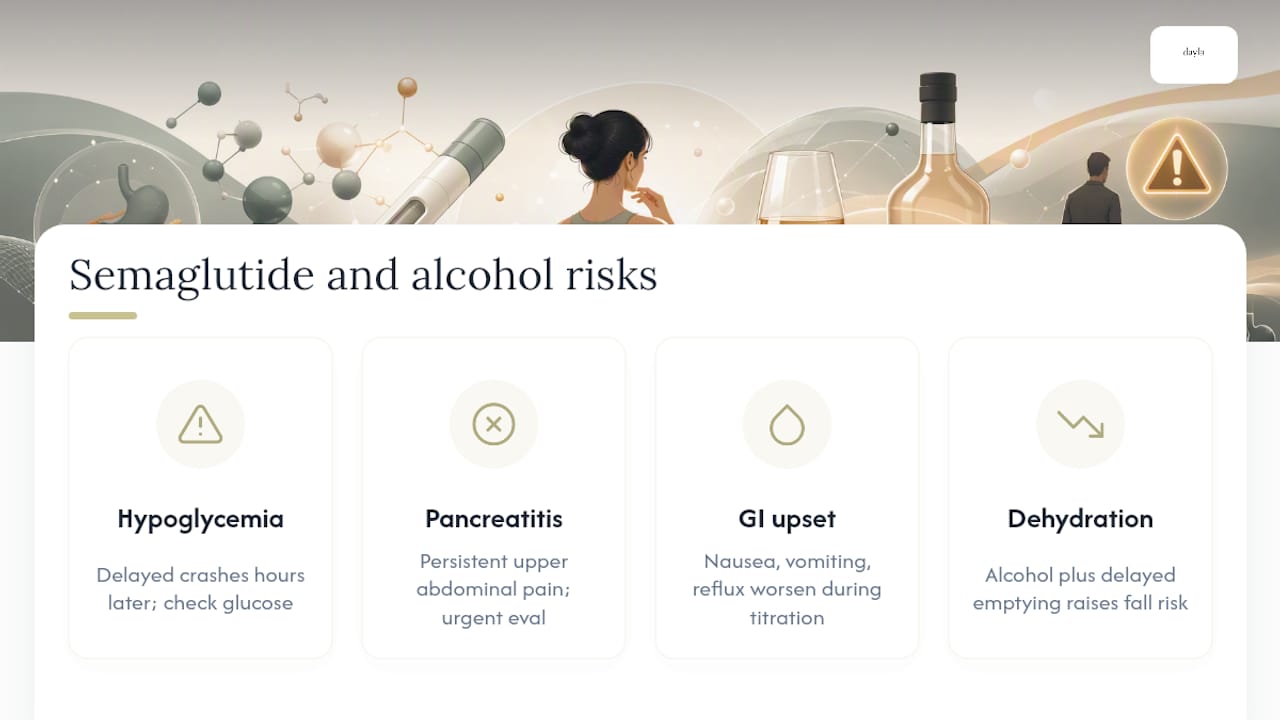
Gastrointestinal amplification is the most common complaint. Semaglutide already causes nausea, vomiting, and reflux for a meaningful share of patients, particularly during dose escalation. Alcohol irritates the same gut lining and worsens delayed gastric emptying, which means the nausea you'd shrug off on a normal night can turn into a genuinely rough one. Clinical reviews of GLP-1 gastrointestinal effects note that these side effects are dose-dependent and tend to peak during titration, which is exactly when alcohol tolerance changes the most.
Dehydration and impairment round out the list. Slowed gastric emptying plus alcohol's own dehydrating effect is a rougher combination than either alone, and it raises fall risk, especially in older adults. If a drink feels stronger or hits faster than expected, treat that as your cue to stop, not push through.
A key clinical distinction: as of 2026, there's no FDA label prohibition against alcohol with semaglutide. It isn't contraindicated. But "not prohibited" is a different standard than "risk-free," and the gap between those two ideas is where most avoidable problems happen.
Rules for Drinking Safely While on Semaglutide
If you're going to drink on semaglutide, a handful of concrete habits lower your risk substantially without requiring you to give up alcohol entirely.
- Eat a real meal first. A balanced plate with protein and carbohydrates slows alcohol absorption and helps stabilize blood sugar, which matters even more when semaglutide is already changing your gastric emptying rate.
- Alternate with water. One glass of water between drinks fights dehydration and gives you a natural pause to notice how intoxicated you're actually getting.
- Skip alcohol on injection day. If you're mid-dose-escalation or already dealing with GI side effects, alcohol on the same day tends to make everything worse. Mid-week, several days out from your weekly dose, is generally the gentler window. Reviewing proper injection timing and technique can help you plan your week around this.
- Coordinate with your prescriber if you're on insulin or a sulfonylurea. Ask for a specific monitoring plan: glucose checks after drinking, a check before bed, and fast-acting carbohydrates on hand in case of a delayed drop.
- Choose lower-sugar drinks over sugary cocktails. A vodka soda or dry wine puts less strain on blood sugar than a margarita or a sweet cocktail, and it keeps your calorie intake from undercutting your weight loss progress.
- Know your stop signal. If a drink hits faster or harder than expected, or nausea spikes, stop. That's your body telling you the usual rules don't apply tonight.
Pro Tip: Keep a small notes app entry with how many drinks you had, what you ate beforehand, and how you felt the next morning. Semaglutide changes alcohol tolerance gradually as your dose increases, and a simple log makes patterns obvious faster than memory alone.
Who Should Be More Careful With Alcohol on Semaglutide?
Some patients face meaningfully higher stakes with semaglutide and alcohol, and the guidance above needs tightening, not loosening, for these groups.
People with type 2 diabetes on insulin or sulfonylureas carry the highest hypoglycemia risk on this list. The combination of alcohol's interference with liver glucose release and these medications' own blood-sugar-lowering effect can produce a crash that arrives well after the drinking has stopped. A documented monitoring plan with your prescriber isn't optional caution here, it's a practical necessity.
People with a current or past alcohol use disorder should understand clearly that semaglutide is not a frontline AUD treatment, even with the encouraging trial data. The NIAAA is explicit that this remains an area of active study, not an approved therapy. If you're managing AUD, addiction-specialty care should lead your treatment plan, with semaglutide as at most a supporting conversation with your care team.
Pregnant and breastfeeding patients face a straightforward answer: avoid alcohol, full stop, and semaglutide use itself carries its own pregnancy-related precautions that your clinician needs to walk through separately. This is not a situation for self-directed harm reduction.
People with a history of pancreatitis or significant liver disease face additive risk from both alcohol and semaglutide independently affecting the pancreas and liver. Specialist input before drinking at all is the responsible move, not an occasional exception.
What Did the Key Clinical Trials Actually Test?
Understanding what these studies did, and did not, prove keeps the bigger claims about semaglutide and alcohol grounded in reality.
The JAMA Psychiatry randomized trial enrolled around 48 adults with alcohol use disorder and randomized them to low-dose weekly semaglutide or placebo over nine weeks. Endpoints included grams of alcohol consumed during controlled lab drinking tasks, peak breath alcohol concentration, self-reported drinks per drinking day, and weekly craving scores. The semaglutide group showed improvement across multiple measures. The limitations are just as important as the results: a small sample, a short window, and a controlled lab environment that doesn't fully mirror real-world drinking patterns.
Separately, a pilot physiological study focused specifically on how GLP-1 receptor agonists change alcohol pharmacokinetics in people with obesity, documenting delayed breath alcohol rise and altered subjective intoxication. This wasn't an alcohol use disorder trial. It was a mechanism study, and it's the piece of evidence that best explains why a drink can feel different in timing and intensity once you're on the medication.
On the observational side, the Scientific Reports analysis combined social media sentiment analysis with real-world usage patterns, which is a fundamentally different kind of evidence than a controlled trial. It shows correlation at scale, not causation in individuals.
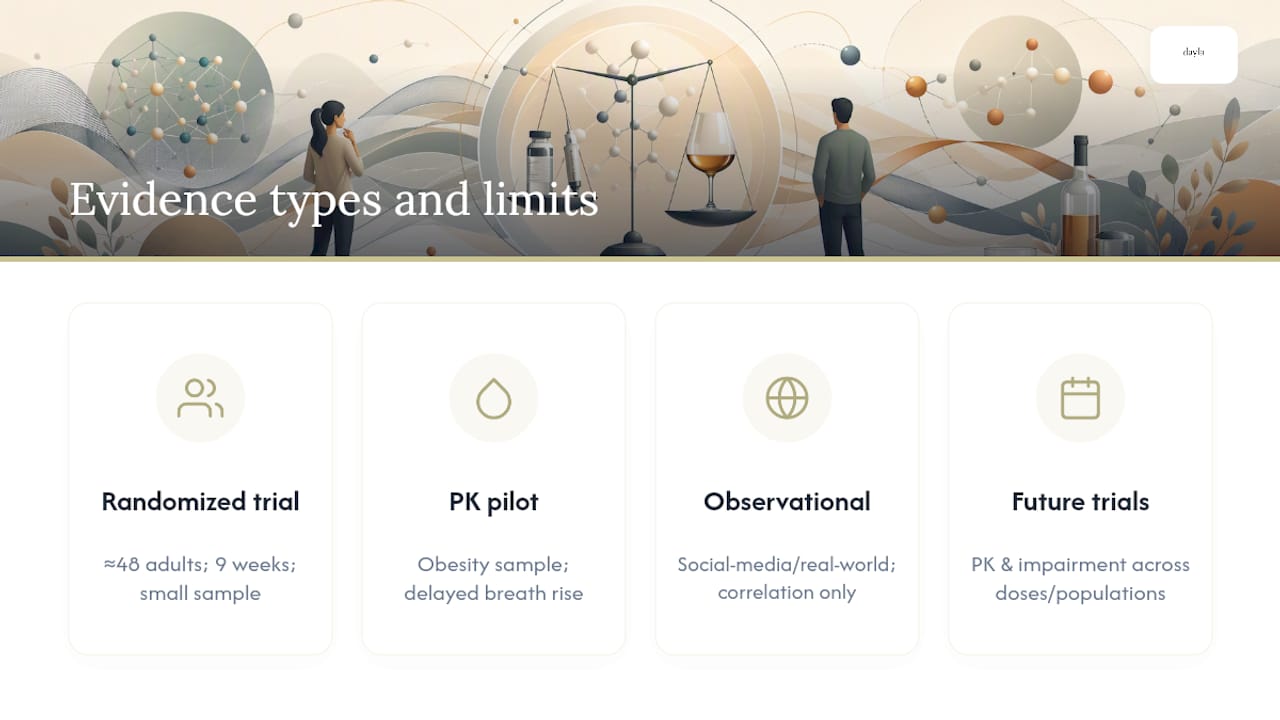
Looking ahead, Clinicaltrials specifically examining how GLP-1 receptor agonist therapy changes alcohol pharmacokinetics and impairment metrics. These trials aim to answer questions the current evidence can't: how much does semaglutide actually change functional impairment at a given blood alcohol level, and does that effect hold across doses and populations. Until that data publishes, treat every current claim about semaglutide reducing alcohol's effects as directionally true but not yet quantified with precision.
How Does Dayla Health Approach Alcohol Questions During Care?
Clinicians on the Dayla Health platform ask direct questions about alcohol use during intake, because the answer changes how a treatment plan gets built. Expect questions about drinking frequency and typical quantity, current medications including insulin or sulfonylureas, and any history of alcohol use disorder or pancreatitis. That information shapes your monitoring plan going forward.
For patients on insulin or secretagogues who drink, the monitoring conversation typically covers glucose checks after drinking and an overnight watch window for delayed hypoglycemia, plus a clear list of pancreatitis warning signs worth reporting immediately. Dietitian visits are part of ongoing care, and those sessions often cover practical drink choices and how alcohol fits into your broader nutrition plan. In some cases, particularly with a heavier drinking history or GI side effects that aren't settling, a clinician may recommend a temporary pause on alcohol rather than pushing through.
Our Take on Where the Evidence Actually Stands
The trial signals here are genuinely exciting, and it would be a mistake to undersell them. But it's also worth being blunt: semaglutide is not an alcohol use disorder treatment today, and treating early craving-reduction data as permission to ignore drinking risk gets the emphasis backward. The safety priorities, hypoglycemia in particular, deserve more attention than the craving headlines usually get.
Our advice stays simple. If you drink, drink less than you used to and pay attention to how your body responds differently now. If you're on insulin or have a history that raises your risk, this is a conversation for your prescriber, not a guess you make alone. Shared decision-making with a clinician who knows your history beats any general rule in an article.
— Flexible
Get Clinician-Supervised GLP-1 Care With Dayla Health
Questions about alcohol and semaglutide are exactly the kind of thing that deserve a real answer from a clinician who knows your medication history, not a guess. Dayla Health builds that oversight into every plan, with no membership fees and transparent cash pricing instead of insurance gatekeeping.
Every plan includes clinician evaluation, ongoing monitoring, and free dietitian visits, whether you choose the GLP-1 Injection plan starting at $179 per month, the GLP-1 Microdose option from $159 per month, or the needle-free Oral GLP Liposomal plan from $149 per month. If you're managing diabetes medication alongside occasional drinking, or you simply want a prescriber who will actually talk through your alcohol questions instead of skipping past them, that kind of coordinated care matters more than most people realize until they need it. Pairing your treatment with smart nutrition planning rounds out the support system further.
Start your online intake with Dayla Health today to get matched with a clinician who can build a monitoring plan around your actual health history, alcohol habits included.
This article is general information, not a substitute for advice from a qualified doctor. Consult a qualified healthcare professional about your own circumstances before acting on anything here.
Sources
- Once-Weekly Semaglutide in Adults With Alcohol Use Disorder: A Randomized Clinical Trial — PubMed / JAMA Psychiatry
- Semaglutide and Tirzepatide reduce alcohol consumption in individuals with obesity — Scientific Reports (2023)
- GLP-1 Drugs Like Ozempic and Alcohol: Potential Issues — WebMD
FAQ
Can I drink alcohol while using semaglutide?
Yes, for most healthy adults, occasional light to moderate drinking is not prohibited on semaglutide, though alcohol often feels stronger and side effects can intensify. People on insulin, sulfonylureas, or with a history of pancreatitis face higher risk and should talk with their prescriber first.
Why does semaglutide make me not want alcohol?
Semaglutide appears to reduce alcohol's pull through two mechanisms: dampened activity in brain reward circuits and slowed gastric emptying that changes how alcohol is absorbed. A randomized trial found reduced craving scores and lower drinking measures in participants over nine weeks, though the effect size and durability are still being studied.
What not to mix with semaglutide?
Alcohol combined with insulin or sulfonylureas is the riskiest overlap, since it raises the chance of delayed, overnight hypoglycemia. Heavy drinking alongside semaglutide also raises pancreatitis risk, and combining alcohol with a missed or doubled semaglutide dose can worsen nausea and dehydration.
What is the best alcohol to drink on semaglutide?
Lower-sugar options like a dry wine, light beer, or a spirit with soda water put less strain on blood sugar than sugary cocktails or mixed drinks loaded with syrup. Sticking to CDC-defined moderate limits, one drink for women and two for men per day, is a reasonable starting ceiling regardless of what you choose.
What should I do if I missed a semaglutide dose and want to drink?
A missed semaglutide dose doesn't change alcohol's risks, but taking it late or doubling up before drinking can spike nausea and GI discomfort. Follow your prescriber's missed-dose guidance first, and avoid alcohol until any resulting nausea or dizziness has settled.