

Semaglutide carries a boxed warning for thyroid C-cell tumors because rodent studies showed dose- and duration-dependent tumor growth, not because human trials have confirmed the same risk. The FDA, DailyMed, and MedlinePlus all flag this uncertainty rather than a proven danger. If you have a personal or family history of medullary thyroid carcinoma or MEN2, semaglutide is off the table. Everyone else should watch for neck lumps, hoarseness, or trouble swallowing and report them right away.
TL;DR:
- Semaglutide's boxed warning is based on rodent studies showing thyroid tumors at high doses, with human relevance still unconfirmed.
- People with a personal or family history of medullary thyroid carcinoma or MEN2 should avoid semaglutide entirely.
- Routine screening tests like calcitonin blood levels or thyroid ultrasounds are not proven useful for low-risk patients and are not recommended.
- The difference in receptor density between rodents and humans explains why tumor risk in animals does not necessarily translate to humans.
- Most human studies show no clear increase in thyroid cancer risk, but long-term effects remain uncertain due to limited follow-up durations.
Table of Contents
- What the FDA and Drug Labels Actually Say About Thyroid C-Cell Tumors
- Why Rodent Studies Found Thyroid Tumors, and Why That Doesn't Translate Directly to People
- What Human Studies Show: Trials, Cohorts, and Systematic Reviews
- Who Should Not Take Semaglutide, and How Your Clinician Should Screen You
- Symptoms to Watch For and the Truth About Thyroid Monitoring
- Special Considerations if You Have Thyroid Disease or Take Levothyroxine
- Questions to Bring to Your Next Appointment
- The Daylahealth Perspective on Screening and Informed Consent
- Sources
What the FDA and Drug Labels Actually Say About Thyroid C-Cell Tumors
The boxed warning on both Wegovy and Ozempic labeling states that semaglutide caused thyroid C-cell tumors in rodents at clinically relevant exposures, and that whether this happens in humans "is unknown," according to DailyMed's Wegovy prescribing information. That phrase, human relevance unknown, is the crux of the entire debate. It's not a confirmed hazard. It's an open question regulators decided was serious enough to put in a box at the top of the label.
The label draws a hard line on who should never start the drug:
- Anyone with a personal history of medullary thyroid carcinoma (MTC)
- Anyone with a family history of MTC
- Anyone with Multiple Endocrine Neoplasia syndrome type 2 (MEN2)
Ozempic's labeling states plainly that routine monitoring with calcitonin blood tests or thyroid ultrasound is of uncertain value for patients without these risk factors, according to DailyMed's Ozempic prescribing information. MedlinePlus reinforces this by instructing patients to report any neck lump, hoarseness, difficulty swallowing, or shortness of breath directly to a clinician rather than waiting for a scheduled screening test, per MedlinePlus drug information.
Why Rodent Studies Found Thyroid Tumors, and Why That Doesn't Translate Directly to People
Rodents have far more GLP-1 receptors on their thyroid C cells than humans do. That single anatomical difference explains a lot of the disconnect between animal findings and what shows up in human trials. When rats and mice are exposed to a GLP-1 receptor agonist over a large share of their lifespan, those receptor-dense C cells respond by proliferating, sometimes developing into calcitonin-secreting tumors.
Human C cells simply don't carry the same receptor density, so the same biological chain reaction doesn't fire the same way. A few points matter here:
- Rodent carcinogenicity studies typically run for two years, which covers most of a rodent's natural lifespan but is a fraction of a human treatment timeline.
- The tumors appeared at exposures well above typical human therapeutic doses in some study designs.
- The proposed mechanism runs through C-cell hyperplasia (a buildup of these calcitonin-producing cells) before progressing toward tumor formation.
Regulators didn't wait for proof this happens in people. They saw a plausible mechanism, a dose-response pattern in animals, and applied a precautionary warning while human data caught up.
Pro Tip: If a clinician tells you "the mechanism doesn't map cleanly onto human biology," that's not dismissiveness. It's an accurate summary of where the science actually stands.
What Human Studies Show: Trials, Cohorts, and Systematic Reviews
Large human trials and observational cohorts have not produced a convincing signal of increased medullary thyroid carcinoma. That's the central finding of a 2025 systematic review covering GLP-1 receptor agonists and thyroid outcomes, which concluded that rodent data drove the original safety concern but human evidence hasn't caught up to confirm it, according to the systematic review published on PMC. The review still calls for continued long-term surveillance, since MTC is rare enough that even large trials may lack the statistical power to rule out a small effect.
A separate literature synthesis looked specifically at meta-analytic data across semaglutide-treated populations. It found genuinely mixed results:
- Some meta-analyses reported a small relative increase in overall thyroid carcinoma risk.
- When researchers isolated papillary thyroid cancer and medullary thyroid cancer individually, neither reached statistical significance.
- Absolute incidence across treated cohorts remained low throughout follow-up, according to the systematic literature review on thyroid carcinogenic risk.
That gap between "relative increase" and "statistically significant absolute risk" trips up a lot of readers. A relative increase sounds alarming until you realize it's often the difference between an already-rare event happening slightly more or less often in a specific dataset. Some newer mechanistic research has gone further, suggesting semaglutide may even influence tumor microenvironments in ways that could suppress certain tumor types, though Endocrine News is careful to note these findings remain preliminary.
What's unknown still matters. Follow-up periods in most human trials run years, not decades, and MTC can take a long time to develop. Nobody can honestly claim the long-term picture is fully painted yet.
Who Should Not Take Semaglutide, and How Your Clinician Should Screen You
Semaglutide is contraindicated for a specific, narrow group of people, and your clinician has an obligation to ask about this before writing a prescription.
- Personal history of MTC. If you've had this cancer before, semaglutide is not an option, full stop.
- Family history of MTC. A first-degree relative with medullary thyroid carcinoma should prompt your clinician to rule out semaglutide and consider genetic counseling.
- MEN2 syndrome. This inherited condition carries a dramatically elevated baseline risk for MTC, making semaglutide unsuitable regardless of your current thyroid status.
- Unclear family thyroid history. If you're not sure, say so. A clinician who hears "I don't know my family's thyroid history" should dig further rather than assume it's clear.
Beyond the contraindications, this comes down to a shared decision. For most patients without these risk factors, the documented metabolic benefits of semaglutide are weighed against a theoretical cancer risk that human data haven't confirmed. That's a conversation, not a formality.
Symptoms to Watch For and the Truth About Thyroid Monitoring
Report these symptoms to a clinician promptly rather than waiting for a routine visit:
- A new lump or swelling in the neck
- Hoarseness that doesn't resolve within a couple of weeks
- Difficulty swallowing
- Shortness of breath with no clear cause
Roswell Park Cancer Center's patient guidance echoes this same list and frames it as the practical takeaway for anyone on semaglutide.
Here's where things get genuinely complicated: serum calcitonin testing and thyroid ultrasound sound like obvious solutions, but neither is a clean answer. Calcitonin has low specificity, meaning plenty of people without MTC will still show mild elevations. Ultrasound picks up benign thyroid nodules constantly, since they're common in the general population regardless of medication use. That's exactly why labels state routine screening in average-risk patients isn't recommended.
Pro Tip: If a calcitonin level comes back above roughly 50 ng/L, or an ultrasound flags a suspicious nodule, that's when specialist referral becomes appropriate, not before.
Special Considerations if You Have Thyroid Disease or Take Levothyroxine
Semaglutide slows gastric emptying, and that alone can shift how much levothyroxine your body actually absorbs. Weight loss itself can also change how much thyroid hormone you need, independent of any drug interaction.
Case reports describe patients on levothyroxine developing suppressed TSH after starting a GLP-1 receptor agonist, sometimes requiring a dose reduction of around 25%, according to a case report published in a peer-reviewed journal. A few practical steps follow from this:
- Get TSH checked 6 to 12 weeks after starting semaglutide or after any dose increase.
- Watch for symptoms of overreplacement (racing heart, anxiety, insomnia) that might signal your levothyroxine dose is now too high relative to your changing needs.
- Loop in your endocrinologist if you're managing hypothyroidism or a prior thyroidectomy alongside a new semaglutide prescription, since the two conditions interact in ways a single prescriber might not fully track.
Weight loss affects your endocrine system broadly, and thyroid hormone dosing rarely stays static through a significant change in body weight.
Questions to Bring to Your Next Appointment
A focused conversation with your clinician beats a vague worry every time. Bring these questions:
- Do I have any personal or family history that would make semaglutide contraindicated for me?
- What symptoms should prompt me to call you immediately rather than wait for my next visit?
- If I'm on levothyroxine, when will we recheck my TSH after I start or adjust this medication?
- What would make you pause or stop this prescription?
Pro Tip: Write down your family's thyroid and cancer history before your appointment. A clinician can screen you far faster with concrete names and conditions than with "I think someone had thyroid issues."
The Daylahealth Perspective on Screening and Informed Consent
Contraindication screening for MTC and MEN2 is treated as non-negotiable and includes clinician-led evaluation before any GLP-1 medication ships, with conversations about personal and family thyroid cancer history.
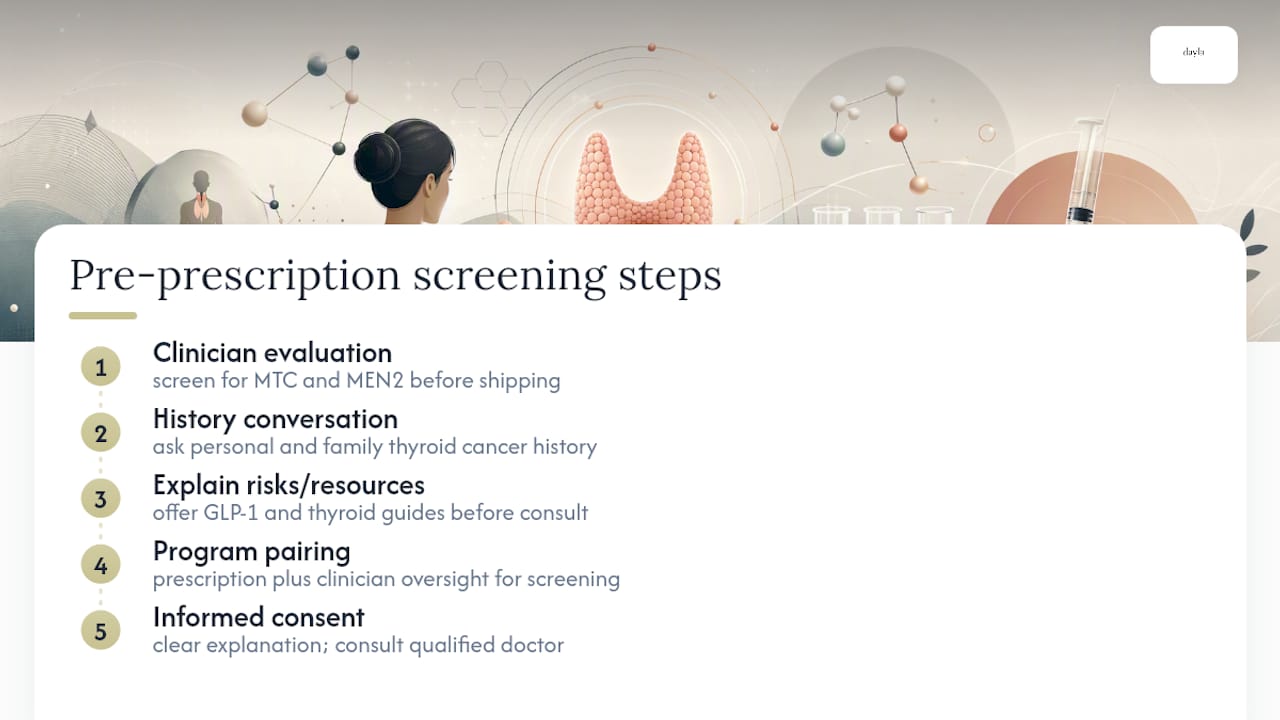
The evidence on semaglutide and thyroid risk is genuinely nuanced, and we'd rather over-explain it than let a patient discover the boxed warning cold on a package insert. For readers who want to go deeper on related mechanisms, our guide to how GLP-1 receptor agonists work and our breakdown of how thyroid function affects weight are good starting points before that first consult.
If you're evaluating whether medically supervised GLP-1 treatment fits your health history, Daylahealth's GLP-1 weight care program pairs prescription access with clinician oversight built around exactly this kind of screening.
— Flexible
This article is general information, not a substitute for advice from a qualified doctor. Consult a qualified healthcare professional about your own circumstances before acting on anything here.
Sources
- Semaglutide Injection: MedlinePlus Drug Information
- DailyMed — WEGOVY (semaglutide) prescribing information
- GLP‑1RAs and thyroid outcomes — systematic review (PMC)