

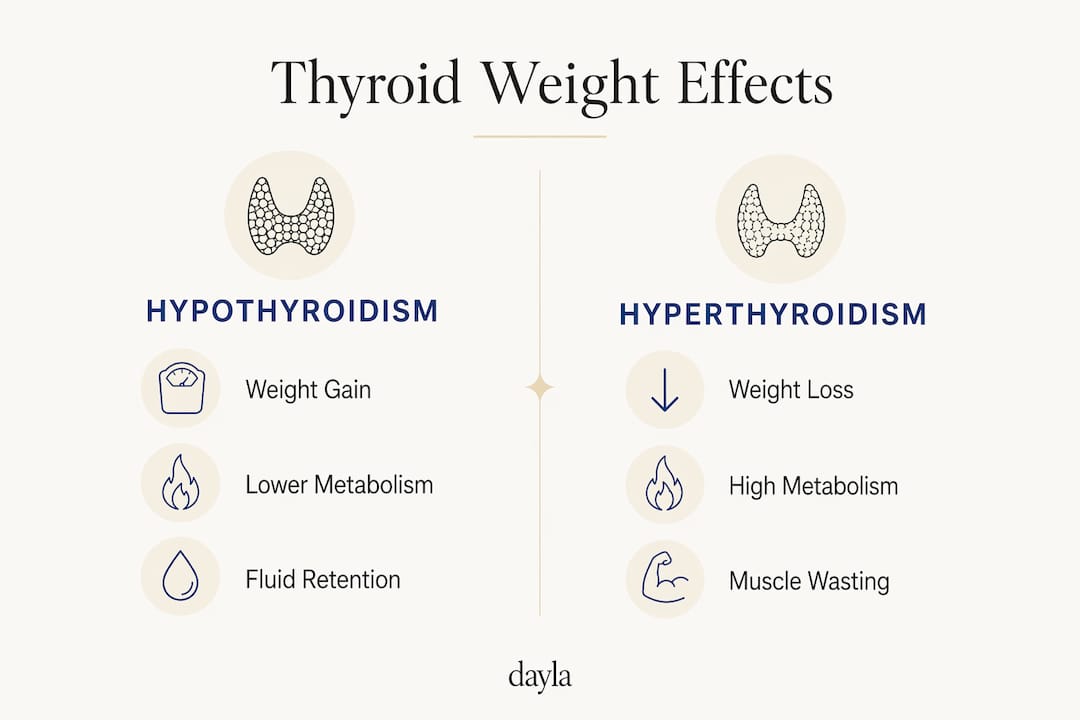
Your thyroid has a real effect on your weight, but probably not as large as you've been told. For most people with hypothyroidism, the typical weight gain is about 3–5 kg (5–10 lb), and much of that reflects fluid retention rather than added fat. Hyperthyroidism drives the opposite: unexplained weight loss that often reverses, sometimes past your starting point, once treatment begins. The American Thyroid Association is clear that thyroid hormones are only one of many regulators of body weight, and that changing thyroid levels alone does not reliably predict how much weight any individual will lose or gain.
If you're noticing unexplained weight changes alongside symptoms like fatigue, cold intolerance, or a racing heart, the right first move is to ask your clinician for a TSH and free T4 test. If autoimmune thyroid disease is suspected, add thyroid peroxidase (TPO) antibodies to that panel. Those three numbers will tell you far more than any symptom checklist.
- Typical hypothyroid weight gain: 3–5 kg (5–10 lb), mostly fluid
- Typical hyperthyroid weight loss: variable, often significant, with rebound risk after treatment
- First test to request: TSH, then free T4; add TPO antibodies if autoimmune disease is suspected
- Key reality check: normalizing thyroid function rarely resolves obesity on its own
Consensus estimate: Most patients with overt hypothyroidism gain no more than 5–10 lb attributable to thyroid dysfunction. Larger weight gains almost always have additional causes.
Table of Contents
- How do thyroid hormones control your metabolism?
- How does hypothyroidism cause weight gain?
- Why does hyperthyroidism cause weight loss, and what happens after treatment?
- How much weight does thyroid disease actually explain?
- What tests tell you whether your thyroid is affecting your weight?
- What should you expect from treatment, and what does it cost?
- Should you use thyroid hormone for weight loss?
- Practical weight-management strategies when you have thyroid disease
- When should you see a doctor about thyroid-related weight changes?
- Key Takeaways
- What clinicians want you to understand about thyroid and weight
- If thyroid treatment isn't enough, Daylahealth can help
- Authoritative sources and further reading
How do thyroid hormones control your metabolism?
The thyroid gland sits at the base of your neck and produces two primary hormones: thyroxine (T4) and triiodothyronine (T3). T4 is the dominant circulating form, but it functions largely as a precursor. Peripheral tissues, particularly the liver and kidneys, convert T4 into the biologically active T3, which is what actually drives cellular metabolism.
T3 works by binding to nuclear receptors inside cells and directly influencing gene expression. The downstream effects are broad: increased oxygen consumption, higher resting energy expenditure, greater heat production (thermogenesis), and faster turnover of carbohydrates, fats, and proteins. When T3 levels are adequate, your basal metabolic rate (BMR) stays in its normal range. When they fall, BMR drops, and your body burns fewer calories at rest.
The connections don't stop at BMR. Thyroid hormones interact with several other metabolic regulators:
- Leptin: T3 influences leptin sensitivity; hypothyroidism can blunt the satiety signal leptin normally provides.
- Neuropeptide Y (NPY): Low T3 may increase NPY activity, which drives appetite upward.
- Insulin sensitivity: Hypothyroidism is associated with mild insulin resistance, which can promote fat storage.
- Adipose and muscle tissue: T3 promotes lipolysis (fat breakdown) and protein synthesis; low T3 favors fat accumulation and lean mass loss over time.
Weight is regulated by a network of hormones, proteins, and neural signals, and thyroid is one contributor among many. That context matters when you're setting expectations for what thyroid treatment will and won't do for your weight.
Pro Tip: Ask your clinician for both TSH and free T4 at your first thyroid evaluation. TSH alone can miss early or secondary thyroid dysfunction, and free T4 gives a more complete picture of hormone availability.
How does hypothyroidism cause weight gain?
When the thyroid underproduces T4 and T3, BMR slows, and the body begins to retain sodium and water in a process called myxedema. This fluid accumulation, driven by increased glycosaminoglycan deposition in connective tissue, accounts for most of the weight gain associated with hypothyroidism. The weight gain is typically modest, around 3–5 kg (5–10 lb), and is rarely the dramatic increase many patients fear.

Severity matters. Subclinical hypothyroidism (elevated TSH with normal free T4) tends to produce minimal or no measurable weight change. Overt hypothyroidism, where both TSH is elevated and free T4 is low, produces more pronounced effects. Even then, gains exceeding 10–15 lb that are attributed solely to the thyroid are unusual and warrant investigation for other causes.
Weight gain in hypothyroidism almost always appears alongside other symptoms. These are the clinical clues that point toward the thyroid rather than lifestyle or another condition:
- Persistent fatigue that doesn't improve with rest
- Cold intolerance, particularly in the hands and feet
- Dry skin, brittle nails, or hair thinning
- Constipation without a dietary explanation
- Slowed thinking or difficulty concentrating
- Low mood or depression
- Irregular or heavier menstrual periods
Statistic to know: Population studies from the DanThyr cohort associate differences in thyroid-function tests with approximately 5 kg differences in body weight across groups, underscoring that the effect is real but modest at the population level.
Risk factors that raise your likelihood of hypothyroidism include:
- Autoimmune thyroiditis (Hashimoto's disease), the most common cause in the U.S.
- Family history of thyroid disease
- Prior thyroid surgery or radioactive iodine treatment
- Certain medications, including lithium, amiodarone, and some checkpoint inhibitors
- Female sex, particularly after pregnancy or menopause
Why does hyperthyroidism cause weight loss, and what happens after treatment?
An overactive thyroid floods the body with excess T3 and T4, pushing BMR into overdrive. Cells burn through energy faster, lipolysis accelerates, and both muscle and bone mass can erode over time. The result is often significant, sometimes rapid, weight loss. The catch: appetite usually rises in parallel, so some people with hyperthyroidism eat substantially more yet still lose weight. Others gain weight because the appetite increase outpaces the metabolic acceleration.

After successful treatment, whether through antithyroid medications, radioactive iodine, or surgery, the metabolic rate normalizes. But eating habits set during the hyperthyroid phase don't always reset at the same pace. Many patients regain the weight they lost and some overshoot their pre-illness weight because appetite and anabolic recovery continue while the elevated caloric intake persists. Understanding this dynamic before treatment helps patients prepare, rather than be caught off guard.
Symptoms that distinguish hyperthyroidism from other causes of weight loss:
- Heart palpitations or a noticeably rapid heartbeat
- Fine tremor in the hands
- Heat intolerance and excessive sweating
- Anxiety, irritability, or difficulty sleeping
- Frequent bowel movements
- Enlarged thyroid (goiter) or eye changes (in Graves' disease)
If you're losing weight without trying and recognize several of these symptoms, request a TSH test promptly. A suppressed TSH is the hallmark finding.
How much weight does thyroid disease actually explain?
The evidence on thyroid-related weight changes is more nuanced than most online sources suggest. Here's what the major studies and reviews actually show:
Consensus estimate: Overt hypothyroidism typically accounts for a modest weight gain, most of it fluid. This figure comes from multiple PMC reviews and is endorsed by the American Thyroid Association.
| Condition | Typical weight effect | Primary composition | Notes |
|---|---|---|---|
| Overt hypothyroidism | +3–5 kg (+5–10 lb) | Fluid/salt retention (myxedema), some fat | Larger gains suggest additional causes |
| Subclinical hypothyroidism | Minimal to none | Unclear; may reflect fluid | Effect size is debated |
| Overt hyperthyroidism | Variable loss | Lean mass, fat, fluid | Appetite often rises simultaneously |
| Post-treatment (hyperthyroid) | Variable gain | Lean mass recovery, fat, fluid | May exceed pre-illness weight |
Population data from the DanThyr cohort shows roughly 5 kg differences in body weight between groups at opposite ends of the thyroid-function spectrum. That's a meaningful association at the population level, but it doesn't mean every individual with a borderline TSH will lose 5 kg by treating it.
Obesity itself complicates the picture. Higher BMI is associated with modestly elevated TSH and altered free T3/T4 ratios, even without primary thyroid disease. Weight reduction can normalize these small abnormalities, which means a mildly elevated TSH in a patient with obesity may reflect metabolic adaptation rather than true hypothyroidism. This bidirectional relationship is one reason clinicians often repeat thyroid tests after weight loss before committing to long-term replacement therapy.
What tests tell you whether your thyroid is affecting your weight?
Core laboratory tests:
- TSH (thyroid-stimulating hormone): The first-line test. Elevated TSH suggests hypothyroidism; suppressed TSH points to hyperthyroidism. Most U.S. labs use a reference range of approximately 0.4–4.0 mIU/L, though interpretation depends on symptoms and clinical context.
- Free T4: Ordered alongside TSH to confirm overt disease. A low free T4 with high TSH confirms hypothyroidism; a high free T4 with suppressed TSH confirms hyperthyroidism.
- Free T3: Useful in select cases, particularly when symptoms persist despite normal TSH and free T4, or when T3 toxicosis is suspected.
- TPO antibodies: Ordered when autoimmune thyroid disease (Hashimoto's or Graves') is suspected based on symptoms, family history, or borderline results.
Practical checklist for your clinician visit:
- Ask for TSH and free T4 together, not TSH alone
- Request TPO antibodies if you have a family history of autoimmune disease or other autoimmune conditions
- Ask about medication interactions that can affect thyroid tests (biotin, certain supplements, corticosteroids)
- If results are borderline, ask about repeating the test in 6–8 weeks before starting treatment
- Discuss the reference range your lab uses and whether your result is clinically significant given your symptoms
Non-thyroid causes to investigate concurrently:
- Medications (corticosteroids, antidepressants, antipsychotics, beta-blockers)
- Mood disorders, particularly depression
- Cushing's syndrome (cortisol excess)
- Polycystic ovary syndrome (PCOS)
- Recent changes in physical activity or diet
- Sleep disorders, including obstructive sleep apnea
Subclinical hypothyroidism, where TSH is mildly elevated but free T4 is normal, is common and does not always require treatment. Clinicians should interpret marginal TSH elevations in the context of BMI, symptoms, and repeat testing before starting long-term replacement.
What should you expect from treatment, and what does it cost?
Hypothyroidism treatment centers on levothyroxine (synthetic T4), which is one of the most prescribed medications in the United States. Once you start at the right dose, the body converts T4 to T3 and metabolic function gradually normalizes. The initial weight loss after treatment is primarily diuresis: the body excretes the excess fluid that accumulated during the hypothyroid period. Fat mass changes are slower and more modest.
Hyperthyroidism treatment (antithyroid drugs, radioactive iodine, or surgery) lowers hormone production. As metabolic rate normalizes, weight typically returns. Some patients gain past their pre-illness baseline, particularly if eating habits established during the high-metabolism phase persist.
Realistic timeline:
- Weeks 1–4: Levothyroxine begins working; some patients notice improved energy and early fluid loss
- Weeks 6–12: First TSH recheck; dose adjustment if needed; most symptom improvement occurs in this window
- Months 3–6: Weight stabilization; fluid loss is largely complete; fat mass changes, if any, become apparent
- Months 6–12: Full metabolic equilibration; if significant excess weight remains, it likely reflects factors beyond thyroid function
Pro Tip: Take levothyroxine on an empty stomach, 30–60 minutes before eating, and avoid calcium, iron supplements, or antacids within four hours. Timing errors are one of the most common reasons patients feel undertreated despite a "normal" TSH.
Approximate U.S. cost ranges (general guidance, not a quote):
- Primary care visit: $150–$300 without insurance; copays typically $20–$50
- Endocrinology visit: $200–$500 without insurance; specialist copays vary
- Standard thyroid lab panel (TSH, free T4): $50–$150 out of pocket; often covered under preventive or diagnostic benefits
- Generic levothyroxine: $10–$30/month without insurance; often $0–$10 with most prescription plans
These figures are approximate and vary by location, provider, and insurance plan.
Should you use thyroid hormone for weight loss?
No. Using thyroid hormone at doses above what your body needs is unsafe and ineffective as a long-term weight-loss strategy. The American Thyroid Association is explicit on this point: excess thyroid hormone causes serious adverse effects, and any weight lost is almost always regained when the hormone is stopped.
Risks of supraphysiologic thyroid hormone use:
- Cardiac arrhythmias, including atrial fibrillation
- Accelerated bone loss and increased fracture risk
- Muscle wasting and reduced physical function
- Insomnia, anxiety, and palpitations
- Suppression of the body's own thyroid production
One crossover trial found L-T3 associated with approximately 2.1 kg greater weight loss compared to L-T4 in a specific, monitored setting, but this finding does not support routine T3 use for weight control. The context was tightly controlled replacement therapy, not weight-loss dosing.
When thyroid hormone adjustment is clinically appropriate:
- Documented overt hypothyroidism with confirmed low free T4
- Monitored replacement therapy titrated to keep TSH within the normal range
- Dose rechecks after significant weight change, pregnancy, or new medications
- Clinician-supervised combination T4/T3 therapy in select patients who remain symptomatic on T4 alone
The line between appropriate replacement and misuse is the TSH target. If your TSH is suppressed below the normal range on your current dose, that's a signal to reduce, not maintain.
Practical weight-management strategies when you have thyroid disease
Optimizing your thyroid treatment is the foundation, but it's rarely sufficient on its own for meaningful fat loss. Delaying obesity-specific treatment while waiting for thyroid normalization is often unwarranted. The evidence supports treating both concurrently.
Step-by-step approach:
- Confirm your thyroid is optimally treated. A TSH in the lower half of the normal range (roughly 0.5–2.5 mIU/L) is where most patients feel best. If you're symptomatic at a TSH of 3.8, that's worth discussing with your clinician.
- Prioritize resistance training. Hypothyroidism reduces lean mass over time. Resistance exercise two to three times per week protects muscle, supports BMR, and improves insulin sensitivity.
- Maintain adequate protein intake. Aim for 1.2–1.6 g of protein per kilogram of body weight daily. Protein supports muscle preservation and increases satiety, which is particularly useful when fatigue blunts motivation to exercise.
- Address fatigue strategically. If low energy is limiting activity, shorter, more frequent sessions (20–30 minutes) are more sustainable than long workouts. Morning exercise often works better for people with thyroid-related fatigue, before the day's demands accumulate.
- Consider evidence-based weight-loss treatments. When thyroid optimization and lifestyle changes aren't enough, prescription options exist. GLP-1 receptor agonists, for example, have strong evidence for meaningful weight reduction and are available through doctor-led programs. You can explore weight loss prescription options to understand what's currently available.
- Use fiber strategically for appetite control. Soluble fiber slows gastric emptying and blunts post-meal glucose spikes, which helps manage appetite when thyroid-related hunger signals are dysregulated.
Questions to bring to your next clinician visit:
- Is my current TSH in the range where I'm likely to feel my best?
- Should we recheck my labs given my recent weight changes?
- Am I a candidate for a weight-loss prescription alongside my thyroid treatment?
- Would a referral to an endocrinologist or a registered dietitian be appropriate?
- What monitoring plan makes sense for the next 6–12 months?
Pro Tip: If you're considering a GLP-1 medication and have thyroid disease, tell your prescribing clinician upfront. Some GLP-1 agents carry a precautionary note regarding thyroid C-cell tumors (based on rodent data), and your clinician will factor your thyroid history into the prescribing decision.
Not sure whether you qualify for a GLP-1? The GLP-1 readiness quiz at GLPCare can help you assess candidacy before your appointment.
When should you see a doctor about thyroid-related weight changes?
Most thyroid-related weight changes develop gradually and don't require emergency care. But some presentations warrant prompt, sometimes urgent, evaluation.
Red flags that need same-day or next-day attention:
- Rapid, unexplained weight loss of more than 5% of body weight over one to two months
- Rapid weight gain with visible swelling, shortness of breath, or difficulty lying flat
- Heart palpitations with fainting or near-fainting episodes
- Severe fatigue combined with cold intolerance and slowed speech (possible myxedema coma, a rare emergency)
- Sudden eye protrusion or significant vision changes (possible Graves' ophthalmopathy)
Routine evaluation is appropriate when:
- You've gained 5–10 lb without a clear dietary or activity explanation and have at least two other hypothyroid symptoms
- You've lost weight without trying for more than four to six weeks
- You have a known thyroid condition and your symptoms have changed despite being on medication
- You have a strong family history of thyroid disease and have never been tested
Clinical note: The American Thyroid Association recommends that clinicians consider thyroid testing in patients presenting with unexplained weight change, particularly when accompanied by other systemic symptoms. A single TSH result is usually sufficient to screen; abnormal results prompt the full panel.
For non-urgent concerns, a primary care visit with a basic thyroid panel is the right starting point. If TSH is significantly abnormal or symptoms are complex, ask for an endocrinology referral. Most endocrinologists can see non-urgent thyroid patients within four to eight weeks.
Key Takeaways
Thyroid dysfunction causes real but typically modest weight changes, and treatment alone rarely resolves significant obesity. Addressing both thyroid function and weight concurrently produces better outcomes than waiting for one to fix the other.
| Point | Details |
|---|---|
| Modest effect size | Hypothyroidism typically causes 3–5 kg (5–10 lb) of weight gain, mostly fluid retention. |
| Test first | Request TSH and free T4; add TPO antibodies if autoimmune disease is suspected. |
| Treatment restores, not transforms | Levothyroxine usually returns weight to pre-illness levels; it rarely resolves pre-existing obesity. |
| Never use thyroid hormone for weight loss | Excess thyroid hormone causes arrhythmia, bone loss, and muscle wasting, with weight regain when stopped. |
| Treat both concurrently | Evidence supports addressing obesity alongside thyroid care, not waiting for thyroid normalization first. |
What clinicians want you to understand about thyroid and weight
The most common misconception I see in thyroid care is the belief that fixing the thyroid will fix the weight. It's an understandable assumption: the thyroid controls metabolism, metabolism controls weight, so treating the thyroid should solve the problem. The reality is more layered.
Normalizing a TSH rarely produces dramatic fat loss. What it does produce is a return toward baseline: the fluid comes off, energy improves, and the metabolic drag lifts. For patients who were at a healthy weight before their thyroid became underactive, that's often enough. For patients who were already carrying excess weight, thyroid treatment is the foundation, not the solution.
The guidelines from the American Thyroid Association and the evidence reviewed in major endocrinology journals are consistent on this point: obesity treatment should not wait for thyroid optimization. Both problems deserve attention at the same time. That means repeat labs, dose titration when needed, and a parallel conversation about behavioral strategies, nutrition, and, when appropriate, prescription weight-loss medications.
What makes the biggest difference in clinical practice is when patients come in with realistic expectations and specific questions. Knowing your TSH target, understanding what your free T4 means, and asking about your options beyond levothyroxine puts you in a far stronger position than waiting to see whether the thyroid medication "works" on its own.
If thyroid treatment isn't enough, Daylahealth can help

When thyroid optimization leaves excess weight unresolved, a doctor-led weight-loss program may be the right next step. Daylahealth offers personalized GLP-1 weight-loss prescriptions designed for people who need more than lifestyle changes alone. GLP-1 medications have strong clinical evidence for meaningful, sustained weight reduction and work alongside thyroid treatment, not instead of it.
If you're ready to explore whether a prescription weight-loss program fits your situation, medically supervised weight loss through Daylahealth gives you access to clinician oversight, personalized dosing, and ongoing support.
This article is general health information, not medical advice. Confirm current guidelines and your individual treatment plan with a qualified clinician or your primary care provider.
Authoritative sources and further reading
These are the primary references used throughout this article. Each is appropriate to share with your clinician.
- American Thyroid Association: Thyroid and Weight — The ATA's patient-facing summary of how thyroid hormones affect body weight, why the relationship is complex, and why thyroid hormone should not be used for weight loss.
- PMC: Hypothyroidism and Obesity — An Intriguing Link — A peer-reviewed review covering the mechanisms, magnitude, and clinical implications of thyroid-related weight gain, including the 3–5 kg estimate.
- PMC: Thyroid Function and Obesity — Covers the bidirectional relationship between thyroid tests and BMI, including population data and the effect of weight loss on thyroid-function normalization.
- Nature Reviews Endocrinology: The Complexity of Thyroid Disease and Body Weight — A high-level review of the mechanisms behind thyroid-related weight change, including the role of myxedema, diuresis, and the risks of supraphysiologic hormone use.
- PMC: When Should Obesity Treatment in Thyroid Disease Begin? — Evidence-based guidance on concurrent management of thyroid dysfunction and obesity, including why delaying obesity treatment is often unwarranted.
- PMC: Thyroid Hormones and Weight Change (2017 Analysis) — Examines whether baseline thyroid hormones predict weight loss or regain during dietary interventions.
- Daylahealth: GLP-1 Weight Loss Programs — For readers whose weight concerns extend beyond thyroid management, Daylahealth's doctor-led GLP-1 programs offer a structured, prescription-based path forward.