

Muscle loss during weight loss is defined as the reduction of skeletal muscle mass that occurs when your body breaks down muscle protein for energy during a calorie deficit. Clinically, this process is called muscle atrophy or muscle wasting, and it is a normal physiological response to sustained energy restriction. Research shows that muscle loss accounts for 10% to 25% of total weight lost, with faster rates under extreme caloric restriction or weight loss medications. That range matters because losing muscle is not just a cosmetic concern. It directly affects your metabolism, your strength, and your ability to keep the weight off long term.
What is muscle loss during weight loss and why does it happen?
Muscle loss begins at the cellular level the moment your calorie deficit outpaces your body's glycogen reserves. Glycogen depletion triggers muscle protein breakdown through a process called gluconeogenesis, where your liver converts amino acids from muscle tissue into glucose for fuel. Your body treats muscle as an energy reserve, not a protected asset, which is why it gets sacrificed during prolonged energy shortages.
The rate of muscle loss is not the same for everyone. Here is what accelerates it:
- Extreme caloric restriction forces your body to cannibalize muscle faster because fat mobilization cannot keep pace with the energy demand.
- Rapid weight loss compresses the timeline, leaving less opportunity for your body to adapt and spare lean tissue.
- High fat-free mass at baseline actually increases risk. People with more muscle lose relatively more during aggressive dieting because their bodies have more muscle to draw from.
- Sedentary behavior removes the mechanical signal that tells your body to preserve muscle, making breakdown the path of least resistance.
- Pharmacological weight loss, including GLP-1 receptor agonists, can accelerate total weight loss and, without proper nutritional support, increase the proportion of muscle lost.
Muscle is metabolically expensive tissue. Your body burns roughly 6 calories per pound of muscle at rest, compared to about 2 calories per pound of fat. During an energy shortage, eliminating that metabolic cost looks like an efficient solution to your body, even though it creates serious downstream problems for you.
What are the consequences of losing muscle while dieting?
The consequences of muscle atrophy during weight loss extend well beyond feeling weaker in the gym. They affect your metabolism, your risk of chronic disease, and your ability to sustain any weight loss you achieve.
- Metabolic slowdown. Losing muscle lowers your resting metabolic rate, which means your body burns fewer calories at rest. This creates the conditions for weight regain the moment you return to normal eating.
- Fat infiltration. Muscle tissue can be replaced by intramuscular fat, a process where fat cells infiltrate the muscle fibers. Your muscle may look similar in size on a scan, but its functional capacity drops significantly.
- Increased inflammation and insulin resistance. Reduced muscle mass is linked to higher systemic inflammation and impaired glucose uptake, both of which raise your risk of type 2 diabetes and cardiovascular disease.
- Impaired strength and mobility. Everyday tasks become harder. Stair climbing, carrying groceries, and recovering from injury all depend on muscle reserves that dieting can quietly deplete.
- Compounded risk for older adults. Age-related muscle loss, called sarcopenia, accelerates after 50. Dieting without muscle preservation strategies on top of natural aging creates a compounding deficit that is difficult to reverse.
"Muscle loss creates a metabolic perfect storm: a lower resting metabolic rate combined with fat infiltration and reduced function means the body is less equipped to sustain weight loss and more prone to regaining it." — Harvard Health
The key insight here is that the number on the scale can look favorable while your body composition is actually moving in the wrong direction. Weight loss and fat loss are not the same thing. Protecting muscle is what makes the difference between the two.
How to minimize muscle loss while losing weight
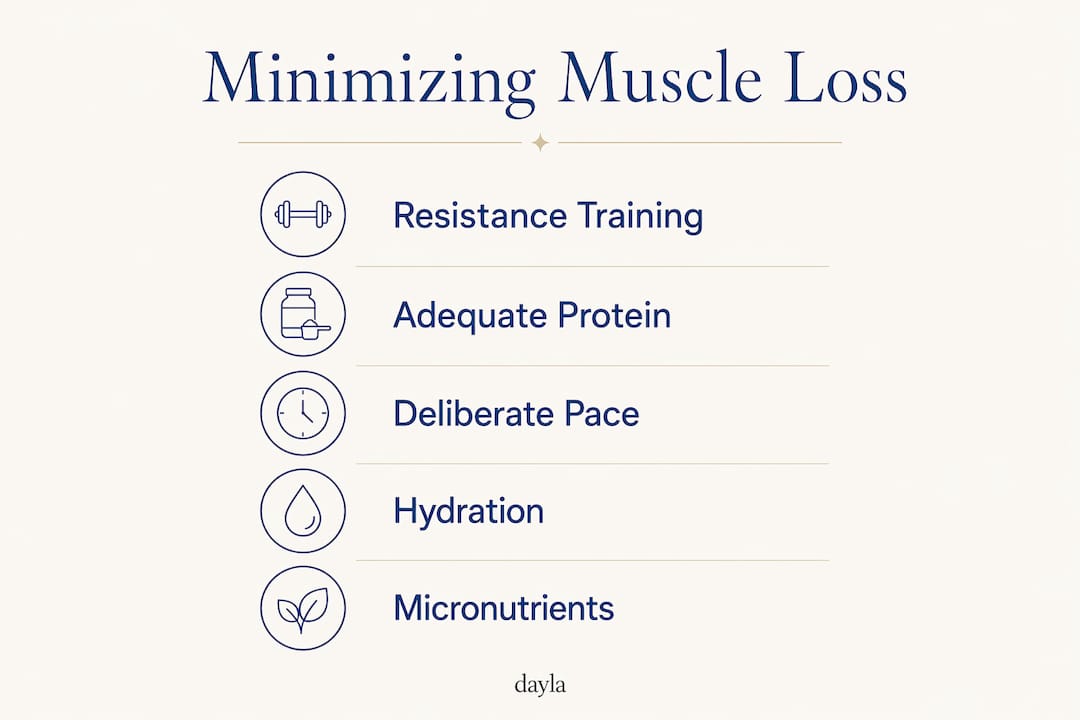
Preventing muscle loss during a calorie deficit is achievable with the right combination of training, nutrition, and pacing. The evidence is clear on what works.
Resistance training comes first
Resistance training is more effective than aerobic exercise for preserving or increasing lean body mass during caloric restriction. Lifting weights, using resistance bands, or performing bodyweight exercises at least twice per week sends a direct signal to your muscles that they are needed. Aerobic exercise burns calories but does not provide the same mechanical stimulus to retain lean tissue. For best results, combine both, but treat resistance training as non-negotiable.

Beyond traditional weightlifting, research confirms that WB-EMS, Pilates, and Yoga all reduce muscle loss during weight loss compared to dieting alone. Whole-body electromyostimulation (WB-EMS) is particularly effective for individuals who cannot tolerate high-impact training. The takeaway is that movement variety counts, as long as it includes a muscle-loading component.
Protein intake is your primary nutritional lever
Protein intake between 1.2 and 1.9 grams per kilogram of body weight per day is the evidence-based range for muscle preservation during dieting. For a 180-pound (82 kg) person, that translates to roughly 98 to 155 grams of protein daily. Leucine-rich sources, including chicken, eggs, Greek yogurt, cottage cheese, and whey protein, are particularly effective because leucine directly activates muscle protein synthesis. Understanding protein's role in weight loss goes beyond hitting a daily number. Distributing protein across three to four meals maximizes the muscle-building signal throughout the day.
Pace your weight loss deliberately
Losing weight at 1 to 2 pounds per week gives your body time to preferentially burn fat rather than muscle. Faster rates force your body into a deeper energy deficit, which accelerates muscle protein breakdown. This pacing recommendation is not arbitrary. It reflects the physiological limit at which fat oxidation can realistically supply the majority of your energy needs.
Pro Tip: Start resistance training and increase protein intake before you begin your calorie deficit. This approach, called prehabilitation, prepares your muscles for the stress of dieting and significantly reduces muscle loss from day one.
Hydration and micronutrients matter more than most people realize
Muscle is approximately 76% water, and chronic dehydration is directly linked to increased muscle protein breakdown. Staying adequately hydrated is a muscle preservation strategy, not just a general health recommendation. Micronutrients including vitamin D, magnesium, omega-3 fatty acids, and B vitamins also support muscle function and reduce the inflammatory burden of dieting.
| Strategy | What the evidence shows |
|---|---|
| Resistance training (2+ times/week) | More effective than cardio for preserving lean mass during caloric restriction |
| Protein intake (1.2 to 1.9 g/kg/day) | Directly supports muscle protein synthesis and reduces breakdown |
| Weight loss pace (1 to 2 lbs/week) | Allows fat oxidation to meet energy needs without excessive muscle sacrifice |
| Hydration | Muscle is 76% water; dehydration accelerates protein breakdown |
| Prehabilitation | Starting exercise before dieting reduces muscle loss from the outset |
How weight loss methods affect muscle retention
Not all weight loss approaches carry the same muscle loss risk. The method you choose shapes how much lean tissue you preserve.
- GLP-1 receptor agonists such as semaglutide and tirzepatide produce significant total weight loss, but without deliberate resistance training and adequate protein intake, a meaningful portion of that loss can come from muscle. Understanding how GLP-1 treatments influence muscle loss is critical for anyone on these medications. The solution is not to avoid GLP-1 therapy. It is to pair it with the right exercise and nutrition protocol.
- Very low-calorie diets (below 800 calories per day) consistently produce higher rates of muscle loss relative to total weight lost. They may deliver fast results on the scale, but the metabolic cost is significant.
- Mediterranean-style diets with adequate protein, healthy fats, and micronutrient density support what researchers call "quality weight loss," prioritizing fat reduction while preserving muscle through leucine-rich foods and anti-inflammatory nutrients.
- Peptide therapies represent an emerging area of support for muscle recovery and metabolic health during weight loss. Certain peptides are being studied for their role in promoting muscle protein synthesis and reducing the catabolic effects of caloric restriction.
- Bariatric surgery carries specific nutritional risks that can accelerate muscle loss, including vitamin and mineral deficiencies that impair muscle function and recovery post-procedure.
The integrated approach, combining a medically appropriate weight loss method with resistance training, adequate protein, and lifestyle support, consistently outperforms any single intervention. Lifestyle modifications that support GLP-1 results follow the same principle: no single lever is enough on its own.
Key takeaways
Muscle preservation during weight loss requires resistance training, adequate protein, and a controlled rate of loss working together.
| Point | Details |
|---|---|
| Muscle loss is normal but manageable | 10% to 25% of weight lost is typically muscle; the right strategies reduce this significantly. |
| Resistance training is non-negotiable | Lifting or loading muscles at least twice per week is the most effective way to preserve lean mass. |
| Protein targets are specific | Aim for 1.2 to 1.9 g/kg/day, distributed across meals, with leucine-rich sources. |
| Pace matters as much as method | Losing 1 to 2 pounds per week protects muscle by allowing fat oxidation to lead. |
| GLP-1 users need extra vigilance | Pharmacological weight loss accelerates results but requires deliberate muscle preservation strategies. |
Why muscle preservation is the real measure of weight loss success
Most people track weight loss by the number on the scale. That is the wrong metric. The number that actually predicts long-term success is your lean body mass, because muscle is what keeps your metabolism running, your joints stable, and your energy levels consistent.
I have seen too many people complete a successful diet, hit their goal weight, and then regain it within a year. In almost every case, the pattern is the same: they lost muscle alongside fat, their resting metabolic rate dropped, and their body simply could not sustain the new weight without continuous restriction. Fast weight loss methods feel efficient, but they often trade short-term results for long-term metabolic disadvantage.
The most important shift you can make is to stop thinking about weight loss and start thinking about fat loss with muscle retention as the goal. That reframe changes everything, from how you train, to how you eat, to how you evaluate progress. Tracking your body composition rather than just scale weight gives you a far more accurate picture of whether your approach is actually working.
Sleep is also underrated in this conversation. Poor sleep elevates cortisol, which directly promotes muscle protein breakdown. Sleep's effect on weight loss outcomes is well-documented, and it belongs in any serious muscle preservation plan alongside training and nutrition.
The goal is not to lose weight. The goal is to lose fat while keeping the tissue that makes your body function well. That distinction is worth every extra gram of protein and every resistance training session.
— Flexible
How Daylahealth supports muscle preservation during weight loss
Daylahealth is built around the principle that weight loss should be medically guided, personalized, and designed to protect your long-term health, not just move the scale.

Through personalized GLP-1 therapy, Daylahealth pairs prescription weight loss medication with professional guidance specifically designed to reduce the risk of muscle loss. The program integrates nutrition counseling, protein targets, and exercise recommendations so that fat loss leads and muscle is protected. For those looking to support muscle recovery and metabolic health further, Daylahealth's peptide longevity therapies offer a targeted complement to any weight loss protocol. Every plan is doctor-led, evidence-based, and built around your body composition goals, not just your weight.
FAQ
Is muscle loss during weight loss normal?
Yes. Muscle loss of 10% to 25% of total weight lost is a normal physiological response to caloric restriction. The goal is to minimize it, not eliminate it entirely.
How do I know if I am losing muscle instead of fat?
Signs of muscle loss include decreased strength, increased fatigue, and a softer body composition despite scale weight dropping. Tracking body composition through DEXA scans or bioelectrical impedance gives a more accurate picture than scale weight alone.
What is the best exercise to prevent muscle loss while dieting?
Resistance training is the most effective exercise modality for preserving lean mass during caloric restriction. Aim for at least two sessions per week targeting all major muscle groups.
Does protein intake really make a difference for muscle preservation?
Yes. Consuming 1.2 to 1.9 grams of protein per kilogram of body weight daily directly supports muscle protein synthesis and reduces the rate of muscle breakdown during a calorie deficit.
Do GLP-1 medications cause muscle loss?
GLP-1 receptor agonists accelerate total weight loss, which can increase the proportion of muscle lost if resistance training and adequate protein intake are not maintained. Pairing GLP-1 therapy with a structured exercise and nutrition plan significantly reduces this risk.