
Yes. GLP-1 receptor agonists carry a documented, clinically meaningful increase in gallbladder and biliary disease, with pooled data showing roughly 30 to 40% higher overall risk, and that risk climbs higher in people using these medications for weight loss rather than diabetes. If you're on semaglutide, tirzepatide, or a related medication, persistent upper-abdominal pain, especially after fatty meals, should prompt you to contact your clinician promptly rather than adopting a wait-and-see approach.
TL;DR:
- Patients on high-dose, long-term GLP-1 therapy for weight loss face a risk ratio of 2.29 for gallbladder disease, more than double the risk seen in diabetes treatments.
- Rapid weight loss from GLP-1 medications independently increases gallstone formation due to bile supersaturation with cholesterol, especially within the first 90 days.
- Persistent upper abdominal pain after fatty meals should prompt urgent medical consultation, as it may indicate gallbladder inflammation or obstruction.
- Baseline assessment and close follow-up, including ultrasound and liver function tests, are critical for early detection and management of biliary complications.
- Individuals with prior gallstones, female sex, older age, or on higher doses are at greater baseline risk and need closer monitoring during therapy.
Table of Contents
- What Is the Actual GLP-1 Gallbladder Risk, According to the Evidence?
- Why Would a Weight Loss Drug Affect Your Gallbladder?
- Who Faces the Highest Gallbladder Risk on GLP-1 Therapy?
- What Symptoms Mean Trouble, Not Just Normal Side Effects?
- How Do Clinicians Monitor and Manage This Risk?
- What If You've Already Had Your Gallbladder Removed?
- How Dayla Health Approaches Gallbladder Risk in Its GLP-1 Program
- Primary Sources for Further Reading
- The Part of This Risk Story That Gets Glossed Over
- Sources
What Is the Actual GLP-1 Gallbladder Risk, According to the Evidence?
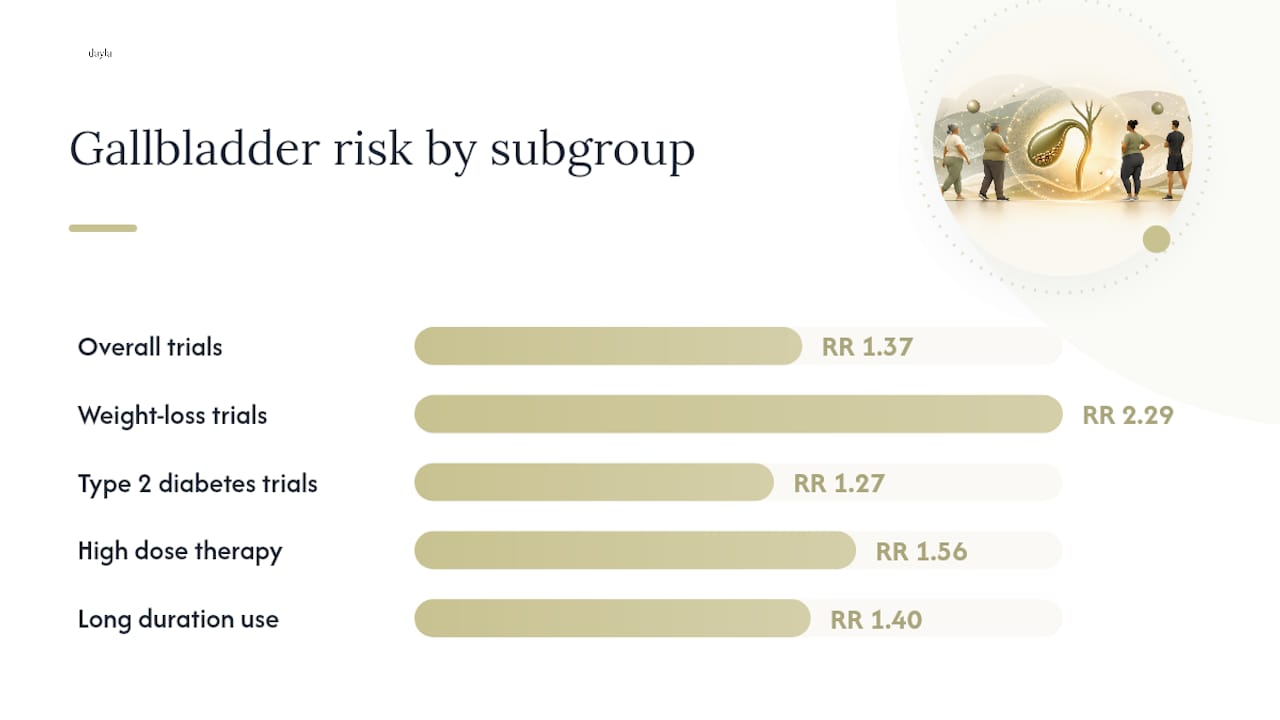
A 2022 systematic review and meta-analysis pooling data across GLP-1 receptor agonist trials found an overall risk ratio of 1.37 for gallbladder or biliary disease. That means people on these medications faced a 37% higher relative risk than those who were not, with a 95% confidence interval of 1.23 to 1.52. That range matters. It tells you the finding is statistically solid, not a fluke of one unusually large trial.
Breaking that number down by condition sharpens the picture. Cholelithiasis, plain gallstones, showed a risk ratio of 1.27. Cholecystitis, an infected or inflamed gallbladder, came in higher at 1.36. Neither number is enormous on its own, but both point the same direction, and both held up across multiple trials pooled into the analysis.
The Core Numbers Overall gallbladder/biliary disease risk: RR 1.37 (95% CI, 1.23–1.52). Weight-loss trial populations: RR 2.29. Type 2 diabetes trial populations: RR 1.27. A 2026 cohort study of over 156,000 patients found three-year adjusted odds ratios of 1.43 for cholelithiasis, 1.45 for cholecystitis, and 1.54 for cholecystectomy.
The indication you're being treated for changes the math substantially. Pooled trials of GLP-1 medications used specifically for weight loss showed a risk ratio of 2.29 for gallbladder or biliary disease, more than double the baseline. Trials in people with type 2 diabetes showed a lower risk ratio of 1.27. Researchers have a working theory for the gap, and it centers on the pace and magnitude of weight loss itself, which we'll unpack in the next section.
Real-world data backs up the trial findings. A large cohort study using TriNetX data followed more than 156,000 patients and found that by three years of treatment, GLP-1 users had:
- Adjusted odds ratio of 1.43 for developing gallstones (cholelithiasis)
- Adjusted odds ratio of 1.45 for gallbladder inflammation (cholecystitis)
- Adjusted odds ratio of 1.54 for needing gallbladder removal (cholecystectomy)
Dose and duration compound the effect. The same 2022 meta-analysis found high-dose GLP-1 therapy carried a risk ratio of 1.56, while lower doses showed no statistically significant increase at all. Longer treatment duration pushed risk ratio up to 1.40, compared to 0.79 for shorter courses, meaning short-term, low-dose use may carry little to no measurable increase in gallbladder events.
None of this data is perfect. Trial populations and real-world cohorts differ in how closely they track biliary symptoms, how consistently ultrasounds get ordered, and how gallbladder events get coded in medical records. Some heterogeneity between studies reflects genuine population differences (diabetes versus obesity, older versus younger patients) and some reflects inconsistent reporting. Still, the direction and consistency of these findings, across trial data and real-world claims data alike, is hard to dismiss as noise.
Why Would a Weight Loss Drug Affect Your Gallbladder?
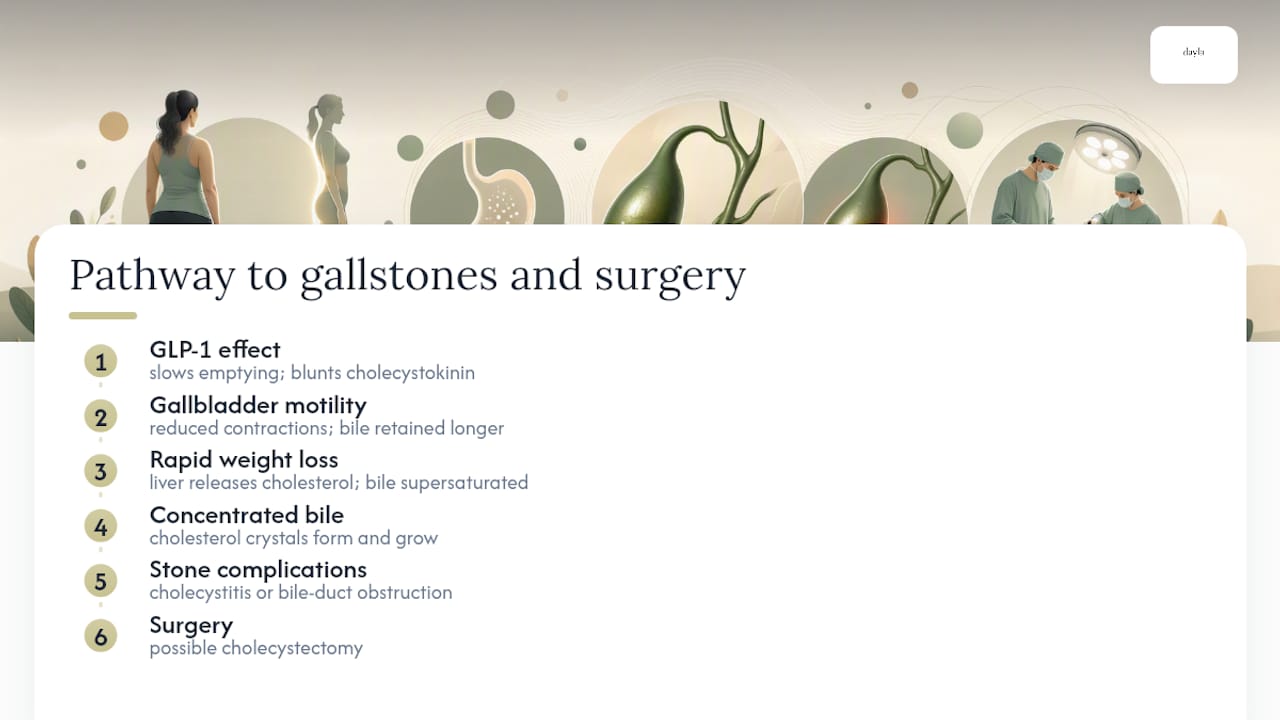
Your gallbladder's job is simple: store bile, then squeeze it into your small intestine when fatty food arrives, triggered by the hormone cholecystokinin. GLP-1 medications slow gastric emptying, which is part of why you feel full longer. That same slowdown appears to extend to gallbladder motility, meaning bile sits longer than it should between meals.
GLP-1 receptor agonists also appear to blunt cholecystokinin signaling itself, according to a 2025 mechanistic review published in Molecular Metabolism. Less cholecystokinin activity means the gallbladder contracts less often and less forcefully. Bile that isn't regularly emptied becomes concentrated, and concentrated bile is exactly the environment where cholesterol crystals form and grow into stones.
Then there's the weight loss itself, which acts as an independent risk driver separate from anything the drug does directly. When you lose weight quickly, your liver mobilizes stored cholesterol faster than your bile can dissolve it, a phenomenon well documented by the National Institute of Diabetes and Digestive and Kidney Diseases in the context of aggressive dieting. Bile becomes supersaturated with cholesterol, and a sluggish, poorly emptying gallbladder gives those crystals time to settle and grow.
That's the likely explanation for why weight-loss trial populations show roughly double the risk seen in diabetes trial populations. It's not that the drug behaves differently. It's that people using it for weight loss tend to lose more weight, faster, and that speed matters. Stone formation is the first domino. From there, a stone can trigger cholecystitis (inflammation) or lodge in the bile duct, and either scenario can end in cholecystectomy.
Who Faces the Highest Gallbladder Risk on GLP-1 Therapy?
Not everyone starting semaglutide or tirzepatide faces the same odds. A handful of factors stack the deck, and knowing where you land helps you and your clinician decide how closely to watch for trouble.
- Higher doses. The maintenance doses used for weight loss (typically higher than diabetes-management doses) carry a risk ratio of 1.56, versus no significant increase at lower doses.
- Longer treatment duration. Risk ratio climbs to 1.40 with extended use, compared to 0.79 for shorter courses.
- Weight-loss indication specifically. Risk ratio of 2.29 in weight-loss trials versus 1.27 in diabetes trials.
- Rapid or large-magnitude weight loss. Fast fat mobilization independently supersaturates bile with cholesterol, regardless of what triggered the weight loss.
- Prior gallstone history, female sex, and older age. These are established baseline gallstone risk factors that compound whatever risk the medication adds.
Pro Tip: Don't assume gallbladder problems only show up after months of treatment. Pharmacovigilance data suggest some biliary events cluster within the first 90 days of starting therapy, often during the steepest phase of weight loss and dose escalation. That's exactly when close symptom tracking matters most.
If you're losing weight unusually fast on a GLP-1 medication, that speed itself is a signal worth mentioning at your next follow-up, not just a milestone to celebrate.
What Symptoms Mean Trouble, Not Just Normal Side Effects?
Nausea, constipation, and mild stomach upset are the expected soundtrack of starting a GLP-1 medication, and they typically ease within a few weeks as your body adjusts to slower digestion. Gallbladder problems feel different, and the distinction matters enough to walk through step by step.
- Expect and tolerate: mild nausea, bloating, constipation, or occasional reflux, especially in the first four to eight weeks or right after a dose increase.
- Watch closely: pain concentrated in the upper right side of your abdomen or just below your breastbone, particularly if it shows up or worsens after a fatty meal.
- Take seriously: pain that persists for more than a few hours, comes with fever, or radiates toward your right shoulder blade.
- Treat as urgent: yellowing of the skin or eyes (jaundice), dark urine, pale stools, or severe pain paired with chills, which can signal a blocked bile duct or an infected gallbladder.
Stanford Medicine's clinical guidance notes that biliary events can be genuinely difficult to distinguish from routine GLP-1 side effects early on, which is exactly why persistence and location of pain matter more than intensity alone. A dull ache that fades in an hour is a different story than sharp, focused pain that lingers.
Call your clinician within the day for new, unexplained right-upper-quadrant pain, even without fever. Go to the emergency room if you develop jaundice, high fever with chills, or severe pain that doesn't ease, since those combinations can point to an infected gallbladder or a duct obstruction that needs prompt treatment.
How Do Clinicians Monitor and Manage This Risk?
Good GLP-1 care starts before the first dose, not after symptoms appear. A thorough intake should ask about prior gallstones, prior gallbladder surgery, and family history of biliary disease, since any of those shifts your baseline risk before the medication enters the picture.
Once treatment begins, certain findings should prompt further workup rather than reassurance: right-upper-quadrant pain that persists beyond a day or two, abnormal liver function tests on routine labs, or any sign of jaundice. The standard first step is an abdominal ultrasound, which reliably detects gallstones and signs of inflammation. Labs, including liver enzymes and a complete blood count, help clarify whether infection is in play. If findings point toward complicated gallstone disease, referral to a surgeon for possible cholecystectomy is the established next step.
Treatment itself follows a fairly conventional path. Uncomplicated gallstones without symptoms often just get watched. Active cholecystitis usually needs antibiotics and, frequently, surgical removal of the gallbladder, with timing depending on severity and how the patient responds to initial treatment.
- Baseline biliary history and counseling before starting therapy
- Prompt imaging for persistent right-upper-quadrant pain or abnormal labs
- Cholecystectomy considered for recurrent or complicated gallstone disease
- Ursodeoxycholic acid (UDCA) as a selective, supervised option in certain cases
On prevention, ursodeoxycholic acid deserves an honest look rather than a blanket recommendation. UDCA improves bile flow and has mechanistic plausibility for reducing stone formation, but a 2026 narrative review found the evidence specifically in GLP-1 populations remains limited. It's a tool clinicians may use selectively, not a preventive supplement to start on your own. Pacing weight loss and following a gradual dose-escalation schedule, rather than pushing for the fastest possible results, remains the most evidence-backed way to lower your personal risk. Our guide on tracking GLP-1 progress effectively walks through what steady, well-monitored progress actually looks like week to week.
Pro Tip: If your care team orders baseline bloodwork before you start a GLP-1 medication, ask specifically whether liver function and gallbladder-related markers are included. A dedicated diagnostics workflow that captures this baseline gives you and your clinician a clear before-and-after comparison if symptoms ever show up.
What If You've Already Had Your Gallbladder Removed?
A prior cholecystectomy is not a strict contraindication to GLP-1 therapy. Your clinician should still individualize the decision, since the biliary mechanics change once the gallbladder is gone, but plenty of people without a gallbladder use these medications successfully under supervision.
Two situations deserve a direct heads-up to your care team. If you have an upcoming endoscopy or procedure requiring anesthesia, slowed gastric emptying from GLP-1 therapy raises the risk of retained stomach contents, so tell your procedural team you're on the medication and follow their fasting instructions closely. If you have a history of ERCP or cholangitis, that history may warrant closer monitoring or a specialist referral rather than routine follow-up alone.
How Dayla Health Approaches Gallbladder Risk in Its GLP-1 Program
Supervised GLP-1 care should start with a real medical history, not a checkbox. That means asking directly about prior gallstones, gallbladder surgery, and biliary symptoms before any prescription decision gets made, then using that history to shape dosing and follow-up frequency from day one.
Ongoing care matters just as much as intake. Scheduled clinician check-ins give patients a structured place to report new or unusual abdominal pain rather than waiting for it to escalate, and dose titration decisions can account for individual side-effect patterns rather than following a rigid, one-size-fits-all schedule.. If you're evaluating whether a supervised prescription pathway fits your situation, Dayla Health's GLP-1 program outlines what clinical oversight and ongoing monitoring look like in practice.
Primary Sources for Further Reading
The 2022 meta-analysis established the core risk ratios cited throughout this article. The TriNetX cohort study confirmed those findings in real-world data. The 2025 mechanistic review explains the biological pathways involved. Always discuss your personal risk with your own clinician.
The Part of This Risk Story That Gets Glossed Over
The conventional advice on GLP-1 gallbladder risk tends to stop at "call your doctor if it hurts," which is true but incomplete. What the evidence actually supports is more specific: risk is not evenly distributed, and treating a diabetes patient on a moderate dose the same as a weight-loss patient racing toward a goal weight misses where the real exposure concentrates. A 2.29 risk ratio in weight-loss trials versus 1.27 in diabetes trials isn't a footnote. It's arguably the single most useful number in this entire conversation, and it rarely makes it past the first paragraph of most patient-facing articles.
What gets underrated is pace. Patients fixate on the dose on the label, but duration and speed of weight loss appear to matter just as much, if not more, to the physiology behind stone formation. If there's one thing to prioritize first, it's this: talk to your clinician about your rate of weight loss, not just your current dose, especially in the first three months. That conversation catches more real problems than waiting for a textbook symptom to appear.
— Flexible
This article is general information, not a substitute for advice from a qualified doctor. Consult a qualified healthcare professional about your own circumstances before acting on anything here.
Sources
- Association of Glucagon-Like Peptide-1 Receptor Agonist Use With Risk of Gallbladder and Biliary Diseases (meta-analysis, 2022)
- Cohort Study: Risk of Gallstones and Biliary Complications With GLP-1 RAs (TriNetX cohort, 156,376 patients)
- GLP-1 receptor agonists and gallbladder disease risk: insights into molecular mechanisms and clinical implications (PMC review, 2025)
- Prevention of biliary diseases associated with GLP‑1 receptor agonist therapy (2026 review)
- GLP-1s 101: What the science says about weight loss, side effects, safety (Stanford Medicine, 2026)