
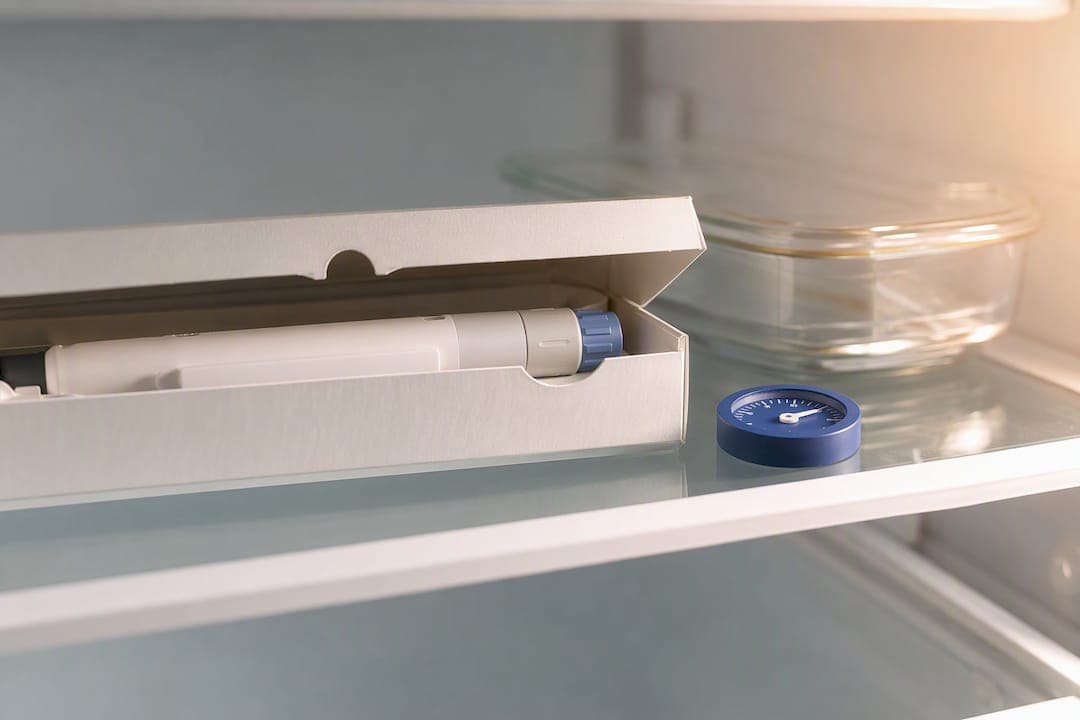
Injectable semaglutide pens and prefilled syringes need refrigeration at 36°F to 46°F (2°C to 8°C) before first use, per OZEMPIC's FDA prescribing information. Once you start using a pen, it can typically move to room temperature for a limited number of days. Oral semaglutide tablets store differently: keep them at a controlled room temperature of 68°F to 77°F (20°C to 25°C) in their original bottle. Never freeze any form of semaglutide, and discard any dose that has been frozen or shows visible changes.
TL;DR:
- Injectable semaglutide pens can be stored refrigerated at 36°F to 46°F before first use, then allowed to stay at room temperature for a limited time after opening, depending on the manufacturer’s instructions.
- Oral semaglutide tablets should always be kept at a controlled room temperature of 68°F to 77°F and protected from moisture, with excursions to 59°F to 86°F allowed briefly.
- Freezing any form of semaglutide damages the medication, requiring immediate discarding, and compounded products often need continuous refrigeration throughout use.
- Proper travel storage involves insulated cases, hotel refrigerators, and carry-on bags, with a thermometer recommended to monitor temperature conditions during transit.
- Visual inspection for cloudiness, discoloration, or particles can help identify degraded doses, but subtle heat damage may require pharmacist consultation even if the medication appears normal.
Table of Contents
- Key storage temperatures at a glance
- Injectable pens and prefilled syringes: what the label actually says
- Oral tablets need a different kind of care
- What to do if your medication gets warm or freezes
- Compounded semaglutide: different rules, different questions
- Traveling with semaglutide without losing your routine
- Spotting degraded medication and disposing of it safely
- Why storage guidance deserves more attention than it gets
- Getting clinician support for your GLP-1 prescription
- Sources
- FAQ
Key storage temperatures at a glance
Knowing the exact numbers helps you avoid guesswork when your routine changes or you travel.
- Unopened, refrigerated storage: 36°F to 46°F (2°C to 8°C) for injectable pens and syringes before first use.
- In-use pen allowances: many injectable semaglutide pens can stay at room temperature, 59°F to 86°F (15°C to 30°C), for a limited number of days once opened, or continue in the refrigerator.
- Oral tablets: controlled room temperature of 68°F to 77°F (20°C to 25°C), with permitted excursions to 59°F to 86°F (15°C to 30°C).
- Freezing: never acceptable for any semaglutide form. A frozen dose should be discarded.
- Compounded semaglutide: often requires continuous refrigeration throughout use, with a shorter beyond-use date set by the compounding pharmacy.
Your medication guide will list the exact day limit for your specific pen or syringe, so check it against your prescription label before relying on memory.
Injectable pens and prefilled syringes: what the label actually says
Manufacturer prescribing information is the most reliable source for injectable storage rules, and it draws a clear line between unopened and in-use medication. Before first use, OZEMPIC's FDA label directs patients to refrigerate the pen at 36°F to 46°F (2°C to 8°C) and to protect it from light in its original carton. Once you begin using a multi-dose pen, you generally have the option to keep it refrigerated or store it at room temperature for the labeled number of days, a detail that differs from single-dose prefilled syringes, which often carry a separate, shorter in-use window. Check your specific product's insert rather than assuming both formats behave the same way.
Where you place the pen inside the refrigerator matters. The middle shelf keeps the medication away from the cooling element in the back, which can approach freezing, and away from the door, where temperature swings happen every time it opens.
Certain exposures are never acceptable, regardless of how brief they seem: a hot car interior, direct sunlight on a windowsill, or a spot near a stove or oven. If any of these happen, do not guess. Document the exposure, inspect the medication, and contact your pharmacy to ask whether the dose is still usable or needs replacement.
A simple daily routine keeps you on track:
- Store: return the pen to its designated refrigerator shelf or a cool, stable room-temperature spot immediately after use.
- Inspect: check the solution for clarity and the pen for damage before each injection.
- Log: note the date you removed the pen from refrigeration if you have switched to room-temperature storage, so you can track your day count.
Pro Tip: Write the date you first used your pen directly on the carton with a marker. It removes any guesswork about how many in-use days you have left.
Oral tablets need a different kind of care

Oral semaglutide tablets follow a room-temperature rule rather than a refrigeration one, and the reasoning comes down to the medication's physical form. Store tablets at a controlled room temperature of 68°F to 77°F (20°C to 25°C), with permitted excursions to 59°F to 86°F (15°C to 30°C) for shorter periods, such as during a commute or a temporary appliance outage.
Keep tablets in their original bottle until the moment you take them. Tablets are less sensitive to modest temperature swings than injectable peptides, but they are far more sensitive to moisture, and the manufacturer's packaging is designed specifically to protect against it. Do not split, crush, or dissolve a tablet, since this breaks the coating that manages absorption and moisture exposure.
- Temperature range: 68°F to 77°F (20°C to 25°C), standard room conditions.
- Excursion limit: up to 59°F to 86°F (15°C to 30°C) for brief periods.
- Moisture protection: keep tablets sealed in the original bottle, away from bathrooms or humid kitchens.
- Damaged tablets: if a tablet becomes damp, discolored, or crushed, consult your pharmacist before taking it.
What to do if your medication gets warm or freezes
Not every temperature slip requires a call to your pharmacy, but some do, and knowing the difference saves you an unnecessary dose loss or an unsafe injection.
- Identify the type of exposure. A pen left on the counter for an hour during a labeled room-temperature window is different from a pen left in a hot car for an afternoon or exposed to freezing overnight.
- Apply the freeze rule without exception. If semaglutide has frozen, do not use it. Freezing can damage the peptide structure, so discard the dose and contact your provider or pharmacy for a replacement.
- Document the incident. Note how long the medication was out of proper storage and your best estimate of the temperature it reached, including whether it was in direct sun, a vehicle, or near a heat source.
- Call before you inject. When exposure falls outside the labeled window, or when you are unsure how hot or cold the medication actually got, contact your pharmacy rather than relying on how the liquid looks. Subtle heat damage is not always visible.
Compounded semaglutide: different rules, different questions
Compounded semaglutide often carries stricter storage requirements than the manufacturer-branded products, and the reasons are structural rather than arbitrary. Many compounded vials require continuous refrigeration throughout their entire use period, without the room-temperature flexibility built into some commercial pens. Beyond-use dates for compounded and reconstituted formulations are assigned by the compounding pharmacy itself, and they tend to be shorter, since these preparations lack the stability testing that supports longer manufacturer-labeled windows.
Before starting a compounded product, ask your pharmacy a short list of direct questions:
- What is the beyond-use date, and how was it determined?
- Does this product require refrigeration for the entire time I'm using it, or only before first use?
- What transport guidance should I follow if I need to travel with it?
- How is sterility maintained, and what does the label show to confirm it?
Treat a missing beyond-use date, vague storage instructions, or a label without clear sterile compounding information as a red flag worth raising with the pharmacy before you proceed.
Traveling with semaglutide without losing your routine
Travel is where storage rules get tested the most, and a little preparation prevents a wasted dose far from home.
- Pack with insulation. Use an insulated case with gel packs, but keep the packs from touching the pen or vial directly to avoid freezing it by accident.
- Use hotel mini-fridges. These typically run cold enough for safe storage, and most hotels will provide a medical-grade refrigerator on request if you need one.
- Keep medication in your carry-on. Cargo holds during air travel can reach freezing temperatures or, on the ground, extreme heat, so carry-on is the safer choice every time.
- Bring documentation. A clinician letter helps at security checkpoints and gives you a record to reference if a pharmacy needs to verify your prescription for a replacement.
Pro Tip: Pack a small travel thermometer alongside your insulated case. It gives you an objective read on conditions instead of relying on how the bag feels.
For a full walkthrough, Dayla Health's six-step semaglutide packing plan covers the clinician letter template and packing order in detail.
Spotting degraded medication and disposing of it safely
A quick visual check before every dose catches most problems, even if it cannot catch all of them.
- Look for cloudiness, particles, or pellets in the solution. Clear, colorless liquid is the expected appearance for injectable semaglutide.
- Check for marked discoloration. A yellow tint or visible clumping means the dose should not be used.
- Confirm your in-use day count. Using a pen beyond its labeled window, even if it looks fine, isn't supported by the manufacturer's data.
- Dispose of sharps properly. Use a dedicated sharps container, and follow FDA guidance on disposing of unused medicines for pens, syringes, and any leftover tablets.
If you're uncertain whether a dose is still good, the safer move is a quick call to your pharmacist or prescriber rather than injecting a dose you're not confident in. Reviewing proper injection site rotation and handling alongside your storage routine also reduces the chances of a wasted dose from mishandling.
Why storage guidance deserves more attention than it gets

Storage instructions get treated as fine print, something you skim once and forget. That's a mistake with a medication like semaglutide, where a few hours in a hot car or a missed refrigeration window can quietly reduce how well a dose works, long before you'd notice anything by looking at it. The visual inspection habit most patients rely on catches the obvious failures, cloudy solution, discoloration, but it does nothing for subtle heat damage that leaves the liquid looking completely normal while the peptide itself has already broken down.
The more useful shift is treating storage as part of your dosing routine, not a separate chore. Logging the date you take a pen out of the refrigerator takes ten seconds and answers a question you'll otherwise have to guess at weeks later. Patients traveling with semaglutide benefit from a clinician letter and a packing plan not because the rules are complicated, but because unfamiliar environments, hotel rooms, airports, rental cars, make it easy to lose track of time and temperature at once. Dayla Health's clinician letters and packing resources exist for exactly that gap between knowing the rule and remembering to follow it under pressure. When storage questions come up that go beyond general guidance, your clinician or pharmacist remains the right first call.
— Flexible
Getting clinician support for your GLP-1 prescription

Storage rules only matter if you have a clear channel back to a clinician or pharmacist when something goes wrong, and that's where a lot of patients get stuck. The GLP-1 prescription service includes ongoing clinician oversight, dietitian consults, and care coaching, so storage questions, dose concerns, or travel planning have a real person to answer them rather than a search bar.
Dayla Health ships GLP-1 Injection plans from $179 per month, GLP-1 Microdose from $159 per month, and Oral GLP-Liposomal from $149 per month, all through Daylahealth, with no membership fees and flexible cancellation. Always verify product-specific storage instructions on your prescription label, and contact your pharmacy directly for any replacement needs.
- Clinician evaluation and ongoing oversight for your GLP-1 prescription.
- Nationwide shipping with no insurance requirement.
- Access to patient education resources, including travel and handling guidance.
If you're ready for a clinician-monitored option that includes support beyond the prescription itself, start with Dayla Health's GLP-1 program.
Sources
- OZEMPIC prescribing information (FDA label, 2026)
- Where and how to dispose of unused medicines | FDA
This article is general information, not a substitute for advice from a qualified doctor. Consult a qualified healthcare professional about your own circumstances before acting on anything here.
FAQ
What happens if semaglutide is not refrigerated?
If your pen or vial stays within its labeled in-use room-temperature window, it generally remains usable, but exposure beyond that window or to high heat can degrade the medication. When you're unsure how long or how hot the exposure was, contact your pharmacy rather than assuming it's fine.
Can I use six-month-old semaglutide?
It depends entirely on the specific expiration and in-use dates printed on your medication label, since these vary by product and by whether the pen has already been opened. Compounded semaglutide typically carries a shorter beyond-use date set by the compounding pharmacy, so check your label or ask your pharmacist rather than relying on a general timeframe.
Can I skip a week of semaglutide for vacation?
Dosing schedule changes are a medical decision that depends on your treatment plan, so this question is best directed to your prescribing clinician rather than answered generically. Your clinician can advise on timing adjustments while keeping storage and travel logistics in mind.
What happens if semaglutide gets warm?
Brief warming within the labeled room-temperature window is typically accounted for in the manufacturer's guidance, but prolonged exposure to heat, such as a hot car, can degrade the medication even if it still looks clear. Since heat damage isn't always visible, contact your pharmacy to confirm whether a warm dose is still safe to use.