
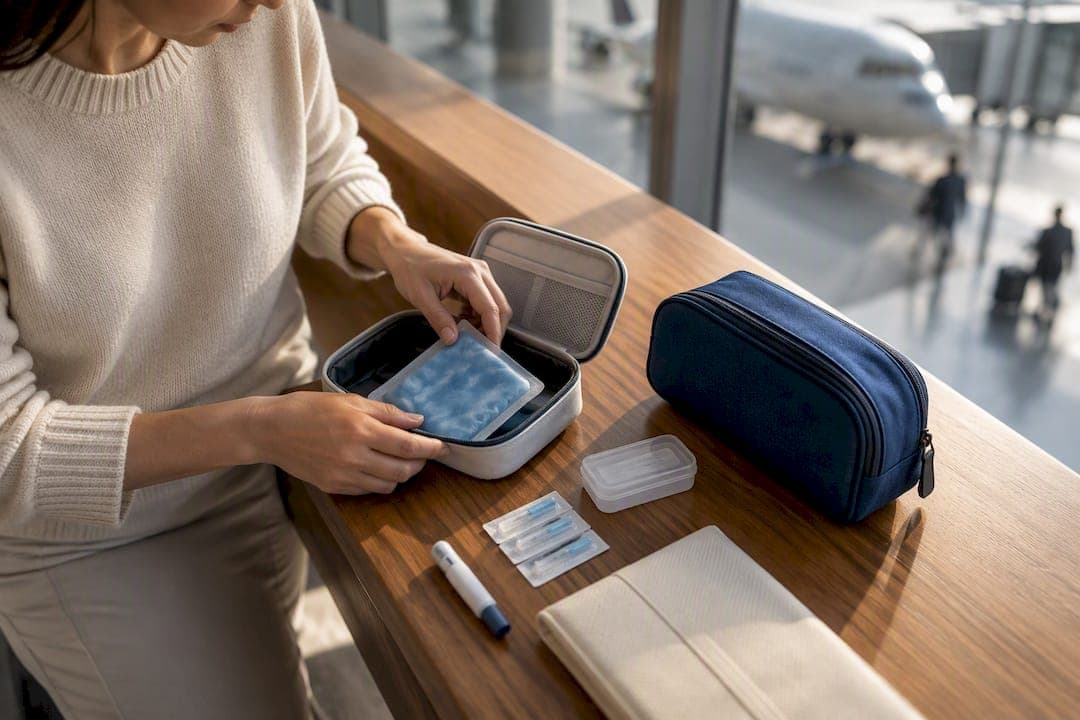
Yes, you can travel with semaglutide, but three rules are non-negotiable. Keep it in your carry-on, never checked baggage. Protect it from freezing and from extended heat above room temperature. Carry your prescription label and, for international trips, a clinician letter on official letterhead along with your sharps case.
TL;DR:
- Always carry semaglutide in your carry-on luggage, keeping it protected from extreme temperatures and carrying your prescription and clinician letter for international trips.
- Most commercial semaglutide pens can be stored at room temperature for 28 to 56 days after initial use, but always verify your specific product’s label, especially if compounded vials require continuous refrigeration.
- Use evaporative wallets like FRIO for short trips or battery-powered coolers for longer international travel, and avoid dry ice, which is unnecessary and may damage the medication.
- Declare your medication and supplies at security screening, and present the proper documentation and clinician letter to smooth through customs in foreign countries.
- Adjust your injection schedule within a 48-hour window when crossing time zones, and coordinate with your healthcare provider if your medication is lost, frozen, or exposed to heat during travel.
Table of Contents
- Can You Take Semaglutide on Planes and Abroad?
- Storage Requirements: Refrigeration, Room Temperature, and What Needs Continuous Cold
- How to Pack Semaglutide: Cooling Methods That Actually Work
- What Happens at TSA Screening With Needles and Gel Packs?
- Time Zones and Dosing: When to Take Your Weekly Shot on the Road
- What If Your Medication Freezes, Overheats, Gets Lost, or Is Stolen?
- Research-Backed Travel Checklist and Clinician-Letter Template
- Hotel Refrigeration, Cruises, and Multi-Week Itineraries
- Timing Injections Around Long-Haul Flights
- Side Effects That Get Worse With Travel Conditions
- Managing Missed or Delayed Doses From Travel Disruptions
- Vaccinations and Illness Prevention While on Semaglutide
- Staying Connected to Your Provider While You Travel
- Why Travel Anxiety Around Semaglutide Is Usually Overblown
- How Dayla Health Supports Travelers on GLP-1 Therapy
- Sources
- FAQ
Can You Take Semaglutide on Planes and Abroad?
The TSA treats semaglutide as a medically necessary medication, and that classification matters more than most travelers realize. The agency explicitly allows injectable medications, related supplies, and cooling packs through security screening once you declare them at the checkpoint. You don't need a note to get through security domestically, though having one speeds things up.
Carry-on placement isn't a suggestion. Cargo holds on commercial aircraft can swing well outside the temperature range your medication needs, and a delayed bag means hours or days without climate control. Keep the pen with you, every time.
International travel adds a layer most people skip until it's too late. A few things to prepare before you leave the country:
- Carry a copy of your prescription and a signed letter from your prescribing provider listing the medication name, dosage, and travel dates.
- Confirm your destination country's rules on importing prescription medication and injectable supplies, since some nations restrict GLP-1 products or require declarations.
- Consider a translated version of your prescription if you're heading somewhere English isn't widely spoken, a step the State Department specifically recommends.
- Pack your sharps and medication together, not split across bags, so customs officers can see the full picture at once.
None of this is complicated, but skipping it is how travelers end up standing at a customs desk trying to explain an unlabeled vial in broken Spanish.
Storage Requirements: Refrigeration, Room Temperature, and What Needs Continuous Cold
Semaglutide is a fragile protein-based drug, and its storage rules exist because heat and freezing both break down the active molecule. Unopened pens need refrigeration at 36 to 46°F (2 to 8°C) until first use. That part is consistent across nearly every brand-name formulation.
Once you start using a pen, the rules loosen, but not indefinitely. FDA prescribing information sets product-specific in-use windows, and most semaglutide pens allow room-temperature storage for somewhere between 28 and 56 days depending on the exact product. That range is wide enough that you cannot assume your pen matches a friend's or a forum post's timeline. Check your specific label, or ask your pharmacist to confirm the number before you pack.
Statistic Callout: In-use room-temperature windows for semaglutide pens can differ by weeks depending on the formulation, and updated FDA label supplements from 2024 and 2025 reflect ongoing changes to these limits. Don't rely on memory. Verify the number on your current box.
Compounded semaglutide vials are a different story. These formulations generally lack the stabilizers found in commercial pens, and most compounding pharmacies require continuous refrigeration with no extended room-temperature grace period. Treat compounded vials as always-cold items, full stop.
A few storage red flags that mean "stop and don't inject":
- The solution looks cloudy, discolored, or has visible particles floating in it.
- The pen or vial was exposed to freezing temperatures, even briefly.
- You're unsure how long it sat outside its labeled temperature range.
MedlinePlus echoes the same caution: when storage is in doubt, the safer move is always to replace the dose, not guess.
How to Pack Semaglutide: Cooling Methods That Actually Work
Your packing strategy should match your trip length, not a one-size-fits-all kit. A weekend trip and a three-week international itinerary call for different tools.
For short trips of a few days, an evaporative cooling wallet like FRIO or a simple insulated pouch with gel packs handles the job without batteries or ice runs. These wallets work by evaporative cooling, which keeps the interior several degrees below ambient temperature for days at a time with zero maintenance. For longer trips without reliable refrigeration, a small battery or USB-powered mini-fridge is worth the extra bag space, or you can call ahead to your hotel and confirm they'll store your medication in a staff refrigerator.
Here's a packing sequence that covers nearly every scenario:
- Medication in its original, labeled packaging, never transferred to an unmarked container.
- An insulated case or FRIO wallet sized for your specific pen or vial.
- Gel packs, kept cool but never in direct contact with the medication itself.
- A dedicated sharps container for used needles.
- A printed copy of your prescription and, for international trips, your clinician letter.
- One or two extra doses if your supply allows it, as a buffer against delays.
Pro Tip: Freeze your gel packs the night before you leave, then wrap them in a thin towel before placing them near your medication, following expert cold injury prevention tips for winter travelers. Direct contact with a fully frozen pack can freeze the pen itself, and a frozen dose has to be thrown out.
Skip dry ice entirely. It's overkill for semaglutide's actual storage needs, it's restricted on many flights, and the extreme cold it produces will damage the medication faster than heat would.
What Happens at TSA Screening With Needles and Gel Packs?
Security lines make people nervous, but semaglutide travelers have clear guidance backing them up. When you reach the checkpoint, tell the officer you're carrying medically necessary medication and cooling supplies. Pull those items into a separate bin for screening rather than burying them in your bag.
A few specifics worth knowing before you get there:
- Unused syringes and pen needles are permitted as long as they're accompanied by the injectable medication they're meant for.
- Gel ice packs and freezer packs used for medication are allowed even if they've partially thawed and gone slushy, so don't panic if yours isn't rock solid anymore.
- You can request a visual inspection instead of an X-ray if you'd rather an officer look at the medication by hand.
- A pharmacy label on the box speeds up the conversation more than any explanation you could give verbally.
International departures benefit from one more document: a clinician letter on official letterhead. It doesn't need to be long. Medication name, dosage, diagnosis, and travel dates are enough to answer most customs questions before they're even asked. Bring your used-needle sharps container too. TSA has no issue with it, but airport trash bins aren't built for sharps disposal, and you'll want it for the return leg anyway.
Time Zones and Dosing: When to Take Your Weekly Shot on the Road
Semaglutide's weekly schedule gives you more flexibility than daily medications, and most clinicians build in a buffer specifically for situations like this. The general rule is a 48-hour window on either side of your normal dosing day, meaning you can shift your injection earlier or later without meaningfully affecting the drug's steady blood levels.
How you handle the shift depends on how far you're traveling:
- For time changes of a few hours, such as coast-to-coast US travel, keep your usual calendar day and let the clock time drift naturally.
- For major shifts, like flying to Europe or Asia, pick a new injection day once at least 48 hours have passed since your last dose, then anchor to that new day going forward.
- Set a phone reminder in your destination's time zone the moment you land, not before, so the alert actually reflects local time.
- Write down the exact day and time you inject during travel, since jet lag makes it easy to lose track and accidentally double up.
This approach lines up with guidance from Everyday Health's GLP-1 travel coverage, which recommends anchoring to the calendar day rather than doing hour-by-hour math across time zones. Simpler math means fewer mistakes.
What If Your Medication Freezes, Overheats, Gets Lost, or Is Stolen?
Don't inject anything you're unsure about. If a pen has been frozen, left in a hot car, or simply looks off, the safest move is to treat it as unusable and get a replacement rather than risk an ineffective or unsafe dose.
Domestically, you have real options if this happens mid-trip:
- Call your prescriber's office or use a telehealth platform to request an emergency refill sent to a local pharmacy.
- Ask your current pharmacy about transferring the prescription to a nearby location, which most chains can do within hours.
- Check urgent care clinics in unfamiliar cities. Many can issue a short-term prescription bridge if you explain the situation.
Abroad, the process takes more legwork. Contact a local clinic or pharmacy directly, and if you're stuck, reach out to the nearest U.S. embassy or consulate for guidance on licensed providers in the area. This is exactly why carrying your prescriber's direct contact information matters. A quick phone call or email exchange between your provider and a local pharmacist can resolve what would otherwise be a multi-day scramble.
Pro Tip: Photograph your prescription label and clinician letter before you leave, and store the images in a cloud folder you can access from any phone. A lost paper copy shouldn't mean starting from zero.
If your supply allows it, packing one extra dose beyond what the trip requires gives you a built-in cushion against exactly this kind of setback.
Research-Backed Travel Checklist and Clinician-Letter Template
Print this before you pack anything else. A one-page checklist covers most travelers' needs:
- Medication in its original labeled box or vial.
- Insulated case or FRIO wallet sized to your pen.
- Gel packs, wrapped, never in direct contact with the medication.
- Sharps container for used needles.
- Printed prescription copy.
- Clinician letter on official letterhead (international trips).
- Photo ID matching the name on your prescription.
- Emergency contact information for your prescriber and pharmacy.
A clinician letter doesn't need a lawyer to draft. Ask your provider to include these items on their letterhead:
| Letter Element | What to Include |
|---|---|
| Patient name | Full legal name matching your ID |
| Medication and dose | Exact drug name and prescribed dosage |
| Diagnosis | Condition being treated |
| Travel dates | Departure and return dates |
| Prescriber contact | Direct phone or email for verification |
For verification on the ground, the TSA's medication FAQ page and your product's FDA prescribing information are the two documents worth bookmarking on your phone. If a border agent has questions, pulling up an official government page settles most disputes faster than any argument you could make.
Hotel Refrigeration, Cruises, and Multi-Week Itineraries
Longer trips shift the problem from "how do I get through security" to "how do I keep this cold for two or three weeks straight." Hotels are usually your easiest solution. Most will store medication in a staff refrigerator behind the front desk or in a kitchen walk-in, but you need to ask when you check in, not on day four when your cooling pack has already warmed up. Request it in writing if the property has an app or confirmation email system, so the request doesn't get lost in a shift change.
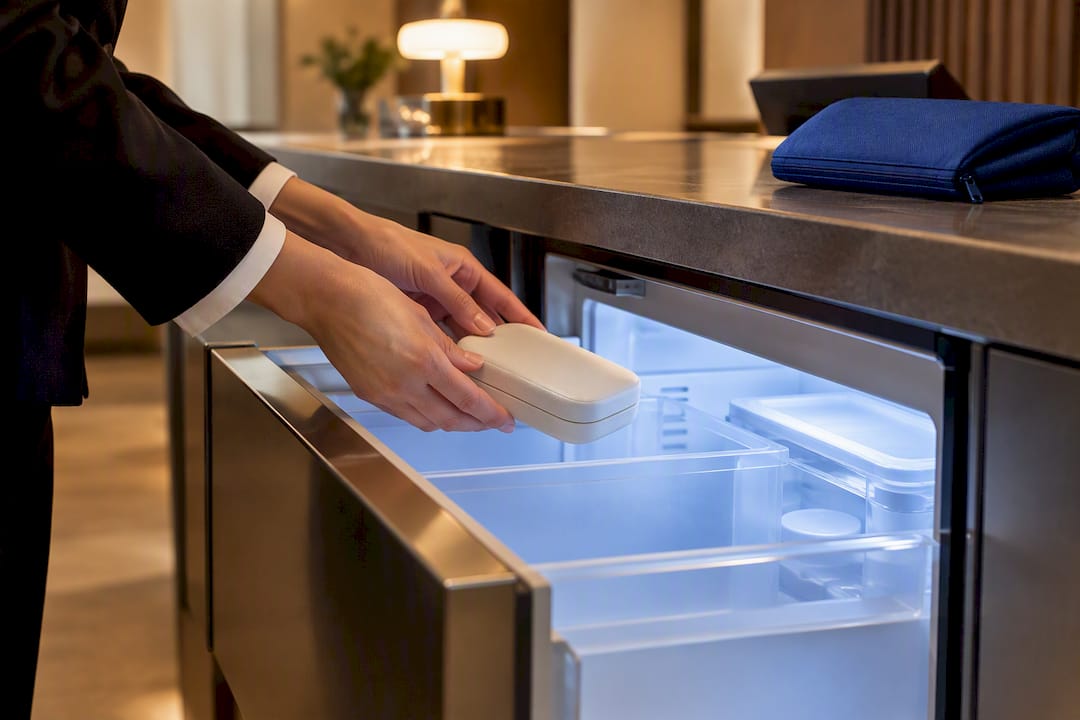
Cruises complicate things slightly because cabin mini-fridges vary wildly in reliability, and some are barely cooler than room temperature. Contact the ship's medical center before you sail. Most major cruise lines can store medication in their clinic refrigerator, and it's worth confirming this by phone rather than assuming it's standard.
For multi-week land trips, especially ones bouncing between cities, a small powered cooler beats repeatedly asking new hotels for favors. USB and battery-powered options are compact enough to fit in a daypack and hold temperature far more reliably than a gel pack alone after the third or fourth day.
Whatever the itinerary, build a temperature check into your routine. Touch the case each morning. If it feels warm, that's your cue to find refrigeration immediately rather than waiting until evening.
Timing Injections Around Long-Haul Flights
Long-haul flights compress a lot of variables into a single sitting: dry cabin air, irregular meal service, and hours of limited movement. None of that rules out injecting on a flight, but timing it well makes a real difference in comfort.
Inject before you get to the airport rather than mid-flight if your schedule allows it. Airplane bathrooms aren't ideal spaces for handling a needle and sharps disposal, and turbulence doesn't mix well with syringes. If your dosing day happens to land during the flight itself, aim for a calm period, ideally after the meal service and before the cabin dims for rest, so you're not fumbling in the dark or during beverage service.
Nausea, one of semaglutide's more common side effects, tends to intensify with cabin pressure changes and the smell of in-flight food. If you've historically had GI symptoms after dosing, consider injecting the evening before a flight rather than the morning of, giving your body a longer runway to settle before you're strapped into a middle seat. This side-effect pattern connects to broader issues around headaches and other reactions some patients experience, which are worth reviewing if travel days have historically hit you harder than normal ones.
Keep your injection kit in your seat-back pocket or under-seat bag, not the overhead bin, so temperature stays consistent and you're not digging through luggage at 30,000 feet.
Side Effects That Get Worse With Travel Conditions
Semaglutide's common side effects, nausea, fatigue, and GI upset, don't disappear on vacation. If anything, travel tends to amplify them. Dehydration is the biggest culprit. Airplane cabins run at humidity levels far below what your body is used to, and it's easy to go six or seven hours without drinking enough water while distracted by a flight or a new city.
Irregular meal timing compounds the problem. Semaglutide slows gastric emptying, which is part of how it works, and skipping meals or eating at unpredictable hours can intensify nausea or lead to lightheadedness. Long layovers, time-zone confusion, and unfamiliar food options all make it harder to eat consistently.
A few practical habits reduce the impact:
- Carry a reusable water bottle and refill it past security, drinking steadily rather than in large bursts.
- Eat small amounts at regular intervals, even if it's just crackers or fruit between connections, rather than skipping meals entirely and overcorrecting later.
- Avoid alcohol on travel days when you're also managing nausea, since it worsens dehydration and can intensify GI symptoms.
- Pack electrolyte packets in your carry-on for flights longer than four or five hours.
If nausea or fatigue becomes severe rather than mild, that's worth a call to your prescriber rather than pushing through it. Travel stress can mask or mimic other issues, and a quick check-in rules out anything more serious.
Managing Missed or Delayed Doses From Travel Disruptions
Flight delays and canceled connections happen, and they can push your injection day later than planned. The 48-hour flexibility window covered earlier gives you room to absorb most of these disruptions without real consequence.
If a delay pushes you past that window, don't try to make up for lost time by injecting early and then resuming your old schedule. Instead, treat the delayed dose as your new baseline. Inject as soon as you reasonably can once you've landed and settled, then count forward from that day for your next scheduled dose.
Missing a dose entirely, whether from a lost pen, a canceled flight home, or simply forgetting during a chaotic itinerary, is not an emergency, but it does need a plan. Contact your prescriber once you're back on solid ground and describe exactly what happened and when. They may recommend resuming at your normal dose or adjusting slightly depending on how much time has passed, and this is not a decision to make on your own based on internet advice.
The bigger risk with travel disruptions is accidental double-dosing, injecting once out of habit and then again after realizing you'd already done it during a jet-lagged haze. Writing down the exact day and time of each injection, even in a basic phone notes app, prevents this far more reliably than memory alone.
Vaccinations and Illness Prevention While on Semaglutide
Semaglutide doesn't carry known interactions that would prevent standard travel vaccines, but the timing around illness deserves attention. GLP-1 medications slow digestion, and travel-related stomach bugs, whether from food, water, or a new environment, can hit harder when your gut is already working more slowly.
If you're traveling somewhere requiring vaccinations like typhoid, hepatitis A, or yellow fever, CDC travel health guidance recommends scheduling these at least a few weeks before departure regardless of your medication regimen, which gives your body time to build immunity and gives you a buffer to manage any mild vaccine side effects like fatigue or low-grade fever separately from your injection schedule.
If you develop a stomach illness while traveling, mention your semaglutide use to any clinic or pharmacy you visit. Dehydration from vomiting or diarrhea compounds faster on GLP-1 medications, and a treating provider needs the full picture to recommend fluids, anti-nausea medication, or a temporary dose adjustment. Don't stop your medication on your own without guidance, but also don't hesitate to seek local care if symptoms are more than mild. A short-term illness abroad is exactly the situation your clinician letter and prescriber contact information exist for.
Staying Connected to Your Provider While You Travel
Distance from your regular clinic shouldn't mean distance from care. Most GLP-1 prescribers now offer telehealth check-ins, and it's worth confirming before you leave that you can reach yours by video or message if a question comes up mid-trip.
A few things worth setting up before departure:
- Save your prescriber's direct phone number and any patient portal login on your phone, not just in an email you'd need to search for.
- Ask whether your provider's telehealth platform works internationally, since some require a US-based phone number or IP address to log in.
- Identify an urgent care or telehealth backup for the specific country or region you're visiting, in case your regular provider is unreachable during off-hours.
- Keep a note of your local emergency number for each country on your itinerary. It isn't always 911.
International cell plans and WiFi calling both make this easier than it used to be, but connectivity gaps still happen on cruises, in rural areas, or during long flights. Building in a backup contact, whether that's a local pharmacy, an urgent care clinic, or embassy guidance, closes the gap for the hours you might be unreachable.
Why Travel Anxiety Around Semaglutide Is Usually Overblown
Most of the fear around traveling with a GLP-1 medication comes from uncertainty, not actual risk. Once you know the storage window on your specific pen, carry-on placement is non-negotiable, and a 48-hour dosing buffer exists for exactly this kind of disruption, the whole thing becomes a packing list rather than a source of stress.
The gap I see most often isn't a lack of information. It's that patients assume airline and customs rules are stricter than they actually are, so they either skip doses unnecessarily or avoid travel altogether. Neither is warranted with a little preparation.
Talk to your prescriber before a trip, especially an international one. Ask for a clinician letter and, if your travel dates fall near a refill, ask about timing it a few days early so you're not counting doses down to the wire. If you're managing costs alongside logistics, it's worth understanding how an HSA or FSA can offset semaglutide expenses, particularly if you're stocking an extra dose for the road. Getting your injection technique right before you leave matters too, and reviewing proper injection sites and rotation removes one more variable from an already busy trip.
— Flexible
How Dayla Health Supports Travelers on GLP-1 Therapy
Some providers recognize the continuity problem travel creates: staying on a clinician-supervised GLP-1 plan without insurance hurdles or scheduling headaches while you're away from home. Many plans include clinician evaluations and ongoing oversight, which means getting a prescriber-signed travel letter or coordinating refill timing before a trip can be a normal part of care, not a special request.

If you're planning a trip and need your prescription timed around departure dates, or you want a clinician letter ready before an international flight, some care teams can help you plan around it. The dayla GLP-1 program includes both injection and needle-free oral options, so travelers who prefer to avoid packing a sharps case altogether have a path to discuss with their clinician. Pricing is transparent and cash-based, with details available on the provider's website, and some plans do not require membership lock-in if your travel schedule changes. Start your evaluation now and ask your care team about travel timing before your next trip.
This article is general information, not a substitute for advice from a qualified doctor. Consult a qualified healthcare professional about your own circumstances before acting on anything here.
Sources
- TSA: Traveling with medication — frequently asked questions
- CDC: Traveling abroad with medicine
- U.S. Department of State: Traveling internationally with medicine
- MedlinePlus: Semaglutide
FAQ
Can I Skip a Week of Semaglutide for Vacation?
Skipping a dose isn't recommended without talking to your prescriber first, since it can affect symptom control and appetite regulation. If travel truly makes dosing impossible that week, contact your provider beforehand. Most will help you adjust the schedule rather than leaving a gap unmanaged.
How Do I Pack My Semaglutide for Travel?
Keep it in your carry-on in its original labeled packaging, inside an insulated case or FRIO wallet with gel packs that don't directly touch the pen. Add a sharps container, your printed prescription, and a clinician letter for international trips. TSA permits these items through security when you declare them at the checkpoint.
How Long Can Semaglutide Be Unrefrigerated?
Most commercial semaglutide pens allow room-temperature storage for a period that varies by product once opened, so check your medication's label for the exact duration. Check your medication's FDA label for the precise number, and treat compounded vials as requiring continuous refrigeration with no grace period.
How Do You Keep Semaglutide Cold When Traveling?
For trips of a few days, an evaporative cooling wallet like FRIO or an insulated pouch with gel packs holds temperature without electricity. For longer trips, a small battery or USB-powered cooler works better, or you can ask your hotel to store the medication in a staff refrigerator.
Is It Safe to Travel Internationally With Semaglutide?
Yes, as long as you carry your prescription and a clinician letter on official letterhead, and you've confirmed your destination's import rules ahead of time. The State Department recommends documentation and, where relevant, a translated prescription to avoid customs delays.