

Start your appeal today: preserve the denial letter, call member services to get the denial reason in writing, and ask your prescriber to begin a Letter of Medical Necessity (LOMN). These three actions, completed within 24–72 hours, protect your appeal rights and build the foundation of a winning documentation packet.
What to collect in the next 24–72 hours:
- Denial letter with the case or claim number
- Your plan's clinical policy (ask member services for the policy number cited in the denial)
- Prescriber name, direct phone, and fax number
- Most recent clinic weight and BMI with the measurement date
- Records of prior weight-loss treatments, medications, and supervised programs
Urgent timeline note: Most commercial plans allow 30–180 days to file an internal appeal. Medicare Part D redetermination requests must be filed within 60 days of the denial notice. If your condition is urgent, you may qualify for an expedited review with a 72-hour decision window. Missing a deadline typically closes that appeal level permanently, so calendar the date the moment you receive the denial.
Obesity Action Coalition guidance confirms that appealing a denial is common and that following the plan's specific process is the single most important procedural step.
Key Takeaways
Appealing a denied GLP-1 prescription requires acting within the first 72 hours, submitting a complete LOMN that mirrors the plan's own clinical policy language, and requesting a peer-to-peer review at every internal appeal level.
| Point | Details |
|---|---|
| Act within 72 hours | Preserve the denial letter, calendar your appeal deadline, and contact your prescriber immediately. |
| LOMN quality determines outcomes | Include BMI with date, ICD-10 codes, comorbidities, prior treatments, and trial citations that match the plan's criteria. |
| Peer-to-peer reviews increase approval rates | Roughly 40% of initial GLP-1 denials are overturned on appeal; peer-to-peer reviews raise that rate further. |
| Plan type shapes your rights | Commercial fully-insured plans allow state external review; ERISA self-funded plans do not; Medicare Part D follows CMS's statutory ladder. |
| Daylahealth as a direct-pay bridge | Daylahealth's GLP-1 service ships nationwide without insurance, with clinician oversight, for patients who need access while appealing. |
Table of Contents
- Why do insurers deny GLP-1 prescriptions?
- How to appeal a denied GLP-1 prescription: step-by-step
- What to send: the Letter of Medical Necessity and your document checklist
- How to get your prescriber to act: scripts, forms, and Medicare representation
- What happens if internal appeals fail?
- Short-term ways to access your GLP-1 while appeals proceed
- Building an evidence-based appeal: which clinical data to cite
- What a successful appeal actually looks like
- Daylahealth offers a direct-pay path while you appeal
- Sources
Why do insurers deny GLP-1 prescriptions?
Understanding the denial reason is the most direct path to a successful rebuttal. GLP-1 medications including Wegovy (semaglutide), Ozempic (semaglutide for type 2 diabetes), Mounjaro (tirzepatide for type 2 diabetes), and Zepbound (tirzepatide for obesity) each carry distinct prior-authorization criteria, and insurers apply them inconsistently.
The five most common denial categories:
1. "Not medically necessary" is the most frequent denial and the most winnable on appeal. It usually means the insurer's reviewer did not see sufficient clinical documentation, not that the drug is actually inappropriate for you. A well-constructed LOMN with ICD-10 codes, BMI history, and comorbidities often reverses this denial at the first internal level.
2. Step therapy / fail-first requirements mean the plan wants evidence you tried a lower-cost intervention first, such as a structured weight-loss program, metformin, or another medication. If your records document those attempts with dates and outcomes, this denial is straightforward to rebut.
3. Non-formulary or excluded benefit is harder to fight but not impossible. Some commercial plans categorically exclude obesity medications; others exclude only specific brand names. Check whether a different GLP-1 on the formulary (for example, a diabetes-indicated version) could be prescribed for your diagnosis.
4. Incomplete prior authorization is an administrative error, not a clinical judgment. Wrong or missing ICD-10 codes, an unsigned PA form, or a missing BMI measurement can trigger an automatic denial. These are often resolved with a corrected resubmission rather than a formal appeal.
5. BMI or threshold documentation gaps occur when the chart note submitted with the PA request does not include a measured BMI with a date. Most plans require a BMI of 30 or above, or 27 or above with at least one weight-related comorbidity such as hypertension, type 2 diabetes, or sleep apnea. A single missing data point can trigger a denial.
Key insight: Administrative errors, including wrong ICD-10 codes and missing BMI measurements, account for a meaningful share of initial GLP-1 denials. Correcting these before filing a formal appeal can resolve the issue faster than a full internal review.
Plan type matters significantly. Commercial fully-insured plans are regulated by your state's insurance department and must follow state external-review laws. Self-funded ERISA employer plans are governed by federal law, which limits state oversight and narrows your external-review options. Medicare Part D operates under CMS rules with its own statutory appeal ladder. Knowing which type of plan you have before you file determines which rights apply to you.
KFF's employer health benefits research documents wide variation in how employer plans structure coverage and appeals, reinforcing that the plan type shapes every step of your strategy.
How to appeal a denied GLP-1 prescription: step-by-step
The GLP-1 prescription appeal process follows a predictable ladder. Each level has a deadline and a required document set. Moving through them in order, with complete documentation, is what converts a denial into an approval.
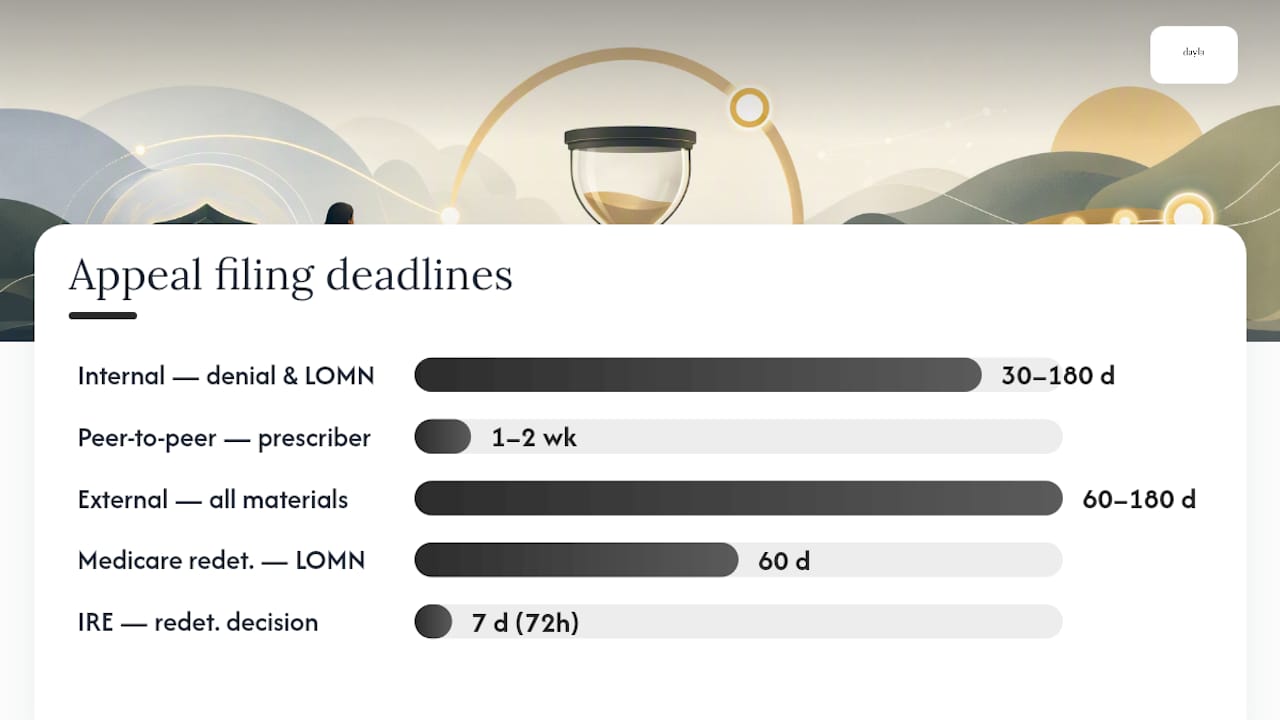
| Appeal Level | Typical Timeline | Required Submission Items |
|---|---|---|
| Internal appeal (commercial) | File within 30–180 days; decision in 30–60 days | Denial letter, LOMN, clinic notes, BMI history, prior-treatment records, ICD-10 codes |
| Peer-to-peer review | Request within 1–2 weeks of denial | Prescriber calls insurer's medical director; clinical rationale, trial data citations |
| External / independent review | File within 60–180 days of internal denial | All prior appeal materials, independent clinical summary |
| Medicare Part D redetermination | File within 60 days of denial | Written request, LOMN, prescriber letter |
| Medicare IRE (reconsideration) | Automatic if redetermination denied; 7-day standard / 72-hour expedited | Same packet plus redetermination decision |
| Medicare ALJ hearing | File within 60 days of IRE decision | All prior decisions, updated clinical evidence |
Step-by-step instructions for each level:
-
File the internal appeal. Submit to the address or portal listed on the denial letter. Send by certified mail or upload via the insurer's secure portal and save the confirmation receipt. Include a cover note that references the plan's clinical policy number from the denial letter and states that the patient meets each published criterion.
-
Request a peer-to-peer review simultaneously. Your prescriber calls the insurer's medical director. This is separate from the written appeal and often produces faster results. Ask the insurer's provider line for the peer-to-peer scheduling number within 1–2 weeks of the denial.
-
Request the complete claim file. You have the right to request all documents the insurer used to make the denial decision. This file often contains the clinical policy criteria verbatim, which you can then quote directly in your appeal letter.
-
Escalate to external review if the internal appeal is denied. For commercial fully-insured plans, contact your state insurance department to initiate an independent external review. For Medicare Part D, the official CMS appeals process moves from redetermination to an Independent Review Entity (IRE), then to an Administrative Law Judge (ALJ), then to the Medicare Appeals Council, and finally to federal district court.
-
Document every submission. Keep a log with the date, method, recipient name, and confirmation number for every document you send or receive. This record becomes critical if you need to escalate or file a complaint with your state insurance commissioner.
Pro Tip: Request expedited review in writing if your prescriber certifies that waiting the standard timeline would seriously jeopardize your health. Expedited commercial appeals must be decided within 72 hours; expedited Medicare Part D redeterminations within 72 hours as well.
What to send: the Letter of Medical Necessity and your document checklist
The LOMN is the single most important document in any GLP-1 insurance appeal. A weak or incomplete LOMN is the most common reason an otherwise valid appeal fails. The NovoMEDLINK denials and appeals guide for Wegovy provides sample LOMNs and recommended documentation bundles that align closely with what payers expect.
Essential LOMN elements your prescriber must include:
- Patient identifiers: Full name, date of birth, member ID, and insurance group number
- Diagnosis with ICD-10 codes: E66.9 (obesity, unspecified) or the appropriate specificity code; E11.x for type 2 diabetes if applicable
- BMI with measurement date: The exact measured value from a clinic visit, not self-reported
- Documented comorbidities: Hypertension, type 2 diabetes, hyperlipidemia, obstructive sleep apnea, or other weight-related conditions with their own ICD-10 codes
- Prior weight-loss efforts with dates: Structured programs, dietary interventions, other medications tried, and documented outcomes
- Clinical rationale for this specific GLP-1: Why this medication, at this dose, for this patient — referencing the prescriber's clinical judgment and relevant trial data
- Prescriber credentials: Signature, NPI number, specialty, and contact information. A letter from a board-certified obesity medicine specialist, credentialed through ABOM, carries additional weight with medical reviewers.
Sample appeal letter outline:
Opening paragraph: State the patient's name, member ID, the medication requested (e.g., Wegovy 0.25 mg weekly), the denial date, and the denial reason as stated in the denial letter. Clearly state that you are appealing and that the denial should be reversed.
Point-by-point rebuttal: Address each denial reason directly. If the denial cites "not medically necessary," quote the plan's own clinical policy criteria and show, line by line, that the patient meets each one. If step therapy is cited, list every prior treatment with start date, end date, dose, and outcome.
Closing request: Request approval of the specific medication and dose. Provide the prescriber's direct contact for peer-to-peer scheduling. State the patient's preferred contact for the decision notice.
Supporting document checklist:
- Clinic weight and BMI notes (at least two measurements with dates)
- Lab results: HbA1c, fasting glucose, lipid panel, and any relevant metabolic markers
- Prior medication records with dates and documented outcomes
- Supervised weight-loss program documentation
- Specialist letters (endocrinology, cardiology, sleep medicine) when comorbidities are present
- Surgical evaluation records if bariatric surgery was considered or recommended
- The plan's clinical policy document (obtained from the claim file or member services)
Pro Tip: Attach the plan's clinical policy as an exhibit and highlight the specific criteria the patient meets. Reviewers respond to documentation that mirrors their own policy language — it removes ambiguity and makes approval the path of least resistance.
How to get your prescriber to act: scripts, forms, and Medicare representation
Your prescriber's active participation is what separates a successful appeal from a denied one. Most office staff handle prior authorizations routinely, but a formal appeal requires more clinical specificity than a standard PA submission.
Steps to activate your prescriber's office:
- Call the office and ask to speak with the prior-authorization coordinator or the prescriber's nurse.
- Explain that your GLP-1 was denied and that you need a formal Letter of Medical Necessity for an insurance appeal, not just a standard PA resubmission.
- Provide the denial letter, your member ID, and the plan's clinical policy number so staff can match the LOMN to the insurer's criteria.
- Confirm the fax number and submission deadline, and ask for a copy of everything submitted.
Sample patient phone script:
"Hi, this is [your name], a patient of Dr. [name]. My insurance denied my GLP-1 prescription and I need to file a formal appeal. I'm asking Dr. [name] to write a Letter of Medical Necessity that addresses the denial reason directly. I have the denial letter and the plan's clinical policy number ready to share. Can we schedule a brief call or can I send these documents to the office today?"
Preparing your prescriber for a peer-to-peer review:
The peer-to-peer is a brief call, typically 10–15 minutes, between your prescriber and the insurer's medical director. Approval rates increase substantially when the prescriber is prepared with specific clinical data rather than a general discussion.
Suggested 5-minute clinical script for the prescriber:
- State the patient's BMI, relevant comorbidities, and prior treatments tried with outcomes
- Reference the specific clinical trial supporting the medication (e.g., the STEP 1 trial for semaglutide, which showed significant mean body weight reduction in adults with obesity)
- Quote the plan's own clinical policy criteria and confirm the patient meets each one
- Request approval for the specific drug and dose, and offer to provide additional documentation
Medicare-specific: Appointment of Representative (CMS Form 1696)
If you are on Medicare Part D and want your prescriber or an advocate to act on your behalf during the appeal, they must complete CMS Form 1696, the Appointment of Representative form. This form authorizes a named individual to file appeals, receive notices, and make decisions on your behalf. Submit it with your first appeal filing. Without it, Medicare will only communicate directly with you, which can slow the process when your prescriber needs to respond to requests.
Pro Tip: Ask your prescriber to note their specialty and any board certifications in the LOMN signature block. A letter signed by a physician with obesity medicine or endocrinology credentials tends to receive more clinical scrutiny from the insurer's medical director, which works in your favor during a peer-to-peer.
What happens if internal appeals fail?
When an internal appeal is denied, you have three main escalation paths depending on your plan type. Knowing which one applies to you before you reach this stage saves critical time.
State external review (fully-insured commercial plans)
If your plan is fully insured and regulated by your state's insurance department, you have the right to an independent external review by a certified Independent Review Organization (IRO). The IRO's decision is binding on the insurer.
- File within the window your state law specifies, typically 60–180 days after the internal denial
- Submit all prior appeal materials plus a concise independent clinical summary
- Contact your state insurance department's consumer assistance program for the correct form and submission address
- Some states allow simultaneous filing of an internal appeal and an external review request
ERISA self-funded employer plans
If your coverage comes through a self-funded employer plan, state external-review laws generally do not apply. ERISA governs these plans at the federal level, which means your remedies after exhausting internal appeals are limited to federal court. The practical implication: exhaust every internal level thoroughly, because litigation is expensive and slow. If you reach this point, consult an ERISA attorney or a patient advocacy organization. GAO reporting documents the variability in insurer decision-making and the procedural importance of exhausting internal rights before escalating.
Medicare Part D appeals ladder
Medicare's statutory appeal sequence is fixed and time-sensitive:
- Redetermination by the plan: file within 60 days of the denial; decision within 7 days standard / 72 hours expedited
- Reconsideration by an Independent Review Entity (IRE): automatic referral if redetermination is denied
- Administrative Law Judge (ALJ) hearing: file within 60 days of the IRE decision; available when the amount in controversy meets the threshold CMS sets annually
- Medicare Appeals Council: file within 60 days of the ALJ decision
- Federal district court: final escalation when the amount in controversy meets the federal threshold
CMS publishes the complete Part D appeals process, including all required forms and statutory timelines. NPR's 2026 reporting on Medicare Part D and GLP-1 coverage also highlights the specific access challenges Medicare patients face for obesity-indicated GLP-1 prescriptions, which makes thorough documentation at every level especially important.
Short-term ways to access your GLP-1 while appeals proceed
An appeal can take weeks to months. You do not have to go without medication during that time. Several practical options can bridge the gap, each with different cost and regulatory profiles.
Manufacturer patient-assistance programs and coupons:
- Novo Nordisk offers a savings card for Wegovy and Ozempic for eligible commercially insured patients; Eli Lilly offers similar programs for Mounjaro and Zepbound
- Patient-assistance programs (PAPs) provide free or reduced-cost medication for patients who meet income criteria; apply directly through the manufacturer's website
- These programs typically require proof of insurance denial, income documentation, and a prescriber's signature
Direct-pay telehealth prescriptions:
A cash-pay prescription through a direct-to-consumer service can start within days of a denial. For out-of-pocket GLP-1 cost guidance, current pricing varies by medication and dose. Keep every receipt and document the continuity of your treatment, because if your appeal succeeds retroactively, some plans will reimburse out-of-pocket costs paid during the appeal period.

Formulary substitution:
If Wegovy is denied but Ozempic is on your plan's formulary for type 2 diabetes, and you have a diabetes diagnosis, your prescriber may be able to prescribe Ozempic under that indication. Similarly, if Zepbound is denied, Mounjaro may be covered for a diabetes indication. This is a clinical decision your prescriber must make based on your diagnosis, not a workaround.
Prescriber samples:
Ask your prescriber's office directly. Manufacturer representatives regularly provide starter samples, and a few weeks of samples can cover the gap while your appeal moves through the first internal level.
Compounded alternatives:
Compounded semaglutide and tirzepatide have been available through 503A and 503B compounding pharmacies, though the FDA's regulatory position on these formulations has shifted. The FDA's guidance on compounded drug risks notes that compounded formulations are not FDA-approved and may differ from the approved product in ways that affect safety and efficacy. Discuss the current regulatory status and clinical appropriateness with your prescriber before choosing this route.
Pro Tip: If you pay out of pocket for any GLP-1 during your appeal, save itemized receipts and ask your prescriber to document the continuity of care in your chart. Some insurers will process a retrospective claim if the appeal is ultimately approved.
Building an evidence-based appeal: which clinical data to cite
A well-documented appeal references the clinical evidence that established the medical necessity of GLP-1 therapy, then maps that evidence directly to the plan's own criteria. This approach is more persuasive than a general argument about the drug's benefits.
Key clinical trials to cite:
| Trial | Medication | Primary Outcome | Relevance to Medical Necessity |
|---|---|---|---|
| STEP 1 | Semaglutide (Wegovy) | Significant mean body weight reduction vs. placebo in adults with obesity | Establishes efficacy for BMI ≥30 or ≥27 with comorbidity |
| SELECT | Semaglutide (Wegovy) | Reduced major adverse cardiovascular events in adults with obesity and established CVD | Supports medical necessity for patients with cardiovascular comorbidities |
| SURMOUNT-1 | Tirzepatide (Zepbound) | Significant mean body weight reduction vs. placebo in adults with obesity | Establishes efficacy for BMI ≥30 or ≥27 with comorbidity |
For GLP-1 clinical evidence and patient outcomes, these trials are the foundation of every medical-necessity argument. Cite the trial name, the primary endpoint, and the patient population studied. Then show that your patient matches that population.
How to use the plan's own clinical policy:
Request the clinical policy document by number from the denial letter or the claim file. Read the coverage criteria carefully. Then, in your appeal letter, quote each criterion verbatim and provide the specific documentation that shows the patient meets it. This technique, quoting the plan's own language back to the reviewer, is consistently cited as one of the highest-impact appeal strategies. MedSwitcher's appeal guidance and WeightSherpa's GLP-1 appeal playbook both report that roughly 40% of initial GLP-1 prior-authorization denials are overturned on appeal, with peer-to-peer reviews materially increasing that rate.
On evidence assembly: Bloomberg's 2026 reporting on AI-assisted appeals tools notes that startups including Claimable and UnderstoodCare are now helping patients and clinicians identify favorable policy language and assemble documentation packets. These tools do not replace a prescriber's clinical judgment, but they can accelerate the process of matching patient records to plan criteria.
Pro Tip: When citing a clinical trial in an appeal letter, include the publication reference (journal name, year, and primary author if available) and the specific outcome statistic. A reviewer who can verify the citation independently is more likely to treat it as authoritative.
What a successful appeal actually looks like
Receiving a denial letter is disorienting, but the path forward is procedural, not personal. Consider a patient prescribed Zepbound for obesity with a BMI of 33 and hypertension. The initial denial cited "not medically necessary" and referenced the plan's clinical policy number in the letter.
Within 48 hours, the patient called member services, confirmed the denial reason in writing, and requested the clinical policy document. The prescriber's office was contacted the same day, and the LOMN was drafted within a week. It included the measured BMI, the hypertension diagnosis with ICD-10 code, a documented history of two prior structured weight-loss programs with dates and outcomes, and a reference to the SURMOUNT-1 trial. The appeal letter quoted the plan's own criteria line by line and attached the clinical policy as an exhibit.
The prescriber completed a peer-to-peer review with the insurer's medical director 10 days after the appeal was filed. The approval came four days later.
The lessons here are consistent with what the evidence shows: speed matters for preserving deadlines, the LOMN must mirror the plan's own language, and the peer-to-peer is often the decisive moment. What does not work is submitting a generic letter without ICD-10 codes or without addressing the specific denial reason cited in the letter.
Daylahealth offers a direct-pay path while you appeal
Waiting through a multi-week appeal is not the only option. Daylahealth provides a direct-to-consumer GLP-1 prescription service designed for patients who need access now, without insurance approval. The process is straightforward: complete an online intake, receive a clinician evaluation, and have your medication shipped directly to you, nationwide, with no insurance requirement.
This is a paid, out-of-pocket service. Coverage and reimbursement vary by plan, and Daylahealth does not bill insurance directly. That said, patients who use a direct-pay option while appealing should keep itemized receipts and ask their prescriber to document continuity of care. If your appeal succeeds, some plans will process a retrospective reimbursement claim for costs incurred during the appeal period.
Daylahealth's GLP-1 weight loss program includes clinician evaluation, personalized dosing, ongoing care coaching, and nationwide shipping, with options for injection, microdose, and needle-free oral delivery. For patients who have faced repeated denials or whose employer plan offers limited appeal rights, this is a clinically supervised path that does not require waiting for insurer approval. Start your online intake to find out whether you qualify.
Sources
These are the primary sources for forms, timelines, and clinical guidance referenced throughout this article.
This article provides general information about the insurance appeals process and is not a substitute for advice from a licensed healthcare provider, insurance professional, or attorney. Confirm current appeal deadlines and procedures directly with your insurer or CMS.