
Online weight loss coaching gives you regular sessions with a trained professional, a plan you can track on your phone and feedback between visits. It works best when a doctor-led team stands behind it. At Dayla, our care coaching and free dietitian visits sit alongside clinician evaluations and, when appropriate, GLP-1 medication, all in one monthly package. That way the coaching is tied to your medical care instead of running separately.
TL;DR
- A solid online program includes weekly sessions, a trained professional, habit tracking, regular feedback and a reduced-calorie eating plan, according to the NIDDK.
- Research supports technology-based coaching for weight loss and for keeping weight off, and longer, more frequent contact tends to do better.
- Maintenance matters as much as the first months: ongoing support reduces regain.
- Check who runs the program, the total cost, how long it lasts and how your health information is protected before you start.
- Our dayla GLP-1 program is $299 per month and bundles clinician oversight, dietitian consults and care coaching.
Table of Contents
- What online weight loss coaching includes
- What the research says about results
- How a coach tailors the plan to you
- Coach, nutritionist or dietitian: who does what
- Questions to ask before you start
- Why coaching works best with medical care
- What to expect over time
- Where Dayla fits
- Our perspective
- FAQ
- Sources
What online weight loss coaching includes
The name covers a wide range, from an app with automated tips to weekly video calls with a registered dietitian. The National Institute of Diabetes and Digestive and Kidney Diseases (NIDDK), part of the U.S. National Institutes of Health, describes what a virtual program should offer. Its list includes weekly online sessions tailored to your goals, support from a trained professional such as a registered dietitian, health counselor or lifestyle coach, and a way to track habits with a cellphone, activity counter or online journal. It also lists regular counselor feedback by email, phone or text, and optional group support through online meetings or chat groups. The NIDDK guidance on choosing a safe and successful program adds that the wider program should include a reduced-calorie eating plan, a physical activity plan if appropriate, and ongoing guidance.
That is your baseline. Anything that offers less, such as a meal plan with no human contact, is closer to a recipe app than to coaching.
Two common formats
A 2021 review of telemedicine weight loss interventions describes two formats. The first is weekly hour-long video counseling sessions, usually over 10 to 12 weeks. In that review, programs lasting longer than six months or with more than 14 sessions tended to produce greater weight loss. The second pairs an online program with telemedicine, where providers watch your progress through apps or remote devices and give feedback at regular intervals, for example short phone calls every two weeks.

The takeaway is practical. Frequency and duration matter, so a program that checks in rarely or ends after a few weeks leaves results on the table.
What the research says about results
Technology-supported coaching has a record behind it. The CDC's Community Guide, which summarizes recommendations from the Community Preventive Services Task Force, recommends multicomponent interventions that use technology-supported coaching or counseling to help people lose weight and to maintain weight loss. Those interventions can use computers, video conferencing, pedometers or mobile apps.
Newer trials add detail:
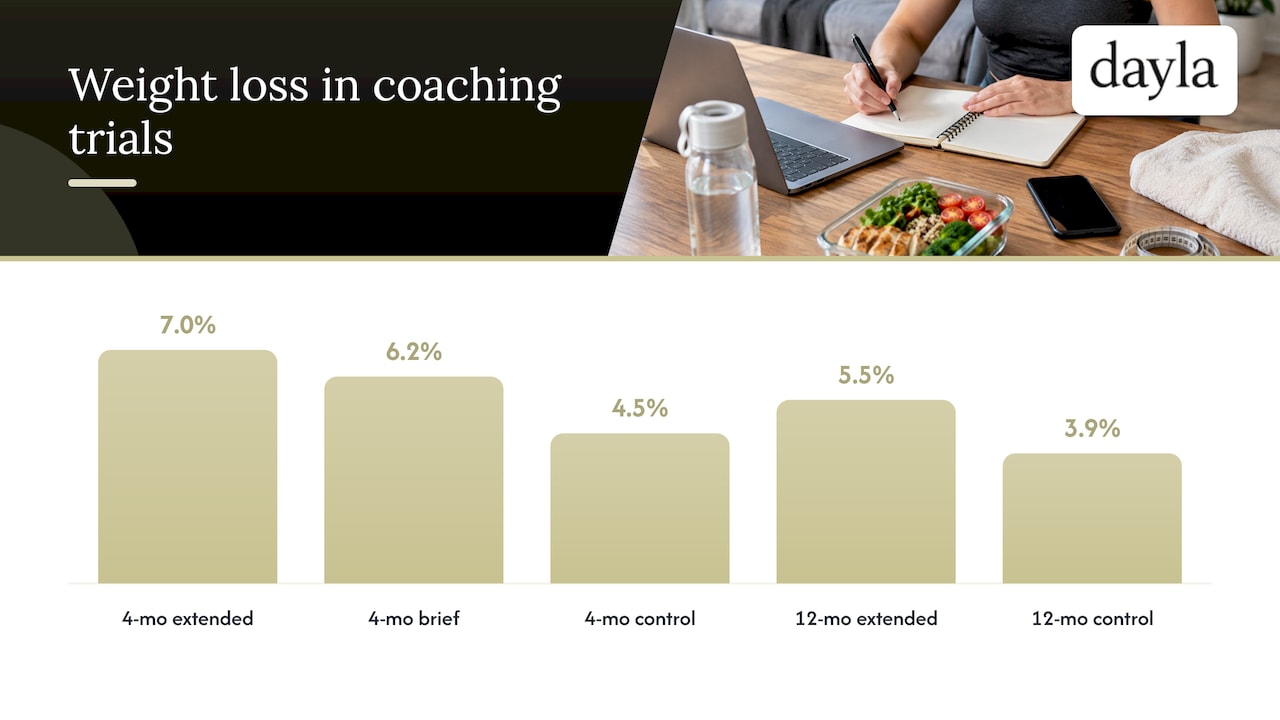
- A 2024 randomized trial of 437 U.S. adults with a BMI of 25 to 45 found that telephone coaching added to an automated online program helped people whose early weight loss was slow. At four months, extended coaching produced a 7.0% loss and brief coaching 6.2%, against 4.5% for the control group. At 12 months, extended coaching still showed 5.5% against 3.9%.
- A 2025 analysis of a rural coaching program found that 18 telephone coaching sessions cost $555 per participant, compared with $27 for education alone. Even so, 34.2% of coached participants lost at least 10% of body weight, against 17.0% in the control group.
- A 2025 review of digital interventions found that a combination of patient information, contact with a specialist and incentives was linked to a 2.52 kg loss at six months. No single component was essential alone.
The pattern across these studies is consistent: a person on the other end, regular contact and structure beat information by itself.
Why maintenance deserves its own plan
Losing weight is one task. Keeping it off is another. In a 2024 trial of 540 primary care patients, nine months of active maintenance, either monthly video lessons or refresher sessions, significantly reduced weight regain at 12 months. People in those groups regained 0.37 to 0.45 kg, against 1.28 kg for the newsletter-only group. The authors point to ongoing maintenance support as the key step after an initial treatment phase.
So when you compare programs, look at what happens in month seven, not just month one. Our guides on how to maintain weight loss results that last and why weight regain happens after stopping go deeper on this.
How a coach tailors the plan to you
Good coaching is not a generic meal plan. Dietitians are expected to use proven counseling methods such as motivational interviewing, which is a conversation style that helps you find your own reasons and plan for change. The guideline on medical nutrition therapy names it as a way to help clients change behavior.
In practice, tailoring covers four areas:
- Nutrition. Your calorie target, protein, food preferences, schedule and budget shape the eating plan.
- Activity. The plan starts from what you can do now and builds from there.
- Behavior. You work on triggers, sleep, stress and routines, with goals you set together.
- Feedback. Your logs and check-ins drive adjustments, so the plan changes when your life does.
Coach, nutritionist or dietitian: who does what
These titles are not interchangeable. A registered dietitian is a credentialed nutrition professional who can provide medical nutrition therapy, meaning individualized nutrition care for a health condition. The title "nutritionist" and the title "coach" are often used more loosely, and requirements vary by state and by employer. A coach supports habits, accountability and motivation. A coach does not diagnose conditions or prescribe medication.
When you review a provider, ask these questions:
- What are the credentials of the person you will speak with, and is that person a registered dietitian or a clinician?
- Who oversees the program medically?
- How often will you meet, and for how long?
- What happens if you have another health condition or take other medications?
The more health factors in your picture, such as diabetes, blood pressure or other prescriptions, the more you benefit from coaching that is connected to a clinician who can see the whole case.
Questions to ask before you start
The NIDDK suggests asking whether the program has been formally studied with results published in a scientific journal, how it is delivered and how long it lasts, the total cost and any excluded fees, whether a doctor or certified health professional runs or oversees it, and what safety risks exist and how follow-up keeps you safe. Use those as your core checklist. Our weight loss program comparison checklist turns them into a side-by-side worksheet.
Warning signs
The NIDDK also lists signs of a program to avoid: promises such as losing 30 pounds in 30 days, losing weight without diet or exercise, or targeting fat in one body area, plus fine-print disclaimers and before-and-after photos that look too good to be true. False claims can be reported to the Federal Trade Commission. For supplements specifically, see our weight loss supplement red flags list.
Privacy
Your weight, medications and health history are sensitive. The U.S. Department of Health and Human Services' telehealth guidance for nutrition care calls for a HIPAA-compliant telehealth platform with secure video, encrypted messaging and user authentication. The same guidance notes that virtual visits can bring in tools such as smart scales, wireless blood pressure monitors and fitness trackers. Ask any provider how your data is protected and which tools it uses.
Cost
Coaching that involves real people costs money, and the research above shows why: staff time is the main expense. Compare the full monthly price, what it includes, and whether medication, lab work or follow-up visits are extra. Our GLP-1 weight management program cost comparison shows how to line these up.
Why coaching works best with medical care
Behavior change is the foundation, but some people need more than habits alone. The 2025 VA/DoD guideline, published in the Annals of Internal Medicine, suggests telephone-delivered comprehensive lifestyle intervention as an alternative to or alongside in-person care. It recommends semaglutide or tirzepatide together with that lifestyle intervention for patients with a BMI of 27 or higher plus an obesity-associated condition, or a BMI of 30 or higher. The guideline defines the lifestyle component as a structured program with self-management support, including assessment and feedback, collaborative goal setting, problem solving and skill building. It is not just general advice on food and exercise. It also suggests ongoing maintenance support to minimize weight regain.
This is the case for a bundled, doctor-led program. Medication decisions belong with a licensed clinician, who reviews your history, current medications and goals. Coaching then helps you eat well on the medication, stay active and build habits that last. Our overview of the benefits of medically supervised weight loss explains how the pieces fit, and our note on telehealth weight loss laws explains what to expect from an online prescriber.
If you take medication for diabetes, are pregnant or planning pregnancy, or have a history of pancreatitis or thyroid conditions, tell the clinician during intake. They decide whether a given medication is appropriate for you.
What to expect over time
Progress is gradual. Most of the studies above measure results over months, not weeks, and the best outcomes came from programs that kept contact going. Plan for a first phase of building routines, a middle phase of adjusting, and a long maintenance phase. Our realistic weight loss timeline walks through each stage.
Where Dayla fits
Dayla offers doctor-led GLP-1 weight loss care online, shipped nationwide, with no insurance required. You complete an online intake, a clinician reviews it, and if you are approved your care starts. Your monthly package bundles clinician evaluations, medication, care coaching and shipping, with dietitian visits at no extra charge. We charge no membership fees, and you can cancel flexibly.
Published plans:
| Plan | Price |
|---|---|
| Oral GLP, liposomal (needle-free) | from $149 per month |
| GLP-1 Microdose | from $159 per month |
| GLP-1 Injection | from $179 per month |
| dayla GLP-1 program | $299 per month |
You can compare the options and start your intake on the Dayla site, or read about compounded GLP-1 weight care. The semaglutide injection maintenance dose page covers the maintenance option.
Our perspective
Coaching changes what you do each day. Medical care changes what your body is working against. We built Dayla around the idea that you should not have to choose between them.
That is why our program is doctor-led, with clinician evaluations, dietitian consults and care coaching included in one monthly price. You get one team and one plan, with nationwide access and cash pricing you can see up front.
We also offer both injection and needle-free oral GLP-1 options, so your plan can fit how you want to take your medication. The goal is a routine you can keep after the first few months, because the research is clear that ongoing support is what protects your results.
Flexible
FAQ
How much weight can I expect to lose with online coaching?
Results vary by person and program. In a 2024 randomized trial, adults who received telephone coaching on top of an online program lost 5.5% to 7.0% of body weight, depending on the time point and coaching intensity. Your clinician and coach can set a realistic target based on your health and goals.
Is an online weight loss coach the same as a nutritionist?
Not necessarily. A registered dietitian holds a specific credential and can provide medical nutrition therapy. A coach focuses on habits and accountability. Ask any provider for the credentials of the person you will meet with, and look for physician oversight.
How often should I meet with a coach?
The NIDDK describes weekly online sessions as a feature of a good virtual program. Research on telemedicine programs found that those lasting more than six months or including more than 14 sessions tended to produce greater weight loss.
Can I get coaching and weight loss medication together?
Yes. Current VA/DoD guidance recommends pairing semaglutide or tirzepatide with a structured lifestyle program for eligible patients. At Dayla, a clinician reviews your intake to decide whether medication is right for you, and care coaching and dietitian visits are part of the package.
Do I need insurance?
Not with Dayla. Our plans are cash-pay, with published monthly prices and nationwide shipping.
Sources
- Choosing a Safe & Successful Weight-loss Program, NIDDK
- A Review of Telemedicine Interventions for Weight Loss
- Obesity: Technology-Supported Coaching or Counseling Interventions, CDC Community Guide
- An Adaptive Telephone Coaching Intervention, JAMA Network Open
- Cost-effectiveness of the Rural LEAP program
- Evaluation of the Aspects of Digital Interventions That Drive Weight Loss
- Pragmatic Implementation of Online Obesity Treatment and Maintenance, JAMA Internal Medicine
- Medical Nutrition Therapy Interventions guideline
- Setting up telehealth to provide nutrition care, HHS
- Adult Overweight and Obesity Management: VA/DoD guideline update, Annals of Internal Medicine