

Weight regain after stopping a weight loss regimen is a predictable biological response, not a personal failure. The clinical term for this phenomenon is "weight recidivism," and it is driven by hormonal dysregulation, metabolic adaptation, and immune system memory that persist long after the diet or medication ends. Obesity is a chronic, relapsing disease requiring ongoing management, not a temporary condition you fix and move on from. Understanding why weight regain happens after stopping is the first step toward building a plan that actually holds.
What hormonal changes cause weight regain after stopping?
The body's appetite hormones shift dramatically after weight loss, and those shifts do not resolve quickly. Ghrelin, the hormone that signals hunger, rises significantly after fat loss. Leptin, the hormone that signals fullness and energy sufficiency, drops sharply as fat stores shrink. Together, these changes create a powerful biological drive to eat more and store fat.
The most striking finding is how long these hormonal changes last. Hormonal dysregulation persists for at least 12 months after weight loss ends, with elevated ghrelin and suppressed leptin continuing to drive hunger and fat accumulation. That means the intense hunger you feel months after stopping a diet or medication is not a sign of weakness. It is a measurable physiological state.

The hypothalamus, the brain region that regulates energy balance, reads these hormonal signals and responds by increasing appetite and reducing energy expenditure. This dual response is why cutting calories alone becomes progressively less effective over time. GLP-1 receptor agonists work specifically by modulating this hormonal environment, reducing ghrelin signaling and enhancing satiety hormone responses. When those medications stop, the hormonal environment reverts.
Key hormonal shifts that drive post-diet weight regain include:
- Ghrelin elevation: Hunger hormone rises and stays elevated for over a year after weight loss
- Leptin suppression: Fullness signals remain blunted, making it harder to recognize when you have eaten enough
- Hypothalamic compensation: The brain interprets low leptin as starvation and increases food-seeking behavior
- Reward pathway reactivation: Without GLP-1 support, the brain's food reward circuits become more responsive to calorie-dense foods
Pro Tip: Tracking hunger levels on a simple 1–10 scale each morning can help you distinguish true physiological hunger from habit-based eating. If your hunger score is consistently above 7 before meals, that is a hormonal signal worth discussing with a clinician.
How does metabolic adaptation drive weight regain?
Metabolic adaptation is the body's built-in defense against weight loss. As you lose weight, your resting metabolic rate drops. The problem is that it drops far more than your smaller body size would predict.
Adaptive thermogenesis reduces resting metabolism by 200–400 calories per day beyond what body mass loss alone would explain. That gap is significant. A person eating the same calories that once produced a deficit may now be eating at maintenance or even surplus, without changing anything.
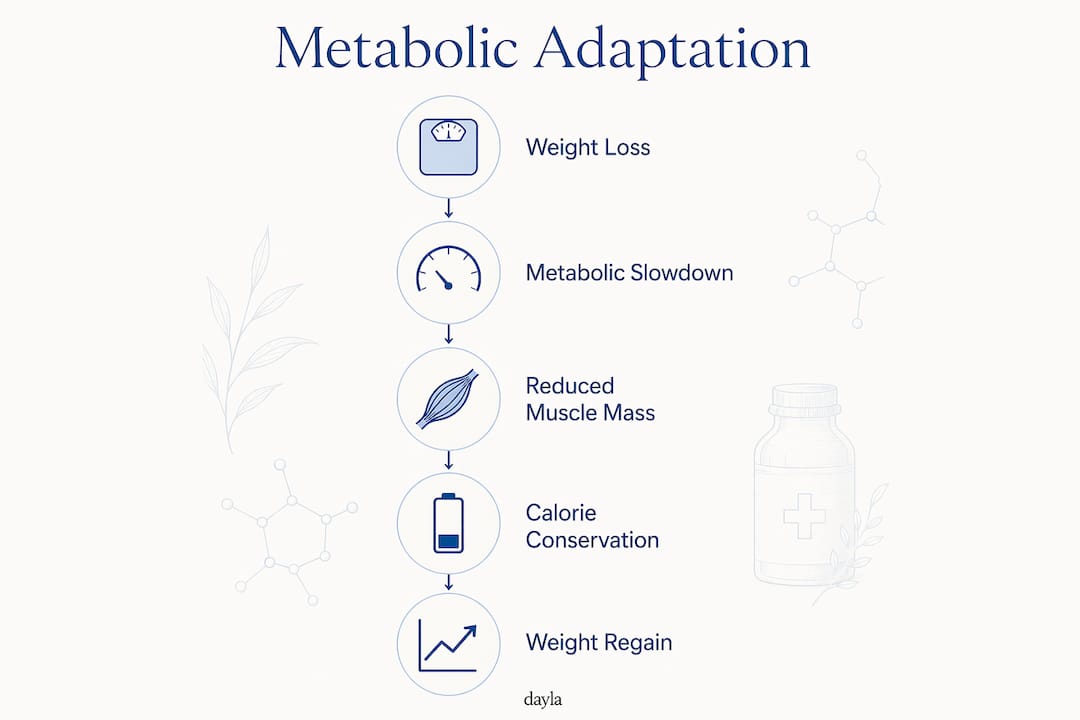
This metabolic slowdown also reflects the loss of lean muscle mass during calorie restriction. Muscle tissue burns more calories at rest than fat tissue. When dieting causes muscle loss alongside fat loss, the metabolic rate drops further. The result is a narrower calorie deficit with every passing week, which explains the weight loss plateau effects many people experience before they even stop their regimen.
| Metabolic factor | Effect during weight loss | Effect after stopping |
|---|---|---|
| Resting metabolic rate | Decreases 200–400 cal/day beyond body size | Remains suppressed for months to years |
| Lean muscle mass | Reduced by calorie restriction | Continues to affect metabolism if not rebuilt |
| Adaptive thermogenesis | Narrows calorie deficit | Promotes fat regain on same calorie intake |
| Energy expenditure | Reduced by hypothalamic compensation | Stays low without active resistance training |
Each cycle of weight loss and regain strengthens the body's energy conservation response, making future weight loss harder. This is why the second or third attempt at losing weight often feels more difficult than the first.
Pro Tip: Resistance training three times per week during and after weight loss preserves lean muscle mass and keeps your resting metabolic rate higher. This is one of the most evidence-supported tools for countering weight loss plateau effects.
Does your body "remember" being heavier?
The answer is yes, and the mechanism is more specific than most people realize. Adipose tissue, commonly called body fat, is not a passive storage depot. It functions as an active organ containing immune cells, and those immune cells retain a form of metabolic memory.
Research shows that memory T-cell populations persist in fat tissue after weight loss and reactivate inflammatory pathways when metabolic stress returns. These cells are maintained primarily through the CD70-CD27 signaling axis. When you regain even a small amount of weight, this immune memory triggers a faster and stronger inflammatory response than the original weight gain did.
"Adipose tissue retains immunologic memory via T-cell populations regulated through the CD70-CD27 axis, which reactivates inflammation promoting fat regain during metabolic stress. Weight loss does not erase this immune memory."
The practical implication is sobering. Repeated weight cycles do not reset the body to a neutral state. Each cycle amplifies the inflammatory response and makes fat regain more likely and faster. This is one reason why people who have yo-yo dieted for years find it progressively harder to maintain any loss.
The key findings from this area of research include:
- Adipose tissue retains immune memory independent of current body weight
- Memory T cells reactivate rapidly upon metabolic stress, even minor caloric surplus
- The CD70-CD27 axis is a potential future therapeutic target for long-term weight management
- Repeated weight cycles increase inflammatory burden in fat tissue over time
Researchers are actively investigating whether targeting this immune memory pathway could produce more durable weight loss remission. For now, the clinical takeaway is clear: preventing regain is biologically easier than recovering from it.
What does clinical evidence show about the timing of weight regain?
The data on weight regain timing is consistent across multiple types of interventions. Whether the weight loss came from a calorie-restricted diet, behavioral program, or medication, the body moves to restore lost weight quickly once the intervention stops.
The most studied recent example involves GLP-1 receptor agonist therapy. Up to two-thirds of lost weight is regained within 12 months of stopping GLP-1 medications. That rate reflects the underlying biology described above, not a flaw in the medication itself. The drug was managing a chronic condition. Stopping it allowed the condition to return.
Similar patterns appear after diet-only interventions. Placebo groups in maintenance trials maintained only 38–49% of their weight loss over 6–12 months without active maintenance support. That means more than half of lost weight returned within a year, even in people who had successfully completed a structured program.
The clinical picture supports one conclusion: obesity requires the same long-term management framework as conditions like hypertension or type 2 diabetes. A doctor would not prescribe blood pressure medication for six months and then stop it because the numbers improved. The same logic applies to weight management. Understanding how GLP-1 changes eating behavior makes it clearer why abrupt cessation produces such rapid regain.
How can you prevent weight regain after stopping?
Prevention is possible, but it requires a structured approach rather than willpower alone. The most effective strategies address the biological drivers of regain directly.
-
Taper, do not stop abruptly. Gradual pharmacological deprescribing, reducing medication dose slowly over weeks rather than stopping overnight, gives the body more time to adjust. Abrupt cessation triggers the fastest hormonal rebound.
-
Transition to a maintenance medication. Clinical trials show that participants maintained 75–79% of their weight loss when transitioning to a daily oral GLP-1 agent, compared to much lower retention in placebo groups. Oral GLP-1 options offer a lower-intensity continuation of hormonal support.
-
Prioritize resistance training. Building and preserving lean muscle mass is the most direct counter to metabolic adaptation. Three sessions per week of compound movements, such as squats, deadlifts, and rows, produces measurable improvements in resting metabolic rate.
-
Increase dietary protein. High-protein diets preserve lean mass during calorie restriction and increase diet-induced thermogenesis. Targeting 1.2–1.6 grams of protein per kilogram of body weight per day is a clinically supported range for weight maintenance.
-
Consider targeted supplementation. Supplementation with Akkermansia muciniphila, a gut microbiome strain, has shown promise in trials for reducing weight regain post-cessation. This is an emerging area with growing clinical support.
-
Commit to behavioral changes permanently. Temporary diets produce temporary results. The behaviors that produced weight loss, consistent meal timing, reduced ultra-processed food intake, regular movement, need to become permanent habits rather than a phase.
Pro Tip: The benefits of medically supervised weight loss extend well beyond the active treatment phase. A clinician can help you build a personalized deprescribing and maintenance plan that accounts for your specific metabolic profile.
Key Takeaways
Weight regain after stopping a weight loss regimen is a biological certainty without a structured maintenance plan, driven by hormonal shifts, metabolic slowdown, and immune memory that persist for months to years.
| Point | Details |
|---|---|
| Hormonal dysregulation persists | Elevated ghrelin and suppressed leptin drive hunger for at least 12 months post-cessation. |
| Metabolic rate drops significantly | Adaptive thermogenesis reduces resting metabolism by 200–400 calories daily beyond body size effects. |
| Adipose immune memory promotes regain | Memory T cells in fat tissue reactivate inflammation rapidly when metabolic stress returns. |
| Regain is fast without intervention | Up to two-thirds of lost weight returns within 12 months of stopping GLP-1 therapy or a diet. |
| Structured maintenance reduces regain | Tapering medication, resistance training, and high-protein diets preserve significantly more weight loss. |
Weight regain is biology, not failure
The framing most people carry into weight loss is fundamentally wrong. They treat it as a problem to solve and a finish line to cross. The biology says otherwise. Hunger after weight loss is a physiological response driven by hormone-mediated signals, not a lack of discipline. Recognizing that distinction changes everything about how you approach maintenance.
I have seen people carry enormous shame about regaining weight they worked hard to lose. That shame is misplaced. The body is doing exactly what it evolved to do: restore energy reserves after a perceived shortage. The problem is not the person. The problem is treating a chronic condition as if it were acute.
The most durable outcomes I have observed come from people who stop thinking about weight loss as a temporary intervention and start thinking about it as ongoing management. That means staying connected to medical support, adjusting strategies as the body changes, and accepting that some form of active maintenance will always be necessary. That is not a failure state. It is just how chronic disease management works.
The good news is that the tools available in 2026 are better than they have ever been. Oral GLP-1 options, emerging gut microbiome therapies, and personalized deprescribing protocols give people real options for maintaining progress. The biology is not destiny. It is just the starting point.
— Flexible
Daylahealth's approach to long-term weight management
Weight regain is not inevitable when you have the right support structure in place. Daylahealth offers doctor-led, personalized GLP-1 care designed for exactly this challenge: not just losing weight, but keeping it off through medically supervised, evidence-based treatment.

Daylahealth's GLP-1 weight loss program includes clinical oversight, personalized dosing, and guidance on maintenance strategies including deprescribing protocols and lifestyle integration. Whether you are currently on a GLP-1 medication and planning your next phase, or you have already stopped and noticed regain beginning, a Daylahealth clinician can help you build a plan grounded in your biology. Explore your options at Daylahealth and take the next step toward sustainable results.
FAQ
Why do I regain weight so fast after stopping medication?
Stopping GLP-1 medication removes the hormonal support that was suppressing ghrelin and enhancing satiety. The body rapidly reverts to its pre-treatment hormonal state, driving increased hunger and fat storage within weeks.
Is weight regain after dieting a sign that the diet failed?
Weight regain is a biological response to calorie restriction, not a sign that the diet was wrong or that you lacked commitment. Hormonal and metabolic changes that promote regain begin during weight loss itself and persist for months after stopping.
How long does metabolic adaptation last after weight loss?
Metabolic adaptation, including a reduced resting metabolic rate, can persist for years after significant weight loss in some individuals. Resistance training and adequate protein intake are the most effective tools for countering this effect.
Can supplements help prevent weight regain?
Clinical trials show that Akkermansia muciniphila supplementation can meaningfully reduce weight regain post-cessation compared to placebo. Oral GLP-1 agents used as a maintenance transition also show strong results for preserving weight loss.
What is the best strategy for maintaining weight loss long-term?
The most effective approach combines gradual medication tapering, resistance training three times per week, a high-protein diet, and ongoing medical supervision. Treating weight management as a chronic condition rather than a completed program produces the most durable outcomes.