

GLP-1 coaching helps you get more weight loss and keep it off by pairing your medication with structured nutrition, resistance training, and behavior-change support. Research shows coaching improves persistence with treatment and directly addresses the risks that come with rapid loss: muscle depletion, nutrient gaps, and eventual regain. A solid program combines nutrition coaching, strength programming, side-effect management, and coordination with your prescriber. Some providers bundle oversight with GLP-1 care plans, making it one option worth considering if you want medication and coaching under one roof.
TL;DR:
- Engaging a GLP-1 coach early helps establish muscle-preserving habits before appetite suppression becomes severe.
- Most programs focus on four pillars: onboarding, nutrition, resistance training, and behavior change, each handled by qualified professionals.
- Prioritize protein intake, especially at breakfast, and use small, tolerable sources like yogurt or shakes to counteract reduced appetite and prevent muscle loss.
- Resistance training two to three times weekly is essential, with program adjustments made based on side effects and energy levels to maintain muscle mass.
- Coordinated programs that integrate prescriber oversight with dietitian, exercise, and behavioral support improve treatment persistence and long-term weight maintenance.
Table of Contents
- What Is GLP-1 Coaching and Why Does It Matter?
- Core Coaching Pillars: A Practical Framework
- How Should Nutrition Change While You're on GLP-1 Medication?
- What Exercise Guidance Do GLP-1 Coaches Give?
- How Do Coaches Handle Side Effects, Plateaus, and Tapering?
- When Should You Start Coaching, and What Does a Program Look Like?
- How Do You Choose the Right GLP-1 Coach?
- Dayla Health's Role in GLP-1 Care and Coaching
- What Surprises People Most About Starting GLP-1 Coaching?
- How Dayla Health Supports Your GLP-1 Plan
- Where to Read More on GLP-1 Coaching and Nutrition
- Sources
- FAQ
What Is GLP-1 Coaching and Why Does It Matter?
GLP-1 coaching is structured, ongoing behavioral and nutrition support delivered alongside your prescription, not instead of it. A coach works in coordination with your prescriber to manage the parts medication alone can't touch: what you eat when your appetite disappears, how you preserve muscle while the scale drops fast, and how you build habits that outlast the drug itself.
The clinical case for this is stronger than most people realize. A review published on PMC found that health and well-being coaching helps patients stick with GLP-1 treatment longer while directly managing side effects and muscle-loss risk. Separately, a joint clinical advisory on nutrition and GLP-1 therapy recommends a multicomponent lifestyle approach to minimize deficiencies and preserve lean mass during rapid weight loss. Trials on GLP-1 medications show weight reductions in the range of 5% to 18% of body weight, according to a systematic review published in Nature Reviews Endocrinology, but that same body of evidence stresses that maintaining the loss, and protecting the muscle you have, depends on what happens outside the injection.
Coaching goals typically fall into a few concrete buckets:
- Protecting lean muscle mass while calorie intake drops sharply
- Managing gastrointestinal side effects so you can eat enough to meet protein needs
- Building exercise habits that stick once the medication's appetite suppression fades
- Preventing the rebound weight gain that shows up after tapering or stopping treatment
- Coordinating with your prescriber on dose timing, labs, and symptom reporting
None of this replaces medical care. It fills the gap between what a prescriber can monitor in a fifteen-minute visit and what actually happens at your dinner table three times a day. Mayo Clinic's patient guidance puts it plainly: lifestyle change is what determines whether weight loss on GLP-1 medication actually sticks.
Core Coaching Pillars: A Practical Framework
Most credible GLP-1 coaching programs are built around four pillars, and the best ones assign each to someone qualified to handle it rather than asking one generalist to do everything.
- Onboarding and baseline assessment. Before any adjustments happen, a coach reviews your current intake, activity level, medication dose and titration schedule, and any lab work. This is often where a registered dietitian nutritionist (RDN) or a certified diabetes care and education specialist (CDCES) sets a protein target and flags anything that needs prescriber attention.
- Nutrition coaching. This is ongoing, not a one-time meal plan. As your appetite shrinks week over week, an RDN adjusts food choices to hit protein and micronutrient targets on far fewer calories than you're used to eating. Session activities here look like reviewing a food log, troubleshooting nausea around meal timing, or restructuring your grocery list around protein-dense, low-volume foods.
- Exercise and strength programming. A strength coach or exercise physiologist builds a resistance training routine scaled to your current fitness and energy level, since the goal is muscle retention, not marathon training. Sessions might involve reviewing form on a handful of compound lifts or adjusting volume when fatigue from a dose increase hits hard.
- Behavior change and relapse prevention. This pillar uses frameworks borrowed from cognitive behavioral therapy (CBT) to address the psychological side of eating less, including old habits around stress eating or social meals that resurface once appetite partially returns. A behavior coach might walk through a specific high-risk situation, like a holiday dinner, and build a plan before it happens rather than after it goes sideways.
Pharmacists sometimes sit alongside this structure too, particularly for compounded formulations or when a client has questions about injection technique, storage, or interactions with other medications. Programs like the Omada Health GLP-1 care track illustrate how this multidisciplinary model works in practice, pairing dedicated coaches, RDNs, and exercise specialists across a single member pathway. The point isn't that every program needs four separate specialists on staff. It's that each pillar needs to be handled by someone with the right training, whether that's one credentialed generalist coach or a small team.
If you're just getting oriented to what starting treatment looks like before coaching enters the picture, how to start your GLP-1 weight loss journey covers the basics of titration and early expectations.
How Should Nutrition Change While You're on GLP-1 Medication?
Protein comes first, and it's not close. Appetite suppression on GLP-1 medications drops total intake fast, and if protein isn't prioritized specifically, the body pulls from muscle to make up the energy deficit. Coaches generally aim for a per-pound-of-body-weight protein target distributed across three or four small meals, since a suppressed appetite often can't handle one large protein-heavy meal even if the daily total looks right on paper.
Practical tactics an RDN or coach will typically use:
- Front-loading protein at breakfast, when nausea is often lowest
- Recommending protein sources that are easy to tolerate in smaller volumes, like Greek yogurt, cottage cheese, or protein shakes, when appetite is at its worst
- Building in a hydration schedule, since reduced thirst cues combined with lower food intake raise dehydration risk
- Flagging labs worth discussing with a prescriber, such as vitamin B12, iron, and vitamin D, especially for anyone on medication longer than a few months
- Adjusting intake targets downward in calories but upward in protein density as the dose titrates up
Pro Tip: Track protein first and calories second for the first month. Most people on GLP-1 medication under-eat protein long before they under-eat calories, and that imbalance is what drives muscle loss, not the calorie deficit itself.
The joint clinical advisory on nutrition and GLP-1 therapy is explicit that a multicomponent approach protects against the nutrient deficiencies common with sharply reduced food intake. During stalls, a coach usually reviews recent labs, sleep, and stress before touching the diet plan at all, since a metabolic plateau often has nothing to do with what's on your plate. For anyone hitting a wall on the scale, how to overcome a weight loss stall on GLP-1 breaks down that troubleshooting sequence in more depth, and the role of diet in GLP-1 treatment covers nutrition strategy across the full course of treatment.
What Exercise Guidance Do GLP-1 Coaches Give?
Resistance training two to three times a week is the baseline most coaches build toward, and it's not a suggestion tacked onto the nutrition plan. The National Academy of Sports Medicine (NASM) specifically advises fitness professionals to prioritize resistance training and weekly check-ins for clients on GLP-1 medications to counter the muscle loss that comes with rapid weight reduction.
Coaches modify programs based on real-world constraints, not textbook ideals:
- Reducing volume, not frequency, during weeks when medication side effects spike fatigue
- Swapping heavy compound lifts for machine-based or banded resistance work for older adults or anyone new to strength training
- Using reps-in-reserve, a simple scale of how many more reps you could do before failure, to track intensity without needing a gym full of equipment
- Checking grip strength or a basic sit-to-stand test periodically as a low-tech proxy for overall strength trends
For anyone managing osteoporosis or low bone density alongside GLP-1 treatment, safe exercise guidelines for bone health outline which movements protect bone density without risking fracture, a consideration that matters more once older adults start losing weight quickly.
Pro Tip: If a full workout feels impossible on a low-energy week, two ten-minute strength sessions still beat skipping the day entirely. Consistency at low volume protects muscle better than sporadic high-intensity sessions.

More on protecting muscle specifically, including protein-to-training ratios, is covered in how to prevent muscle loss during GLP-1 therapy.
How Do Coaches Handle Side Effects, Plateaus, and Tapering?
Side effects, plateaus, and eventual dose changes each have a fairly predictable coaching response, and knowing the sequence in advance takes a lot of the anxiety out of each stage.
- Manage GI side effects with food, not just willpower. Nausea, constipation, and reflux affect a meaningful share of GLP-1 users, and most cases respond to smaller, lower-fat meals, slower eating pace, and consistent hydration rather than requiring a medication change. Escalate to your prescriber if vomiting is persistent, if you can't keep fluids down for more than a day, or if abdominal pain is severe.
- Troubleshoot plateaus in order, not all at once. A coach typically checks sleep quality and stress levels first, since both disrupt appetite-regulating hormones, then reviews recent labs, then confirms protein intake is still on target, and only then adjusts activity levels. Jumping straight to "eat less, move more" usually skips the actual cause.
- Plan a taper or maintenance phase months in advance, not the week it happens. The biggest regain risk shows up when someone reduces or stops medication without a nutrition and strength routine already locked in. Coaches use the weeks leading up to a taper to solidify habits that don't depend on suppressed appetite, so hunger returning doesn't immediately undo months of progress.
If a dose transition is coming up, transitioning to a GLP-1 maintenance dose safely walks through what to expect and how to prepare nutritionally before appetite starts to shift back.
When Should You Start Coaching, and What Does a Program Look Like?
Earlier is better, and the data backs that up specifically: engaging a coach during the early titration phase, sometimes called the honeymoon phase, lets you lock in muscle-preserving habits before rapid appetite suppression sets in, rather than trying to course-correct after months of under-eating protein.
Good entry points include:
- Before your first dose, to set nutrition and training baselines
- During early titration, when appetite drops fastest and habits are easiest to establish
- At a plateau, when troubleshooting needs a structured process
- Ahead of a planned taper, to protect against regain
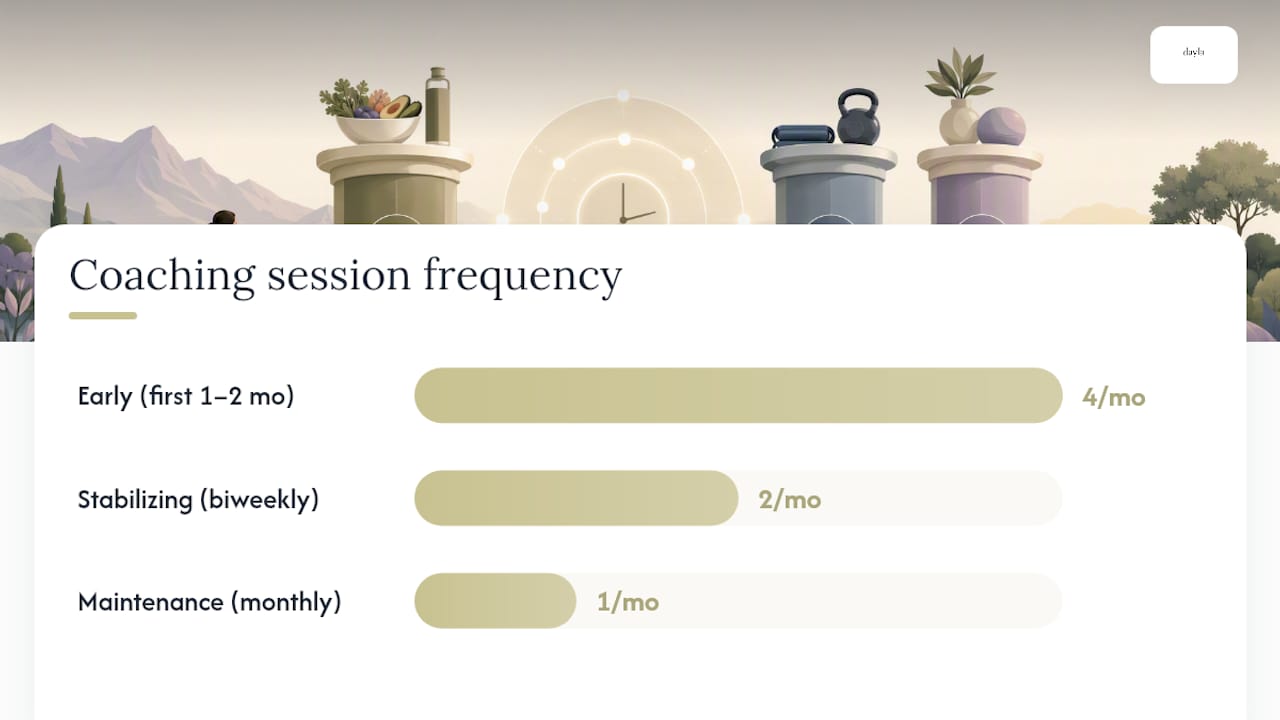
Typical program structure follows a predictable cadence: weekly sessions for the first month or two while habits are forming, shifting to biweekly check-ins as things stabilize, then monthly or booster sessions for longer-term maintenance. Most structured programs run three to six months for an initial engagement, though many clients continue at a lower touch level well beyond that. Framed against the cost of regained weight, and the medical cost of muscle loss in older adults specifically, coaching is generally positioned as a modest add-on to a much larger medication and health investment rather than a separate expense to weigh independently.
How Do You Choose the Right GLP-1 Coach?
Credentials and clinical integration separate a real coaching program from someone repackaging generic fitness advice with a GLP-1 label slapped on it.
- Confirm the coach or program has access to an RDN, not just a "nutrition coach" with no formal credential.
- Ask whether a CDCES is involved, particularly if you have diabetes or prediabetes alongside your weight-loss goals.
- Ask directly how the program coordinates with your prescriber, and get a concrete answer, not a vague "we work with your doctor."
- Confirm strength or resistance training programming is included, not just cardio recommendations.
- Ask how side effects get triaged, and what the threshold is for referring you back to a medical provider.
- Ask what protein and calorie targets look like, and whether they adjust as your dose titrates.
- Ask how progress gets tracked beyond the scale, ideally including strength metrics or body composition.
- Ask what a taper or maintenance plan looks like before you ever need one.
- Ask about session cadence and total program length upfront, in writing.
- Ask what happens if you plateau. A vague answer here is a warning sign.
Three red flags worth walking away from: a program that promises a specific number on the scale, one that discourages any communication with your prescriber, and one with no credentialed nutrition or exercise staff at all. For readers who want a framework for tracking whether a program is actually working, how to track GLP-1 progress effectively lays out concrete markers beyond weight alone.
Dayla Health's Role in GLP-1 Care and Coaching
Some providers offer direct-to-consumer GLP-1 prescriptions and compounded peptides with ongoing clinical oversight, dietitian consults, and care coaching bundled into one subscription, shipped nationwide without requiring insurance. That structure puts prescriber oversight and coaching support under a single point of contact rather than asking you to coordinate between a prescriber and a separate coaching service yourself.
For readers who want to go deeper on specific pieces of the coaching puzzle, the Dayla Health blog covers lifestyle changes that boost GLP-1 results, how GLP-1 changes eating behavior, and signs your GLP-1 medication is working.
None of this replaces individualized medical care. Any side effect that feels severe, or any question about drug interactions, belongs with your prescriber, not a coach.
What Surprises People Most About Starting GLP-1 Coaching?
The honeymoon phase catches almost everyone off guard. Appetite suppression in the first several weeks feels dramatic, almost effortless, and it lulls people into skipping the habit-building work because the weight is already coming off without it. That's exactly backwards. The easiest window to build a resistance training habit and a protein routine is while the drug is doing heavy lifting on appetite, not after it wears off.
The other pattern worth naming: appetite doesn't disappear forever. It fluctuates, and often returns partially even mid-treatment. Clients who treated the medication as a total solution, rather than a tool that buys time to build durable habits, are the ones who struggle most when hunger comes back. Coaching that starts early treats the drug as leverage, not a cure, and that framing changes almost everything about how the first few months go.
— Flexible
How Dayla Health Supports Your GLP-1 Plan
If you're weighing where to get coaching that actually talks to your prescriber instead of operating in a separate lane, some providers build that coordination into the plan itself rather than leaving you to manage two disconnected providers. Subscriptions may bundle GLP-1 or compounded peptide prescriptions with clinician evaluations, dietitian consults, and ongoing care coaching, shipped directly to you without an insurance requirement standing in the way.

That means your nutrition guidance, your dosing schedule, and your side-effect questions all route through people who can see the full picture, not a coach guessing at what your prescriber already knows. If muscle preservation and long-term maintenance matter to you as much as the number on the scale, explore Dayla Health's GLP-1 program or check the current weight loss plans to see what's included. Starting is a short online intake, followed by clinician review before your first shipment goes out. Have your current weight, medication history, and any recent labs ready when you begin, as that may help with the approval process.
Where to Read More on GLP-1 Coaching and Nutrition
A short list of primary sources worth reading directly if you want the underlying clinical detail:
- Health and well-being coaching adjuvant to GLP-1 induced weight loss, a peer-reviewed look at coaching's role in medication persistence and side-effect management
- Nutritional priorities to support GLP-1 therapy for obesity, a joint clinical advisory on multicomponent lifestyle support
- Considering GLP-1 medications: why lifestyle change is key, Mayo Clinic's patient-facing overview
- Supporting clients through their GLP-1 medication journey, NASM's guidance for fitness professionals
This article is general information, not a substitute for advice from a qualified doctor. Consult a qualified healthcare professional about your own circumstances before acting on anything here.
Sources
- Nutritional priorities to support GLP-1 therapy for obesity (joint advisory)
- Supporting clients through their GLP-1 medication journey (NASM)
FAQ
Is there a free online GLP-1 coaching course available?
There isn't a single standardized free course, but resources like Mayo Clinic's patient guidance and NASM's professional blog offer credible, no-cost background on the nutrition and exercise principles coaches use.
How much do weight loss coaches typically charge?
Rates vary widely by credential and program structure, ranging from basic app-based coaching to higher-touch programs that include RDN and prescriber coordination, so ask for a clear breakdown before committing to any plan.
What is the 70/30 rule in coaching?
Definitions of this rule vary across fitness and nutrition coaching contexts, and it isn't a standardized clinical framework for GLP-1 care specifically, so treat any specific percentage split you hear with caution and ask your coach to explain their own reasoning.
What do people wish they'd known before starting GLP-1?
Most people underestimate how much protein intake drops without deliberate effort, and how important it is to start resistance training before appetite suppression peaks rather than after muscle loss has already begun.
Does Dayla Health offer coaching alongside GLP-1 prescriptions?
Some providers bundle dietitian consults and ongoing care coaching with GLP-1 and compounded peptide prescriptions, coordinated through the same clinical team managing medication.