

GLP-1 receptor agonists can meaningfully improve the weight and metabolic problems that drive PCOS, and trial data links that improvement to more regular cycles and higher natural pregnancy rates. The catch: PCOS is not an FDA-approved indication for any GLP-1 medication, so use is off-label, contraception is required during treatment, and the right first step is a conversation with a clinician about your labs, goals, and medical history.
TL;DR:
- GLP-1 drugs like tirzepatide can produce around 19.4% weight loss over 10 months in women with PCOS, with most losing at least 10% of body weight.
- These medications significantly boost natural pregnancy rates, nearly doubling the chance compared to control groups when used for 24 to 32 weeks.
- Side effects are mostly gastrointestinal, occur early, and require dose escalation; GLP-1s are not advised during pregnancy, and contraception is necessary during treatment.
- Insurers often do not cover off-label use for PCOS, making transparent cash options from providers like Dayla Health a practical choice.
- Long-term reproductive benefits and live-birth outcomes are still under study, so treatment should involve careful monitoring and planning with a clinician.
Table of Contents
- GLP-1 for PCOS: What the Weight and Metabolic Data Shows
- Can GLP-1 Drugs Improve PCOS Fertility and Cycle Regularity?
- Is GLP-1 Safe for PCOS? Side Effects and Pregnancy Guidance
- How Are GLP-1s Dosed for PCOS, and How Long Until You See Results?
- GLP-1 vs Metformin for PCOS: Which One, or Both?
- Turning the Research Into a Plan: What a Supervised GLP-1 Care Path Looks Like
- Dayla Health: A Supervised Way to Access GLP-1 Care for PCOS
- A Publisher's Take on Where the Evidence Actually Lands
- Sources
- FAQ
GLP-1 for PCOS: What the Weight and Metabolic Data Shows
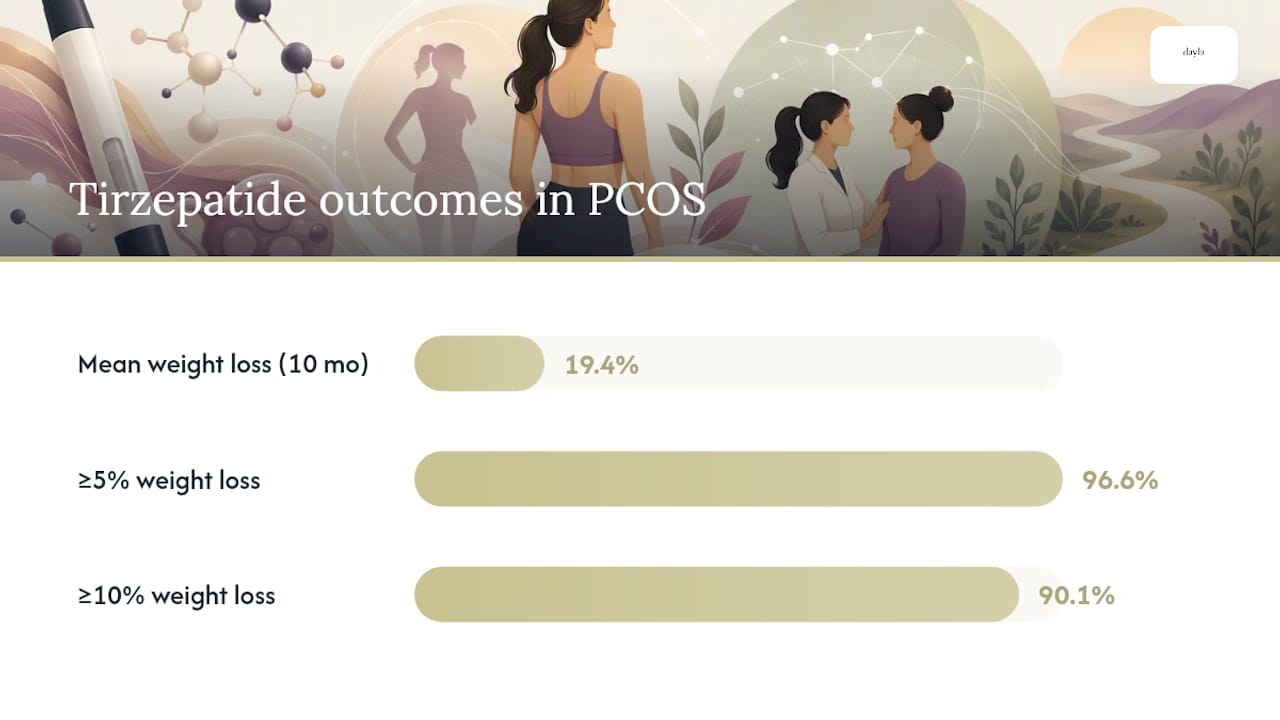
The strongest signal comes from real-world tirzepatide use. Women with self-reported PCOS lost a mean of 19.4% of body weight at 10 months, with 96.6% reaching at least 5% weight loss and 90.1% reaching at least 10%.
Randomized trials of liraglutide and semaglutide tell a similar story on a smaller scale. A 26-week liraglutide trial found roughly 5 kilograms more weight loss than placebo, alongside improved HOMA-IR and androgen markers compared with metformin.
By the numbers:
- 19.4% mean weight loss with tirzepatide at 10 months in a real-world PCOS cohort
- 90.1% of that group lost at least 10% of body weight
- Improved insulin resistance (HOMA-IR) reported across multiple GLP-1 trials versus metformin alone
The caveat that matters most here: most controlled trials run 12 to 32 weeks with modest sample sizes, and study designs vary enough that pooling results across them takes real caution.
Can GLP-1 Drugs Improve PCOS Fertility and Cycle Regularity?
Yes, and the effect size is bigger than many people expect. A 2023 systematic review of 11 randomized trials found GLP-1 receptor agonists raised natural pregnancy rates with a relative risk of 1.72, meaning women on these drugs got pregnant naturally at nearly twice the rate of comparison groups.
- Menstrual cyclicity improved most reliably after 24 to 32 weeks of treatment, not in the first few weeks
- One RCT found semaglutide added to metformin produced a 35% natural pregnancy rate versus 15% for metformin alone
- Liraglutide trials also documented increased SHBG, reduced free testosterone, and smaller ovarian volume alongside weight loss
Live-birth data and IVF-specific outcomes remain thin. A clinical trial registry entry for tirzepatide targeting ovarian dysfunction endpoints is currently active, which tells you fertility-specific evidence is still catching up to the metabolic data. The most honest framing right now: GLP-1 therapy works as metabolic optimization before conception, not as a fertility treatment in its own right.
Is GLP-1 Safe for PCOS? Side Effects and Pregnancy Guidance
The side-effect profile is predictable and mostly gastrointestinal. Nausea, constipation, and reduced appetite show up most often in the first weeks of treatment, and gradual dose escalation is the standard way to keep them manageable, a pattern confirmed in the 2023 international PCOS guideline.
- GI symptoms (nausea, bloating, constipation) are the most common complaints, especially during dose increases
- Hypoglycemia risk from GLP-1s alone is low, but rises when combined with insulin or sulfonylureas
- GLP-1 agents are not recommended during pregnancy, and effective contraception is expected while on treatment
- Long-term safety data in reproductive-age women remains limited, which is why ongoing monitoring matters
Pro Tip: If you're planning to conceive within the next year, talk to your clinician about the timeline for pausing GLP-1 therapy before you try. Stopping abruptly without a plan can complicate both weight maintenance and cycle tracking.
Reviews of the evidence, including a meta-analysis on liraglutide plus metformin, consistently flag that durability of reproductive benefit and live-birth safety are still open questions. That is not a reason to avoid GLP-1 therapy. It is a reason to treat it as a monitored decision, not a set-and-forget prescription.
How Are GLP-1s Dosed for PCOS, and How Long Until You See Results?
Trial protocols vary by drug, but the pattern is consistent: start low, increase gradually, and expect the reproductive benefits to lag behind the weight loss.
- Liraglutide trials typically escalate over several weeks to a daily maintenance dose, with cycle improvements showing up around 26 weeks.
- Semaglutide studies, often combined with metformin, follow a similar slow titration and report stronger pregnancy and metabolic outcomes at 24 to 32 weeks.
- Tirzepatide, used more often for weight-driven cases, showed its largest cumulative effect at the 10-month mark in real-world data.
Across all three, digital engagement and coaching correlated with meaningfully larger weight loss, which lines up with what most clinicians already assume: medication plus support beats medication alone. Discontinuation tends to bring weight regain, so this works best as a sustained plan discussed openly with your care team, not a short course.
Pro Tip: Track your cycle alongside your weight from day one. Reproductive changes often lag body-composition changes by two to three months, and having your own data makes that gap less confusing.
For a closer look at what a typical titration schedule involves, see how to transition to a maintenance dose safely.
GLP-1 vs Metformin for PCOS: Which One, or Both?
Metformin has been the default PCOS medication for decades, and it still earns its place for people with mild insulin resistance who tolerate it well and want a lower-cost option. But head-to-head evidence increasingly favors GLP-1 therapy, or GLP-1 plus metformin, for anyone dealing with higher body weight or more pronounced insulin resistance.
- Meta-analyses show GLP-1 receptor agonists, alone or combined with metformin, outperform metformin alone on BMI reduction, HOMA-IR, and androgen levels
- Metformin remains reasonable for mild cases, cost-sensitive patients, or those wanting to avoid injectable therapy
- GLP-1 use for PCOS stays off-label regardless of which drug is chosen, and insurance coverage varies widely by plan and diagnosis coding
The decision usually comes down to how much weight and insulin resistance are driving your symptoms, not brand preference.
Turning the Research Into a Plan: What a Supervised GLP-1 Care Path Looks Like
Good GLP-1 care for PCOS follows a sequence, not a single prescription. It starts with a clinician evaluation and baseline labs, moves through a contraception conversation if pregnancy is possible, and continues with dose escalation paired with dietitian follow-up.
- Clinician evaluation and baseline labs (glucose, insulin, lipids, androgens)
- Contraception discussion before the first dose, if pregnancy is a possibility
- Medication and formulation selection based on weight, insulin resistance, and tolerance
- Gradual dose escalation with dietitian check-ins along the way
- Ongoing tracking of weight, cycle regularity, and side effects
The model builds around that sequence: clinician oversight, dietitian visits, multiple GLP-1 formulations, and nationwide shipping so care does not depend on where you live. Watch for red flags like severe abdominal pain, persistent vomiting, or signs of dehydration, and contact your clinician promptly if they appear. If you want more detail on getting started, this walkthrough on beginning a GLP-1 weight loss plan covers the intake process step by step.
Dayla Health: A Supervised Way to Access GLP-1 Care for PCOS
This approach removes the two biggest barriers women hit when trying to start GLP-1 therapy for PCOS: finding a clinician who takes the diagnosis seriously, and paying membership fees on top of medication costs. There are none here, just transparent cash pricing and nationwide clinician access.
The program starts with an online evaluation and baseline health review, then moves into medication selection between injection, microdose, or needle-free oral GLP-1 formats, all backed by ongoing clinician oversight and free dietitian visits. Options include the GLP-1 Injection plan from $179 per month, GLP-1 Microdose from $159 per month, and Oral GLP · Liposomal from $149 per month, with flexible cancellation if your needs change. If you're ready to see which formulation fits your PCOS symptoms and metabolic profile, start your GLP-1 evaluation today and get a personalized plan built around your labs, not a generic protocol.
A Publisher's Take on Where the Evidence Actually Lands
The metabolic case for GLP-1 therapy in PCOS is strong, and the reproductive signal, a nearly doubled natural pregnancy rate in pooled trials, is more compelling than most patients realize. What remains genuinely unknown is durability: whether cycle improvements hold after years of treatment, and what happens to live-birth rates rather than short-term pregnancy signals. Anyone considering this route should ask for baseline labs, a clear contraception plan, and a monitoring schedule before the first dose, not after.
— Flexible
This article is general information, not a substitute for advice from a qualified doctor. Consult a qualified healthcare professional about your own circumstances before acting on anything here.
Sources
- Weight loss outcomes with tirzepatide in women with and without self-reported polycystic ovary syndrome - PMC
- Systematic review (2023) showing increased natural pregnancy rate with GLP-1 use
- Recommendations From the 2023 International Evidence-based Guideline for the Assessment and Management of Polycystic Ovary Syndrome
FAQ
Which GLP-1 Is Best for PCOS?
No single GLP-1 drug is officially "best" since none carry an FDA-approved PCOS indication, but semaglutide and tirzepatide currently have the strongest weight-loss and metabolic data, including 19.4% mean weight loss with tirzepatide in a real-world cohort. Liraglutide has the longest track record for reproductive-specific outcomes like cycle regularity.
Is GLP-1 Covered by Insurance If You Have PCOS?
Coverage varies widely because GLP-1 use for PCOS is off-label, and many insurers require a diabetes or higher-weight diagnosis code to approve it. Transparent cash pricing avoids that uncertainty, so coverage decisions don't hold up your care.
How Do Clinicians Treat PCOS Beyond GLP-1 Medications?
Standard approaches include metformin for insulin resistance, hormonal contraceptives for cycle regulation, and lifestyle changes targeting weight and activity. GLP-1 receptor agonists are increasingly added when weight and insulin resistance are the dominant drivers, often alongside metformin rather than replacing it.
Is Wegovy or Ozempic Better for PCOS?
Both contain semaglutide, so their metabolic effects on PCOS are similar; the difference is dosing and approved indication (Wegovy for weight management, Ozempic for type 2 diabetes). For PCOS specifically, the choice usually depends on which indication your clinician can prescribe under and what your insurance or cash-pay plan supports.