
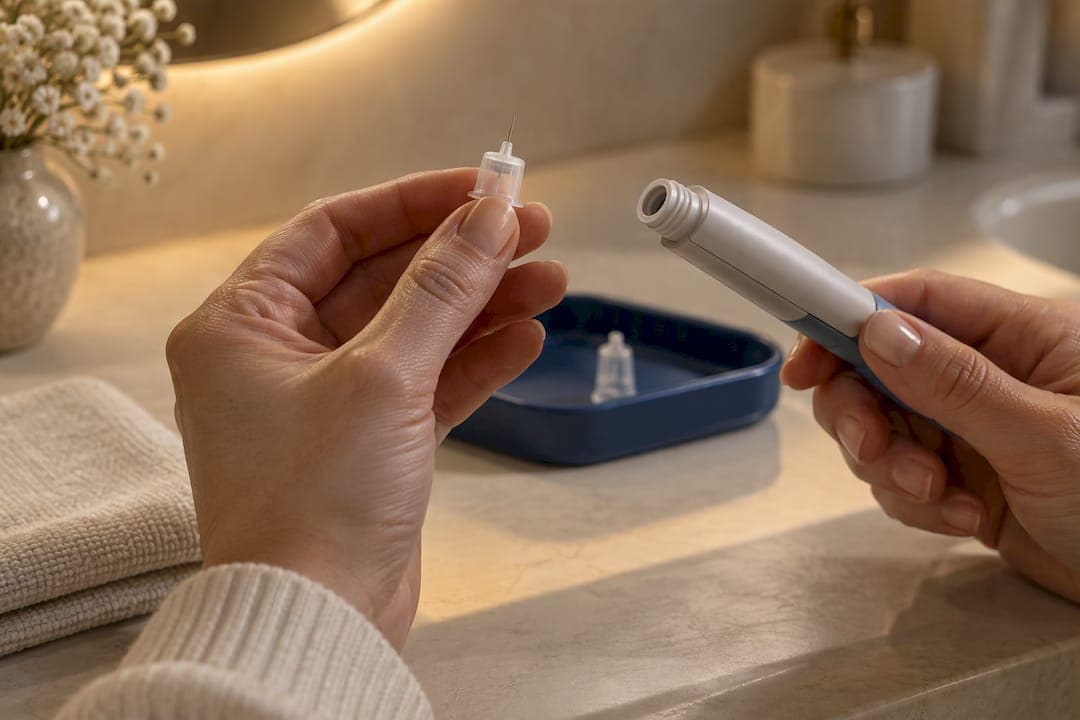
Use the needle that comes with your pen, or the exact syringe your pharmacy specifies for a vial prescription. Pen presentations like Ozempic typically supply a NovoFine Plus 32G, 4 mm needle, and most GLP-1 injections fall in the 29G to 32G, 4 to 6 mm range. Always use a new needle for each injection, and never share a pen with another person.
TL;DR:
- Needle choice for vial-based semaglutide depends on the pharmacy or prescriber's instructions, as no universal standard applies.
- Pen devices like Ozempic come with manufacturer-specified needles, typically 32G by 4 mm, and patients should never substitute their own needles.
- Needle gauge and length are selected based on injection site fat thickness, with most adults using 4 mm and preferring higher gauge numbers for comfort.
- Drawing accurate doses from vials requires confirming the vial's concentration and using syringe units properly to avoid dosing errors.
- Always follow device-specific instructions and consult your pharmacist or prescriber if uncertain about needle size, dose, or injection technique.
Table of Contents
- Manufacturer and FDA label guidance for pens, autoinjectors, and vials
- How to choose the right gauge and length
- Syringe units and dose conversions for vial prescriptions
- Injection technique, site rotation, and safe needle disposal
- When to bring in a clinician or pharmacist
- Why product-specific guidance beats a universal needle rule
- Get clinician-reviewed GLP-1 care with Dayla Health
- Sources
- FAQ
Manufacturer and FDA label guidance for pens, autoinjectors, and vials
The needle question has a different answer depending on how your semaglutide is packaged. Prefilled pens and autoinjectors come with the needle decision already made for you. Vial-based prescriptions put that decision in your prescriber's or pharmacist's hands.
Ozempic pens are supplied with NovoFine Plus 32G, 4 mm needles. If you use this pen presentation, you use the needle it comes with rather than sourcing your own. Wegovy works differently: it is dispensed as a single-dose autoinjector with an integrated needle, and the FDA label instructs patients to inject subcutaneously into the abdomen, thigh, or upper arm, with provider training recommended before the first use.
Neither the Ozempic nor the Wegovy label sets a single universal needle standard for every semaglutide product on the market. The Ozempic prescribing information emphasizes subcutaneous administration and site rotation but leaves the specific gauge and length to the device or the dispensing pharmacy. That distinction matters most for compounded semaglutide dispensed in vials, where there is no built-in needle at all.
A few points define who controls the needle choice for each format:
- Prefilled pens like Ozempic ship with a manufacturer-specified needle, and patients use that needle rather than substituting their own.
- Autoinjectors like Wegovy have the needle built into the device, so there is no separate needle to select.
- Vial-based compounded semaglutide has no supplied needle, so the pharmacy or prescriber sets the syringe gauge, length, and dose markings.
- FDA labeling for these products centers on subcutaneous placement and rotating sites, not on a fixed gauge-and-length rule that applies across every brand.
If your prescription comes in a vial, do not assume the specs printed on an Ozempic box apply to your syringe. Ask your pharmacist directly, and treat their answer as the final word for your prescription.
How to choose the right gauge and length
Gauge describes a needle's diameter: the higher the number, the thinner the needle. Length is measured in millimeters and determines how deep the needle reaches. GLP-1 injections use thin, short needles because the medication is delivered into the fatty layer just under the skin, not into muscle.
In practice, 32G by 4 mm needles are commonly supplied by pen devices for subcutaneous injections. A 29G needle occasionally comes into play when a prescriber wants a slightly sturdier needle, though it is less common than the finer 32G option for pen users.
Length selection often comes down to how much subcutaneous fat sits at the injection site. A shorter 4 mm needle works well for most adults injecting into the abdomen or thigh, since that tissue is typically thin enough that a shorter needle still reaches the right layer without going deeper. A 6 mm needle may suit someone with more subcutaneous thickness at the site, or a site where the fat layer sits a bit lower. This is a judgment call your prescriber or pharmacist is positioned to make, since it depends on your body and the specific site you use.
A short list to keep the choice straightforward:
- Gauge measures thickness (higher number, thinner needle); length measures depth in millimeters.
- 32G by 4 mm is the common pen default; 4 to 6 mm covers most adult injections.
- Thinner subcutaneous tissue generally pairs with a shorter needle; thicker tissue may call for 6 mm.
- Treat these as typical ranges, not fixed rules, and defer to written instructions when they differ.
Pro Tip: If a new site feels tender or the medication seems to leak back out, mention it at your next appointment. Your prescriber can adjust needle length rather than having you guess.
Syringe units and dose conversions for vial prescriptions
Vial-based dosing runs on a different math than pen dosing, and mixing the two up is one of the more consequential mistakes a patient can make. Standard U-100 syringes measure volume, not medication strength directly, and the CDC's syringe conversion reference lays out the baseline math clearly: 100 units equals 1 mL, so 1 unit equals 0.01 mL.
A few conversions make this concrete:
- 2.5 units on a U-100 syringe equals 0.025 mL of solution.
- 8 units equals 0.08 mL of solution.
- The milligrams delivered depend on concentration, so the same 0.08 mL draw can carry very different doses depending on the vial's strength.
That last point is where confusion tends to creep in. Milligrams delivered equal the volume drawn multiplied by the concentration of the vial, and Ozempic's own prescribing details show pen concentrations varying across presentations. A compounded vial can carry a different concentration entirely, so drawing "the same units" as a friend's prescription can mean two different doses.
Never try to convert a pen's labeled dose into syringe units on your own, and never transfer medication from a pen into a separate syringe. For any vial prescription, confirm the concentration printed on your pharmacy label before you draw a single unit, and ask your pharmacist to walk through the math with you if anything looks unfamiliar.

Injection technique, site rotation, and safe needle disposal
Good technique protects both the dose you are getting and the tissue you are injecting into. The Ozempic Medication Guide recommends training before your first injection, rotating sites, and never sharing a pen with anyone else, even if the needle is changed.
Approved injection sites are the abdomen, the front of the thigh, and the upper arm. Rotating among these sites helps prevent the skin thickening or irritation that can come from repeated injections in the same small area.
A practical run-through for most injections looks like this:
- Clean the site and let it dry before inserting the needle.
- For a 4 mm needle, insert at a 90-degree angle without pinching the skin; longer needles may call for a gentle pinch, depending on your subcutaneous thickness.
- Hold the needle in place for the count your device instructions specify before withdrawing.
- Remove the needle immediately after the injection and dispose of it in a sharps container, following your local disposal guidance.
Safety rules here are non negotiable in the sense that they apply regardless of pen or vial: use a new needle every time, never share a pen even between people using the same medication, and never inject into muscle or directly into a vein. If you are traveling, a short packing plan covering refrigeration needs and a clinician letter can prevent a scramble at security or a missed dose.
Pro Tip: Set a rotation pattern, such as moving clockwise around the abdomen or alternating between abdomen and thigh weekly, so you are not relying on memory alone.
When to bring in a clinician or pharmacist
Some questions are better answered by a person who can see your prescription and your injection site than by a general guide. If a vial's concentration is unclear, if you are unsure how many units to draw, or if you notice redness, swelling, or pain after an injection, that is a reason to call your prescriber or pharmacist directly rather than guess.
Hands-on training also matters more than most patients expect. Clinician-led injection training covers the small details, like pinch technique and hold time, that are hard to get right from a written instruction sheet alone. For vial-based compounded semaglutide, verifying pharmacy instructions and concentration before your first dose is one of the more useful checks a patient can run.
When your device's Instructions for Use conflict with a general rule you have read somewhere, including this one, follow the Instructions for Use and your pharmacy label. They are written for your specific product and your specific prescription.
Why product-specific guidance beats a universal needle rule
The instinct to find one correct needle size is understandable, but it works against you here. A rule copied from a friend's pen or a forum post ignores the fact that pens, autoinjectors, and compounded vials are built and dosed differently. The FDA labeling for these products backs that up: it prioritizes subcutaneous placement and site rotation over any single gauge and length that applies everywhere.
The most reliable habit is not memorizing a number. It is checking your device's own instructions or your pharmacy label every time, and asking for a supervised demonstration before your first self-injection if anything feels uncertain. That single step catches more dosing and placement errors than any general rule could.
— Flexible
Get clinician-reviewed GLP-1 care with Dayla Health
You do not have to sort through needle specs and vial concentrations on your own. Dayla Health's GLP-1 plans include clinician oversight, dietitian consults, and care coaching alongside your prescription, so questions about your specific device or dosing get answered by a real person.

- GLP-1 Injection, GLP-1 Microdose, and Oral GLP·Liposomal plans are available with details on the pricing page.
- Plans ship nationwide with no membership fees and transparent cash pricing.
- Cancellation policies are flexible, and dietitian visits may be included.
If you are ready for a prescription with guidance built in, visit the Dayla Health GLP-1 plans to get started, and confirm any device-specific needle or dosing questions with your assigned clinician along the way.
This article is general information, not a substitute for advice from a qualified doctor. Consult a qualified healthcare professional about your own circumstances before acting on anything here.
Sources
- Does the Ozempic® pen come with needles? | Ozempic
- Wegovy (semaglutide) injection label
- Vaccine administration: needle gauge and length (CDC)
FAQ
What is 2.5 units on a syringe?
On a standard U-100 syringe, 2.5 units equals 0.025 mL of solution, since 100 units equal 1 mL. The milligrams that volume delivers depend on your vial's concentration, so confirm that number with your pharmacist rather than assuming.
Is a 1/2 inch needle okay for subcutaneous injection?
A half inch needle, or 12.7 mm, is longer than the 4 to 6 mm range typically used for GLP-1 injections, and CDC needle-length guidance shows that appropriate needle length varies by route, product, and injection site rather than following one fixed standard. Follow your prescriber's or pharmacy's specific instructions for your medication instead of applying a length meant for a different injection type.
What do 8 units of semaglutide look like in a syringe?
Eight units on a U-100 syringe measures 0.08 mL of solution, based on the standard conversion where 100 units equal 1 mL. The actual dose in milligrams depends on your vial's concentration, so this volume can represent different strengths across different prescriptions.
What are the best needles for GLP-1 injections?
For pen presentations, the best needle is the one supplied with the device, such as the NovoFine Plus 32G, 4 mm needle that comes with Ozempic pens. For vial-based prescriptions, the right needle is whatever gauge and length your pharmacist or prescriber specifies on your dispensing label, since that choice accounts for your particular concentration and dosing needs.
How does Dayla Health support new GLP-1 patients?
Dayla Health pairs GLP-1 and Oral GLP · Liposomal plans with clinician oversight and dietitian consults, so patients get device-specific answers instead of generic rules. Plans start from $149 a month and ship nationwide with no membership fees required.