
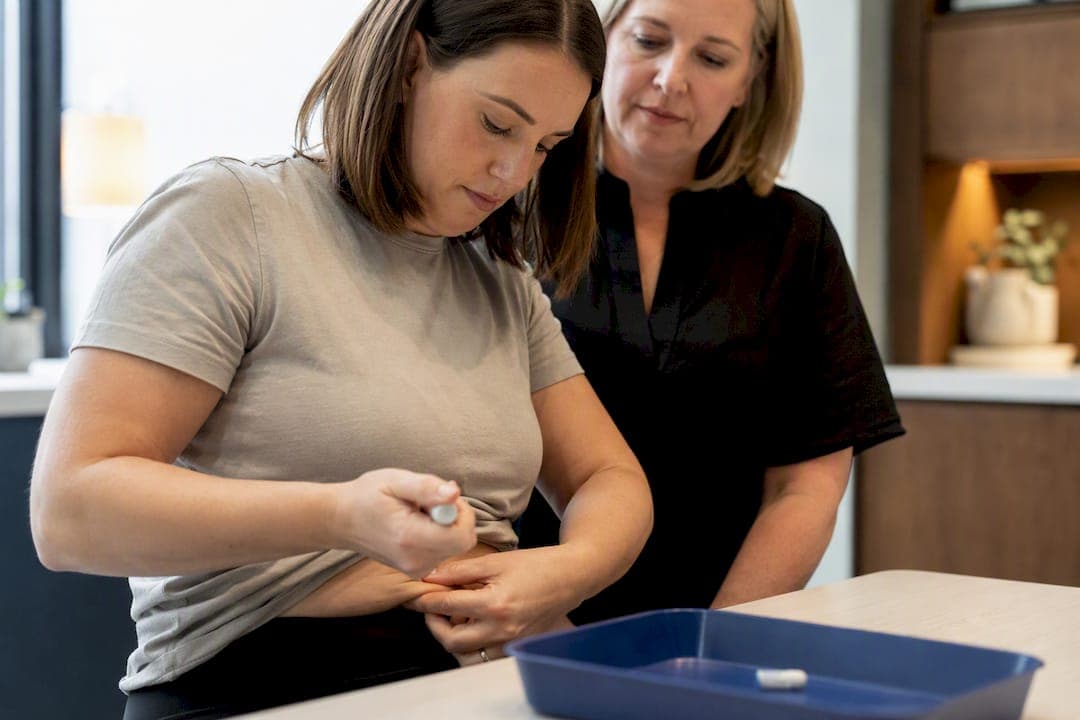
Yes, you can learn to self-inject GLP-1 medication, but only after a healthcare professional demonstrates the technique and confirms you can do it safely on your own. The core steps are simple: prepare your supplies, inspect the medication, choose and rotate your injection site, inject subcutaneously, and dispose of the needle immediately in a sharps container. Weekly dosing and consistent site rotation are what make this routine, not risky.
TL;DR:
- Proper injection training must be completed with a healthcare professional demonstrating technique and confirming your ability before self-injecting regularly.
- Using a clean, well-lit workspace and gathering supplies beforehand reduces mistakes, with specific attention to medication inspection and correct storage.
- Consistently rotating injection sites between the abdomen, thigh, and upper arm avoids lipohypertrophy, with careful site tracking and avoiding damaged or inflamed areas.
- Always visually check the medication for clarity, discoloration, particles, and proper expiration before each injection to prevent using compromised medication.
- Immediate disposal of needles in a sharps container is crucial for safety, with never recapping or bending needles to avoid needlestick injuries.
Table of Contents
- What You Need for GLP-1 Injection Training
- Step-by-Step Injection Technique for GLP-1 Pens and Syringes
- Where to Inject and How to Rotate Sites
- How to Check Your Medication Before Every Injection
- What to Do About a Missed Dose
- Sharps Disposal and What to Do Right After Injecting
- What Clinician-Led Training Should Cover
- What I've Learned About Needle Anxiety and Injection Training
- How Dayla Health Supports Your GLP-1 Injection Training
- Sources
What You Need for GLP-1 Injection Training
Before you touch a needle, get your workspace right. Most injection mistakes happen not during the injection itself but in the ten seconds before it, when someone is rummaging for a swab or realizes the sharps container is in another room.
Start with a clean, well-lit surface at counter height. You want to see the pen's dose window clearly and have both hands free.
Gather these supplies before every injection:
- Your prescribed GLP-1 pen or prefilled syringe, at room temperature if it's been refrigerated
- A new pen needle, if your device requires attaching one separately
- Alcohol swabs for the injection site
- A closable, puncture-resistant sharps container, placed within arm's reach, not across the room
- A clock or phone timer to track hold time after injection
- A small mirror if you're injecting your upper arm without help, or another person to assist
Read the Instructions for Use (IFU) that came with your specific pen model before your first injection, and reread it any time your prescription changes presentation. WEGOVY, for instance, comes in several pen designs, and the dialing and priming steps differ slightly between them, according to DailyMed's WEGOVY labeling. A technique that worked perfectly on one pen type can fail on another if you skip this step.
Check three things every single time: the expiration date printed on the pen or carton, the clarity of the solution, and whether the medication has been stored correctly. Most GLP-1 medications need refrigeration before first use and can be kept at room temperature for a limited window afterward, depending on the product. Confirm your specific storage rule with your pharmacist rather than assuming it matches a friend's prescription.
Wash your hands with soap and water for a full 20 seconds before you open anything. This isn't a courtesy step. Skin flora at the injection site is one of the few controllable variables in preventing local infection, and it costs you nothing but a few seconds at the sink.
Step-by-Step Injection Technique for GLP-1 Pens and Syringes
This is where clinician-supervised practice matters most. Reading about injection technique and performing it under a trained eye are different experiences, and the gap between them is exactly what a supervised first dose is designed to close.
Follow this sequence for a standard GLP-1 pen injection:
- Remove the pen from the refrigerator (if applicable) and let it reach room temperature for 15 to 30 minutes. Injecting cold medication is not dangerous, but it stings more than it needs to.
- Inspect the solution through the window. It should be clear and colorless with no floating particles. If it looks cloudy or discolored, stop and do not use it.
- Attach a new needle if your device requires one, following the twist-on or push-on method specified in your IFU. Never reuse a needle from a previous injection.
- Perform a flow check if your pen model calls for one. This confirms medication moves through the needle before you dial your actual dose.
- Dial your prescribed dose. Confirm the number in the dose window matches what your clinician set, not what you think you remember from last week.
- Choose and clean your site with an alcohol swab, and let it air dry for a few seconds. Injecting through wet alcohol increases the sting.
- Pinch the skin gently if instructed by your IFU, then insert the needle at the angle your specific pen or syringe requires. Most GLP-1 pens are designed for a straight, perpendicular insertion into the subcutaneous layer.
- Press the injection button fully and hold it down. Watch the dose counter drop to zero.
- Hold for the recommended count, typically 5 to 10 seconds after the counter reaches zero, before withdrawing the needle. This ensures the full dose clears the needle rather than pooling at the injection tip.
- Withdraw the needle at the same angle you inserted it, then release the pinched skin.
- Dispose of the needle immediately in your sharps container. Do not recap it.
Syringe-based dosing follows a similar logic but requires you to draw up the correct volume manually, which is why manufacturer prefilled pens have become the dominant format for GLP-1 therapy. If your prescription is compounded and dispensed in vials with separate syringes, your clinician should walk through the drawing and dosing steps specifically, since the margin for measurement error is higher than with a fixed-dose pen.
A few device-specific notes matter here. Some pens, like certain FlexTouch models, are not recommended for patients with significant visual impairment because the dose window and click mechanism rely on sight rather than tactile feedback. If a pen shows no flow during a check, the standard troubleshooting sequence is to confirm the needle is fully attached, repeat the flow check per your IFU, and replace the needle if the blockage doesn't clear. Never force the injection button against resistance. That's a sign something is wrong with the needle or cartridge, not a problem you solve with more pressure.
Pro Tip: Practice your first two or three injections in front of a mirror, even after your clinician-supervised session. Watching the needle angle and your own hand position helps you catch small habits, like tensing the injection-site muscle, that are hard to notice by feel alone.
None of this replaces a live demonstration. The manufacturer guidance behind WEGOVY and similar therapies is explicit that a healthcare professional should show you how to use the pen before you inject on your own, and that you should only self-inject once you've been assessed as able to do it correctly, according to the WEGOVY Medication Guide on DailyMed. Ask your clinician to watch you perform a full injection, start to finish, before you do the first one alone.
Where to Inject and How to Rotate Sites
GLP-1 medications are approved for subcutaneous injection into three areas: the abdomen, the front of the thigh, and the back of the upper arm, according to WEGOVY's injection site labeling. The medication should never be injected into muscle or directly into a vein.
For the abdomen, stay roughly two inches away from the navel in any direction, avoiding your beltline where clothing friction can irritate the site. The thigh injection goes into the fleshy front portion, not the inner or outer thigh where there's less subcutaneous fat to work with. The upper arm site is trickier to reach yourself, which is why many patients use this area only when someone else can administer the injection, or skip it in favor of the abdomen and thigh.
Rotation matters as much as site selection. Injecting the same quarter-inch of skin week after week leads to lipohypertrophy, a lumpy thickening of fatty tissue that can reduce how well your body absorbs the medication. You have two practical approaches:
- Within-area rotation: stay in the abdomen but move to a different quadrant each week, working in a clockwise pattern
- Area-to-area rotation: alternate between abdomen, thigh, and upper arm on a weekly cycle
Either method works as long as you're consistent and tracking it. A simple mark sheet on your refrigerator, or a note in your phone's calendar app, does the job. Some patients use a body-map printout and circle the used site each week so they never guess.
Skip any site that's bruised, inflamed, scarred, or shows signs of broken skin. If you notice a firm lump, persistent redness, or a site that feels warm and tender days after injecting, that's worth a call to your clinician. It may be early lipohypertrophy, and continuing to inject there will only make absorption less predictable.
Pro Tip: Keep your rotation simple by picking one direction and sticking to it. "Clockwise around the abdomen, then move to the left thigh" is easier to remember three months in than a complicated grid system you invented on day one.
The Mayo Clinic's practical guide to semaglutide injection reinforces this same site logic and pairs it with a reminder that medication works best alongside consistent nutrition and activity habits, not as a standalone fix.
How to Check Your Medication Before Every Injection
Every single injection deserves a 15 second visual check before the needle touches skin. This habit catches problems that are otherwise invisible until they cause a failed dose or a preventable reaction.
Hold the pen or vial up to a light source. The solution should be clear and colorless, with no floating particles, clumps, or discoloration. GLP-1 medications are not naturally cloudy, so any haze is a signal to stop.
Check these four things every time:
- Clarity: the solution is clear and colorless, no exceptions
- Particles: no visible floating matter or sediment
- Expiration date: printed on the pen and the outer carton
- Physical condition: no cracks, leaks, or damage to the pen body or needle housing
If the medication looks cloudy, discolored, or contains particles, do not use it. This applies even if the pen looks otherwise fine and even if you're mid-titration and don't want to delay a dose. Call your pharmacist or prescribing clinician, explain what you observed, and ask for guidance before proceeding. A wasted dose is a minor inconvenience. An unknown-quality injection is not worth the risk.
If your medication's presentation changes between refills, meaning the pen looks different, the box design has shifted, or the dosing mechanism feels unfamiliar, treat it as a new device. Request a fresh walkthrough from your clinician rather than assuming the old technique transfers over. Manufacturer guidance is specific on this point: switching pen presentations means retraining for that presentation, since dialing and priming steps aren't universal across every device design, per DailyMed's WEGOVY instructions.
Damaged pens get the same treatment. A cracked cartridge window, a needle that won't seat properly, or a pen that's been dropped and might have a hairline fracture all warrant a call before use, not a guess.
What to Do About a Missed Dose
Missing a weekly GLP-1 dose is common, especially in the first few months while a new routine is settling in. The fix depends entirely on how much time has passed.
According to the WEGOVY Medication Guide, if your next scheduled dose is more than 48 hours away, take the missed dose as soon as you remember. If it's less than 48 hours away, skip the missed dose entirely and take your next dose on the regular schedule. Doubling up is never the right call.
A few scheduling habits make missed doses less likely in the first place:
- Pick a day tied to something fixed in your week, like "every Sunday morning before coffee," rather than a floating reminder
- Set a recurring phone alarm labeled clearly, not just a generic notification
- If you need to shift your dosing day permanently, you can move it as long as at least 3 days separate your old and new dose, but confirm this with your clinician first
If you miss two or more consecutive weeks, call your clinician before your next injection. This matters more during dose titration, when your body is adjusting to a step up in dose. Skipping weeks during an active titration phase can change how your next dose should be administered, and your prescriber may want to restart you at a lower dose rather than resuming where you left off. A GLP-1 dosing schedule guide walks through what titration typically looks like week by week.
Sharps Disposal and What to Do Right After Injecting
The injection isn't finished until the needle is safely in a sharps container. This is the step people rush, and it's the one with the most direct safety consequence if skipped.
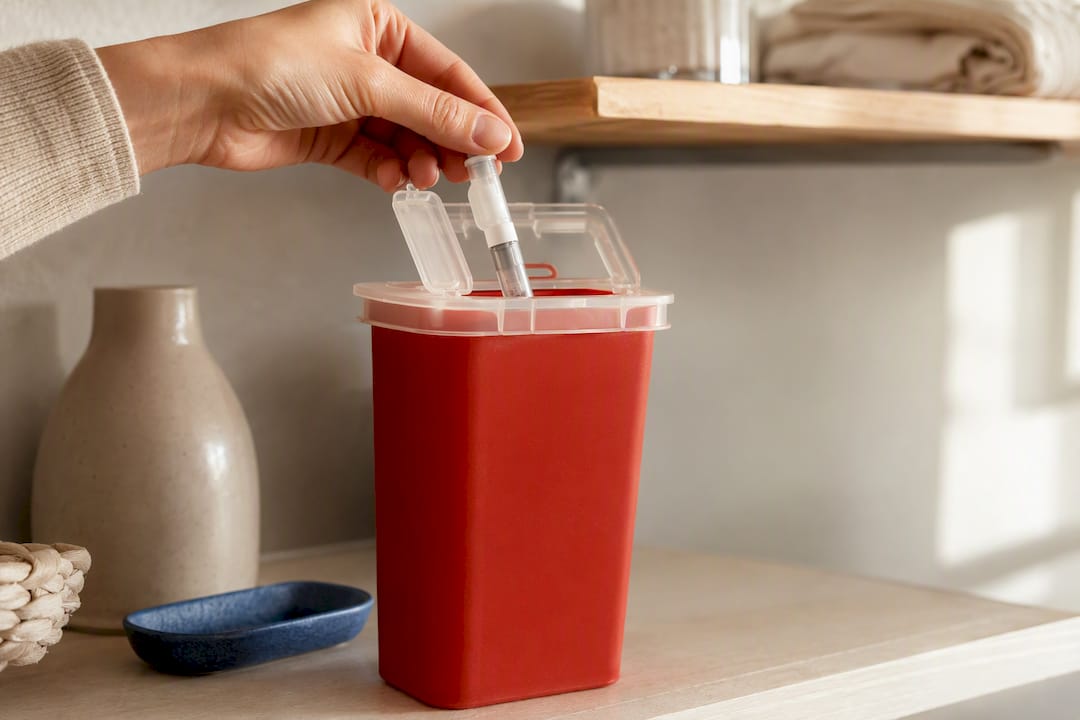
Keep a closable, puncture-resistant, leakproof sharps container within arm's reach before you even open your pen. Fumbling to find a container after you've already injected is how needlestick injuries happen, according to CDC and NIOSH guidance on sharps disposal. The container should be labeled or color-coded appropriately and sturdy enough that a stray poke can't puncture through the side or bottom.
Follow these disposal rules every time:
- Drop the used needle straight into the sharps container immediately after injecting
- Never recap, bend, or break a used needle
- Stop using a container once it's about three-quarters full, and seal it per your local guidelines before disposal
- Check your city or county rules for sharps drop-off locations, since curbside trash disposal of full containers is often prohibited
Needlestick injuries among home users are rare when containers are placed correctly and used immediately, which is exactly the behavior CDC/NIOSH recommends building into the injection routine itself rather than treating disposal as an afterthought.
If a needlestick does happen, wash the area with soap and water right away and seek medical evaluation promptly. A clinician can assess whether any follow-up testing or post-exposure guidance applies to your situation. Store full containers upright, away from children and pets, and transport them to a drop-off site in a way that keeps the lid sealed the entire time.
What Clinician-Led Training Should Cover
A proper first-injection session is not a five-minute pamphlet handoff. It's a structured walkthrough where your clinician confirms your identity and prescription, reviews the Instructions for Use with you aloud, and physically demonstrates the injection before watching you do it yourself.
The gold standard here is what's often called "teach-back." Your clinician performs the injection once, explains each step as they go, then watches you complete a full injection on yourself while they observe. This isn't about testing you. It's about catching the small habits, like an inconsistent needle angle or rushing the hold time, that are nearly impossible to self-correct from a written guide alone.
A complete supervised training session should include:
- A live demonstration of the specific pen or syringe you'll be using
- Direct observation of you performing at least one full injection
- Documentation that you can demonstrate correct technique independently
- A discussion of site rotation and a plan for tracking it
- Contact information for questions between visits, especially around side effects
Support staff play a real role after that initial session too. Triage support for common side effects, like nausea or injection-site reactions, and logistical help with prescription refills and shipping timing, are part of what keeps a GLP-1 routine sustainable rather than something that quietly falls apart after month two.
Dayla Health's clinician-led evaluation process folds this training directly into onboarding, pairing supervised instruction with written follow-up materials you can revisit anytime. A side effects management plan gives you a reference for common reactions and when they warrant a call versus watchful waiting, and a guide to starting your GLP-1 program walks through what to expect from that first clinician evaluation before you ever pick up a pen.
What I've Learned About Needle Anxiety and Injection Training
Most people who dread their first GLP-1 injection aren't afraid of pain. They're afraid of doing it wrong, of some invisible mistake that undoes the whole process. That fear tends to be louder than the actual experience deserves.
The subcutaneous needles used in GLP-1 pens are short and thin, designed specifically to minimize discomfort in fatty tissue rather than muscle. Most patients describe the sensation as a quick pinch, gone before they've finished counting to five. What actually reduces anxiety isn't reassurance about pain. It's repetition under supervision, watching someone else do it correctly, then doing it yourself while they're still in the room to catch a mistake before it becomes a habit.
By the third or fourth week, the routine stops feeling like a medical procedure and starts feeling like brushing your teeth: automatic, unremarkable, done without much thought. That shift is the entire point of proper training.
— Flexible
How Dayla Health Supports Your GLP-1 Injection Training
Dayla Health pairs clinician-led evaluation with the injection training and ongoing support this guide describes, so you're never handed a pen without a real walkthrough first.
Getting started means a clinician evaluation, not a checkout cart. You complete an online intake, a licensed clinician reviews your history and confirms eligibility, and if approved, your prescription ships with written instructions and access to care coaching for questions that come up after your first few doses. That coaching layer matters most in weeks two through six, when titration questions and site-rotation habits are still settling in and a quick answer beats a guessing game.
Dayla Health also carries compounded peptide options, including BPC-157 and growth hormone peptides, for patients whose care plan extends beyond GLP-1 alone. If you're ready to see whether you qualify, start with the GLP-1 weight loss program page to review options and begin your intake.
Sources
For dosing, technique, and safety specifics beyond this guide, these primary sources carry the full prescribing detail:
- WEGOVY (semaglutide) injection highlights — DailyMed
- Sharps disposal container guidance — CDC/NIOSH
- How to inject semaglutide for weight loss — Mayo Clinic Diet
This article is general information, not a substitute for advice from a qualified doctor. Consult a qualified healthcare professional about your own circumstances before acting on anything here.