

U.S. guidelines are clear: adults with a BMI of 30 kg/m² or higher qualify for prescription weight-management therapy, as do adults with a BMI of 27 kg/m² or higher who have at least one obesity-related comorbidity such as type 2 diabetes, hypertension, or obstructive sleep apnea. That threshold rule, endorsed by the Endocrine Society, The Obesity Society, AACE, and the ADA, is the starting point for every prescribing decision, not the finish line. BMI is a population-level screening tool, and CDC guidance is explicit that it requires clinical context to be meaningful for individual patients.
With 40.3% of U.S. adults meeting BMI-defined obesity criteria, the clinical and public health stakes are high. Yet payer barriers, BMI misclassification, and under-recognition of metabolic risk mean that many eligible patients go untreated.
TL;DR: Eligibility checklist
- BMI ≥30 kg/m²: Qualifies for pharmacotherapy regardless of comorbidities.
- BMI 27–29.9 kg/m² + at least one obesity-related comorbidity: Also qualifies; document the comorbidity explicitly for prior authorization.
- BMI below threshold but high metabolic risk: Supplement with waist circumference, metabolic labs, and adiposity-related complications to build a defensible clinical case.
- Insurance/prior authorization: Most payers require documented BMI, comorbidity evidence, and prior lifestyle modification attempts before approving chronic weight-management agents.
Table of Contents
- What BMI measures, and where it falls short in clinical practice
- How major guidelines use BMI to determine pharmacotherapy candidacy
- FDA-approved medications for chronic weight management: quick reference
- Deciding who to prescribe: candidacy, contraindications, and shared decision-making
- Practical titration schedules, monitoring, and when to stop or switch
- Side effects, red flags, and counseling patients before they start
- How BMI thresholds affect coverage: prior authorization and cash-pay realities
- How BMI-based prescribing differs across special populations
- The limits of BMI and how to build a metabolic-risk case for borderline patients
- How medications fit into a broader care plan: lifestyle, devices, and surgery
- Key Takeaways
- BMI as a gatekeeper: why the standard needs a more honest conversation
- Daylahealth: clinician-evaluated GLP-1 care, shipped to you without insurance barriers
- Authoritative references and next-step resources
What BMI measures, and where it falls short in clinical practice
BMI is calculated as weight in kilograms divided by height in meters squared (kg/m²). For clinicians working in U.S. customary units, the formula is: weight (lbs) ÷ height (in)² × 703. The CDC classifies BMI into four standard categories for adults.
| BMI Range (kg/m²) | Category |
|---|---|
| — | Underweight |
| — | Normal weight |
| 27–29.9 | Overweight |
| 30–34.9 | Obesity Class I |
| 35–39.9 | Obesity Class II |
| ≥40 | Obesity Class III (severe) |
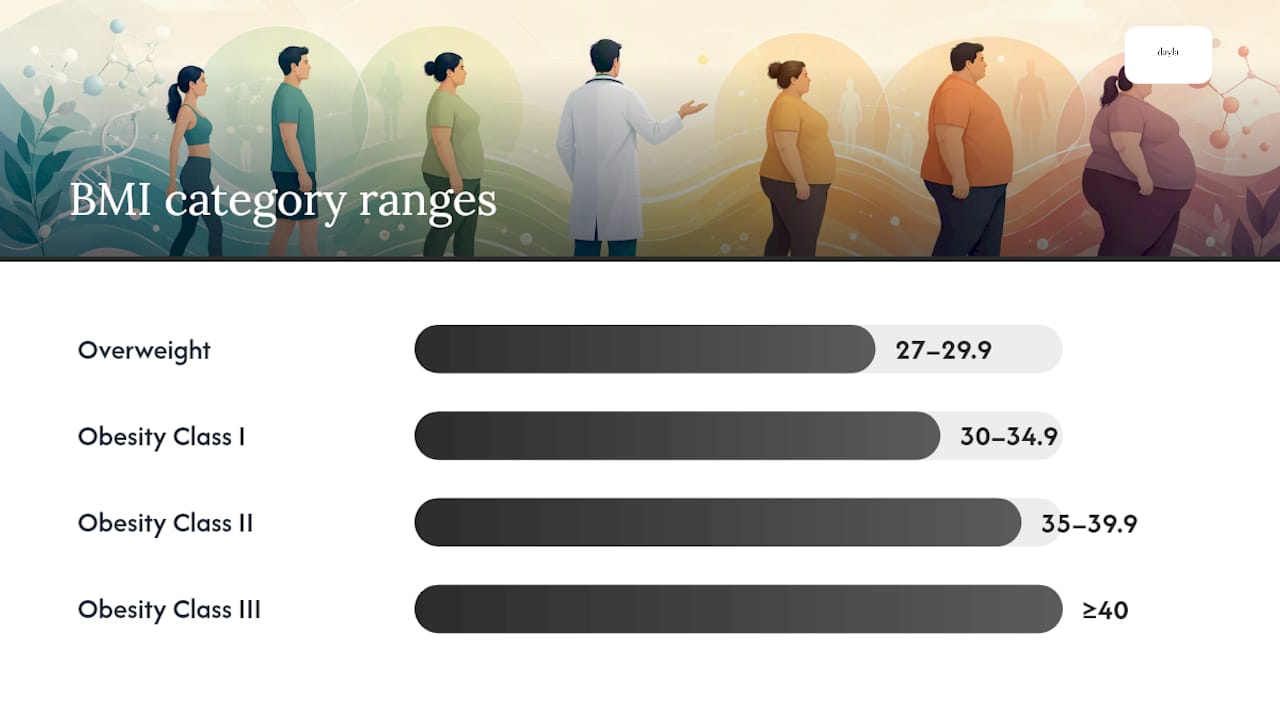
BMI was designed as a population-level epidemiological tool, not a direct measure of body fat or metabolic health. It cannot distinguish fat mass from lean mass, and it provides no information about fat distribution. A competitive athlete with high muscle mass and a sedentary individual with visceral adiposity can share the same BMI while carrying entirely different cardiometabolic risk profiles.
Several clinical blind spots deserve attention. Older adults often experience sarcopenia, losing muscle while gaining fat, so their BMI can understate adiposity. Patients of Asian descent tend to carry metabolically active visceral fat at lower BMI values than white populations, a pattern that has prompted guideline bodies to consider lower action thresholds for these groups. Short stature can inflate BMI without reflecting proportional fat mass, and patients with edema or ascites may show falsely elevated values.
The 2025 clinical practice guideline update recommends supplementing BMI with measures of central adiposity, specifically waist circumference and waist-to-hip ratio, when making prescribing decisions. This is not optional nuance for borderline cases; it is the current standard of care.

Pro Tip: When a patient's BMI sits near a threshold or their metabolic risk seems disproportionate to their BMI, add a waist circumference measurement (action thresholds: >88 cm in women, >102 cm in men) and consider ordering a fasting glucose, HbA1c, and fasting lipid panel before finalizing the prescribing decision. Documenting these values in the chart also strengthens prior authorization submissions.
How major guidelines use BMI to determine pharmacotherapy candidacy
The core threshold rule has been consistent across U.S. guideline bodies for over a decade: offer pharmacotherapy to adults with BMI ≥30 kg/m², or BMI ≥27 kg/m² with at least one obesity-related complication (ORCD). The organizations endorsing this framework include The Obesity Society, the Endocrine Society, AACE, and the ADA, all of which are cited in the Endotext pharmacologic treatment reference.
The April 2026 ACP living clinical guideline extends this framework by explicitly applying evidence to the overweight population (BMI 27–30) with comorbidities and acknowledging BMI's limitations, including the need for ethnicity-specific thresholds.
Comorbidities that qualify a patient at BMI 27–29.9 kg/m²:
- Type 2 diabetes or prediabetes
- Hypertension
- Dyslipidemia
- Obstructive sleep apnea
- Metabolic dysfunction-associated steatotic liver disease (MASLD/MASH)
- Atherosclerotic cardiovascular disease (ASCVD) or high 10-year ASCVD risk
- Osteoarthritis with functional impairment
- Polycystic ovary syndrome (PCOS)
Ethnicity-specific adjustments: For patients of South Asian, East Asian, or Southeast Asian descent, many clinicians and some guideline bodies support considering pharmacotherapy at BMI thresholds approximately 2.5 kg/m² lower than standard cutoffs, reflecting higher visceral adiposity and cardiometabolic risk at lower BMI values. The 2025 guideline update explicitly recommends using ethnicity- and sex-specific cutoffs when assessing candidacy.
Documentation checklist for pharmacotherapy and prior authorization:
- Recorded height and weight with calculated BMI
- Comorbidity diagnosis codes with supporting lab or clinical evidence
- Documentation of prior lifestyle modification attempts (duration, modality, outcome)
- Waist circumference when BMI is near threshold
- Prescribing rationale tied to a specific obesity-related complication when BMI is 27–29.9 kg/m²
FDA-approved medications for chronic weight management: quick reference
The FDA has approved several agents specifically for chronic weight management in adults, and the list has grown meaningfully since 2021. The NIDDK provides a current patient- and clinician-facing summary of approved options.
| Medication | Route | Typical Dose Range | Mean Weight Loss (Trial) | Key Absolute Contraindications |
|---|---|---|---|---|
| Semaglutide (Wegovy) | SC injection, weekly | 0.25 mg → 2.4 mg | ~15% body weight (STEP 1) | Personal/family MTC or MEN2, pregnancy |
| Liraglutide (Saxenda) | SC injection, daily | 0.6 mg → 3.0 mg | ~8% body weight (SCALE) | Personal/family MTC or MEN2, pregnancy |
| Tirzepatide (Zepbound) | SC injection, weekly | 2.5 mg → 15 mg | ~20–22% body weight (SURMOUNT-1) | Personal/family MTC or MEN2, pregnancy |
| Phentermine/topiramate (Qsymia) | Oral, daily | 3.75/23 mg → 15/92 mg | ~8–10% body weight (EQUIP/CONQUER) | Pregnancy, glaucoma, hyperthyroidism, MAOI use |
| Naltrexone/bupropion (Contrave) | Oral, daily | 8/90 mg → 32/360 mg | ~5–6% body weight (COR trials) | Seizure disorder, uncontrolled hypertension, opioid use, MAOI use, pregnancy |
| Orlistat (Xenical/Alli) | Oral, with meals | 60 mg (OTC) / 120 mg (Rx) | ~3–5% body weight | Chronic malabsorption, cholestasis |
| Phentermine (Adipex-P) | Oral, daily | 15 mg | Variable (short-term use only) | Cardiovascular disease, hyperthyroidism, glaucoma, MAOI use, pregnancy |
| Orforglopron (Foundayo) | Oral, daily | Titrated per labeling | Phase 3 data pending full publication | Personal/family MTC or MEN2, pregnancy |
Tirzepatide (Zepbound) is the obesity-indication brand; it is distinct from Mounjaro, which carries a type 2 diabetes indication. Orforglopron (Foundayo) received FDA approval in 2026 as the first oral small-molecule GLP-1 receptor agonist for chronic weight management, offering a needle-free alternative for patients who cannot or prefer not to self-inject.
Practical prescribing notes: GLP-1 receptor agonists and the GLP-1/GIP dual agonist tirzepatide require gradual up-titration to minimize gastrointestinal adverse effects. Orlistat works locally in the gut and has no systemic absorption, making it the only agent in this class appropriate for patients with contraindications to centrally acting drugs. Phentermine is approved only for short-term use (typically up to 12 weeks) and carries Schedule IV controlled substance status. Monitor blood pressure and heart rate at each visit for all sympathomimetic agents.
Deciding who to prescribe: candidacy, contraindications, and shared decision-making
Candidacy for pharmacotherapy combines the BMI threshold rules with a clinical assessment of obesity-related complications and contraindications. A comprehensive weight loss medication candidacy review that goes beyond BMI alone is the current standard.
Candidacy checklist:
- BMI ≥30 kg/m², or BMI 27–29.9 kg/m² with at least one ORCD
- No absolute contraindications to the intended agent
- Documented discussion of treatment goals, expected outcomes, and duration
- Baseline labs completed (see monitoring section)
- Pregnancy status confirmed and contraception plan in place for agents with teratogenic risk
Contraindication reference:
| Contraindication Type | Condition | Affected Agents |
|---|---|---|
| Absolute | Personal or family history of medullary thyroid carcinoma (MTC) or MEN2 | Semaglutide, liraglutide, tirzepatide, orforglopron |
| Absolute | Pregnancy or planned pregnancy | All approved chronic weight-management agents |
| Absolute | Active seizure disorder or history of seizures | Naltrexone/bupropion (Contrave) |
| Absolute | Current opioid use or acute opioid withdrawal | Naltrexone/bupropion (Contrave) |
| Absolute | Uncontrolled hypertension | Phentermine, phentermine/topiramate |
| Absolute | Narrow-angle glaucoma | Phentermine/topiramate (Qsymia) |
| Relative | History of pancreatitis | GLP-1 receptor agonists (use with caution, monitor) |
| Relative | Severe depression or active suicidality | Naltrexone/bupropion (requires close monitoring) |
| Relative | Severe renal impairment | Adjust or avoid certain agents per labeling |
Shared decision-making prompts: Before initiating therapy, a structured conversation should cover four areas. First, set a realistic weight-loss goal: a 5–10% reduction in body weight produces clinically meaningful improvements in blood pressure, glycemia, and lipids, and losing 10% of body weight has well-documented cardiometabolic benefits. Second, discuss the most common adverse effects for the chosen agent and how to manage them. Third, address cost and coverage honestly: many patients will face prior authorization requirements or out-of-pocket costs. Fourth, set expectations for duration: these are chronic therapies, and weight regain after stopping is the norm, not the exception.
Practical titration schedules, monitoring, and when to stop or switch
Titration and monitoring differ meaningfully by drug class. Rushing up-titration on GLP-1 agents is the single most common cause of early discontinuation due to nausea and vomiting.
Titration and monitoring by class:
- Semaglutide (Wegovy): Start at 0.25 mg SC weekly for 4 weeks, increase by 0.25 mg every 4 weeks to a target of 2.4 mg. If a dose is not tolerated, hold at the current dose for an additional 4 weeks before attempting to escalate.
- Tirzepatide (Zepbound): Start at 2.5 mg SC weekly for 4 weeks, increase by 2.5 mg every 4 weeks to a target of 10–15 mg based on tolerability and response.
- Liraglutide (Saxenda): Start at 0.6 mg SC daily for 1 week, increase by 0.6 mg weekly to a target of 3.0 mg. Daily injection burden is higher than weekly agents.
- Orforglopron (Foundayo): Titrate per current FDA-approved labeling; oral administration removes injection barriers but GI monitoring remains relevant.
- Phentermine/topiramate (Qsymia): Start at 3.75/23 mg daily for 14 days, then advance to 7.5/46 mg. Evaluate at 12 weeks; if less than 3% weight loss, escalate to 11.25/69 mg for 14 days, then 15/92 mg. Reassess at 12 more weeks.
- Naltrexone/bupropion (Contrave): Start at 8/90 mg daily for week 1, increase weekly by one tablet to a target of 2 tablets twice daily (32/360 mg total). Blood pressure monitoring at each step.
- Orlistat: No titration required; take 120 mg (Rx) or 60 mg (OTC) with each fat-containing meal, up to three times daily.
Baseline and follow-up monitoring:
- Baseline: fasting glucose or HbA1c, comprehensive metabolic panel (CMP), fasting lipid panel, blood pressure, heart rate, pregnancy test (women of childbearing potential), TSH if clinically indicated.
- Follow-up at 4 weeks: tolerability check, blood pressure and heart rate (especially for sympathomimetics), GI symptom review for GLP-1 agents.
- Follow-up at 12 weeks: weight response assessment. If less than 5% weight loss at 12–16 weeks on a therapeutic dose, reassess adherence, dose adequacy, and whether switching agents is appropriate.
- Ongoing: HbA1c every 3–6 months in patients with diabetes, lipid panel annually, mental health and suicide-risk screening at each visit for naltrexone/bupropion.
Stopping or switching criteria:
- Intolerable adverse effects after adequate dose-reduction attempts
- Less than 5% weight loss at 12–16 weeks on a therapeutic dose (consider switching class)
- Confirmed pregnancy (stop immediately; counsel on contraception before restarting)
- New absolute contraindication (e.g., new seizure diagnosis for naltrexone/bupropion)
- For prior authorization appeals after a coverage denial: document the dose achieved, duration of therapy, weight response, and clinical rationale for continuation or switch.
Side effects, red flags, and counseling patients before they start
Adverse effects are the primary reason patients discontinue weight-management medications within the first 90 days. Proactive counseling before the first dose significantly improves persistence.
Common adverse effects by class:
- GLP-1 and GLP-1/GIP agents: Nausea (most common, typically peaks at dose escalation), vomiting, diarrhea, constipation, and injection-site reactions. Nausea usually improves within 4–8 weeks at a stable dose. Eating smaller, lower-fat meals and avoiding lying down after eating reduces severity.
- Phentermine and phentermine/topiramate: Dry mouth, insomnia, elevated heart rate, elevated blood pressure, paresthesias (topiramate component), and cognitive slowing at higher topiramate doses. Avoid late-day dosing to minimize insomnia.
- Naltrexone/bupropion: Nausea, headache, insomnia, dizziness, and constipation. The FDA requires a boxed warning for neuropsychiatric events, including suicidality, consistent with the bupropion class warning. Screen for depression and suicidal ideation at baseline and each follow-up.
- Orlistat: Oily spotting, fecal urgency, and steatorrhea, particularly with high-fat meals. These effects are dose-dependent and serve as a behavioral reinforcement mechanism. Supplement with fat-soluble vitamins (A, D, E, K) taken at least 2 hours apart from orlistat.
Red flags requiring immediate pause or evaluation:
- Severe abdominal pain radiating to the back (possible pancreatitis): hold GLP-1 agents and evaluate.
- Signs of dehydration from severe vomiting or diarrhea: hold GLP-1 agents, assess renal function.
- New or worsening depression, suicidal ideation, or significant mood changes: hold naltrexone/bupropion, refer for mental health evaluation.
- Significant tachycardia or hypertension on sympathomimetic agents: reduce dose or discontinue.
Model counseling language:
For patients who do not yet meet BMI thresholds but carry significant metabolic risk, a reasonable shared plan includes intensive lifestyle therapy with a registered dietitian, documented reassessment of BMI and metabolic markers at 3 months, and a clear agreement to revisit pharmacotherapy candidacy if weight or metabolic risk worsens.
How BMI thresholds affect coverage: prior authorization and cash-pay realities
Insurance coverage for weight-management medications in the U.S. remains inconsistent and, for many patients, the primary barrier to access. The joint TOS/OMA/OAC guidance statement documents this directly, noting that payer variability and prior-authorization burdens create significant treatment gaps despite clinical eligibility.
Coverage landscape:
- Private insurers: Coverage varies widely. Many large commercial plans now cover at least one GLP-1 agent for obesity, but prior authorization is nearly universal and often requires documented BMI, comorbidities, and prior lifestyle program participation.
- Medicare: Part D traditionally excluded drugs approved solely for weight management. Patients with a qualifying cardiovascular indication (e.g., semaglutide's ASCVD indication under SELECT trial data) may access coverage through that route. Confirm current CMS guidance, as policy has been evolving.
- Medicaid: Coverage is state-dependent. Some states cover approved agents; others do not. Check your state's Medicaid formulary directly.
Prior authorization documentation checklist:
- Current BMI with date of measurement
- Diagnosis codes for obesity-related comorbidities with supporting labs or clinical notes
- Documentation of at least 3–6 months of structured lifestyle modification (diet and exercise program)
- Prescriber's clinical rationale for the specific agent chosen
- Prior medication trial history if applicable (for step-therapy requirements)
- Specialist note if required by the plan (some require endocrinology or obesity medicine consultation)
Appeal tips and alternatives:
- Request a peer-to-peer review with the payer's medical director when a prior authorization is denied; clinician-to-clinician conversations resolve a meaningful proportion of denials.
- Document non-weight endpoints (HbA1c improvement, blood pressure reduction, ASCVD risk) in the chart and appeal letter, particularly for GLP-1 agents with cardiovascular indications.
- For patients facing coverage denials or unaffordable copays, budget-conscious GLP-1 treatment options and manufacturer savings programs (where available) can reduce out-of-pocket costs.
- Direct-to-consumer, clinically supervised cash-pay services offer an alternative pathway for patients who meet clinical criteria but cannot navigate insurance barriers. These services should maintain rigorous clinical evaluation and safety monitoring, as noted in the Frontiers in Endocrinology analysis of BMI-based access barriers.
How BMI-based prescribing differs across special populations
Standard BMI thresholds apply to most adults, but several populations require modified approaches.
| Population | Key Consideration | Practical Guidance |
|---|---|---|
| Adolescents (12+) | Wegovy (semaglutide) is FDA-approved for ages 12+; tirzepatide approval for adolescents is under review | Use age- and sex-specific BMI percentiles (≥95th percentile = obesity); involve pediatric specialist |
| Pregnancy | All approved weight-management agents are contraindicated | Counsel on contraception before starting; stop immediately if pregnancy occurs; refer to OB |
| Breastfeeding | Safety data insufficient for most agents | Avoid pharmacotherapy; prioritize dietary and behavioral support |
| Older adults | Sarcopenia may cause BMI to understate adiposity; weight loss can worsen muscle mass | Prioritize functional outcomes; consider resistance training alongside therapy; monitor renal function |
| Renal impairment | GLP-1 agents generally tolerated but monitor for dehydration-related AKI; orlistat not recommended in severe CKD | Adjust per labeling; monitor CMP more frequently |
| Hepatic impairment | Limited data for most agents in severe hepatic disease | Use with caution; avoid agents with significant hepatic metabolism in Child-Pugh C |
| Asian populations | Higher cardiometabolic risk at lower BMI | Consider action thresholds approximately 2.5 kg/m² lower than standard cutoffs. |
For adolescents, the FDA approved semaglutide (Wegovy) for chronic weight management in patients aged 12 and older with an initial BMI at or above the 95th percentile for age and sex. This is a meaningful shift: pharmacotherapy is no longer reserved for adults. Pediatric prescribing should involve a multidisciplinary team and careful monitoring of growth parameters.
Older adults present a different challenge. BMI can underrepresent adiposity in patients with sarcopenia, and aggressive weight loss in frail patients risks accelerating muscle loss. Functional goals (improved mobility, reduced joint pain) often matter more than a specific weight target in this population.
The limits of BMI and how to build a metabolic-risk case for borderline patients
BMI is a useful screening tool, but treating it as a hard gate for pharmacotherapy creates real treatment inequities. Research published in Frontiers in Endocrinology (2024) documents how BMI-only criteria can deny treatment to patients with significant adiposity-related complications who fall just below the threshold. A 2025 Springer analysis further documents a "BMI bias" in prescribing patterns, where clinicians under-prescribe effective cardiometabolic agents to lower-BMI patients who still carry meaningful metabolic risk.
The 2025 clinical practice guideline update and the ACP 2026 living guideline both push toward a complication-centric model, sometimes called Adiposity-Based Chronic Disease (ABCD), that supplements BMI with waist circumference, metabolic labs, and documented adiposity-related complications.
Clinical workflow for borderline or below-threshold patients:
- Measure waist circumference (action thresholds: >88 cm in women, >102 cm in men).
- Order fasting glucose or HbA1c, fasting lipid panel, and blood pressure measurement.
- Document any adiposity-related complications: prediabetes, MASLD, OSA, PCOS, osteoarthritis, or elevated 10-year ASCVD risk score.
- If central adiposity and at least one complication are present, the clinical case for pharmacotherapy is defensible even when BMI is 25–26.9 kg/m².
- Record the full metabolic-risk justification in the chart, including waist circumference, relevant labs, and the specific complication driving the decision.
Pro Tip: When writing a prior authorization letter for a patient with BMI just below the standard threshold, lead with the complication diagnosis code and its supporting evidence, then present the BMI and waist circumference together. Payers respond better to a complication-first narrative than a BMI-first one, and it aligns with how the 2025 and 2026 guidelines frame the decision.
How medications fit into a broader care plan: lifestyle, devices, and surgery
Pharmacotherapy works best as one component of a multimodal plan. The evidence is consistent: medications combined with intensive lifestyle intervention produce greater and more durable weight loss than either approach alone.
Decision flow:
- Medication alone reasonable: Patient has BMI ≥30 or ≥27 with comorbidity, has already attempted structured lifestyle modification, and has no contraindications. Medication can be initiated alongside basic dietary counseling without requiring formal program enrollment.
- Add intensive lifestyle intervention: For patients with BMI 27–34.9 kg/m² and moderate metabolic risk, combining pharmacotherapy with a structured behavioral program (≥14 sessions in the first 6 months) improves outcomes and satisfies most payer requirements for prior authorization.
- Refer for bariatric surgery evaluation: Consider referral when BMI is ≥40 kg/m², or ≥35 kg/m² with significant comorbidities, and pharmacotherapy has produced inadequate response (less than 5–10% weight loss after 6 months on a therapeutic dose). Bariatric surgery produces the largest and most durable weight loss of any available intervention.
When combination or switching is appropriate:
- If a patient achieves partial response on a GLP-1 agent but plateaus before reaching a clinically meaningful weight-loss target, consider switching to tirzepatide, which has demonstrated superior efficacy in head-to-head-style analyses.
- Combining a GLP-1 agent with orlistat is not standard practice and adds GI adverse effect burden without clear additive benefit.
- Adding intensive dietary support to any pharmacotherapy regimen improves outcomes; dietary approaches that complement GLP-1 treatment are well-documented and should be part of every treatment plan.
Referral guidance:
- To obesity medicine: include current BMI, comorbidity list, medication history (agents tried, doses, duration, response), and insurance status.
- To endocrinology: include thyroid function tests, glucose/HbA1c, and any suspected secondary causes of weight gain (hypothyroidism, Cushing's syndrome).
- To bariatric surgery: include documentation of prior non-surgical weight-loss attempts, current medications, and a psychological evaluation if available.
Key Takeaways
BMI thresholds of ≥30 kg/m² or ≥27 kg/m² with an obesity-related comorbidity are the U.S. guideline standard for initiating prescription weight-management therapy, but metabolic risk, central adiposity, and ethnicity-specific factors must inform every individual prescribing decision.
| Point | Details |
|---|---|
| Core eligibility thresholds | BMI ≥30 kg/m² qualifies for pharmacotherapy; BMI 27–29.9 kg/m² qualifies with at least one documented obesity-related comorbidity. |
| Supplement BMI with metabolic data | Add waist circumference, HbA1c, and fasting lipids when BMI is near threshold or metabolic risk appears disproportionate. |
| Efficacy benchmarks vary by agent | Tirzepatide (Zepbound) leads with ~20–22% mean weight loss (SURMOUNT-1); semaglutide (Wegovy) averages ~15% (STEP 1). |
| Prior authorization requires documentation | Record BMI, comorbidity codes, prior lifestyle attempts, and clinical rationale before submitting; complication-first framing improves approval rates. |
| Daylahealth access pathway | Daylahealth provides clinician-evaluated GLP-1 prescriptions and compounded peptides shipped nationwide, without insurance requirements, for patients who meet clinical criteria. |
BMI as a gatekeeper: why the standard needs a more honest conversation
The clinical community has spent years debating whether BMI is a good metric. The more useful question is whether it is a good gatekeeper. And the answer, increasingly, is no.
BMI was never designed to make individual clinical decisions. It was designed to describe populations. Using it as a binary on/off switch for prescription access creates a system where a 5'4" woman with visceral adiposity, prediabetes, and a 36-inch waist is denied treatment because her BMI reads 26.8, while a muscular athlete with BMI 31 and no metabolic risk qualifies automatically. That is not precision medicine. It is administrative convenience dressed up as clinical rigor.
The 2024–2026 guideline updates from the ACP, the Obesity Society, and the 2025 clinical practice guideline update are all moving in the same direction: toward complication-centric prescribing, where the presence of adiposity-related disease drives the decision more than a single number on a scale. This is the right direction. The challenge is that payers have not caught up. Most prior authorization forms still ask for BMI first, comorbidities second.
The practical implication is this: clinicians need to document metabolic risk proactively, not reactively. Build the case in the chart before the prior authorization is submitted, not after it is denied. And for patients who cannot navigate the insurance system at all, direct-to-consumer clinically supervised services that maintain rigorous safety screening represent a legitimate access pathway, not a workaround.
The equity dimension matters too. BMI thresholds calibrated on predominantly white European populations systematically underserve Asian patients, who carry greater cardiometabolic risk at lower BMI values. Applying ethnicity-specific thresholds is not a concession to complexity; it is basic clinical accuracy.
Daylahealth: clinician-evaluated GLP-1 care, shipped to you without insurance barriers
For patients who meet clinical criteria but face prior authorization denials, coverage gaps, or simply want a faster path to evaluated care, Daylahealth offers a direct alternative. The model is straightforward: a clinician reviews your intake, evaluates your eligibility based on BMI, comorbidities, and health history, and if appropriate, prescribes a GLP-1 weight-loss medication or compounded peptide, shipped directly to you nationwide.

Daylahealth's GLP-1 weight-loss program includes injection, microdose, and needle-free oral delivery options, ongoing clinical oversight, dietitian consultations, and care coaching, all bundled into a monthly subscription with no insurance required. That means no prior authorization forms, no step-therapy requirements, and no waiting for a payer to approve what your clinician already determined is appropriate.
Getting started takes minutes. Complete the online intake, which covers your health history, current medications, and weight-loss goals. A licensed clinician reviews your information, typically within 24–48 hours. If you qualify, your medication ships directly to your door. The cash-pay model means the cost is transparent upfront, and clinical oversight is built into every step.
This is not a supplement store. Every prescription is clinician-approved, every patient is monitored, and safety screening is part of the process. Start your evaluation at Daylahealth and get a clear answer on your eligibility without navigating an insurance maze.
Authoritative references and next-step resources
The sources below provide the full prescribing details, patient handouts, and guideline statements referenced throughout this article. Clinician-level and patient-facing resources are noted where relevant.
- Pharmacologic Treatment of Overweight and Obesity in Adults - Endotext - NCBI Bookshelf
- Joint TOS/OMA/OAC expert guidance statement on the pharmacological management of United States adults with overweight or obesity using the GRADE approach - PMC
- Pharmacotherapy for obesity management in adults: 2025 clinical practice guideline update - PMC
- Pharmacologic Treatments With Lifestyle Modifications in Nonpregnant Adults With Overweight or Obesity in Outpatient Settings: A Living Clinical Guideline From the American College of Physicians (April 2026)
- Frontiers in Endocrinology — BMI and treatment access (2024)
- Springer article on BMI bias in prescribing (2025)
- Prescription Medications to Treat Overweight & Obesity - NIDDK
- About Body Mass Index (BMI) - CDC
This article provides general clinical and educational information about BMI and weight-management pharmacotherapy. It is not a substitute for individualized medical advice, and prescribing decisions should be made in consultation with a licensed clinician using current FDA labeling and applicable guidelines.