

The most commonly used peptides for muscle preservation fall into two groups: GH-axis secretagogues (Ipamorelin, CJC-1295, MK-677/ibutamoren, Sermorelin) and tissue-repair peptides (BPC-157, TB-500). Clinicians typically measure IGF-1 as the downstream biomarker to confirm whether GH-axis peptides are producing a physiological effect. This peptides for muscle preservation list is built for adults who want clinical clarity, not hype.
Who might reasonably consider peptides:
- Older adults experiencing documented lean-mass loss despite adequate protein and resistance training
- Adults on GLP-1 medications losing weight rapidly and seeking to protect muscle tissue
- People in aggressive caloric deficits with confirmed sarcopenia risk
- Post-surgical or injury-recovery cases under clinician supervision
Who should avoid them without specialist clearance:
- Anyone with active cancer or a high-risk cancer history
- Pregnant or breastfeeding individuals
- People with uncontrolled diabetes or significant insulin resistance
- Those with certain cardiovascular conditions
The evidence floor matters. Large, high-quality randomized controlled trials proving clear muscle-building benefits of these peptides in healthy, well-trained adults are largely absent. Most human data comes from GH-deficiency populations, older adult trials, or animal models. Clinician oversight is not optional — it is the minimum standard for safe use.
Key Takeaways
The most effective approach to muscle preservation pairs optimized protein, creatine, and resistance training with clinician-supervised peptides only when those fundamentals are already in place and a documented clinical need exists.
| Point | Details |
|---|---|
| Six core peptides | Ipamorelin, CJC-1295, MK-677, Sermorelin, BPC-157, and TB-500 are the most commonly discussed for muscle preservation. |
| Evidence is limited | Large RCTs in healthy adults are largely absent; the strongest human data is MK-677's 1.6 kg fat-free mass gain in older adults. |
| IGF-1 is the key marker | Clinicians use serum IGF-1 to confirm GH-axis response; supraphysiologic levels are a warning sign, not a goal. |
| Fundamentals come first | Protein at 1.6–2.2 g/kg/day, creatine at 5 g/day, and progressive resistance training have stronger evidence than any peptide. |
| Daylahealth supervised care | Daylahealth provides clinician-evaluated, lab-monitored peptide protocols with certified compounding and nationwide shipping. |
Table of Contents
- How peptides can support muscle preservation
- The peptides for muscle preservation list: six key profiles
- Safety, contraindications, and what to monitor
- How peptides are given, dosing formats, and U.S. availability
- What the clinical evidence actually shows
- Practical next steps: questions to ask your clinician
- The case for realistic expectations
- Supervised peptide therapy through Daylahealth
- Sources
How peptides can support muscle preservation
Two mechanistic pathways explain most of the peptides on this list. Understanding which path a peptide takes tells you what to expect and what to monitor.
GH-axis secretagogues stimulate the pituitary gland to release growth hormone, which then triggers the liver to produce IGF-1 (insulin-like growth factor 1). IGF-1 promotes protein synthesis, supports satellite cell activity in muscle tissue, and reduces protein breakdown. Clinicians use serum IGF-1 as the practical readout because GH itself pulses unpredictably throughout the day, making it hard to measure reliably. A rising IGF-1 level after starting a secretagogue confirms the axis is responding. IGF-1 as a clinical biomarker is the standard checkpoint for this peptide class.

Tissue-repair peptides work differently. BPC-157 and TB-500 do not stimulate the GH axis. Instead, preclinical and orthopaedic literature describes their roles in angiogenesis (new blood vessel formation), extracellular matrix remodeling, and accelerated tissue healing. The muscle-preservation rationale here is indirect: faster recovery from injury or training stress means less muscle lost to disuse and inflammation. The mechanistic flow looks like this:
Peptide class → immediate effect → clinical signal → expected muscle outcome
- GH-axis secretagogue → pituitary GH release → rising serum IGF-1 → reduced muscle catabolism, improved protein synthesis
- Tissue-repair peptide → angiogenesis + matrix remodeling → faster recovery from injury/training → less disuse-related muscle loss
Both paths are plausible. Neither is proven in large, well-designed trials in healthy adults, which is the honest framing every reader deserves before reviewing the individual profiles below.
The peptides for muscle preservation list: six key profiles
GH-axis secretagogues and repair peptides are the most commonly discussed classes for muscle support, and the six profiles below cover every peptide the clinical and community literature consistently features.
Ipamorelin
Class: Growth hormone-releasing peptide (GHRP). Route: Subcutaneous injection. Ipamorelin is selective for GH release with minimal effect on cortisol or prolactin, which is why clinicians often prefer it over older GHRPs. It is typically dosed in the evening to align with the body's natural overnight GH pulse.
- Why it's used for preservation: Raises GH and downstream IGF-1 without the cortisol spike that can accelerate muscle breakdown.
- Human evidence: Small trials and clinical observation; no large RCTs in healthy, well-trained adults.
- Common side effects: Mild water retention, transient hunger, headache.
- Monitoring: IGF-1 at baseline and 6–8 weeks; fasting glucose.
- Regulatory note: Compounded prescription product in the U.S.
CJC-1295
Class: GHRH analog. Route: Subcutaneous injection. CJC-1295 extends the GH pulse by mimicking growth hormone-releasing hormone. It is frequently stacked with Ipamorelin because the two mechanisms are complementary: CJC-1295 amplifies the pulse, Ipamorelin triggers it. This combination is among the most commonly cited GH-axis stacks for body-composition and lean-mass preservation.
- Why it's used for preservation: Sustained GH elevation supports IGF-1 production and protein synthesis over time.
- Human evidence: Limited human trials; most data extrapolated from GHRH-analog research.
- Common side effects: Injection-site reactions, water retention, flushing.
- Monitoring: IGF-1, fasting glucose, lipid panel.
- Regulatory note: Compounded prescription product in the U.S.
MK-677 (Ibutamoren)
Class: Oral GH secretagogue (ghrelin mimetic). Route: Oral capsule or liquid. MK-677 is the only GH secretagogue on this list that does not require injection, which drives much of its popularity. In a 12-month trial in older adults (Nass et al.), MK-677 produced a 1.6 kg fat-free mass gain compared to placebo — a meaningful signal in a sarcopenic population, though extrapolation to young, healthy athletes is limited.
- Why it's used for preservation: Oral convenience plus sustained GH/IGF-1 elevation; useful for older adults or those avoiding injections.
- Human evidence: The strongest human trial data among GH secretagogues, though still in specific clinical populations.
- Common side effects: Increased appetite, water retention, elevated fasting glucose, potential insulin resistance with prolonged use.
- Monitoring: IGF-1, HbA1c, fasting glucose (important given glucose-raising effect), lipid panel.
- Regulatory note: Not FDA-approved; sold as a research chemical in the U.S. — not a compounded prescription product.
Sermorelin
Class: GHRH analog (synthetic fragment of endogenous GHRH). Route: Subcutaneous injection. Sermorelin has the longest clinical history of any peptide on this list, with established use in GH-deficiency contexts. It stimulates the pituitary more physiologically than synthetic GHRH analogs, which some clinicians consider a safety advantage. Prescription and compounding oversight applies in the U.S.
- Why it's used for preservation: Physiological GH stimulation with a well-characterized safety profile relative to other secretagogues.
- Human evidence: Established in GH-deficiency populations; limited data in healthy adults for muscle preservation specifically.
- Common side effects: Injection-site reactions, flushing, headache, transient dizziness.
- Monitoring: IGF-1, fasting glucose, thyroid function (some protocols include TSH).
- Regulatory note: Compounded prescription product in the U.S.; longer clinical history than most peptides on this list.
BPC-157
Class: Tissue-repair peptide (synthetic fragment of body protection compound). Route: Subcutaneous injection or oral (oral bioavailability is debated). BPC-157 does not raise GH or IGF-1. Its proposed muscle-preservation role is through recovery: preclinical and orthopaedic literature describes angiogenesis and extracellular matrix remodeling that may accelerate healing from training stress or injury, reducing the disuse atrophy that follows.
- Why it's used for preservation: Recovery support after injury or intense training; may reduce the muscle loss that accompanies prolonged rehabilitation.
- Human evidence: Preclinical and limited orthopaedic data; no large human RCTs for muscle preservation.
- Common side effects: Nausea (especially oral), dizziness; limited long-term human safety data.
- Monitoring: No specific biomarker readout; liver function tests (LFTs) and CBC in supervised protocols.
- Regulatory note: Compounded product; prescription oversight recommended. Daylahealth offers supervised BPC-157 with clinician evaluation.
TB-500 (Thymosin Beta-4 fragment)
Class: Tissue-repair peptide. Route: Subcutaneous injection. TB-500 is a synthetic fragment of Thymosin Beta-4, a protein involved in actin regulation, cell migration, and tissue repair. Like BPC-157, its muscle-preservation rationale centers on recovery rather than anabolism. The two are sometimes stacked for injury-recovery protocols, though human outcome data remains sparse.
- Why it's used for preservation: Accelerated recovery from musculoskeletal injury; may reduce inflammation-driven muscle wasting.
- Human evidence: Primarily preclinical; limited human data from orthopaedic and wound-healing contexts.
- Common side effects: Fatigue, headache, nausea; limited long-term safety data in humans.
- Monitoring: LFTs, CBC; no validated biomarker equivalent to IGF-1 for this class.
- Regulatory note: Research chemical in the U.S.; not an approved or compounded prescription product in most clinical settings.
Summary overview:
Safety, contraindications, and what to monitor
The most common side effects across GH-axis secretagogues are water retention, increased appetite, transient headache, and injection-site reactions. The more clinically significant concern is metabolic: GH elevation raises blood glucose, and prolonged use of secretagogues can contribute to insulin resistance. MK-677 carries the highest glucose-raising risk among the oral options and warrants HbA1c monitoring, not just fasting glucose.
Contraindications to take seriously:
Active cancer or a personal history of hormone-sensitive malignancy is the clearest contraindication. GH and IGF-1 are growth signals, and elevating them in the presence of malignant cells is a recognized concern across endocrinology. Pregnancy and breastfeeding are absolute contraindications for all peptides on this list. Uncontrolled type 2 diabetes or significant insulin resistance warrants specialist review before any GH-axis secretagogue is considered. Certain cardiovascular conditions, particularly those sensitive to fluid retention, also require careful evaluation.
Drug interactions are not well characterized for most of these peptides in formal pharmacokinetic studies. The practical concern is additive glucose dysregulation when GH-axis peptides are combined with corticosteroids or other agents that raise blood sugar. Patients on insulin or oral hypoglycemics need closer glucose monitoring.
Baseline labs before starting any GH-axis secretagogue:
A clinician-supervised protocol typically includes serum IGF-1, fasting glucose, HbA1c, a lipid panel, liver function tests, and a complete blood count. These establish your metabolic baseline and flag pre-existing conditions that would change the risk-benefit calculation.
Ongoing monitoring cadence: IGF-1 is typically rechecked at 6–8 weeks to confirm the axis is responding and that levels are not climbing above the age-adjusted reference range. Fasting glucose and HbA1c are rechecked at 3 months and then every 6 months for sustained use.
Elevated IGF-1 above the age-adjusted reference range is not a goal — it is a warning sign. Supraphysiologic IGF-1 is associated with increased cancer risk in epidemiological data. The clinical target is restoration to the upper-normal range for your age, not maximization.
Pro Tip: When you first discuss peptides with a prescribing clinician, bring your most recent fasting glucose, HbA1c, and any prior IGF-1 results. Ask specifically: "What is the target IGF-1 range for my age, and at what level would you pause or stop the protocol?" A clinician who cannot answer that question clearly is not the right prescriber for this therapy.
How peptides are given, dosing formats, and U.S. availability
The main routes are subcutaneous injection and oral administration. Route matters practically: injections allow more precise dosing and better bioavailability for most peptides, while oral MK-677 trades some of that precision for convenience and eliminates needle use entirely.
Practical dosing formats:
- Subcutaneous injection (Ipamorelin, CJC-1295, Sermorelin, BPC-157, TB-500): Typically administered with an insulin syringe into the abdomen or thigh. Ipamorelin and CJC-1295 are most often dosed in the evening to align with the natural overnight GH pulse.
- Oral (MK-677): Taken once daily, typically at night. Daily oral dosing maintains relatively stable GH/IGF-1 elevation rather than pulsatile peaks.
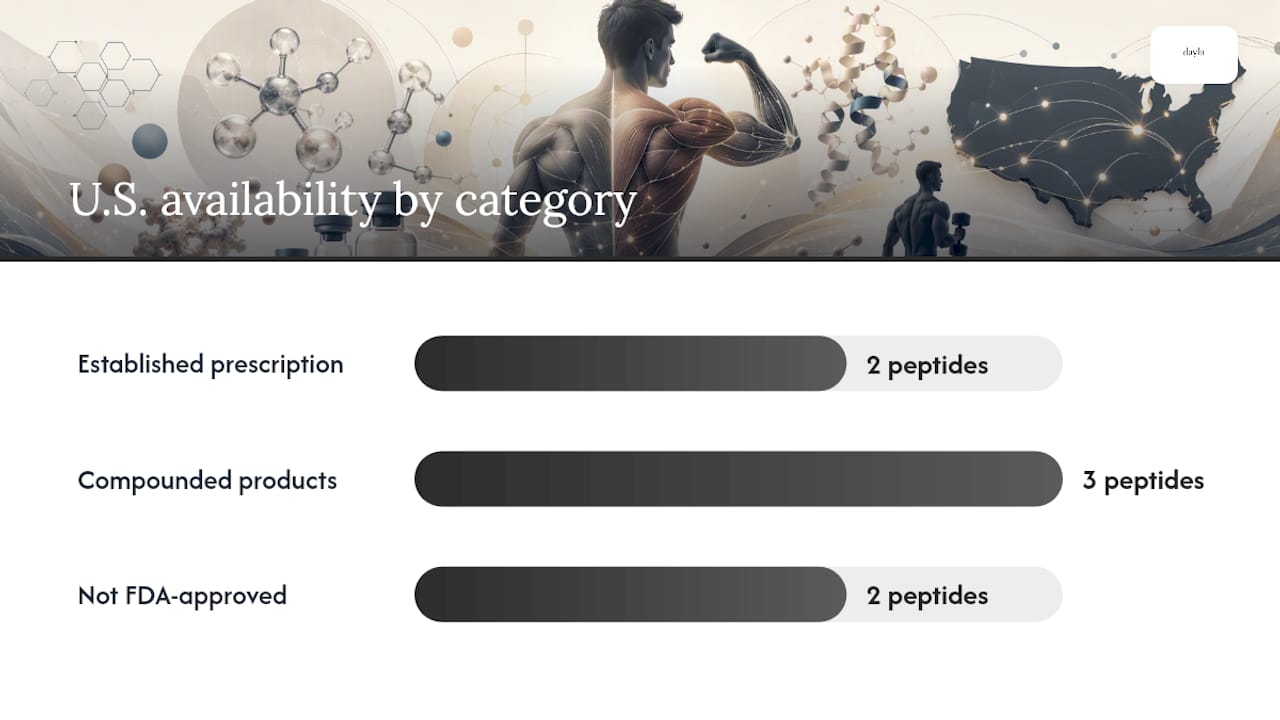
- Compounded peptides: Most GH-axis secretagogues and BPC-157 available in the U.S. are compounded products, meaning they are prepared by a licensed compounding pharmacy rather than manufactured by a pharmaceutical company.
U.S. regulatory and compounding notes:
- Sermorelin and tesamorelin have established prescription histories in the U.S. for GH-deficiency indications. CJC-1295, Ipamorelin, and BPC-157 are available as compounded products through licensed pharmacies under clinician prescription.
- MK-677 and TB-500 are not FDA-approved medications and are not available as compounded prescriptions in most clinical settings. They circulate primarily as research chemicals, which means no regulatory oversight of purity, sterility, or dosing accuracy.
- When purchasing any compounded peptide, ask the pharmacy for a certificate of analysis (COA) from an independent third-party lab confirming identity, purity, and sterility. A reputable supervised service will provide this without being asked.
- Avoid any vendor that cannot provide a COA, does not require a clinician evaluation, or ships without a valid prescription where one is required. These are the minimum quality markers, not optional extras.
For a broader look at how peptide therapy misconceptions affect purchasing decisions, that resource covers quality-assurance gaps in detail.
What the clinical evidence actually shows
The honest summary: large, high-quality RCT evidence for muscle preservation benefits of these peptides in healthy, well-trained adults is limited. Most human evidence comes from GH-deficiency populations, older adult trials, or animal models. That does not mean the peptides are ineffective, but it does mean the confidence interval around any claimed benefit is wide.
MK-677 has the strongest human trial data of the six. The Nass et al. 12-month trial in older adults showed a 1.6 kg fat-free mass gain versus placebo, a clinically meaningful finding in a sarcopenic population. Extrapolating that result to a 35-year-old athlete in a caloric deficit requires caution. Sermorelin has the longest prescription history but most of its evidence base is in GH-deficient patients, not healthy adults seeking preservation. BPC-157 and TB-500 have compelling preclinical mechanistic data, but human outcome data for muscle preservation remains sparse.
Non-peptide supports with stronger or comparable evidence:
Preserving lean mass is multifactorial, and the fundamentals below have more consistent human evidence than most peptides on this list.
- Protein: Target 1.6–2.2 g per kg of body weight daily; prioritize leucine-rich sources (whey, eggs, meat) to maximize muscle protein synthesis per meal.
- Creatine monohydrate (5 g/day): The highest-evidence, lowest-cost muscle-preservation supplement available. Prioritize it before any experimental peptide option.
- Omega-3 fatty acids: Anti-inflammatory effect supports muscle protein synthesis; evidence-backed for older adults and those in caloric deficits.
- Vitamin D: Deficiency is associated with accelerated muscle loss; supplementation in deficient individuals supports muscle function.
- Magnesium: Involved in muscle contraction and protein synthesis; commonly deficient in adults eating in a caloric deficit.
- Iron: Supports oxygen delivery to muscle; relevant for premenopausal women and those with dietary restrictions.
- Hydration: Even mild dehydration impairs muscle protein synthesis and performance; often overlooked in preservation protocols.
For adults on GLP-1 medications specifically, the muscle-loss prevention guide covers how to stack these fundamentals with supervised peptide options.
Practical next steps: questions to ask your clinician
Three clinical scenarios make peptides a reasonable conversation to have with a prescriber: documented lean-mass loss despite optimized protein intake and consistent resistance training; older adults with confirmed or high-risk sarcopenia; and perioperative or injury-recovery cases where disuse atrophy is a real near-term threat.
Decision checklist before discussing peptides with a clinician:
- Baseline labs completed (IGF-1, fasting glucose, HbA1c, lipid panel, LFTs, CBC).
- Protein intake at or above 1.6 g/kg/day for at least 8 weeks.
- Progressive resistance training in place at least 3 days per week.
- Contraindications reviewed (cancer history, diabetes status, cardiovascular conditions).
- Non-peptide options (creatine, vitamin D, omega-3s) already implemented.
Questions to bring to your prescriber:
- "Will you monitor IGF-1 and fasting glucose, and how often?"
- "What is the target IGF-1 range for my age and sex?"
- "At what IGF-1 level would you pause or stop the protocol?"
- "Is this peptide available as a compounded prescription, or is it a research chemical?"
- "What compounding pharmacy do you use, and can I see their certificate of analysis?"
- "How long is the initial protocol, and what outcome would justify continuing?"
If your protein intake is not yet optimized and you are not doing resistance training consistently, those are the first priorities. Creatine monohydrate at 5 g/day is the next step. Peptides are an adjunct for when those foundations are already in place, not a substitute for them.
The case for realistic expectations
Peptides are not a shortcut. That framing is not cautious hedging — it reflects what the evidence actually shows. The GH-axis secretagogues on this list work by nudging a physiological system that already exists in your body. When protein intake is inadequate and resistance training is absent, there is no anabolic signal for elevated IGF-1 to amplify. The peptide has nothing to work with.
Where peptides genuinely add value is in the gap between what nutrition and training can do and what a specific clinical situation demands. An older adult losing muscle rapidly on a GLP-1 medication, despite eating enough protein and training consistently, is a reasonable candidate for a supervised GH-axis secretagogue. A 30-year-old who has not yet tried creatine is not.
The repair peptides, BPC-157 and TB-500, occupy a different category. Their value proposition is recovery, not anabolism. If an injury is keeping you out of the gym, the muscle loss that follows is real and clinically meaningful. A supervised recovery-peptide protocol in that context has a clear rationale, even if the human evidence is still developing.
Daylahealth's supervised peptide services exist for the reader who has done the homework, optimized the fundamentals, and wants clinician-guided access to these options with proper monitoring in place.
Supervised peptide therapy through Daylahealth
Daylahealth offers clinician-supervised peptide therapy with the oversight, lab monitoring, and pharmacy safeguards that make the difference between a safe protocol and a risky one.

What's included when you start a supervised peptide program through Daylahealth:
- Clinician evaluation: A licensed prescriber reviews your health history, goals, and contraindications before any peptide is prescribed.
- Baseline and follow-up labs: IGF-1, fasting glucose, HbA1c, and relevant panels are ordered and reviewed at protocol milestones.
- Certified compounding quality: Peptides are sourced from licensed compounding pharmacies with certificates of analysis confirming purity and sterility.
- Care coaching and dietitian consults: Protein targets, creatine, and training alignment are addressed alongside the peptide protocol.
- Nationwide shipping: Prescription medications shipped directly to you, no insurance required.
Prescription-only peptides are prescribed and dispensed under full clinician oversight. Research chemicals are not part of the supervised protocol. To review your options and start a clinician evaluation, visit the Daylahealth peptides page or explore growth-hormone support services directly.
Sources
Most peptide evidence is context-dependent and population-specific. Read these sources critically, noting whether the study population matches your own situation before drawing conclusions.
- Peptides for Bodybuilding: Efficacy, Safety, Types, and More
- Beyond protein: 6 other nutrients that help prevent muscle loss
- GLP‑1 medications and muscle loss: what to know about nutrition and supplements | Mayo Clinic
- Preserve Muscle on Semaglutide & Tirzepatide (2026)