

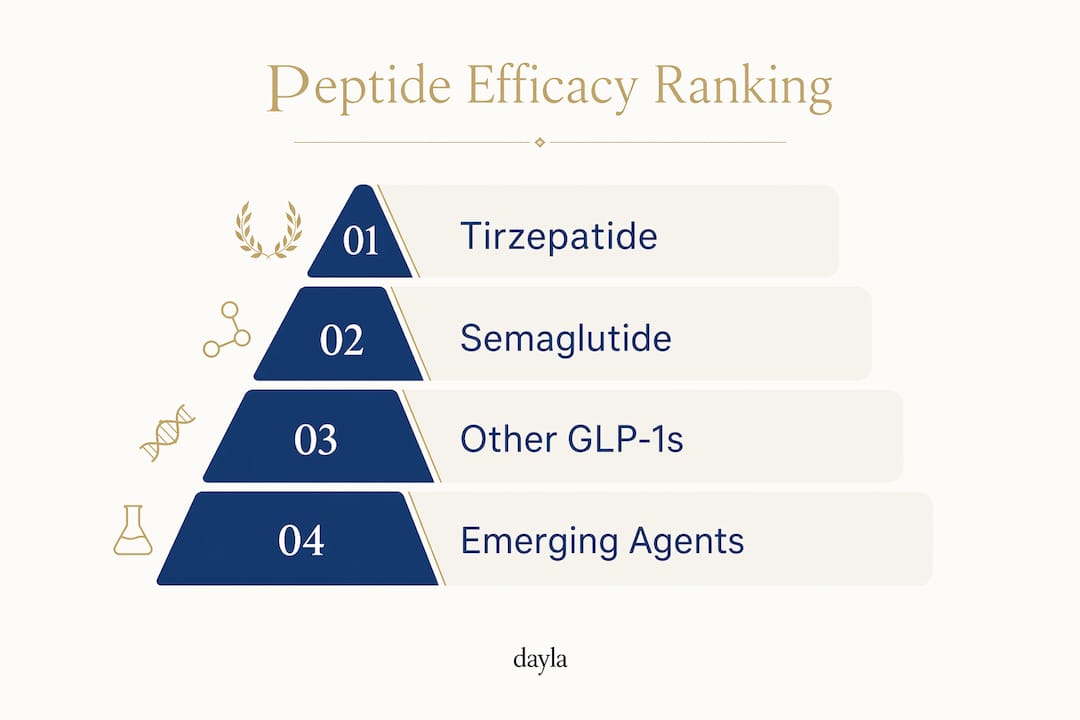
The FDA-approved leaders in peptide-based weight loss are tirzepatide (Zepbound/Mounjaro) and semaglutide (Wegovy/Ozempic), with tirzepatide showing the largest average body-weight reduction in clinical trials. A third option, orforglipron, received FDA approval in April 2026 as the first daily oral GLP-1 receptor agonist for obesity, expanding access for patients who prefer to avoid injections.
Here is the quick evidence-based verdict before you read further:
- Tirzepatide (Zepbound): Up to 22.5% average body-weight loss over 72 weeks in SURMOUNT phase 3 trials. Best choice when maximal weight loss is the primary goal and medical supervision is in place.
- Semaglutide (Wegovy): Average body-weight loss observed in STEP trials, with a documented reduction in major adverse cardiovascular events in the SELECT trial. Preferred when cardiovascular risk reduction is a co-equal goal.
- Orforglipron: Newly approved oral GLP-1 agonist (April 2026). Lower peak efficacy than the best injectables, but a meaningful option for needle-averse patients.
- Liraglutide (Saxenda): An older GLP-1 agonist with a well-established safety record; modest efficacy compared to newer agents.
- Tesamorelin: FDA-approved only for HIV-associated lipodystrophy, not for general weight loss.
Clinician recommendation: Discuss tirzepatide first if your primary goal is aggressive weight reduction and you have no contraindications. Choose semaglutide if you carry significant cardiovascular risk or prefer a longer-established safety profile. Bring this weight loss peptides comparison guide to your next appointment as a starting point.
Table of Contents
- How do weight-loss peptides actually reduce body weight?
- FDA-approved peptides for weight loss: what the trials show
- What are the real safety risks you need to know?
- How do you choose the right peptide therapy for your situation?
- What peptides are coming next in clinical trials?
- Why grey-market and compounded peptides carry serious risks
- What does legitimate, medically supervised peptide care look like?
- Key Takeaways
- The case for evidence-first peptide care
- Supervised GLP-1 and peptide care, delivered to your door
- Authoritative references for further reading
How do weight-loss peptides actually reduce body weight?
Most clinically meaningful weight loss from peptides flows through the incretin pathway, specifically GLP-1 (glucagon-like peptide-1) and GIP (glucose-dependent insulinotropic polypeptide) receptors. Understanding the mechanism helps explain why different agents produce different results.
The pathway works in three stages: gut-released hormones signal the brain's appetite centers (primarily the hypothalamus and brainstem), which then reduce hunger and caloric intake while also slowing gastric emptying. Downstream metabolic effects follow, including improved insulin sensitivity, reduced glucagon secretion, and in the case of dual agonists, direct effects on adipose tissue.
Here is how the main mechanism classes compare clinically:
- GLP-1 receptor agonists (semaglutide, liraglutide, orforglipron): Suppress appetite and slow gastric emptying. Reduce caloric intake primarily through central satiety signals.
- Dual GLP-1/GIP agonists (tirzepatide): Add GIP receptor activation, which appears to improve adipose metabolism and insulin sensitivity on top of appetite suppression. This likely explains why tirzepatide outperforms single-receptor GLP-1 drugs in head-to-head data.
- Growth hormone-releasing peptides (tesamorelin): Work through a different axis entirely, stimulating GH release to reduce visceral adipose tissue. Clinically narrow indication.
The magnitude of weight loss maps closely to mechanism. Agents that hit both GLP-1 and GIP receptors consistently produce larger reductions than those targeting GLP-1 alone, which is why tirzepatide's 22.5% trial result set a new benchmark in the field.
FDA-approved peptides for weight loss: what the trials show
Tirzepatide (Zepbound / Mounjaro)
Tirzepatide is a once-weekly subcutaneous injection and the highest-efficacy approved option available today.
- Mechanism: Dual GLP-1/GIP receptor agonist
- FDA indication: Zepbound approved for chronic weight management in adults with obesity (BMI ≥30) or overweight (BMI ≥27) with a weight-related comorbidity; Mounjaro approved for type 2 diabetes
- Headline efficacy: Up to 22.5% average body-weight loss over 72 weeks in SURMOUNT phase 3 trials
- Common adverse events: Nausea, vomiting, diarrhea, constipation, decreased appetite
- Serious risks: Potential risk of thyroid C-cell tumors (black box warning, based on rodent data); pancreatitis; hypoglycemia when combined with insulin or sulfonylureas
- Monitoring notes: Contraindicated in personal or family history of medullary thyroid carcinoma or MEN2; baseline and periodic thyroid monitoring recommended
- Counseling point: Tirzepatide slows gastric emptying, which can reduce absorption of oral contraceptives. Patients using hormonal contraception should discuss backup methods with their clinician.
Semaglutide (Wegovy / Ozempic / Rybelsus)
Semaglutide is available in three formulations targeting different indications, making it one of the most versatile agents in this class.
- Mechanism: GLP-1 receptor agonist
- FDA indication: Wegovy (2.4 mg weekly injection) approved for chronic weight management; Ozempic approved for type 2 diabetes and cardiovascular risk reduction; Rybelsus (oral, 14 mg daily) approved for type 2 diabetes only, not weight management
- Headline efficacy: Approximately 15% average body-weight loss over 68 weeks in STEP trials; SELECT trial demonstrated a 20% reduction in major adverse cardiovascular events
- Common adverse events: Nausea, vomiting, diarrhea, constipation, abdominal pain
- Serious risks: Same thyroid C-cell tumor warning as tirzepatide; pancreatitis risk; gallbladder disease
- Counseling point: Semaglutide's cardiovascular outcomes data from SELECT makes it the preferred choice when a patient's clinician wants both weight reduction and documented MACE risk reduction.
Liraglutide (Saxenda / Victoza)
Liraglutide was the first GLP-1 agonist approved specifically for weight management and remains an option, particularly for patients with prior tolerability data.
- Mechanism: GLP-1 receptor agonist (daily injection)
- FDA indication: Saxenda approved for chronic weight management; Victoza approved for type 2 diabetes
- Headline efficacy: Modest compared to newer agents; demonstrated some average body-weight loss in trials.
- Common adverse events: Nausea, diarrhea, constipation, injection-site reactions
- Serious risks: Same thyroid and pancreatitis warnings as the class; heart rate increase
- Practical note: Daily dosing and lower efficacy relative to tirzepatide and semaglutide make liraglutide a second-line choice for most patients today, though its longer market history provides a well-characterized safety record.
Orforglipron (oral GLP-1, approved April 2026)
Orforglipron is the most recent addition to the approved landscape, representing a genuine shift in how GLP-1 therapy can be delivered.
- Mechanism: GLP-1 receptor agonist (small-molecule, non-peptide structure enabling oral delivery)
- FDA indication: Approved April 1, 2026 for adults with obesity or overweight with a weight-related comorbidity
- Route: Once-daily oral tablet
- Headline efficacy: Lower average weight loss than injectable tirzepatide or semaglutide in trials, but clinically meaningful; oral GLP-1s trade some peak efficacy for substantially improved adherence in needle-averse patients.
- Common adverse events: Nausea, vomiting, diarrhea (similar GI profile to injectable GLP-1s, though often milder)
- Practical note: Orforglipron does not require refrigeration or injection training, which may improve real-world adherence in patients who have struggled with injectable regimens.
Tesamorelin (Egrifta)
Tesamorelin occupies a narrow, specific niche that is frequently misrepresented in online discussions.
- Mechanism: Growth hormone-releasing hormone (GHRH) analog; stimulates endogenous GH secretion to reduce visceral adipose tissue
- FDA indication: Approved exclusively for HIV-associated lipodystrophy; not indicated for general obesity or weight management
- Route: Daily subcutaneous injection
- Practical note: Prescribing tesamorelin for general weight loss is off-label and unsupported by the evidence base that governs the other agents in this guide. Patients who encounter it marketed as a general fat-loss peptide should ask their clinician for clarification.
Comparison table: approved agents at a glance
| Agent | Avg. efficacy (trial) | Mechanism | Route | FDA weight-loss status | Common AEs |
|---|---|---|---|---|---|
| Tirzepatide (Zepbound) | Up to 22.5% average body-weight loss over 72 weeks in SURMOUNT phase 3 trials | GLP-1 / GIP dual agonist | Weekly injection | Approved (obesity/overweight + comorbidity) | Nausea, vomiting, diarrhea |
| Semaglutide (Wegovy) | ~15% / 68 wks | GLP-1 agonist | Weekly injection | Approved (obesity/overweight + comorbidity) | Nausea, diarrhea, constipation |
| Liraglutide (Saxenda) | ~5–8% | GLP-1 agonist | Daily injection | Approved (obesity/overweight + comorbidity) | Nausea, diarrhea, injection-site reactions |
| Orforglipron | Lower than injectables | GLP-1 agonist (oral small molecule) | Daily oral tablet | Approved April 2026 (obesity/overweight + comorbidity) | Nausea, vomiting, diarrhea |
| Tesamorelin (Egrifta) | Visceral fat reduction only | GHRH analog | Daily injection | Not approved for general weight loss | Fluid retention, joint pain, glucose changes |
What are the real safety risks you need to know?
Potency and GI tolerability move in opposite directions across this drug class. The agents that produce the largest weight loss also tend to produce the most pronounced nausea, particularly early in treatment. Titration schedules are the clinical tool for managing this tradeoff: starting at a low dose and increasing slowly over weeks to months reduces nausea and vomiting while allowing the body to adapt.
Common adverse events across GLP-1 and dual-agonist classes:
- Nausea (most common, especially during dose escalation)
- Vomiting and diarrhea
- Constipation
- Decreased appetite (expected; can become problematic if severe)
- Injection-site reactions (for injectable formulations)
Red-flag symptoms that require immediate clinician contact:
- Severe, persistent abdominal pain (possible pancreatitis)
- Yellowing of skin or eyes (possible gallbladder disease)
- Neck mass, hoarseness, or difficulty swallowing (possible thyroid concern)
- Severe vomiting with inability to keep fluids down (dehydration risk)
- Signs of hypoglycemia if also taking insulin or sulfonylureas
Contraindications and important interactions:
- Personal or family history of medullary thyroid carcinoma or MEN2 syndrome (contraindicated for all GLP-1 and dual-agonist agents)
- Pregnancy: GLP-1 agonists and tirzepatide are not recommended during pregnancy; patients planning conception should discontinue with adequate washout time
- Oral contraceptive absorption: tirzepatide's gastric-emptying delay can reduce OCP plasma levels; backup contraception is advised for at least four weeks after each dose increase
- Other oral medications with narrow therapeutic windows may also be affected by delayed gastric emptying; review the full medication list with a clinician
Recommended monitoring during therapy:
- Baseline: comprehensive metabolic panel, HbA1c, lipid panel, thyroid function, weight, blood pressure
- Ongoing: weight and blood pressure at each visit; HbA1c and metabolic panel every 3–6 months; kidney function if GI losses are significant; gallbladder evaluation if symptomatic
Pro Tip: Keep a brief symptom log during the first 12 weeks of therapy. Noting when nausea peaks relative to injection timing helps your clinician decide whether to slow the titration schedule or adjust the injection day, which often resolves the issue without stopping treatment. Your GLP-1 side effects management plan is a practical resource for tracking this.
How do you choose the right peptide therapy for your situation?
The headline percentage from a clinical trial is not the right starting point for a personal decision. The better framework starts with your goals, your health profile, your tolerance for injections, and your realistic budget.
Core decision factors:
- Primary goal: Maximal weight loss with appropriate medical oversight points toward tirzepatide. Documented cardiovascular risk reduction alongside weight loss points toward semaglutide.
- Comorbidities: Type 2 diabetes may qualify you for Mounjaro or Ozempic, which can affect insurance coverage. Significant cardiovascular disease history makes semaglutide's SELECT data particularly relevant.
- GI tolerance: Patients with a history of gastroparesis, severe GERD, or prior GI surgery should discuss these conditions carefully before starting any GLP-1 or dual agonist.
- Route preference: If injections are a barrier, orforglipron's oral format is now a clinically supported alternative, though with lower peak efficacy.
- Contraception status: Women using oral contraceptives need a specific counseling conversation before starting tirzepatide.
- Cost and coverage: Insurance coverage varies significantly by indication and formulary. Manufacturer savings programs exist for some agents; self-pay cash pricing varies by pharmacy and compounding status.
Questions to bring to your clinician:
- Which agent fits my BMI, comorbidities, and cardiovascular risk profile?
- What titration schedule will you use, and how long before we expect meaningful results?
- What labs do you want at baseline and during treatment?
- How does this medication interact with my current prescriptions?
- If I use oral contraceptives, what backup method do you recommend?
- What is the plan if I experience significant nausea or vomiting?
- What does long-term maintenance look like if I reach my goal weight?
On cost: insurance coverage for weight-management indications remains inconsistent. Many commercial plans cover Wegovy or Zepbound with prior authorization, but coverage can change with formulary updates. Manufacturer copay cards can reduce out-of-pocket costs substantially for eligible patients. For those paying cash, medically supervised programs that bundle clinician evaluation, medication, and monitoring often provide more predictable pricing than navigating retail pharmacy costs separately.
Combining medication with structured dietary support produces more sustainable outcomes than medication alone. Multidisciplinary programs that pair prescribers with dietitians and coaches consistently outperform medication-only approaches in long-term follow-up data.

What peptides are coming next in clinical trials?
The pipeline beyond current approvals is genuinely promising, though availability timelines remain uncertain.
- Retatrutide (triple agonist, GLP-1/GIP/glucagon): Produced the highest body-weight reduction reported in any phase 2 obesity trial to date, exceeding even tirzepatide's benchmark. Still investigational; not FDA-approved. Phase 3 trials are ongoing, and regulatory submission is at least one to two years away under the most optimistic scenarios.
- Survodutide (GLP-1/glucagon dual agonist): Phase 2 data showed substantial weight loss with a differentiated mechanism that includes glucagon receptor activation, potentially offering metabolic benefits beyond appetite suppression alone. Phase 3 enrollment is active.
- Cagrilintide/semaglutide combination (CagriSema): Pairs an amylin analog with semaglutide. Phase 3 data are expected to read out within the next 12–18 months; early signals suggest efficacy above semaglutide alone.
The practical implication: if you are eligible for an approved agent today, waiting for pipeline drugs carries real cost in terms of health outcomes. Approved options, particularly tirzepatide and semaglutide, already deliver clinically meaningful results under medical supervision. Pipeline agents may eventually raise the ceiling further, but they are not available outside clinical trial enrollment.
Why grey-market and compounded peptides carry serious risks
Medically supervised prescriptions filled through licensed pharmacies are the only reliably safe pathway for peptide therapy. Grey-market sourcing, whether through unverified online vendors, overseas suppliers, or research-chemical sites, removes the clinical and quality safeguards that make these medications effective rather than harmful.
Practices to avoid entirely:
- Purchasing peptides from vendors who do not require a prescription
- Ordering from international sellers without U.S. pharmacy licensure or oversight
- Using DIY dosing protocols sourced from social media or forums
- Accepting products without a Certificate of Analysis (COA) from an accredited lab
- Proceeding without any clinician follow-up or monitoring plan
What safe sourcing actually looks like:
- A valid prescription from a licensed U.S. clinician who has reviewed your health history
- Medication dispensed by a 503A or 503B accredited pharmacy with documented COA for each lot
- Scheduled clinician follow-up to monitor response, side effects, and labs
- A clear adverse-event protocol so you know exactly what to do if something goes wrong
The short-term risks of unverified sourcing include contamination, incorrect concentration, and dosing errors that can produce dangerous hypoglycemia or severe GI events. The longer-term risk is the absence of monitoring for contraindications that a clinician would catch, such as early thyroid changes or gallbladder disease, before they become serious.
Pro Tip: Before purchasing any compounded peptide, ask the provider for the pharmacy's 503A or 503B accreditation number and the COA for your specific lot. A legitimate program will provide both without hesitation. If a vendor cannot or will not supply these documents, that is a clear signal to look elsewhere.
What does legitimate, medically supervised peptide care look like?
A trustworthy program is not just a prescription delivery service. It is a structured clinical relationship with defined checkpoints, qualified oversight, and a clear plan for what happens when things do not go as expected.
What a quality program includes:
- Comprehensive intake: health history, current medications, contraindication screening, and baseline labs before any prescription is issued
- A written titration schedule tailored to your starting dose and target
- Scheduled clinician follow-ups at defined intervals (typically weeks 4, 8, and 12, then quarterly)
- Access to a registered dietitian or nutrition coach to support dietary changes alongside medication
- A pharmacy partner with verified accreditation and COA documentation
- A documented adverse-event protocol with clear instructions for contacting clinical staff
Red flags that suggest a vendor lacks real clinical infrastructure:
- No clinician contact before or during treatment
- No baseline labs required
- No pharmacy partner named or verifiable
- Dosing instructions that are generic rather than individualized
- No follow-up scheduled after the first shipment
Daylahealth's model is built around exactly this structure: clinician evaluation, pharmacy-fulfilled medication, dietitian consults, and care coaching, all coordinated through a single program so nothing falls through the gaps. How peptides help weight loss is a detailed resource on the evidence behind this integrated approach.
Key Takeaways
Tirzepatide leads on efficacy among FDA-approved weight-loss peptides, semaglutide offers the strongest cardiovascular outcomes data, and orforglipron's April 2026 approval now gives needle-averse patients a clinically supported oral option.
| Point | Details |
|---|---|
| Tirzepatide leads on efficacy | Up to 22.5% average body-weight loss over 72 weeks in SURMOUNT phase 3 trials, the highest of any approved agent. |
| Semaglutide for cardiovascular risk | SELECT trial data showed a reduction in major adverse cardiovascular events, making it the preferred choice for high-CV-risk patients. |
| Orforglipron expands access | FDA-approved April 2026 as a daily oral GLP-1 agonist; lower peak efficacy than injectables but a real option for needle-averse patients. |
| Supervision is not optional | Titration, monitoring, and pharmacy oversight are what separate safe, effective therapy from dangerous DIY sourcing. |
| Daylahealth's supervised pathway | Daylahealth offers clinician-evaluated, pharmacy-fulfilled GLP-1 and peptide programs with dietitian access and care coaching, shipped nationwide. |
The case for evidence-first peptide care
The most common mistake people make when researching peptide therapy is treating efficacy percentages as the whole story. They are not. A 22.5% average weight reduction in a controlled trial is a remarkable number, but it was achieved with careful titration, regular monitoring, and structured support. The patients in SURMOUNT were not self-dosing from an unverified vendor. They had clinical oversight at every step.
What concerns me about the current market is the gap between what the evidence supports and what is actually being sold. Legitimate GLP-1 and dual-agonist therapy, prescribed and monitored correctly, is one of the most significant advances in obesity medicine in decades. But the same demand that drove those trial results has also created a grey market where people are purchasing unverified compounds, skipping labs, and managing side effects without any clinical guidance. That is not peptide therapy. That is a risk with no upside.
Daylahealth's position is straightforward: evidence-backed, clinician-supervised care is the only model worth recommending. That means a real prescriber reviewing your health history, a licensed pharmacy filling your medication, and scheduled follow-up to catch problems early. The medication matters, but the clinical structure around it is what makes outcomes sustainable.
Supervised GLP-1 and peptide care, delivered to your door
If you are ready to move from research to a supervised program, Daylahealth offers a direct path: clinician evaluation, personalized GLP-1 or peptide prescription, pharmacy-fulfilled medication, and ongoing care coaching, all bundled into a single monthly program with no insurance required.
What the program includes:
- Clinician evaluation: A licensed provider reviews your health history and determines the right medication and starting dose for your profile.
- Pharmacy fulfillment: Medication is dispensed through accredited pharmacy partners with documented COA and shipped directly to you.
- Dietitian access: Structured nutritional guidance alongside your medication, because the evidence consistently shows better outcomes with both.
- Monitored titration: Your dose is adjusted on a schedule designed to minimize side effects and maximize results.
- Care coaching: Ongoing support between clinical visits to keep you on track.
Daylahealth ships nationwide without requiring insurance. To see which GLP-1 weight-loss program fits your goals, complete the online intake and a clinician will review your case. You can also explore the full range of peptide therapy options available through the platform.
Authoritative references for further reading
The claims in this guide are grounded in primary clinical and regulatory sources. For your own research and clinician conversations, these are the most relevant references:
- FDA press announcement: orforglipron approval, April 2026
- SURMOUNT and tirzepatide/semaglutide phase 3 trial data (PubMed)
- Clinical review on titration and adverse event management (PMC)
- AJMC coverage: orforglipron approval and pharmacy oversight context
- Dual-agonist mechanism explainer (clinical expert video)
- NIH/NLM: liraglutide and GLP-1 class reference
- PMC: GLP-1 receptor agonist pharmacology and clinical outcomes
- PMC: Obesity pharmacotherapy and multidisciplinary program evidence
This article is general health information, not medical advice. Confirm current prescribing guidelines, your eligibility, and your monitoring plan with a licensed clinician before starting any peptide therapy.