
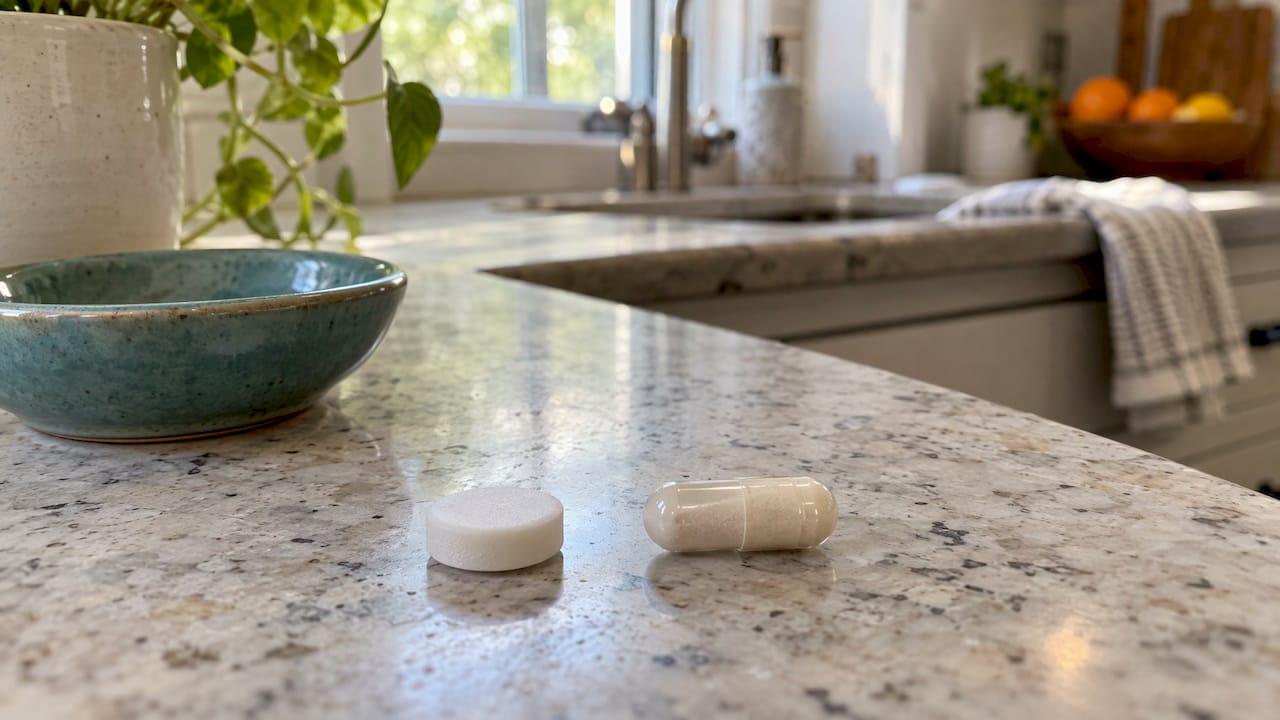
A troche is a small lozenge that dissolves slowly in your mouth. A capsule is swallowed whole and releases its contents in the digestive tract. That is the core difference, but it is not the one that decides whether a peptide product works for you. The formulation, the peptide itself and the pharmacy behind the product matter more. For weight loss, the safest route is a doctor-led prescription, where a clinician chooses the delivery form and monitors your response. That is how we approach personalized GLP-1 care at Dayla Health.
This guide explains both forms in plain terms, shows what the published research says about oral peptide delivery, and gives you a way to judge any peptide product before you take it.
TL;DR
- A troche dissolves in the mouth, so some of the peptide may be absorbed through the lining of the cheek or under the tongue. A capsule is swallowed and absorbed in the gut.
- Neither form is better by default. Results depend on the specific peptide and how the product is formulated.
- FDA-approved drugs, compounded drugs and dietary supplements are held to different standards, and the label tells you which one you are buying.
- A clinician-supervised prescription gives you dosing, monitoring and a regulated pharmacy. Dayla Health offers GLP-1 injection, microdose and needle-free oral options.
Table of Contents
- What a troche is, and what a capsule is
- Why peptides are harder to take by mouth
- What the research shows about oral delivery
- Troche vs capsule at a glance
- Prescription peptides, compounded peptides and supplements
- Safety: who a doctor will want to look at first
- How to choose: a practical checklist
- Oral or injectable: which is more effective?
- Where Dayla Health fits
- Our perspective
- FAQ
- Sources
What a troche is, and what a capsule is
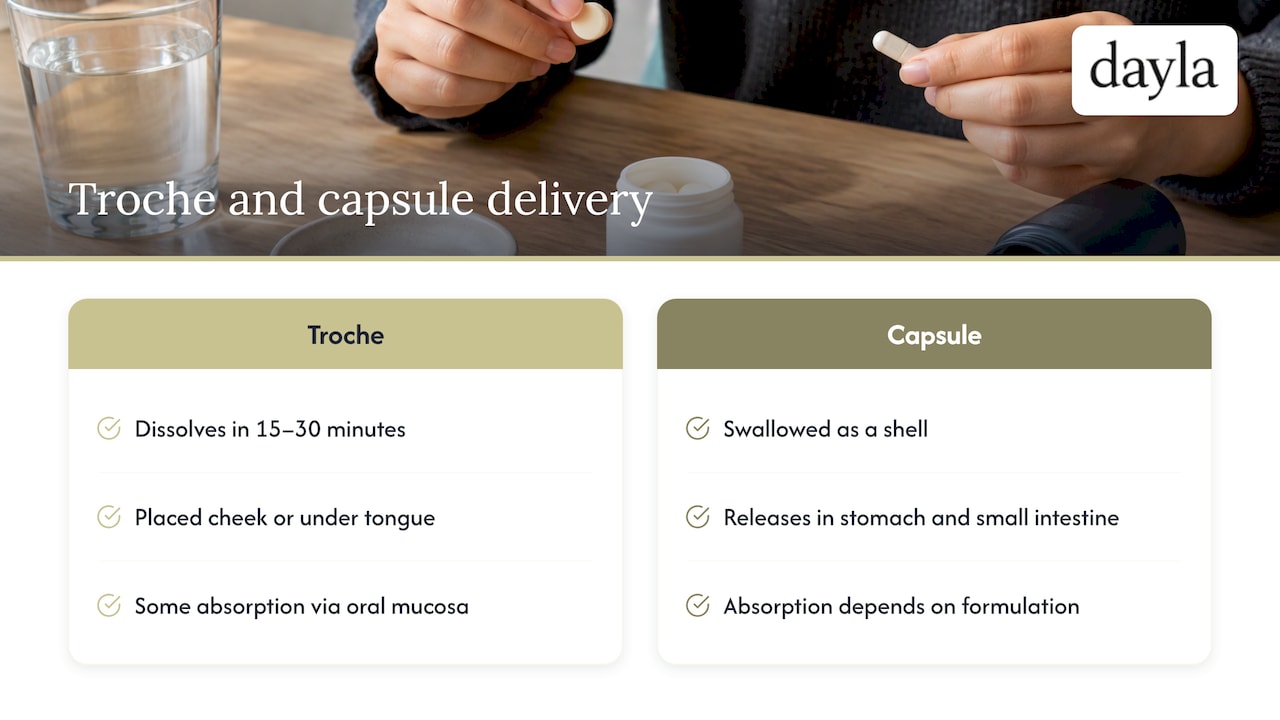
A troche (pronounced "TRO-key") is a lozenge or hard tablet made to dissolve slowly, usually over 15 to 30 minutes, between the cheek and gum or under the tongue. The idea is that part of the dose can pass through the thin tissue lining the mouth, called the oral mucosa, and reach the bloodstream without going through the stomach first.
A capsule is a shell, usually gelatin or plant-based, filled with powder or liquid. You swallow it. It travels through the stomach and small intestine, where the contents are released and, for some medicines, absorbed.
That is the textbook contrast. A peer-reviewed review of oral peptide delivery notes that real-world delivery depends on the particular formulation, and that no standardized definition or head-to-head clinical comparison of troches and capsules exists. In other words, you cannot pick a winner from the shape of the dose alone.
Why peptides are harder to take by mouth
Peptides are short chains of amino acids. Your digestive system is built to break proteins and chains of amino acids down, so a peptide swallowed in a plain capsule faces stomach acid, digestive enzymes and a gut lining that does not readily let large molecules through.
This is the reason injectable peptides have long been the standard. It is also why researchers have spent years developing delivery systems for the oral route. A 2022 review of oral peptide delivery describes both the progress and the work that remains, and says newer approaches such as nanoparticles, self-emulsifying systems and ingestible devices need clinical studies to establish safety and efficacy.
Two things follow for you as a reader:
- Oral peptide products that work are engineered. They rely on a specific delivery design for a specific molecule.
- Claims that any peptide works equally well in any troche or capsule go beyond the evidence.
What the research shows about oral delivery
The strongest human evidence comes from approved oral peptide medicines, which were developed with formal trials.
- A 2021 review of oral octreotide describes a Phase I study in 75 healthy volunteers and the OPTIMAL Phase III trial in 56 patients. In that trial, IGF-1 normalization was reported in 58% of patients on the capsule and 19% on placebo. The capsule was reported as tolerated, with mild adverse events in 35% of participants in the Phase I study.
- A 2024 review of gastrointestinal permeation enhancers notes that repeated daily dosing of oral semaglutide reaches steady-state therapeutic levels in most treated patients, while exposure varies considerably between individuals.
- A 2023 review of oral absorption shows that an absorption enhancer's effect cannot be assumed to carry over from one peptide to another. In rat experiments, the enhancer SNAC improved absorption of octreotide and lanreotide but did not raise pasireotide exposure.
The pattern is consistent. Each successful oral peptide has its own formulation, its own dose and its own trial data. These findings concern specific products. They do not tell you how an unapproved troche or an over-the-counter capsule will behave.
What this means for troche vs capsule
A troche can be a sensible format when a formulation is designed for absorption through the mouth lining. A capsule can be a sensible format when the formulation is designed to protect the peptide and release it in the gut. In both cases, the question to ask is the same: was this exact product designed, dosed and tested for this exact peptide?
Troche vs capsule at a glance
| Feature | Troche | Capsule |
|---|---|---|
| How you take it | Dissolves slowly between cheek and gum or under the tongue | Swallowed with water |
| Where absorption is intended | Oral mucosa, plus some swallowed portion | Stomach and intestine |
| Time in use | Typically 15 to 30 minutes to dissolve | Swallowed in seconds |
| What decides results | Formulation, peptide, dose, holding time | Formulation, protective coating or enhancer, peptide, dose |
| Practical points | Needs to be left in place, with no chewing or swallowing early | Easy to carry and take; timing with food and water may matter |
| Evidence base | Product-specific; no standard head-to-head comparison | Strongest for approved, engineered oral medicines |
Use the table as a guide to how each form works, not as a ranking. A well-made product in either form beats a poorly made product in the other.
Prescription peptides, compounded peptides and supplements
The second question buyers ask is how prescription peptides differ from supplements. The difference is oversight, and FDA's consumer guidance lays it out:
- FDA-approved drugs go through premarket review of safety, effectiveness and manufacturing quality for their intended use.
- Compounded drugs are prepared by a pharmacy for an individual patient and are not FDA-approved. They do not receive FDA's premarket review of safety, effectiveness or quality.
- Dietary supplements are not FDA-approved before they are marketed. Their structure-function claims need an FDA notification and a disclaimer that the claim has not been evaluated by FDA and that the product is not intended to diagnose, treat, cure or prevent disease.
So a capsule sold as a peptide supplement and a compounded troche made on a prescription sit in different regulatory categories, even if the ingredient name sounds similar. The category tells you who is accountable for the product and what it may legally claim.
Compounding rules worth knowing
Compounding is allowed under specific conditions. In its January 2025 interim policy on compounding with bulk drug substances, FDA states that the exemptions apply only when statutory conditions are met. A bulk substance generally needs an applicable USP/NF monograph, has to be a component of an FDA-approved drug, or has to appear on the 503A bulks list. These requirements apply to licensed pharmacists, pharmacies, federal facilities and licensed physicians.
If you are comparing products, this is a practical filter. A compounded product should come from a licensed U.S. pharmacy, prepared on a prescription written for you. Our guide to 503A vs. 503B compounding standards explains the pharmacy types and the red flags to look for, and our five-step compounded semaglutide checklist shows how to verify what is in a vial or dose.
Rules in this area have moved quickly in recent years. Our overview of the 2026 FDA peptide reclassification covers the changes, and the FDA pages above are the place to confirm the current position.
Safety: who a doctor will want to look at first
Peptides are active medicines, and a doctor-led process matters because the factors that change safety are individual. FDA's draft clinical pharmacology guidance for peptide drugs, published in December 2023, names the considerations developers and prescribers have to weigh:
- Hepatic (liver) impairment
- Drug-drug interactions
- QTc prolongation, a change in the heart's electrical cycle
- Immunogenicity, meaning your immune system reacting to the peptide
The guidance treats these as things to evaluate for each peptide, not something you can assume away from the name of the compound. Before starting any peptide, tell the prescribing clinician about every medicine and supplement you take, your liver and heart history, and any past reactions to injectable or oral medicines. If you are pregnant, planning pregnancy or breastfeeding, raise that at the start as well.
Once you begin, the first weeks are when dose changes and side effects are most likely to come up. Our guide to online peptide safety monitoring describes what to expect and which symptoms to report.
Sublingual and mouth-dissolving products also depend on correct measuring. The same principles of starting low and increasing gradually appear in guidance on measuring and titrating a dose for other mouth-absorbed products, and they apply here: follow the prescribed amount, and change it only with your clinician.
How to choose: a practical checklist
Whether you are looking at a troche, a capsule or another format, run through these questions.
- Is it a prescription, a compounded preparation or a supplement? The answer sets the level of oversight and what the seller may claim.
- Is a licensed clinician reviewing your health history? An online intake followed by clinician approval is the standard for prescription GLP-1 care.
- Does the pharmacy hold the right license? Compounded products should come from a licensed pharmacy filling a prescription for you.
- Is the exact peptide and dose stated? Vague labels such as "peptide blend" make it impossible to know what you are taking.
- Is there evidence for this peptide in this form? Approved oral medicines come with trial data. Our guide to oral peptide bioavailability explains how to read absorption data.
- Who follows up with you? Dose adjustments, side effects and progress checks are part of safe use.
- Is the price clear? A cash price that bundles the clinician, the medication and shipping is easier to compare than a price for the product alone.
If you want to compare peptides themselves, see our weight loss peptides comparison guide and the evidence ranking of fat-burning peptides. For a broader look at what peptides are used for, read peptide therapy use cases.
Oral or injectable: which is more effective?
The honest answer is that it depends on the peptide and the product. Approved oral peptide medicines exist, and each reached the market because its formulation was developed and tested for that molecule. Injectable products deliver the peptide directly under the skin, which is why many peptide medicines are given that way. The 2023 review is explicit that these comparisons are product-specific and do not generalize to all peptides.
For you, the more useful question is which format you will take consistently, under supervision, with a dose set for you. Some people prefer a weekly injection. Others want a needle-free route. A program that offers both lets the clinician match the format to you instead of the other way around.
Where Dayla Health fits
If your goal is weight loss, you do not need to work out troche vs capsule formulations on your own. At Dayla Health, a clinician reviews your intake and, if you are approved, prescribes GLP-1 medication delivered to your door anywhere in the United States, with no insurance required.
You choose the delivery that suits you:
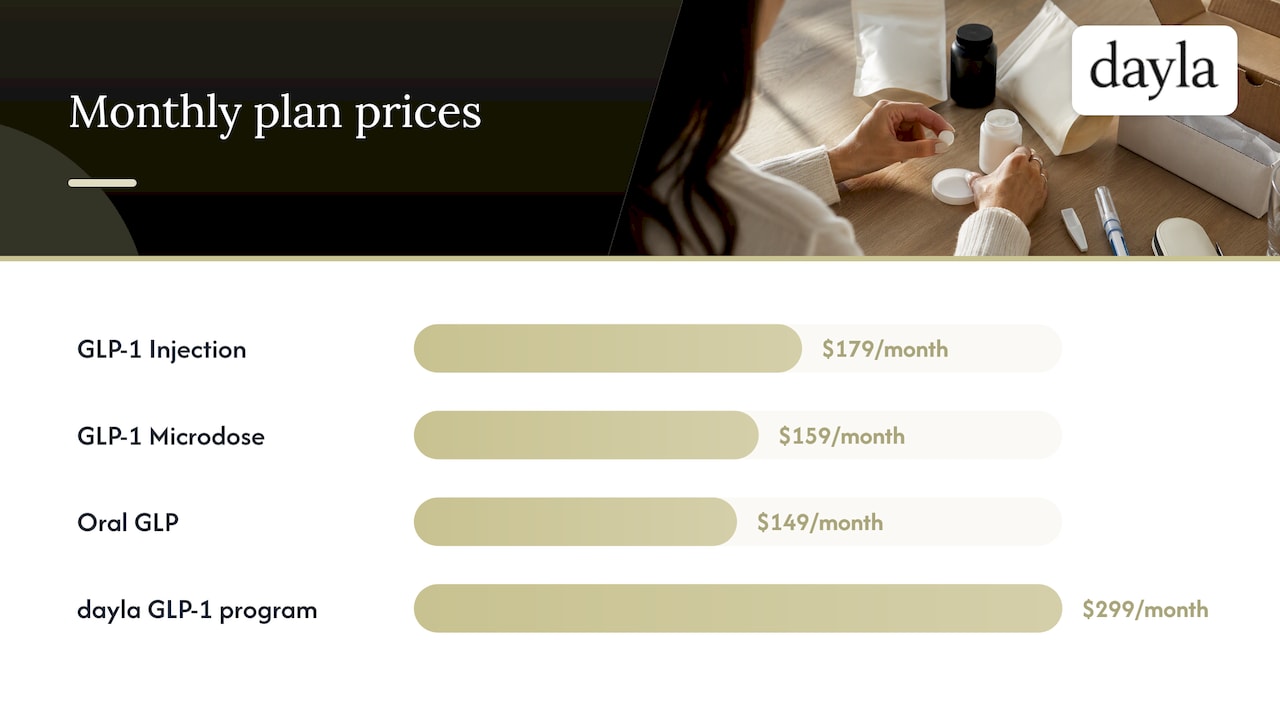
- GLP-1 Injection, from $179 per month
- GLP-1 Microdose, from $159 per month
- Oral GLP · Liposomal, a needle-free option, from $149 per month
- dayla GLP-1 program, $299 per month
Plans are paid in cash and bundle clinician evaluations, medication, care coaching and shipping. Our positioning is simple: no membership fees, transparent pricing, nationwide clinician access, free dietitian visits and flexible cancellation.
See the options and start your intake on the Dayla Health home page, or go straight to the semaglutide injection maintenance dose. If tirzepatide is on your mind, our page on compounded tirzepatide rules since October 2, 2026 explains what applies to U.S. patients.
Our perspective
Most people who ask us about troches and capsules are really asking a different question: how do I take a peptide safely and get a result I can see on the scale?
Our answer starts with the person, not the pill. A doctor-led evaluation comes first, then medication from a licensed pharmacy, then follow-up. A format is only as good as the clinical care around it.
That is why we built personalized GLP-1 care around choice. You can take an injection, a microdose or a needle-free oral GLP-1, and a clinician matches the option to your health history and preferences. Free dietitian visits and care coaching sit alongside the medication, because lasting weight loss involves food, sleep and routine as well as dosing.
We price in the open and ask for no membership fee. If your plan is not right for you, cancellation is flexible. Our job is to make a medical decision feel clear, supported and unhurried.
Flexible
FAQ
Are peptide troches better than capsules?
Neither is better in general. A troche is designed to dissolve in the mouth, and a capsule is designed to release in the gut. What matters is whether the specific product was formulated and dosed for the specific peptide. A clinician can help you choose a format that suits your health history.
Are prescription peptides different from peptide supplements?
Yes. FDA explains that approved drugs get premarket review of safety, effectiveness and quality. Compounded drugs and dietary supplements do not. Prescription peptides are also supervised by a clinician who evaluates you and sets your dose.
Who should avoid peptides?
People with liver impairment, a history of heart rhythm problems, medicines that could interact, or past immune reactions need a clinician's review before starting, based on the factors in FDA's peptide guidance. Pregnancy and breastfeeding should also be discussed with the prescriber first. Share your full medication and supplement list at intake.
Are oral or injectable peptides more effective?
It depends on the peptide and the formulation. Oral peptide medicines that work were engineered and tested for their specific molecule, and the same is true of injectables. Your clinician can recommend the option that fits your goals, and Dayla Health offers injection, microdose and needle-free oral GLP-1 plans.
Sources
- Transient Permeation Enhancer (TPE) oral octreotide review, Expert Opinion on Drug Delivery, 2021
- Progress and limitations of oral peptide delivery, 2022
- Gastrointestinal Permeation Enhancers Beyond Sodium Caprate, 2024
- Oral Absorption of Middle-to-Large Molecules, Pharmaceutics, 2023
- Is It Really 'FDA Approved'? FDA consumer update
- Clinical Pharmacology Considerations for Peptide Drug Products, FDA draft guidance, December 2023
- Interim Policy on Compounding Using Bulk Drug Substances, FDA, January 2025