
Routine compounded tirzepatide is no longer legally available to the general public in the United States. The FDA declared the shortage resolved on October 2, 2024, closing the exception that once let compounders mass-produce copies. What remains is a narrow lane: patient-specific 503A compounding, prescribed for documented clinical necessity. For most patients, the safer, lawful path now runs through FDA-approved medication or a clinician-led program like Dayla Health.
TL;DR:
- Routine mass-produced compounded tirzepatide is no longer legally available in the US since the FDA lifted the shortage exception in October 2024.
- Only patient-specific compounding for documented medical necessity remains lawful under strict conditions, such as allergies or unique dosing needs.
- The difference between 503A and 503B compounding is crucial; only 503A pharmacies with a valid prescription can legally prepare individualized tirzepatide.
- Compounded GLP-1 drugs pose safety risks due to lack of premarket review, with documented issues including formulation tampering and unstudied ingredient combinations.
- Verified access to safe, legal tirzepatide is best through FDA-approved products or clinician-led telehealth services offering ongoing medical oversight.
Table of Contents
- Is Compounded Tirzepatide Availability Still Legal? The Timeline
- What's the Difference Between 503A and 503B Compounding?
- What Are the Safety Risks of Compounded GLP-1 Drugs?
- When Is Patient-Specific Tirzepatide Compounding Still Allowed?
- How Do You Verify a Compounding Pharmacy or Telehealth Provider?
- What Legal Alternatives Exist for Tirzepatide Access?
- Dayla Health's Position on Compounded Tirzepatide
- Get Clinician-Led GLP-1 Access Through Dayla Health
- Where to Verify Current Compounded Tirzepatide Rules
- Sources
- FAQ
Is Compounded Tirzepatide Availability Still Legal? The Timeline
The shortage that once justified widespread compounding ended on a specific date, and everything that followed has narrowed access further. The FDA's October 2024 shortage resolution triggered wind-down periods for 503A pharmacies and 503B outsourcing facilities that had been supplying compounded tirzepatide during the supply gap. A December 19, 2024 declaratory order reinforced that decision, and federal appellate courts upheld limits on mass compounding through 2026.
Enforcement has followed a consistent pattern:
- Warning letters sent to compounders continuing to advertise tirzepatide as a general-purpose alternative
- A proposed rule (April 30, 2026) to exclude tirzepatide and semaglutide from the 503B bulks list entirely
- Continued FDA guidance clarifying compounder policy as national supply stabilized
The practical takeaway: if a website is selling tirzepatide as a cheaper, no-questions-asked alternative to Zepbound, that offer sits outside current law. Legitimate compounding now requires an individual clinical reason, not simple demand.
What's the Difference Between 503A and 503B Compounding?
Two distinct legal pathways govern compounded drugs, and confusing them is where most patients get misled. Section 503A covers traditional, patient-specific compounding: a licensed pharmacist prepares a single prescription based on an individual doctor's order. Section 503B covers outsourcing facilities, which can produce in bulk but only under stricter oversight, and only when a drug appears on the FDA's shortage or bulks list.
The distinction matters because:
- 503A requires a real prescription tied to one patient's documented need, not a marketing funnel.
- 503B allowed scale, which is exactly why the shortage exception fueled mass tirzepatide compounding between 2022 and 2024.
- Quality standards diverge, too: 503B facilities register with the FDA and follow current good manufacturing practice rules, while 503A pharmacies operate under state board oversight with lighter federal sterility inspection.
Once the shortage ended, the 503B bulk pathway lost its legal basis for tirzepatide, leaving 503A's individualized model as the only route that can still function within the law.
What Are the Safety Risks of Compounded GLP-1 Drugs?
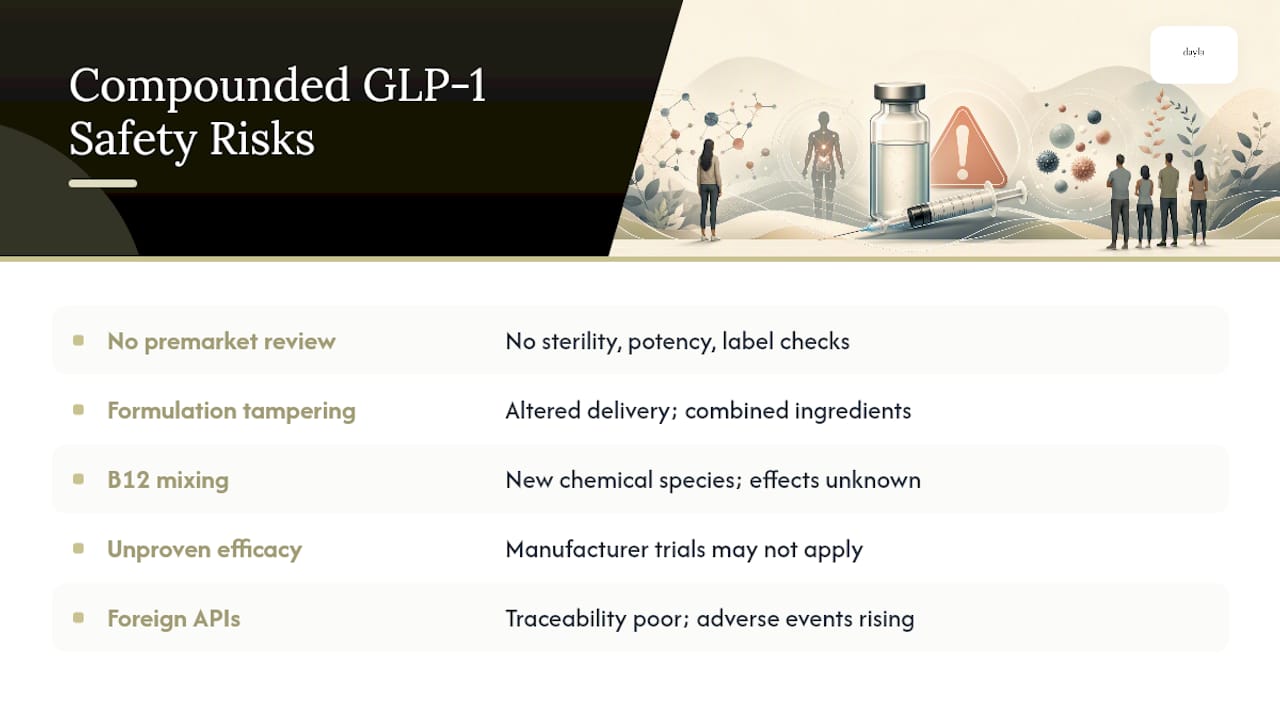
Compounded tirzepatide skips the premarket review that FDA-approved products go through, which means there's no independent verification of sterility, potency, or label accuracy before it reaches a patient. That gap has produced real consequences. Stanford Medicine's analysis of compounded GLP-1 safety points to formulation tampering, some compounders altered delivery methods or combined ingredients specifically to dodge the "essentially a copy" restriction that limits compounding of approved drugs.
One documented case stands out: laboratory testing found that mixing tirzepatide with vitamin B12, a combination some compounders marketed as an "enhanced" formula, produced new chemical species through bonding between the two substances. Nobody has studied what that does in the human body.
Efficacy data for tirzepatide comes from trials of the manufacturer's product. Those results don't automatically carry over to a compounded version with different excipients, concentration, or delivery method.
Watchdog groups tracking the supply chain, including the Partnership for Safe Medicines, have documented rising adverse events tied to foreign-sourced active ingredients entering compounded GLP-1 products with little traceability.
When Is Patient-Specific Tirzepatide Compounding Still Allowed?
Narrow exceptions exist, and they hinge entirely on documented medical necessity, not preference. A prescriber can lawfully request 503A compounding when:
- **The patient has a documented allergy to an inactive ingredient in the FDA-approved formulation (a specific preservative or stabilizer, for example).
- A unique dose or delivery format is medically required and the manufacturer doesn't produce it, such as a pediatric-scale dose for an off-label pathway.
- The prescriber documents the clinical justification in writing, and the pharmacy retains that record along with lot numbers and sourcing documentation for every batch prepared.
What does not qualify: wanting a lower price, wanting faster access, or general weight-loss goals that an approved product already treats. Those are the exact justifications the FDA's rule changes were designed to shut down, per its guidance on compounder policy.
How Do You Verify a Compounding Pharmacy or Telehealth Provider?
Before trusting any pharmacy or provider offering a compounded GLP-1, confirm the basics yourself rather than taking a website's word for it.
- Check the pharmacy's state license and confirm it operates as a 503A facility, not an unregistered supplier.
- Ask about PCAB accreditation or written sterility standard operating procedures.
- Request the active ingredient's source, a certificate of analysis, and lot-specific documentation.
- Confirm a licensed clinician actually evaluated you and documented a specific clinical need, not just a form you filled out.
Red flags: mass advertising with no clinician screening, vague or foreign API sourcing, and no willingness to share batch documentation.
Pro Tip: If a pharmacy hesitates to answer a direct question about where its active ingredient comes from, treat that as a disqualifying answer, not a minor gap.
If you suspect a product is unsafe or mislabeled, report it through FDA MedWatch and your state board of pharmacy. Those reports are what drive most enforcement action.
What Legal Alternatives Exist for Tirzepatide Access?
FDA-approved tirzepatide is sold under two brand names: Mounjaro for type 2 diabetes and Zepbound for chronic weight management. Both come with premarket safety review, consistent dosing, and manufacturer quality control that compounded versions simply cannot match.
Cost, historically the main argument for compounding, has narrowed as manufacturer self-pay vial programs have brought branded pricing closer to what compounded versions used to cost. That shift moves the real question away from price and toward oversight.
- Manufacturer direct-pay programs now offer reduced-cost vials without insurance requirements.
- Clinician-led telehealth services, including options for obtaining a GLP-1 prescription online, pair approved medication with ongoing medical supervision.
- Oral and needle-free formats remain limited since no FDA-approved oral tirzepatide exists in the U.S. as of 2026, so any product claiming otherwise deserves scrutiny.
Dayla Health's Position on Compounded Tirzepatide
Dayla Health recommends FDA-approved tirzepatide or documented, patient-specific compounding under direct clinician oversight, never routine mass-market copies. Our team has reviewed more than 730 safety reports tied to compounded GLP-1 products to inform that stance. Patients deserve care built on documentation, not marketing.
— Flexible
Get Clinician-Led GLP-1 Access Through Dayla Health
A lawful, doctor-led path to GLP-1 care is available as an alternative to compounding gray areas you have to investigate yourself. There are options with transparent cash pricing and clinician evaluation plus dietitian consults included, so you can be more confident your provider reviewed your case.
Options start with the GLP-1 Microdose plan from $159 a month, the GLP-1 Injection plan from $179 a month, or the needle-free Oral GLP · Liposomal plan from $149 a month for patients who want to avoid injections altogether. The dayla GLP-1 program at $299 a month bundles medication with ongoing care coaching for patients who want more support built in. If diet support alongside your prescription matters to you, pairing your plan with phase-based protein guidance can help you get more from the medication itself. Start an intake to see which options fit your situation and to schedule a clinician review.
Where to Verify Current Compounded Tirzepatide Rules
- FDA compounding laws overview: explains 503A and 503B rules in detail.
- Stanford Medicine safety analysis: covers documented formulation risks.
- FDA MedWatch: the official channel for reporting adverse events or suspect products.
This article is general information, not a substitute for advice from a qualified doctor. Consult a qualified healthcare professional about your own circumstances before acting on anything here.
Sources
- FDA — Compounding laws and human drug compounding
- Stanford Medicine — Compounded GLP-1s: why doctors worry about safety
- FDA — MedWatch adverse event reporting
FAQ
Is Compounded Tirzepatide Still Available in the USA?
Only in a narrow sense. Routine, mass-market compounded tirzepatide is no longer legally available since the FDA resolved the shortage in October 2024; only patient-specific 503A compounding with documented clinical necessity may still qualify.
Is Compounded Tirzepatide Available Again?
No, it hasn't reopened for general use. The shortage exception that allowed broad compounding closed permanently once supply stabilized, and 2026 court rulings upheld those restrictions rather than reversing them.
Will Zepbound Be Cheaper in 2026?
Manufacturer self-pay vial programs have already narrowed the price gap between branded and compounded options, and that trend is expected to continue as competition and manufacturing capacity expand. Exact pricing varies by program and dose, so check the manufacturer's current offer directly.
Which Online Provider Is Best for Tirzepatide Access?
The strongest option is a clinician-led telehealth service that prescribes FDA-approved medication with real medical oversight rather than an unverified compounding source. Such models offer plans starting at competitive prices for oral options and include ongoing clinician review built into plans.