

Compounded tirzepatide is not FDA-approved, and it carries meaningfully more risk than the brand-name version your doctor can prescribe. The core problems are unreviewed manufacturing quality, contamination potential, dosing inconsistency, and unverified additives mixed in without safety testing. If you are weighing this option, talk to a licensed clinician first and prioritize FDA-approved, properly dispensed medication over an unverified compounding source.
TL;DR:
- Compounded tirzepatide lacks FDA approval and often involves unverified manufacturing, increasing risks of contamination, dosing errors, and unsafe additives.
- Over 730 adverse events have been reported to the FDA, mostly gastrointestinal issues and injection-site reactions, with actual numbers likely higher.
- Proper licensure, batch testing, and clinician evaluation are essential if choosing to use compounded tirzepatide, but most patients should stick with FDA-approved medication.
- Unverified compounded products can contain impurities, inconsistent dosing, or mislabeling, leading to serious health risks and unpredictable side effects.
- A clinician-led approach with licensed pharmacies offers safer access to GLP-1 treatments, avoiding the dangers associated with unregulated compounding.
Table of Contents
- What the FDA Says About Compounded Tirzepatide Safety Right Now
- How Compounded Tirzepatide Can Actually Harm You
- What the Adverse Event Data Actually Shows
- A Practical Safety Checklist Before You Consider Compounded Tirzepatide
- Our Approach to Safer GLP-1 Access
- The Access Pressure Is Real, But It Doesn't Change the Safety Math
- Get Supervised GLP-1 Care Without the Compounding Risk
- Sources
- FAQ
What the FDA Says About Compounded Tirzepatide Safety Right Now
The FDA has been direct: compounded tirzepatide is not an approved drug, and the agency warns these products can contain impurities, be contaminated, or contain incorrect doses. That warning isn't theoretical. It reflects real enforcement activity aimed at telehealth companies and mass compounding operations that scaled up during the tirzepatide shortage.
As of September 2026, the FDA has logged more than 730 adverse event reports tied to compounded tirzepatide, including severe nausea, vomiting, diarrhea, abdominal pain, constipation, and injection-site reactions.
Pro Tip: That 730-plus figure almost certainly understates the real number. Many state-licensed pharmacies aren't required to report adverse events to the FDA at all, so the true count is likely higher.
The FDA's practical guidance for patients boils down to a short list:
- Talk to a licensed healthcare provider before starting any GLP-1 medication.
- Verify that the dispensing pharmacy is properly licensed in your state.
- Avoid online sellers who skip a real medical evaluation.
- Watch for red flags like vague sourcing, no named pharmacy, or pressure to buy quickly.
The agency has also proposed removing tirzepatide from certain compounding bulk-drug lists, a move that signals where federal oversight is headed next.
How Compounded Tirzepatide Can Actually Harm You
Three mechanisms drive most of the real-world harm reports, and each one is worth understanding on its own terms.
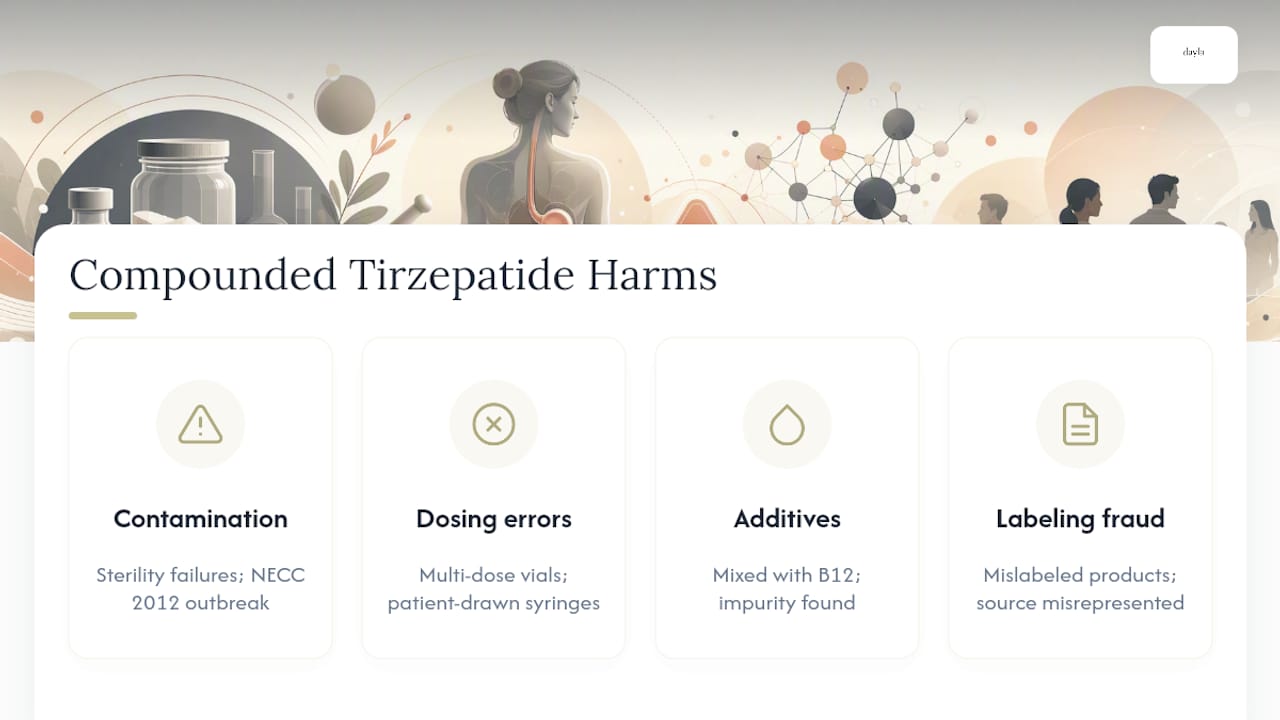
Contamination and sterility failures. Tirzepatide is an injectable, which means it has to be manufactured under strict sterile conditions. Many compounding pharmacies operate outside the current good manufacturing practice standards that branded drugmakers follow. This isn't a hypothetical risk. The 2012 New England Compounding Center meningitis outbreak, which sickened hundreds of patients from contaminated injectable steroids, remains the clearest historical proof that sterile compounding failures can turn deadly.
Dosing errors and potency variability. Compounded tirzepatide typically comes in multi-dose vials that patients draw up themselves with a syringe, unlike the pre-filled, pre-measured pens used for the FDA-approved version. A small measurement mistake can mean a significant overdose or underdose. Peer-reviewed safety reviews point to inaccurate potency as one of compounding's most persistent risks, since batch-to-batch consistency isn't independently verified the way it is for approved drugs.
Additives and adulteration. Some compounders market tirzepatide blended with vitamin B12 or other "personalized" additives. Eli Lilly tested these mixtures and found a previously unreported impurity when tirzepatide was combined with B12, prompting the company to issue a public warning. Mixing peptides with other compounds can alter potency or immune response in ways no one has studied.
Labeling fraud. Some products are mislabeled or misrepresent their source pharmacy entirely, making it nearly impossible for a patient to trace what they actually injected.
What the Adverse Event Data Actually Shows
The 730-plus reports the FDA has logged skew heavily toward gastrointestinal symptoms and injection-site reactions, roughly matching the side-effect profile listed for FDA-approved tirzepatide on MedlinePlus. The difference is frequency and severity. Case reports in the medical literature describe dosing errors from compounded products serious enough to require hospital evaluation, something rarely seen with properly dosed, pen-delivered medication.
Here's the honest caveat: this data almost certainly undercounts the real problem. The FDA itself acknowledges that adverse events from compounded products are likely underreported because many state-licensed pharmacies have no obligation to report to the agency at all. Attribution is also messy. When a patient has a reaction, it's not always clear whether the compounded drug, an additive, a dosing mistake, or an unrelated health issue caused it. Treat the 730 figure as a floor, not a ceiling.
A Practical Safety Checklist Before You Consider Compounded Tirzepatide
Start with the default position clinical experts recommend: compounding should be reserved for patients who have a documented medical reason an FDA-approved product can't meet, like a specific allergy or a dosing need no commercial pen offers. For most people, an FDA-approved, licensed-pharmacy-dispensed medication is the safer route.
If you're still evaluating a compounding source, work through this list:
- Confirm the pharmacy holds an active state license and ideally PCAB accreditation, a voluntary but rigorous quality standard.
- Ask for a certificate of analysis showing batch-level potency and purity testing.
- Confirm the pharmacy follows USP compounding standards for sterile preparations.
- Ask whether a licensed clinician actually evaluated you, not just an intake form.
Pro Tip: A legitimate compounding pharmacy will hand over its licensing and testing information without hesitation. Hesitation, vague answers, or "trust us" responses are the clearest red flag there is.
Walk away from any telehealth seller that skips a real clinician evaluation, can't name its compounding site, or pressures you to buy immediately. If you already have symptoms after using a compounded product, stop use, seek medical care, and report the event to FDA MedWatch and your state pharmacy board.
Our Approach to Safer GLP-1 Access
This service is built around doctor-led, personalized GLP-1 care, not unverified compounding. Every prescription runs through clinician evaluation before dispensing, and the model keeps oversight in place from intake through delivery.
We've written directly about the tradeoffs this article raises, including a cost breakdown for accessing tirzepatide without insurance, an explainer on why PCAB accreditation matters when evaluating any compounding pharmacy, and an analysis showing no evidence supports microdosing tirzepatide below 2.5 mg.
The model addresses the exact risks covered above:
- Clinician oversight replaces guesswork on dosing.
- Licensed dispensing channels replace unverifiable sourcing.
- Ongoing coaching catches side effects early instead of after the fact.
The Access Pressure Is Real, But It Doesn't Change the Safety Math
Tirzepatide shortages and high list prices pushed a lot of patients toward compounded alternatives, and that pressure is understandable. But a supply problem doesn't make an unreviewed drug safer. The evidence points one direction: clinician-led care built on FDA-approved medication reduces the risks documented above, while unverified compounding multiplies them. Patients who've had a bad reaction should report it. Better oversight only improves if the data behind it actually reflects what's happening.
— Flexible
Get Supervised GLP-1 Care Without the Compounding Risk
This service gives you a clinician-led path to GLP-1 treatment instead of a guessing game with unverified sourcing. Every patient completes an online intake, gets evaluated by a licensed clinician, and receives a prescription for an FDA-approved medication when it's the right clinical fit, backed by dietitian consults and ongoing care coaching.
That oversight is the difference this entire article has been building toward: a real clinician reviewing your history, a real pharmacy dispensing your medication, and real follow-up instead of a one-time transaction with an anonymous seller. Explore FDA-approved weight loss medication options to see what's actually cleared for use, or browse the GLP-1 prescription program to start your intake today. Nationwide shipping means you don't need to live near a specialty clinic to get supervised care.
This article is general information, not a substitute for advice from a qualified doctor. Consult a qualified healthcare professional about your own circumstances before acting on anything here.
Sources
- Understanding the risks of compounded drugs
- Safety of Compounded Medications - PMC
- An open letter from Eli Lilly and Company warning of potential patient safety risks associated with tirzepatide compounded with vitamin B12
FAQ
Is It Safe to Get Compounded Tirzepatide?
It carries more risk than FDA-approved tirzepatide because compounded versions aren't reviewed for purity, potency, or sterility, and the FDA has tied them to over 730 adverse event reports as of September 2026.
Did the FDA Shut Down Compounded Tirzepatide?
Not entirely. The FDA has proposed excluding tirzepatide from certain compounding bulk-drug lists and has taken enforcement action against telehealth firms and mass compounders, but compounding still continues in narrower, medically justified cases.
Can I Still Get Compounded Tirzepatide?
Yes, in limited circumstances where an FDA-approved product can't meet a documented medical need, and only through a properly licensed pharmacy with a real clinician evaluation behind it.
What Is the Latest News on Compounded Tirzepatide?
Regulatory attention through 2026 has centered on removing tirzepatide from bulk compounding lists and cracking down on telehealth companies that dispense it without adequate clinical oversight.
How Do I Report a Problem With Compounded Tirzepatide?
Stop using the product, seek medical care if you have symptoms, and file a report with FDA MedWatch and your state pharmacy board so the adverse event gets documented.