
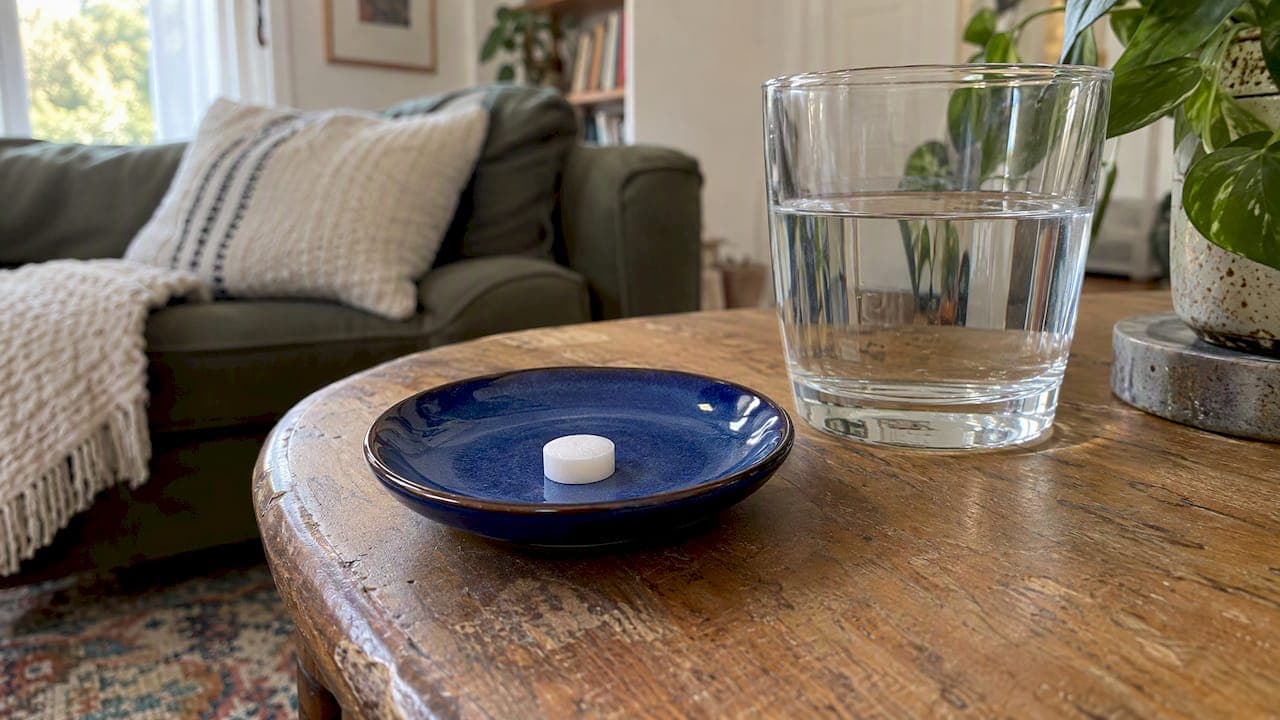
There is no FDA-labeled dose for a compounded semaglutide troche. Your dose comes from your prescribing clinician and is printed on your pharmacy label: the strength per troche, the number of troches, and how often you take them. Any chart that converts an injection or tablet dose into a troche dose is a guess, and you should not use one to change your own dose.
This guide explains why, what a responsible titration looks like, which questions to ask before your first troche, and when to call your clinician.
TL;DR
- No FDA-approved dosing schedule exists for compounded semaglutide troches. FDA labels cover specific injection and tablet products only.
- Your troche dose is set by your clinician and shown on your pharmacy label. Do not convert from injection units or tablet milligrams.
- Clinicians start low and raise the dose only after reviewing how you tolerate it, the same safety principle used in FDA labeling.
- Call your clinician promptly for persistent vomiting or diarrhea, dehydration, severe abdominal pain, or signs of an allergic reaction.
- Tell your clinician about thyroid cancer history, pancreas or gallbladder disease, other GLP-1 use, diabetes medicines, and upcoming procedures before you begin.
Table of Contents
- What a semaglutide troche is, and what it is not
- Why you cannot convert an injection dose to a troche dose
- How the approved tablet is dosed, and why that is not your troche schedule
- What a clinician-set troche schedule looks like in practice
- A safe process for getting a semaglutide troche prescription
- Our perspective: why we do not publish a troche dose chart
- Side effects and when to call your clinician
- Troche, drops, tablet, or injection: choosing a form
- Questions to ask before your first troche
- Getting started with Dayla Health
- FAQ
- Sources
What a semaglutide troche is, and what it is not
A troche is a small dissolvable dose form. You place it in your mouth, usually under the tongue or between the cheek and gum, and let it dissolve. Compounded versions are made by a pharmacy to a prescriber's order. They are not the same product as the semaglutide injection or the tablet that the FDA has approved.
That difference drives everything about dosing. An FDA label describes one product, with one formulation, tested in clinical trials. The WEGOVY label lists injection strengths of 0.25 mg, 0.5 mg, 1 mg, 1.7 mg, 2.4 mg, and 7.2 mg, and tablet strengths of 1.5 mg, 4 mg, 9 mg, and 25 mg. Those numbers belong to those products. None of them is a validated troche regimen.

So when you see a number like "0.25 mg" in search results, ask which product it refers to. A 0.25 mg weekly injection and a troche with a similar-looking number are different things.
Why you cannot convert an injection dose to a troche dose
It is tempting to take a familiar injection schedule and divide it into daily troches. The pharmacology does not support that.
Semaglutide is a large peptide. Swallowed or absorbed through the mouth, only a small fraction reaches the bloodstream. A 2025 study of 22 healthy volunteers compared 3 mg of oral semaglutide with 0.25 mg injected under the skin and found a relative oral bioavailability of 0.66%. A clinical pharmacokinetic analysis of the approved tablet found bioavailability of about 0.8% under recommended conditions.
Two points follow from this:
- Absorption is formulation-dependent. The approved tablet uses an absorption enhancer called SNAC. A compounded troche may use a different formulation, so tablet results do not transfer to it.
- Handling changes exposure. For the approved tablet, fasting time after the dose, the volume of water taken with it, and body weight all affected how much semaglutide the body absorbed. A troche has its own conditions, which your pharmacy and prescriber should explain.
Both studies examined oral tablets, not compounded sublingual troches. They do not give a troche dose. What they do show is that a precise-looking conversion chart creates false confidence. If a website tells you that a certain troche milligram amount equals a certain weekly injection dose, it is claiming something the published research does not establish.
How the approved tablet is dosed, and why that is not your troche schedule
The FDA-approved WEGOVY tablet gives a useful picture of how cautious titration works. According to the FDA label, treatment starts at 1.5 mg once daily for 30 days, then rises on a schedule every 30 days toward a maintenance dose, which for adult weight reduction is 25 mg once daily.
This is an approved schedule for one tablet. It is not a recommendation for a troche. A troche prescribed at 1 mg or 3 mg per day is not on the same scale as a 1.5 mg or 25 mg tablet, because the two are absorbed differently.
What does carry over is the principle. FDA labeling escalates gradually because stomach and bowel side effects depend on dose. A clinician prescribing a troche should apply the same logic:
- Start at the prescribed starting strength, not at a strength you saw online.
- Stay at that strength for the period your clinician specifies.
- Increase only after a review of how you feel, what you have lost, and whether side effects are manageable.
What a clinician-set troche schedule looks like in practice
The exact numbers differ by prescriber and pharmacy, and that is the point. Some pharmacy product pages describe the pattern in general terms. One compounding pharmacy's 2 mg troche listing says dosing typically starts low and is titrated gradually to reduce GI side effects, and that dosing is individualized. We cite it only to show that even sellers of these products say the schedule is individual, not as a dose for you to copy.
When your prescription arrives, find these four items on the label and confirm each with your clinician:
| Label item | What to confirm |
|---|---|
| Strength per troche | The milligrams in one troche, not the total per week |
| Amount per dose | How many troches you take at one time |
| Frequency | Daily or another interval, and the time of day |
| Administration | Under the tongue or in the cheek, how long to hold it, and whether to eat or drink before or after |
If any of these is unclear, ask before the first dose. Do not measure a troche by injection syringe units, split troches unless instructed, or add a second troche on a day you feel the first was weak.
A safe process for getting a semaglutide troche prescription
Here is the sequence a careful U.S. patient should expect.
- Complete a clinician evaluation. A licensed clinician reviews your history and decides whether semaglutide is appropriate for you and in which form.
- Disclose your full history. Tell the clinician about current and past GLP-1 use, all medicines, diabetes, digestive disease, gallbladder or pancreas problems, any personal or family history of medullary thyroid carcinoma or MEN 2, pregnancy plans, and upcoming procedures.
- Verify the prescription. Check strength, amount per troche, frequency, and instructions against what your clinician told you.
- Report before any increase. Share your weight change and any side effects before your dose goes up.
- Keep the same pharmacy information. Know which pharmacy prepared your medication. Our guide to verifying compounded semaglutide walks through a five-step checklist based on FDA warnings.
The FDA label contraindicates semaglutide for people with a personal or family history of medullary thyroid carcinoma or MEN 2, and it carries warnings for pancreatitis, gallbladder disease, hypoglycemia, kidney injury from volume depletion, severe gastrointestinal reactions, hypersensitivity, retinopathy complications, heart rate increase, and pulmonary aspiration. A good program screens for these before prescribing and checks again during titration.
Our perspective: why we do not publish a troche dose chart
We are a doctor-led, direct-to-consumer GLP-1 service, and we choose not to publish a troche conversion chart. The reason is simple. A chart would look helpful and could be wrong for the person reading it.
Our approach to personalized GLP-1 care rests on a few principles:
- Dose follows the patient. Your clinician sets your strength after an evaluation, and adjusts it based on what you report.
- Delivery form is a choice, not a hierarchy. Injection, microdose, and needle-free oral options each suit different people. Your clinician helps you pick the one that fits your history and preferences.
- Support matters as much as the prescription. Our packages include ongoing clinical oversight, dietitian consults, and care coaching, so questions about dose, nausea, or appetite have an owner.
- Transparent cash pricing. You pay one published monthly price, with no membership fees and flexible cancellation.
When a reader asks us whether a number they found online is right for them, our answer is always to bring it to the clinician who knows their history.
— Flexible
Side effects and when to call your clinician
The FDA label lists nausea, diarrhea, vomiting, constipation, abdominal pain, dyspepsia, and dizziness among the common adverse reactions of semaglutide. Which ones you feel, and how strongly, depends on the product, the dose, other conditions, and other medicines.
Semaglutide also has a long effective half-life, so effects can build after a dose increase rather than appearing the same day. That is another reason to hold each step for the period your clinician set, not to speed it up.
Contact your clinician promptly if you have:
- Vomiting or diarrhea that does not stop, or signs of dehydration such as dizziness, very dark urine, or little urine. Dehydration can injure the kidneys.
- Severe or ongoing abdominal pain.
- Signs of an allergic reaction.
- Symptoms of low blood sugar, if you also take insulin or a medicine that stimulates insulin release.
FDA labeling says semaglutide is not recommended for people with severe gastroparesis, and that when used for weight reduction it should be stopped once pregnancy is recognized. If you are planning a pregnancy, read our article on semaglutide and birth control and talk to your clinician early.
If you are scheduled for surgery or any procedure with anesthesia or sedation, tell the team you take semaglutide. The label warns about aspiration risk. For a broader overview of warning symptoms and precautions, this semaglutide side effects guide covers what patients should watch for.
Constipation is common and manageable. Our constipation plan sets out six clinic-aligned steps you can discuss with your clinician. If you take other medicines, review semaglutide drug interactions as well, since thyroid medicine in particular needs attention.
Troche, drops, tablet, or injection: choosing a form
The right form depends on your history, your comfort with needles, and how you want to take the medication. Here is a plain comparison by type of delivery.
| Form | How you take it | Dosing source | Main consideration |
|---|---|---|---|
| FDA-approved injection | Weekly, under the skin | FDA label | Approved schedule, needs pen storage and handling |
| FDA-approved tablet | Daily, swallowed on an empty stomach | FDA label | Strict administration conditions affect absorption |
| Compounded troche | Dissolved in the mouth | Prescriber and pharmacy label | No FDA dosing schedule, formulation varies |
| Compounded sublingual or oral liquid | Held under the tongue or swallowed | Prescriber and pharmacy label | No FDA dosing schedule, formulation varies |
If you choose an injectable form, storage matters too. Our guide to semaglutide pen storage and travel covers the 36 to 46°F range. If you want to understand ingredient forms, read about the semaglutide base versus salt issue the FDA has raised.
Questions to ask before your first troche
Bring this list to your evaluation or message it to your care team:
- What strength will I start on, and for how long?
- What are the criteria for increasing my dose?
- Which pharmacy prepares my medication, and can I see the ingredient list?
- Should I eat or drink before or after the troche, and for how long?
- What should I do if I miss a dose or vomit after taking one?
- Which symptoms mean I should call you the same day?
- How does this fit with my other medicines?
A clinician who answers these clearly, in writing, is a clinician you can trust with a titration.
Getting started with Dayla Health
If you want medically supervised GLP-1 care without insurance requirements, we offer a bundled monthly plan that includes clinician evaluation, medication, care coaching, dietitian consults, and nationwide shipping. Published options include GLP-1 injection from $179 per month, GLP-1 microdose from $159 per month, and oral GLP-1 liposomal from $149 per month. Our dayla GLP-1 program is $299 per month.
If you prefer a needle-free route, see our semaglutide sublingual drops, or compare every option on our weight loss treatment page. Your clinician decides which product and strength are right for you after your intake.
FAQ
What is the starting dose of a semaglutide troche?
There is no single FDA-approved starting dose for a compounded troche. Your clinician chooses a low starting strength and writes it on your pharmacy label. Follow that label, and do not substitute a number from a chart or from an injection or tablet schedule.
Can I convert my semaglutide injection dose to troches?
No, not on your own. Research on oral semaglutide shows very low and formulation-dependent absorption, so an injection amount cannot be turned into a reliable troche amount by arithmetic. If you want to switch forms, ask your clinician to set a new plan.
How often do the troche doses go up?
That depends on your prescriber. The approved tablet is raised every 30 days, but that schedule is specific to that product. For a troche, your clinician should review your tolerance and progress before any increase, and you should not raise your own dose.
What if I feel sick after increasing my dose?
Mild nausea can occur with GLP-1 medicines, but tell your clinician about it before the next increase. Contact them promptly if you have persistent vomiting or diarrhea, signs of dehydration, severe abdominal pain, or an allergic reaction.
Sources
- FDA WEGOVY label, tablet dosing (2026)
- FDA WEGOVY label, injection strengths (2026)
- Comparative bioavailability of oral and subcutaneous semaglutide in healthy volunteers (2025)
- Clinical pharmacokinetics of oral semaglutide
- Semaglutide 2 mg troche product page