

GLP-1 receptor agonists quiet food noise by directly modulating the brain circuits that generate persistent, intrusive food-related thoughts. This is not appetite suppression in the traditional sense. Medications like semaglutide and tirzepatide work at the neurochemical level, targeting hypothalamic neurons and reward pathways to reduce the compulsive mental chatter around food that many people experience throughout the day.
Here is what that process involves at its core:
- Dorsomedial hypothalamus (DMH) activation: GLP-1 receptor neurons in the DMH encode preingestive satiation, signaling fullness before a meal is even finished. Calcium imaging and optogenetics confirm that GLP-1 receptor agonists selectively enhance this activity during eating.
- Default mode network (DMN) dampening: The DMN, the brain network most active during self-referential thought and mind-wandering, shows reduced hyperactivity under GLP-1 therapy, which correlates with fewer intrusive food thoughts.
- Dopamine reward blunting: GLP-1 agonists reduce the dopamine-driven "wanting" and "liking" responses to hyperpalatable foods, making ultra-processed options less mentally compelling.
- AgRP neuron inhibition: GLP-1 suppresses arcuate nucleus AgRP neurons, the primary drivers of rebound hunger after weight loss, enabling more sustained appetite control.
- Brainstem signaling: The nucleus tractus solitarius (NTS) produces endogenous GLP-1 and acts as a meal-termination brake, a mechanism that synthetic GLP-1 agonists amplify.
Semaglutide (marketed as Ozempic and Wegovy) and tirzepatide (Mounjaro and Zepbound) are the two GLP-1 receptor agonists with the most clinical data on food noise reduction. Both work through these overlapping but distinct pathways, and understanding the neuroscience behind them helps explain why patients often describe the experience as the mental noise around food simply going quiet.
What is food noise, and where does GLP-1 fit in?
Food noise refers to intrusive, persistent thoughts about food that interfere with daily functioning and healthy eating behaviors. It is not ordinary hunger. It is the background mental preoccupation with what to eat next, how much, when, and whether you "should," even when you are not physically hungry. Recent literature treats food noise as a cognitive and neurobiological phenomenon with measurable correlates in the default mode and reward networks of the brain.

GLP-1, or glucagon-like peptide-1, is an incretin hormone produced in the gut and the brainstem. Its primary physiological roles include stimulating insulin secretion in response to meals, slowing gastric emptying, and signaling satiety to the brain. GLP-1 receptors are distributed across the hypothalamus, brainstem, and limbic system, which is why synthetic GLP-1 receptor agonists have such broad effects on appetite and food-related cognition.
The FDA approved semaglutide for chronic weight management in 2021, and tirzepatide followed with approval for the same indication in 2023. Both were originally developed for type 2 diabetes, but their effects on appetite and food cognition quickly became the defining clinical story. GLP-1 receptors in the hypothalamus and brainstem are the anatomical basis for this effect.
Two distinct hunger systems are relevant here. Homeostatic hunger is the body's physiological drive to maintain energy balance, regulated primarily by the hypothalamus. Hedonic hunger is the desire to eat for pleasure, reward, or emotional reasons, driven by dopaminergic circuits in the limbic system. Food noise lives mostly in the hedonic system, and GLP-1 receptor agonists address both, which is what makes them neurochemically different from older appetite suppressants.
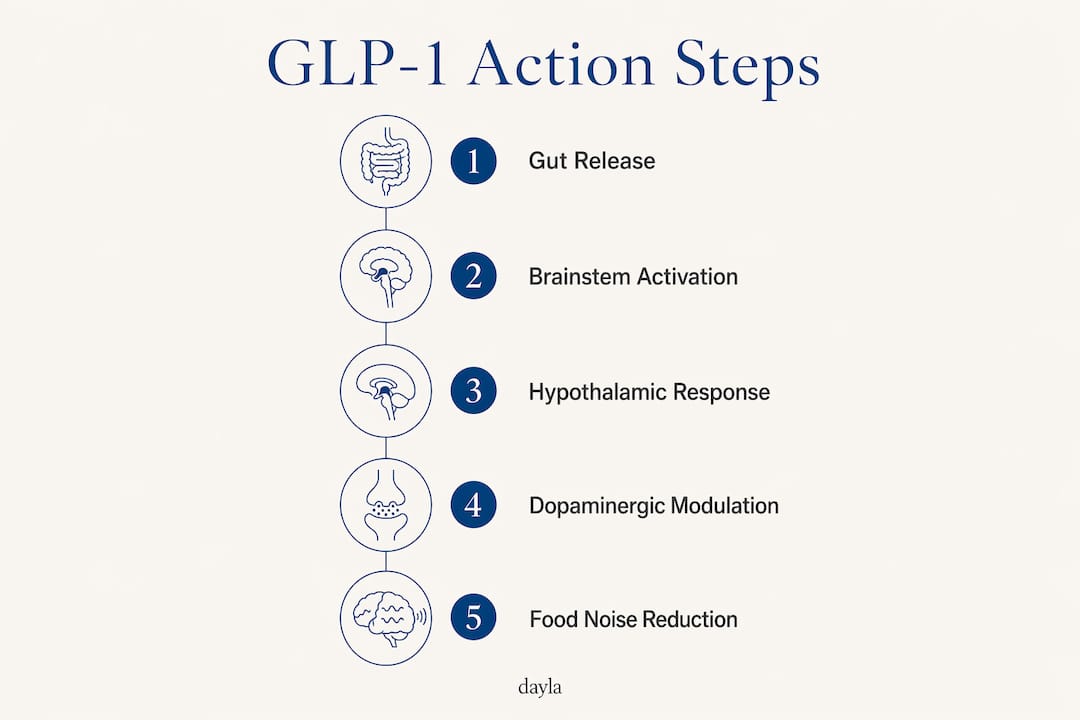
How GLP-1 receptor agonists reshape the brain's hunger and reward circuits
The neurochemical action of GLP-1 on food noise is not a single pathway. It is a cascade across interconnected brain regions, each contributing to the overall quieting effect.

Key brain regions and their roles
| Brain Region | GLP-1 Receptor Role | Effect on Food Noise |
|---|---|---|
| Dorsomedial hypothalamus (DMH) | Encodes preingestive satiation | Signals fullness before meal completion |
| Arcuate nucleus (AgRP/NPY neurons) | Suppresses hunger-driving neurons | Reduces rebound hunger after caloric deficit |
| Nucleus tractus solitarius (NTS) | Produces endogenous GLP-1 | Acts as brainstem meal-termination brake |
| Ventral tegmental area (VTA) | Modulates dopamine reward signaling | Blunts "wanting" response to hyperpalatable food |
| Default mode network (DMN) | Reduces self-referential food rumination | Fewer intrusive food-related thoughts |
The step-by-step neurochemical sequence
- GLP-1 agonist binds hypothalamic receptors. Synthetic GLP-1 receptor agonists like semaglutide bind to GLP-1 receptors on DMH neurons, activating preingestive satiation signals that reduce meal size and frequency.
- AgRP/NPY neuron suppression. GLP-1 receptor activation inhibits AgRP and neuropeptide Y (NPY) neurons in the arcuate nucleus. These neurons are the primary drivers of hunger, and their suppression is why GLP-1 agonists blunt rebound hunger that typically follows caloric restriction.
- NTS brainstem signaling amplified. The NTS produces endogenous GLP-1 and optogenetic stimulation of NTS GLP-1 neurons suppresses food intake without producing aversion. Synthetic agonists extend and amplify this natural brake signal.
- Dopamine reward pathway modulation. GLP-1 receptors in the ventral tegmental area and nucleus accumbens reduce dopamine release in response to hyperpalatable food cues. The result is a measurable reduction in both the "liking" and "wanting" components of food reward.
- DMN activity normalized. Reduced hyperactivity in the default mode network correlates with fewer spontaneous food-related thoughts, which is the subjective experience patients describe as food noise going quiet.
- Blood-brain barrier considerations. Endogenous GLP-1 has a short half-life and limited central nervous system penetration. Long-acting synthetic agonists like semaglutide cross the blood-brain barrier more effectively via circumventricular organs and active transport, reaching hypothalamic and brainstem targets at therapeutically relevant concentrations.
The distinction between homeostatic and hedonic hunger matters here. GLP-1 receptor agonists address both simultaneously. They reduce the physiological drive to eat through hypothalamic and brainstem pathways, and they reduce the pleasure-driven compulsion to eat through dopaminergic reward circuit modulation. Older appetite suppressants typically addressed only one of these systems, which is why their effects on food noise were limited.
Pro Tip: If you are on GLP-1 therapy and still experiencing significant food noise, the issue may be hedonic rather than homeostatic hunger. Discuss this distinction with your prescribing clinician, as dose titration and behavioral support address these two systems differently.
What the clinical evidence says about GLP-1 and food noise
The clinical picture for GLP-1 and food noise is strong, though not without nuance. Studies using validated instruments like the Food Noise Questionnaire (FNQ) and the Control of Eating Questionnaire (CoEQ) have produced consistent findings across multiple patient populations.
- GLP-1 plus behavioral programs outperform behavioral programs alone. FNQ scores decreased significantly more in patients using GLP-1 medications alongside behavioral weight management compared to behavioral intervention alone, measured over one month.
- Semaglutide reduces hedonic food interest. CoEQ data show that semaglutide treatment diminishes reward-based food interest, including reduced hunger, appetite, and pleasure derived from high-palatability foods.
- Dopamine-driven cravings are measurably blunted. Patients on GLP-1 therapy report muted compulsive drives toward ultra-processed foods despite retaining the physical capacity to eat them. This is a neurochemical effect, not a behavioral one.
- Gastrointestinal side effects affect continuation. Approximately 4.5% of patients discontinue GLP-1 therapy due to gastrointestinal adverse effects including nausea and diarrhea. Managing these side effects early is critical for treatment durability.
- Food noise can return after stopping medication. The neuroadaptations that quiet food noise are tied to active GLP-1 receptor stimulation. When medication is discontinued without concurrent behavioral support, intrusive food thoughts often reemerge, sometimes within weeks.
- GLP-1 does not resolve disordered eating patterns. While GLP-1 receptor agonists reduce the neurological volume of food noise, they do not address the psychological or emotional roots of disordered eating. Patients with binge eating disorder or emotional eating patterns require additional clinical support.
Statistic callout: GLP-1 receptor agonists lead to discontinuation in about 4.5% of patients due to gastrointestinal side effects, making early side-effect management a clinical priority for sustained food noise reduction.
Treatment response also varies by individual. Factors including baseline dopamine sensitivity, gut microbiome composition, and prior dietary patterns all influence how dramatically food noise quiets on GLP-1 therapy. For patients managing GLP-1 side effects, early intervention with dose titration and dietary adjustments significantly improves retention and long-term outcomes.
GLP-1 versus willpower: why they are not the same thing
The most common misconception about GLP-1 therapy is that it works by making patients "less hungry" in the same way that willpower or dietary restraint does. The mechanisms are fundamentally different, and conflating them leads to unrealistic expectations and inadequate treatment planning.
| Mechanism | GLP-1 Neurochemical Effect | Willpower-Based Restraint |
|---|---|---|
| Origin | Neurochemical modulation of reward and satiety circuits | Prefrontal cortex cognitive override of limbic drives |
| Sustainability | Maintained while medication is active | Depletes with mental fatigue and stress |
| Effect on cravings | Reduces the neurological intensity of food desire | Suppresses behavioral response without reducing desire |
| Dopamine involvement | Directly blunts dopamine reward response to food cues | No direct effect on dopamine signaling |
| Homeostatic hunger | Suppressed via hypothalamic and brainstem pathways | Unaffected; physiological hunger signals remain intact |
| Hedonic hunger | Reduced via reward circuit modulation | Temporarily overridden; returns with cognitive load |
Willpower operates through the prefrontal cortex, the brain's executive control center. It can override limbic-driven food cravings in the short term, but it is a finite resource that depletes with stress, sleep deprivation, and decision fatigue. GLP-1 receptor agonists work upstream of this process, reducing the neurological intensity of the craving itself so that executive control is less taxed.
This distinction has real clinical implications. Patients who have spent years "failing" at dietary restraint are not lacking willpower. They are fighting a neurobiological signal that willpower was never designed to override indefinitely. GLP-1 therapy changes the signal, not just the response to it.
That said, GLP-1 does not immediately repair the psychological relationship with food. Long-term GLP-1 therapy induces neuroadaptations that improve cognitive control over food intake, but research supports combining pharmacotherapy with cognitive behavioral therapy for obesity (CBT-OB) for sustained remission. The medication quiets the noise; behavioral therapy addresses why the noise developed in the first place.
Complementary behavioral approaches that work alongside GLP-1 therapy include:
- CBT-OB (Cognitive Behavioral Therapy for Obesity): Addresses maladaptive thought patterns around food, body image, and eating behavior.
- Acceptance and Commitment Therapy (ACT): Builds psychological flexibility around food-related thoughts without requiring their elimination.
- Mindfulness-based eating practices: Train attention away from food rumination and toward present-moment hunger and satiety cues.
- Structured meal planning: Reduces decision fatigue and the cognitive load that amplifies food noise.
Understanding how GLP-1 changes eating behavior at the neural level helps patients and clinicians set accurate expectations. The medication creates a neurochemical window of opportunity. What happens in that window, behaviorally and psychologically, determines long-term outcomes.
How to get the most from GLP-1 treatment
GLP-1 therapy works best when it is supported by deliberate lifestyle choices. The neurochemical quieting of food noise creates favorable conditions for behavioral change, but those conditions need to be used actively.
Pro Tip: Treat the reduced food noise you experience on GLP-1 therapy as a clinical window, not a permanent state. Use it to build consistent meal habits and behavioral patterns that will support you if medication is ever adjusted or discontinued.
Practical strategies that complement GLP-1 medication management and lifestyle sustainability include:
- Consistent meal timing. Regular meal schedules stabilize hunger signaling and reduce the erratic food thoughts that arise from unpredictable eating patterns. Aim for three structured meals at consistent times rather than grazing throughout the day.
- Prioritize protein and fiber. Both nutrients extend satiety signals and work synergistically with GLP-1's hypothalamic effects. Protein in particular supports lean mass preservation during weight loss.
- Minimize ultraprocessed foods. Behavioral strategies recommended by registered dietitians consistently emphasize reducing ultraprocessed food exposure, which reduces the dopaminergic food cue load that GLP-1 is working to dampen.
- Protect sleep quality. Sleep deprivation elevates ghrelin and suppresses leptin, counteracting GLP-1's satiety effects. Seven to nine hours of sleep per night is not optional for patients on GLP-1 therapy.
- Avoid overly restrictive eating. Severe caloric restriction triggers compensatory hunger signals that can overwhelm GLP-1's appetite-suppressing effects. Moderate, sustainable deficits produce better long-term outcomes.
- Engage behavioral counseling. Integrating GLP-1 therapy with structured behavioral support, whether through CBT-OB, a registered dietitian, or a health coach, significantly improves the durability of food noise reduction.
- Use distraction strategically. When food noise does arise, brief structured activities, a short walk, a focused task, or a non-food-related social interaction, can interrupt the rumination cycle without requiring willpower-based food refusal.
Lifestyle changes that support GLP-1 results are not secondary to medication. They are what converts a pharmacological effect into a lasting behavioral shift. The patients who sustain their outcomes after dose reductions or discontinuation are almost always those who used the medication's quieting effect to build new habits rather than simply eating less.
The bottom line on GLP-1 and food noise
GLP-1 receptor agonists represent a genuine neurochemical advance in the treatment of food noise and obesity-related appetite dysregulation. The mechanism is specific, the clinical evidence is consistent, and the patient experience, food thoughts going quiet in a way that willpower never achieved, reflects real changes in hypothalamic, brainstem, and reward circuit activity.
Key points to carry forward:
- The mechanism is central, not peripheral. GLP-1's main impact on food noise comes from brain-level neurochemical modulation, particularly in the DMH, NTS, and dopaminergic reward pathways, not simply from slowing gastric emptying.
- Semaglutide and tirzepatide have the strongest clinical data. Both reduce food noise scores on validated questionnaires and blunt hedonic food interest in ways that older appetite suppressants did not.
- Effects are medication-dependent. Food noise tends to return when GLP-1 therapy is stopped without concurrent behavioral support. This is not a treatment failure; it is a pharmacological reality that underscores the need for integrated care.
- GLP-1 is not a substitute for behavioral therapy. The neuroadaptations from chronic GLP-1 use improve cognitive control over eating, but they do not resolve the psychological roots of disordered eating. CBT-OB and similar approaches remain clinically necessary for long-term remission.
- Lifestyle optimization amplifies the effect. Consistent meal timing, adequate sleep, protein-forward nutrition, and reduced ultraprocessed food exposure all work with GLP-1's neurochemical action rather than against it.
- Realistic expectations matter. GLP-1 therapy is powerful and well-evidenced, but it is one component of a multidisciplinary approach. Ongoing research continues to refine understanding of which patients benefit most and how to sustain those benefits over time.
Key Takeaways
GLP-1 receptor agonists quiet food noise by neurochemically modulating hypothalamic, brainstem, and dopaminergic reward circuits, producing measurable reductions in intrusive food-related thoughts that willpower-based approaches cannot replicate.
| Point | Details |
|---|---|
| Core neurochemical mechanism | GLP-1 activates DMH neurons and suppresses AgRP/NPY neurons to reduce both homeostatic and hedonic hunger signals. |
| Reward circuit modulation | Semaglutide and tirzepatide blunt dopamine-driven "wanting" and "liking" of hyperpalatable foods at the neurochemical level. |
| Clinical evidence | FNQ and CoEQ data show GLP-1 medications reduce food noise significantly more than behavioral programs alone. |
| Medication dependency | Food noise often returns after stopping GLP-1 therapy without concurrent behavioral support, requiring integrated treatment planning. |
| Lifestyle amplification | Consistent meal timing, adequate sleep, and minimizing ultraprocessed foods enhance and extend GLP-1's appetite-quieting effects. |
Start your GLP-1 journey with Daylahealth

Daylahealth offers doctor-led, personalized GLP-1 care designed around your specific health profile and goals. If you are ready to address food noise at its neurochemical source, explore GLP-1 weight loss treatment through Daylahealth's clinical program. Every plan is built with medical oversight, ongoing support, and the behavioral guidance that makes GLP-1 therapy work long-term.