

The GLP-1 neuroprotective effect is defined as the capacity of glucagon-like peptide-1 receptor agonists to preserve neuronal survival by suppressing neuroinflammation, improving mitochondrial energy metabolism, and blocking apoptotic cell death. This mechanism extends well beyond glucose control. Research now links GLP-1 receptor agonists (GLP-1 RAs) such as semaglutide and liraglutide to measurably reduced risk of Alzheimer's disease, Parkinson's disease, and vascular dementia in large patient populations. The science is moving fast, and the clinical implications for neurodegenerative disease management are significant enough that researchers and clinicians need a clear, evidence-based picture of what GLP-1 actually does in the brain.
What is the GLP-1 neuroprotective effect at the cellular level?
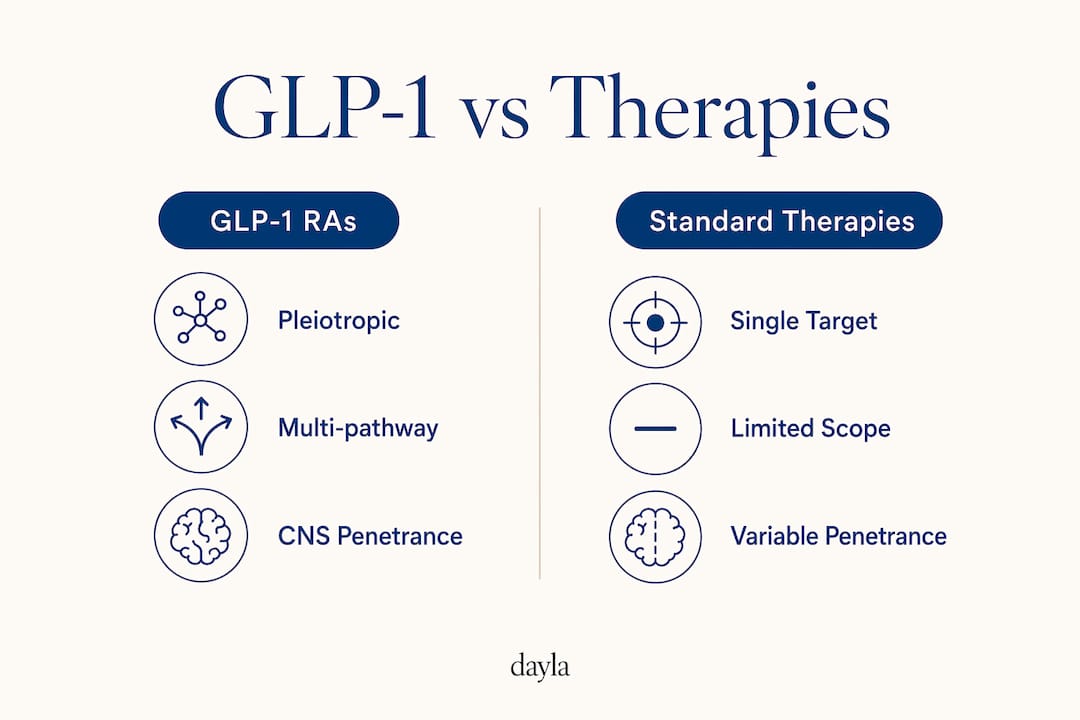
GLP-1 RAs protect neurons through multiple pathways simultaneously, which is the core reason they attract so much attention in neurodegeneration research. Most drugs target a single molecular pathway. GLP-1 RAs hit several at once, which mirrors how the brain actually fails in diseases like Alzheimer's and Parkinson's.
The key cellular mechanisms include:
- Anti-inflammatory signaling. GLP-1 RAs suppress microglial and astrocyte activation and lower pro-inflammatory cytokine concentrations in brain tissue. Chronic neuroinflammation is a primary driver of neuronal loss in both Alzheimer's and Parkinson's disease, making this effect clinically relevant.
- Mitochondrial support. Neurons are metabolically demanding cells. GLP-1 signaling improves mitochondrial function and stabilizes energy production, protecting neurons from the metabolic stress that accelerates degeneration.
- Apoptosis inhibition. GLP-1 RAs block key apoptotic signaling cascades, reducing programmed cell death in stressed neurons. They also promote autophagy, the cellular process that clears toxic protein aggregates like amyloid-beta and alpha-synuclein.
- Neurotrophic factor upregulation. These agents increase brain-derived neurotrophic factor (BDNF), a protein that supports neuron growth, survival, and synaptic plasticity.
- Proteostasis improvement. By reducing toxic protein aggregation, GLP-1 RAs address one of the hallmark features of both Alzheimer's and Parkinson's pathology.
Pro Tip: Protection conferred by GLP-1 therapies is partly independent of weight loss or glucose lowering. This means the neuroprotective signal is a direct tissue-level effect, not a downstream consequence of metabolic improvement.
The pleiotropic nature of these mechanisms is what separates GLP-1 RAs from most existing neurodegenerative therapies. No single pathway explains the benefit. The combination of anti-inflammatory, metabolic, and anti-apoptotic effects working together is likely what produces the outcomes seen in population data.

What does clinical research reveal about GLP-1 and brain health?
The epidemiological evidence is striking. A large-scale propensity-matched cohort study found that obese patients treated with GLP-1 RAs showed significantly reduced dementia risk, with relative risks ranging from 0.438 to 0.627 across Alzheimer's disease, Lewy body dementia, and vascular dementia. That range means treated patients carried roughly 37–56% lower risk compared to untreated controls. Semaglutide users in the same dataset also showed reduced Parkinson's disease risk and lower all-cause mortality.
| Study Type | Key Finding | Source |
|---|---|---|
| Large cohort study | Relative risk of dementia 0.438–0.627 in GLP-1 RA users | ScienceDirect, 2024 |
| Phase 3 trials (EVOKE/EVOKE+) | Testing semaglutide for Alzheimer's disease-modifying potential | Frontiers in Endocrinology, 2025 |
| Neuroimaging studies | Preserved cerebral glucose metabolism via FDG-PET | JCI, 2025 |
| Parkinson's disease models | Reduced pro-inflammatory cytokine release, inhibited microglial activation | Frontiers in Neurology, 2024 |
The ongoing Phase 3 EVOKE and EVOKE+ trials are testing semaglutide directly in Alzheimer's disease patients to validate disease-modifying potential. Early data show preserved cerebral glucose metabolism on FDG-PET imaging, which confirms that GLP-1 pathways are engaging in the brain. Cognitive outcomes, however, remain mixed. This gap between biomarker engagement and clinical cognitive improvement is the central translational challenge in the field.
"Biomarkers like FDG-PET cerebral glucose metabolism improvement have shown target engagement but have not yet translated into consistent cognitive improvement in trials." — JCI, 2025
Long-term epidemiological data from millions of patients show strong associations between GLP-1 RA use and lower dementia incidence. Causality still requires validation through randomized controlled trials. The observational signal is strong enough, though, that multiple major trial programs are now underway.
How do GLP-1 neuroprotective effects compare to other neurodegenerative therapies?
Most approved therapies for Alzheimer's and Parkinson's disease target a single molecular mechanism. Lecanemab and donanemab, for example, target amyloid-beta clearance. Levodopa addresses dopamine deficiency in Parkinson's. These single-target approaches have produced modest clinical benefits at best, partly because neurodegeneration involves multiple failing systems simultaneously.
GLP-1 RAs take a fundamentally different approach. Their pleiotropic effects address multiple pathways at once, including insulin signaling, mitochondrial function, proteostasis, and neuroinflammation. This breadth of action may explain why population data show such strong associations even when individual trial results are mixed.
| Therapy Type | Target | Breadth of Action | CNS Penetrance |
|---|---|---|---|
| GLP-1 receptor agonists | Multiple pathways | High (pleiotropic) | Limited with current molecules |
| Anti-amyloid antibodies | Amyloid-beta | Single target | Moderate |
| Levodopa/carbidopa | Dopamine replacement | Single target | High |
| Next-gen dual/triple agonists | GLP-1 + GIP + glucagon | Very high | Under investigation |
One of the most useful frameworks for understanding GLP-1's mechanism is the exercise analogy. GLP-1 RAs act as pharmacological analogues of exercise by enhancing insulin signaling, supporting mitochondrial health, reducing neuroinflammation, and promoting synaptic plasticity. Exercise is the most consistently neuroprotective intervention known. A drug that replicates those mechanisms pharmacologically is a genuinely different class of tool.
The primary limitation is CNS penetrance. Current GLP-1 RA molecules may not reach sufficient brain concentrations to consistently affect neurodegenerative disease progression. Next-generation dual and triple agonists targeting GLP-1, GIP, and glucagon receptors simultaneously are in development specifically to address this limitation and expand CNS access.
What are the practical implications for researchers and clinicians?
GLP-1 RAs are not yet approved for neurodegenerative disease indications. Their current clinical role is in type 2 diabetes and obesity management, where their established safety profile supports the case for repurposing. The neuroprotective data are promising but experimental. Clinicians should treat them as strong hypothesis-generating evidence, not practice-changing proof.
Several practical considerations shape the path forward:
- Patient selection matters. Biomarker-driven trial design, identifying patients by disease stage, genetic risk (APOE4 status, for example), and metabolic profile, will be critical for detecting true treatment effects.
- Drug delivery is an active problem. Molecules with better CNS penetrance are needed. Intranasal delivery and modified GLP-1 analogues are among the approaches under active investigation.
- Combination strategies are likely necessary. GLP-1 RAs combined with lifestyle modification may produce additive neuroprotective effects. Lifestyle factors that enhance GLP-1 results include aerobic exercise, sleep quality, and dietary patterns that support endogenous GLP-1 secretion.
- Biomarker endpoints need standardization. FDG-PET, cerebrospinal fluid amyloid and tau, and plasma neurofilament light chain are all candidate markers, but trials use different endpoints, making cross-study comparison difficult.
- The window of intervention may be early. Preclinical data suggest GLP-1 RAs are more effective at preventing neurodegeneration than reversing established damage. Early intervention trials in at-risk populations are a logical next step.
Pro Tip: For clinicians managing patients with both metabolic disease and elevated dementia risk, the benefits and side effects of GLP-1 RAs are already well-characterized. The metabolic indication provides a legitimate pathway to prescribe while neuroprotective evidence matures.
The field is at an inflection point. The epidemiological signal is strong, the mechanisms are biologically plausible, and multiple Phase 3 trials are underway. What the field needs now is rigorous, biomarker-stratified trial data that can confirm causality and define which patients benefit most.
Key Takeaways
GLP-1 receptor agonists protect neurons through pleiotropic mechanisms, including anti-inflammation, mitochondrial support, and apoptosis inhibition, making them a uniquely multifaceted tool in neurodegenerative disease research.
| Point | Details |
|---|---|
| Core neuroprotective mechanisms | GLP-1 RAs suppress neuroinflammation, improve mitochondrial function, inhibit apoptosis, and upregulate BDNF simultaneously. |
| Clinical epidemiological signal | Large cohort data show dementia risk reductions of 37–56% in GLP-1 RA-treated patients compared to controls. |
| Translational gap | FDG-PET shows brain target engagement, but consistent cognitive improvement in clinical trials has not yet been demonstrated. |
| CNS penetrance limitation | Current molecules may not reach sufficient brain concentrations, driving development of next-generation dual and triple agonists. |
| Practical clinical status | GLP-1 RAs are experimental for neuroprotection; biomarker-driven, disease-specific trials are the critical next step. |
The most underappreciated fact about GLP-1 neuroprotection
The conversation around GLP-1 in neurodegenerative disease tends to focus on the headline numbers, the dementia risk reductions, the Alzheimer's trial announcements. What gets less attention is the mechanism story, and I think that is where the real insight lives.
The fact that GLP-1 protection is partly independent of weight loss or glucose control changes the entire framing. This is not a metabolic drug with incidental brain benefits. It is a molecule that acts directly on neuronal tissue to modulate inflammation, energy metabolism, and cell survival. That distinction matters enormously for how we design trials and select patients.
The exercise analogy also deserves more serious attention from the research community. Exercise is the single most consistently neuroprotective intervention across every major neurodegenerative condition studied. A drug that replicates those mechanisms pharmacologically is not just another diabetes treatment. It is a fundamentally different category of neuroprotective tool.
My honest concern is that the field will interpret mixed cognitive trial results as evidence that GLP-1 RAs do not work in the brain, when the more accurate interpretation is that current molecules may not reach the brain in sufficient concentrations, and current trials may not be selecting the right patients at the right disease stage. The science warrants continued investment, not premature conclusions.
— Flexible
GLP-1 therapies and cognitive support at Daylahealth
Daylahealth offers doctor-led, personalized GLP-1 care for patients seeking evidence-based metabolic and wellness support. As the neuroprotective science matures, the same GLP-1 receptor agonists generating excitement in neurodegenerative research are available through Daylahealth's clinical program.

Daylahealth's GLP-1 therapy program connects you with licensed clinicians who can evaluate your metabolic profile and guide appropriate treatment. For those interested in complementary approaches to cognitive and systemic health, Daylahealth also offers cognitive support peptides as part of a broader longevity-focused care model. Every plan is personalized, clinician-reviewed, and grounded in current evidence.
FAQ
What is the GLP-1 neuroprotective effect?
The GLP-1 neuroprotective effect refers to the ability of GLP-1 receptor agonists to preserve neuronal survival by suppressing neuroinflammation, improving mitochondrial energy metabolism, inhibiting apoptosis, and increasing neurotrophic factors like BDNF. These mechanisms operate directly in brain tissue, independent of weight loss or glucose control.
Which GLP-1 drugs show neuroprotective effects?
Semaglutide and liraglutide are the most studied GLP-1 receptor agonists in neuroprotection research. Semaglutide is currently being evaluated in the Phase 3 EVOKE and EVOKE+ trials for Alzheimer's disease.
Does GLP-1 protect against Alzheimer's and Parkinson's disease?
Large cohort studies show GLP-1 RA users have significantly reduced risk of Alzheimer's disease, Lewy body dementia, vascular dementia, and Parkinson's disease compared to untreated controls. Randomized controlled trial data confirming causality are still emerging.
Why do GLP-1 drugs not always improve cognition in clinical trials?
Current GLP-1 molecules have limited CNS penetrance and may not reach sufficient brain concentrations to consistently affect cognitive outcomes. Trial design issues, including patient selection and disease stage, also contribute to mixed results.
How does GLP-1 neuroprotection differ from existing Alzheimer's treatments?
GLP-1 RAs act on multiple pathways simultaneously, including neuroinflammation, insulin signaling, mitochondrial function, and proteostasis, while most approved Alzheimer's therapies target a single mechanism such as amyloid-beta clearance. This pleiotropic action is considered a potential advantage over single-target drugs.