

If your insurance covers Wegovy or Zepbound, use that path first. If it doesn't, the Novo Nordisk multi-month subscription or a vetted telehealth subscription like Daylahealth's are the two strongest options. Expect $149 to $399 a month depending on the path, with Medicare's temporary Bridge program offering $50 medication copays for eligible beneficiaries starting July 1, 2026.
TL;DR:
- Manufacturer subscriptions offer lower fixed monthly prices but require multi-month commitments through approved telehealth partners, limiting flexibility.
- Telehealth plans typically bundle medication, clinician support, and shipping for $179 to $399 monthly, with varying transparency and quality control.
- Retail or clinic visit models separate clinical fees from medication costs, making them preferable if insurance covers part of the drug expense.
- Medicare's upcoming $50 monthly copay through the Bridge program applies only to the medication, not related healthcare services, and requires prior authorization.
- During the first 90 days, most patients will experience tolerability issues like nausea in the initial weeks, with weight changes usually visible between weeks six and twelve.
Table of Contents
- What Are the Main Types of GLP-1 Subscriptions?
- How Much Does a GLP-1 Subscription Cost?
- What Is the Medicare GLP-1 Bridge Program?
- How Do You Choose the Right GLP-1 Subscription?
- What Happens During Titration on a Subscription?
- Daylahealth's Subscription: What's Included and Who It Fits
- What Should You Expect in Your First 90 Days on a Subscription?
- Where This Information Comes From
- Sources
What Are the Main Types of GLP-1 Subscriptions?
A GLP-1 subscription is not one thing. It's three distinct commercial models, and confusing them is how people end up overpaying or getting locked into something that doesn't fit their treatment timeline.
The manufacturer subscription is the newest of the three. Novo Nordisk's program lets patients commit to Wegovy for a set number of months in exchange for a lower, fixed monthly price. This model limits price volatility. You know what you'll pay for the commitment length, and Novo Nordisk enrolls patients through specific telehealth partners rather than direct retail pharmacy purchase.
Telehealth subscriptions, by contrast, bundle several things into one recurring charge: the medication itself (often a compounded version rather than brand-name Wegovy or Zepbound), a clinician evaluation and ongoing check-ins, shipping, and sometimes messaging access to a care team. These plans vary widely in what "included" actually means, which is where a lot of buyer confusion starts. A $199 monthly plan and a $349 monthly plan might contain the same medication dose with very different levels of clinician access built in.
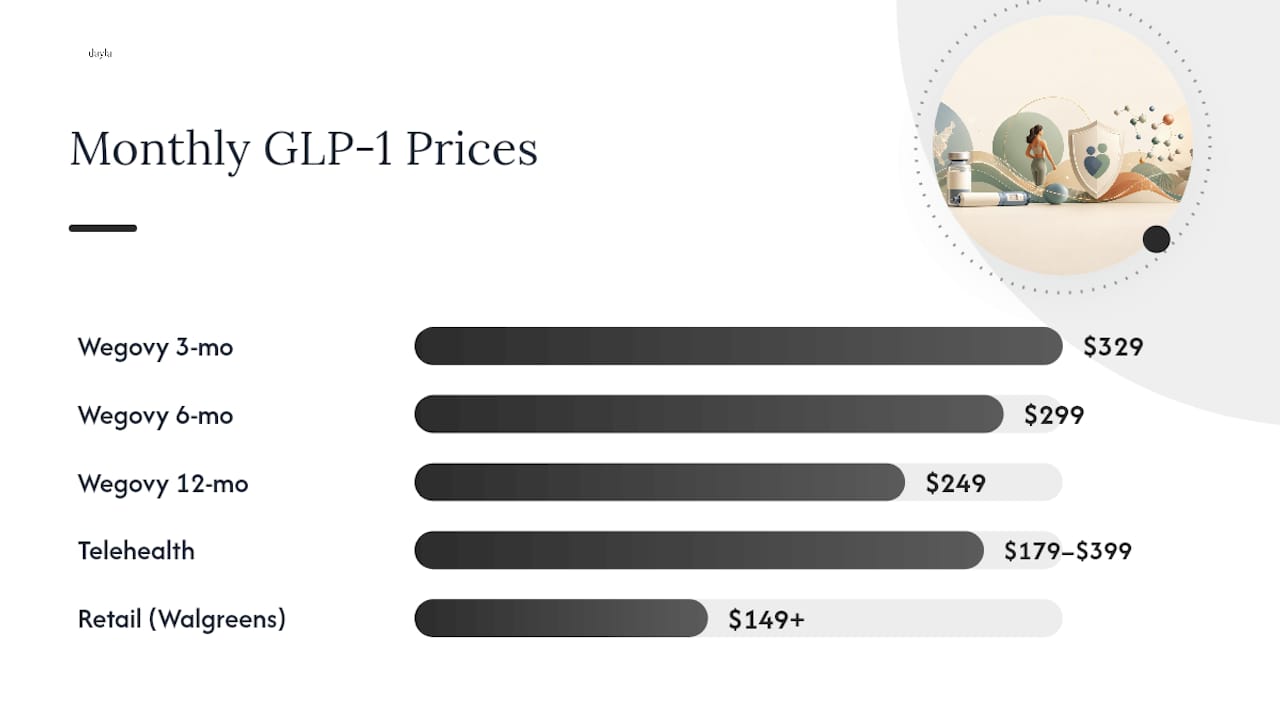
The retail or clinic visit model separates the two costs entirely. You pay a visit fee, then pay for medication separately, often with a manufacturer savings card applied at the pharmacy counter. Walgreens, for example, lists a $49 per-visit fee with GLP-1s starting at $149 a month, medication priced on its own. This structure suits people who already have insurance covering part of the medication cost and just need the clinical visit piece handled quickly.
Here's how the trade-offs break down in practice:
- Manufacturer subscriptions reward commitment with lower pricing but require enrollment through approved partners and a multi-month lock-in.
- Telehealth subscriptions offer the most bundled convenience, often the fastest start, but pricing transparency depends entirely on the provider.
- Retail/clinic visits keep clinical and medication costs separate, which works well if insurance already covers part of the drug cost.
- Compounded medication typically costs less than brand-name product but shifts the value proposition toward the pharmacy's legitimacy and quality assurance.
The real decision isn't "which is cheapest on paper." It's which structure matches how confident you are that you'll tolerate the medication, because backing out of a 12-month commitment costs more than starting month-to-month ever will.
How Much Does a GLP-1 Subscription Cost?
Sticker prices on GLP-1 subscription pages rarely tell the whole story. The advertised number usually reflects the medication tier, not the full bill you'll actually see.
Start with the manufacturer program. Novo Nordisk's subscription for injectable Wegovy runs three tiers: a 3-month commitment at $329 a month, a 6-month tier at $299 a month, and a 12-month commitment dropping to $249 a month, with total annual savings up to $1,200. The pill form of Wegovy carries its own separate tier pricing under the same program structure.
Telehealth compounded subscriptions land in a wider range, typically $179 to $399 a month depending on the provider, the compounded dose, and whether clinician follow-up visits are bundled or billed as extras. Retail options like Walgreens start lower on the visit side, with a $49 clinical fee and medication beginning around $149 a month before any manufacturer savings card discount.
| Wegovy subscription tier | Monthly price | Commitment | Reported annual savings |
|---|---|---|---|
| 3-month | $329 | 3 months | Baseline |
| 6-month | $299 | 6 months | Moderate |
| 12-month | $249 | 12 months | Up to $1,200 |
The line items that actually move your total bill: medication dose (higher maintenance doses often cost more than starter doses), whether the clinician visit is bundled or itemized separately, a standalone membership or platform fee some telehealth providers layer on top of the medication price, and shipping, which is usually included but occasionally an add-on for expedited delivery.
Pro Tip: Before you enroll, ask directly whether dose increases trigger a price change and whether follow-up clinician visits during titration are covered by your monthly fee or billed as separate appointments. Providers rarely volunteer this detail upfront, and it's the single biggest source of subscription bill shock.
If you're building out a monthly budget for treatment, our out-of-pocket GLP-1 cost guide walks through common cost scenarios in more depth, and our budget planning guide breaks down how to plan for a full year of treatment rather than just the first month.
What Is the Medicare GLP-1 Bridge Program?
Medicare's temporary GLP-1 Bridge program starts July 1, 2026 and runs through December 31, 2027, giving eligible Part D beneficiaries access to select GLP-1 medications for a $50 monthly copayment that covers medication only.
That last part matters more than it sounds. The $50 copay applies to the drug itself, not to the clinician visits, lab work, or other healthcare services tied to your treatment. Those costs still run through your normal Part D and Medicare cost-sharing structure.
Medicare's coverage guidance names Foundayo, Wegovy, and Zepbound among the drugs included under the Bridge, though coverage details differ by formulation. Zepbound, for instance, carries pen-versus-vial restrictions that affect which version is covered under the program.
A few practical things worth knowing before you count on this program:
- The $50 copay does not count toward your Part D out-of-pocket spending threshold, so it won't help you reach catastrophic coverage faster.
- Prior authorization is typically required, meaning your prescriber has to document medical necessity before the pharmacy can process the discounted price.
- Coverage is tied to specific formulations of each drug, not a blanket approval across every dose and delivery method.
- The program has a hard end date of December 31, 2027, so it is not a permanent pricing fix.
If you're on Medicare and think you might qualify, the fastest path is a direct conversation with your prescriber about prior authorization, or a call to 1-800-MEDICARE to confirm your plan's specific coverage. A partner walkthrough of the Bridge program covers the enrollment logistics in more detail if you want a second explanation of how the timeline works.
How Do You Choose the Right GLP-1 Subscription?
Comparing subscription pages side by side gets confusing fast because every provider frames pricing differently. A short checklist cuts through most of it.
- Confirm the medication type. Is it brand-name Wegovy or Zepbound, or a compounded version? Both are legitimate paths, but they carry different regulatory status and different price points.
- Ask how often you'll see a clinician. A subscription with no real clinical touchpoint beyond the initial intake is a red flag, not a convenience feature.
- Get the pharmacy name in writing. A legitimate provider will tell you exactly which pharmacy fulfills your prescription without hesitation.
- Ask what a dose change costs. Some plans absorb dose increases into the flat monthly fee; others bill titration changes as new charges.
- Read the cancellation policy before you enroll, not after your first bad experience. Month-to-month flexibility versus multi-month lock-in should be clear from day one.
- Check whether shipping and refill cadence are guaranteed or dependent on manual reordering each month.
Watch for these red flags specifically: no licensed clinician review before prescribing, a pharmacy that won't name itself, vague "starting at" pricing with no full-cost breakdown, and surprise charges that appear only after your card is already on file. Chameleon Health Care's overview of GLP-1 eligibility requirements is a useful reference if you want to understand how providers typically screen candidates before approval.
Pro Tip: Ask every provider one direct question: "If my dose changes, does my subscription price change, and how much notice will I get?" The answer tells you more about the provider's honesty than anything on their pricing page.
For a side-by-side look at how different program structures stack up on cost, the GLP-1 program cost comparison guide breaks down the math across subscription types in more detail than a single checklist can.
What Happens During Titration on a Subscription?
Titration is the gradual, scheduled increase in your GLP-1 dose, and it exists specifically to reduce side effects like nausea and gastrointestinal discomfort. FDA labeling sets the standard escalation schedule for each medication, and a good subscription should be built around that schedule, not around a fixed shipping calendar that ignores it.
Patients often have more flexibility than they realize. If a dose increase brings on intolerable side effects, many patients can request to remain at a lower dose longer rather than pushing forward on schedule. A subscription worth paying for should make that adjustment easy, not something you have to fight for through a support ticket queue.
What a titration-friendly subscription should include:
- Fast clinician access when side effects appear, not a multi-day wait for a callback.
- Clear rules on how dose changes affect your shipment and your bill.
- The option to pause or slow escalation without losing your place in the program.
- Documentation of each dose decision, so your care history travels with you if you switch providers.
Clinical overviews from sources like Harvard Health describe nausea, constipation, and fatigue as the most commonly reported early side effects, usually easing as the body adjusts to each new dose level. This is also where month-to-month flexibility earns its price premium: locking into a 12-month manufacturer subscription before you know how your body handles titration can turn a good deal into an inconvenient one if you need to pause treatment or switch medications early. Before you start, a baseline check-in with your clinician, a plan for managing early side effects, and clear knowledge of when to call for help all matter more than the subscription price tag itself.
Daylahealth's Subscription: What's Included and Who It Fits
Daylahealth's compounded GLP-1 weight care subscription is built around the exact checklist above: no insurance requirement, transparent bundling, and real clinical support through the titration process that actually matters most in the first few months.
Here's what's bundled into a single monthly membership: a clinician evaluation before your first prescription, medication options including compounded GLP-1 formulations, dietitian consults, ongoing care coaching, nationwide shipping, and a refill cadence built around your titration schedule rather than a rigid calendar. You're not paying separately for a visit fee, then separately for medication, then separately for follow-up access. It's one price, one relationship, one care team that already knows your dose history.
This fits best if you're paying cash, don't have insurance coverage for GLP-1s, and want bundled clinical oversight instead of piecing together a clinic visit here and a pharmacy order there. If that's your situation, the GLP-1 product page walks through current options and dosing paths, and enrollment starts with a short online intake before clinician review.
What Should You Expect in Your First 90 Days on a Subscription?
The first two weeks are almost always about tolerance, not results. Mild nausea and appetite changes show up early, often easing by week three or four as the starting dose becomes routine.
By weeks four through eight, most people move through their first dose increase. This is the window where subscription flexibility earns its keep. If side effects spike after an increase, you want a clinician you can reach that week, not a queue that takes ten days to answer.
Weight change becomes noticeable for most people somewhere between week six and week twelve, though the pace varies by starting dose and individual response. This is also the point where people reassess. If the subscription's clinical support has felt thin, or the medication cost has crept up in ways the plan didn't disclose upfront, month 3 is when most people either recommit or switch paths.
Pro Tip: Keep a simple weekly log of weight, side effects, and how you're feeling about the plan itself. Bring it to every clinician check-in. Our guide to tracking GLP-1 progress has a simple template if you want more structure than a notes app.
— Flexible
Where This Information Comes From
The pricing and program details in this guide come directly from primary sources, not secondhand summaries. The CMS press release on the Medicare GLP-1 Bridge program and Medicare's own weight-loss drug coverage page lay out eligibility, copay, and prior authorization rules directly. Wegovy subscription tier pricing comes from Novo Nordisk's official program announcement, and retail pricing examples come from Walgreens' virtual weight management program.
For dosing and safety specifics, FDA product labeling remains the authoritative reference, alongside clinical overviews like Harvard Health's summary of GLP-1 side effects. If you want a deeper look at Daylahealth's own approach to bundled subscription care, the weight care landing page outlines current enrollment steps and clinical oversight in full.
This article is general information, not a substitute for advice from a qualified doctor. Consult a qualified healthcare professional about your own circumstances before acting on anything here.
Sources
- Coming soon: CMS to provide $50 monthly access to GLP-1 medications for Medicare beneficiaries
- Medicare coverage: weight-loss drugs
- Novo Nordisk launches first and only multi-month subscription program for FDA-approved Wegovy® offering savings of up to $1,200/year
- GLP-1s for Weight Loss - Online Treatment | Walgreens Weight Management