
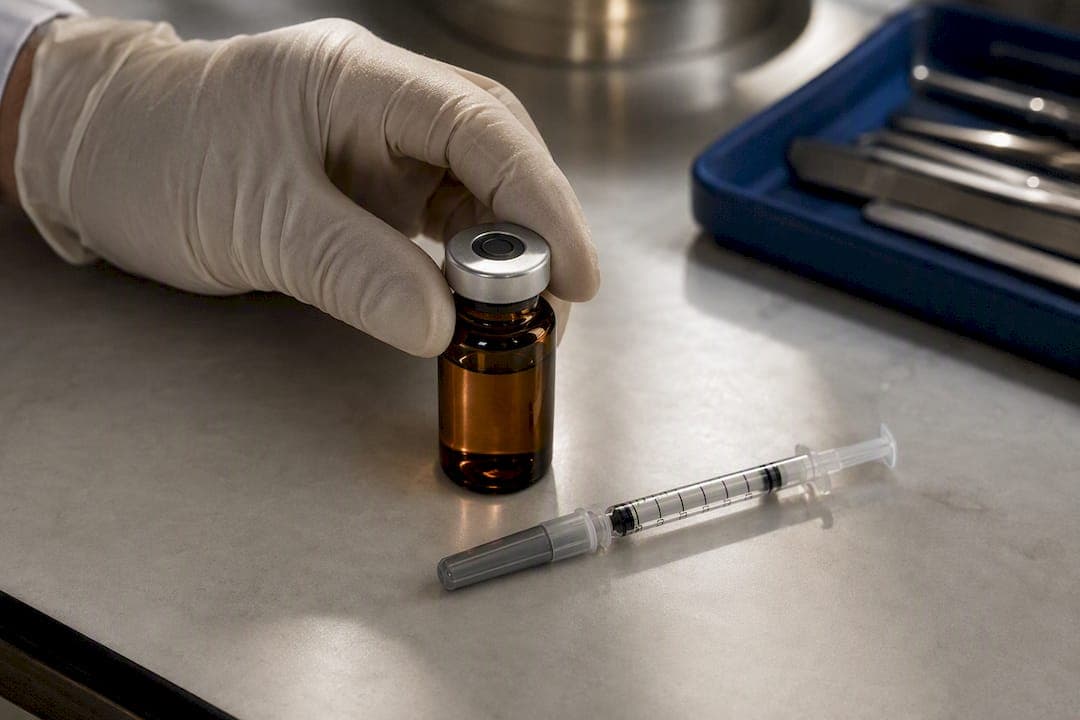
Adding B12 to a GLP-1 injection generally does not increase weight loss for people with normal B12 levels. It only helps with fatigue or nerve symptoms when a true deficiency exists. Most compounded formulas mix in a high dose of B12 per weekly dose, far above the daily requirement, but that extra volume doesn't translate into a metabolic edge for most patients.
TL;DR:
- Adding B12 to a GLP-1 injection offers no weight loss benefits unless there's a confirmed deficiency, and most formula doses significantly exceed daily requirements without extra metabolic effect.
- B12's biological functions are unrelated to GLP-1 mechanisms, and no scientific evidence indicates B12 improves GLP-1 side effects or accelerates fat loss in non-deficient individuals.
- Deficiency correction through B12 is beneficial for at-risk groups but does not support marketing claims of enhanced weight loss or energy for people with normal B12 levels.
- Compounded B12 injections are much pricier than oral supplements, which are effective and safer for most low B12 levels, with high-dose oral B12 matching injections in efficacy.
- Proper testing and clinical evaluation are essential before adding B12 to treatment, avoiding automatic or broad-based supplementation without documented deficiency or medical justification.
Table of Contents
- What Is a GLP-1 Plus B12 Formulation?
- Why B12's Biology Doesn't Boost GLP-1 Weight Loss
- When B12 Actually Helps (and When It Doesn't)
- What Compounding Adds in Cost and Risk
- How Much B12 Is in These Compounds, and How to Test First
- What FDA Compounding Rules Mean for You
- How Dayla Health Approaches B12 and GLP-1 Care
- A Quick Checklist Before You Say Yes to Added B12
- Start Clinician-Guided GLP-1 Care With Dayla Health
- Sources
- FAQ
What Is a GLP-1 Plus B12 Formulation?
A "GLP-1 plus B12" product is a compounded injection that blends semaglutide or tirzepatide with a form of vitamin B12, usually cyanocobalamin or methylcobalamin. Compounding pharmacies build these blends by request, often marketed as an energy-boosting or nausea-easing upgrade to the standard prescription.
Cyanocobalamin shows up most often because it holds up better in solution than methylcobalamin, making it easier to store and ship without breaking down. That's a manufacturing convenience, not a clinical advantage.
Here's what vendors typically claim versus what the evidence actually supports:
- Vendor claim: B12 reduces GLP-1-related nausea and fatigue for everyone.
- Reality: No controlled trials show B12 addition reduces GLP-1 side effects in people who aren't deficient.
- Vendor claim: The combination speeds up fat loss.
- Reality: Weight-loss trial data comes from semaglutide or tirzepatide alone, not from B12-added versions.
- Vendor claim: More B12 means more energy, always.
- Reality: Extra B12 only restores energy when a deficiency was causing the fatigue in the first place.
Why B12's Biology Doesn't Boost GLP-1 Weight Loss
GLP-1 drugs work by slowing gastric emptying, suppressing appetite through receptors in the brain, and improving insulin response, the same mechanism behind how GLP-1 helps with diabetes management. None of that pathway touches vitamin metabolism.
B12 plays a completely different role in the body. It supports red blood cell formation and nerve function, and its absorption depends on stomach acid and a protein called intrinsic factor pulling it out of food in the small intestine. Semaglutide and tirzepatide do slow gastric emptying and reduce acid production, which in theory could make dietary B12 slightly harder to absorb over time, according to Healthline's review of the combination. But documented B12 deficiency from GLP-1 use alone is uncommon, and when it happens, it's usually tied to reduced food intake rather than a direct drug interaction.
Put simply: one mechanism suppresses appetite and slows digestion, and the other repairs blood cells and nerves. There's no biological bridge between the two that would make injectable B12 accelerate fat loss. Marketing copy sometimes implies otherwise, but the pathways just don't intersect that way.

When B12 Actually Helps (and When It Doesn't)
No published trial has tested whether adding B12 to semaglutide or tirzepatide produces more weight loss than the GLP-1 drug alone, according to a review from Middleway Nutrition. Weight-loss benchmarks used in advertising almost always come from trials of the GLP-1 medication by itself.
Who's actually at risk of low B12? Vegans and vegetarians, adults over 60, long-term metformin users, people on proton pump inhibitors for reflux, and post-bariatric surgery patients all face a higher chance of deficiency, independent of whether they're on a GLP-1.
Where B12 earns its place is correcting an existing shortfall. Deficiency causes fatigue, brain fog, tingling in the hands and feet, and in advanced cases, irreversible nerve damage. If someone falls into one of the at-risk groups above, replacing B12 can genuinely restore energy, but that benefit belongs to the deficiency correction, not the GLP-1 itself.
- Correcting confirmed deficiency: real, well-documented benefit.
- Boosting weight loss beyond what the GLP-1 already does: no supporting trial evidence.
- General "everyone feels more energetic" marketing claim: unsupported for people with normal labs.
What Compounding Adds in Cost and Risk
B12 has a strong safety margin. It's water-soluble, so amounts beyond what the body needs are typically excreted rather than stored to dangerous levels. That's the good news.
The regulatory picture is messier. The FDA has issued alerts about compounded GLP-1 products, including dosing errors tied to compounding practices, and draws a clear line between individualized compounding for a documented clinical need and mass-market compounding aimed at broad sales. The latter draws more scrutiny because dosing consistency and sourcing controls vary widely between pharmacies.
Cost is the other issue worth weighing:
- Compounded GLP-1 plus B12 vials often carry a premium price over a standard GLP-1 prescription, for an ingredient that may do nothing if your B12 is already normal.
- A basic oral B12 supplement costs a few dollars a month and works just as well for most deficiencies.
- Targeted intramuscular B12 dosing, reserved for confirmed absorption disorders, delivers the same correction without paying for it in every single weekly vial.
Paying extra for an ingredient your body doesn't need isn't a safety risk. It's just money spent on nothing.
How Much B12 Is in These Compounds, and How to Test First
Typical compounded formulas load about 1,000 mcg of B12 into each weekly injection. The daily requirement for adults sits at just 2.4 mcg, which means one weekly shot delivers roughly 290 times a full day's need in a single dose.
The smarter first step is testing, not guessing. A baseline serum B12 level, paired with a methylmalonic acid (MMA) test when results land in a borderline zone, tells you whether supplementation is even necessary. Retesting at 6 to 12 months tracks whether levels hold steady on GLP-1 therapy.
| Option | Typical dose | Best for |
|---|---|---|
| Compounded weekly injection | a high-dose amount | Documented deficiency with absorption concerns |
| High-dose oral tablet | a high daily dose | Most confirmed deficiencies, per repletion research |
| Standard multivitamin | 2.4 mcg daily | Maintenance in low-risk individuals |
High-dose oral B12 works as well as injections for most people, making it the more cost-effective route unless an absorption disorder is confirmed.
What FDA Compounding Rules Mean for You
The FDA permits compounding pharmacies to create individualized medications when a licensed clinician documents a specific patient need, but that's different from a pharmacy mass-producing a GLP-1 plus B12 blend to sell broadly online. The agency's own compounding Q&A draws this distinction explicitly, and it matters for anyone shopping for these products.
Before ordering a compounded blend, a few checks protect you:
- Confirm the pharmacy is licensed and can name the specific clinical rationale for adding B12 to your prescription.
- Ask whether your dose was chosen based on your labs or applied as a default to every customer.
- Be cautious of any seller advertising the B12 addition as a universal upgrade rather than a targeted correction.
Individualized compounding, backed by documentation, is legitimate. A one-size-fits-all vial marketed to anyone buying a GLP-1 prescription is the version worth questioning.
How Dayla Health Approaches B12 and GLP-1 Care
Responsible GLP-1 care starts with data, not defaults. Before recommending any supplementation, Dayla Health's model reviews baseline labs and risk factors, things like diet pattern, age, and other medications, rather than adding B12 to every prescription automatically.
That review sits inside a broader care package:
- Clinician evaluation before treatment begins, with ongoing check-ins as doses adjust.
- Titration guidance so dose increases match how your body responds.
- Dietitian support to address nutrient intake alongside medication, which matters since diet quality on GLP-1 therapy affects natural B12 intake more than the drug itself does.
- Monitoring over time rather than a one-time prescription and no follow-up.
Pro Tip: If you're already taking a daily multivitamin with B12 and your last blood panel came back normal, a supraphysiologic weekly B12 injection is very likely just extra cost with no metabolic payoff, according to Cleveland Clinic's review of B12 shots.
A Quick Checklist Before You Say Yes to Added B12
Get baseline labs first unless you fall into a clear high-risk group. Favor oral B12 for routine correction. Save injectable B12 for confirmed deficiency, not as a default add-on.
Ask any provider or pharmacy why B12 was added to your specific prescription, what dose and form they use, and what quality controls govern their compounding process. If the answer is a generic sales pitch rather than a clinical reason tied to your labs, treat that as a signal to look elsewhere. A pharmacy that can't explain its own dosing rationale, or one operating with no verifiable license, deserves skepticism regardless of how polished the marketing looks.
— Flexible
Start Clinician-Guided GLP-1 Care With Dayla Health
Responsible GLP-1 care starts with data, not defaults: supplementation should be a decision based on lab results, not a default add-on in every vial. If you're weighing whether GLP-1 therapy makes sense and whether B12 supplementation applies to your situation, the process starts with an online intake and a clinician review, not a guess.

The path commonly involves completing an intake, evaluation by a clinician, and receiving a plan tailored to labs, health history, and goals, with dietitian support and coaching as part of care. Every recommendation, including whether B12 belongs in your regimen, gets tied to your actual numbers rather than a blanket policy. Explore Dayla Health's GLP-1 program or start with the compounded weight care intake to see what a personalized plan looks like for you.
Sources
For readers who want the primary references behind this article: the NIH B12 fact sheet covers dosing and safety in detail, the FDA compounding Q&A explains regulatory boundaries, and the STEP-1 semaglutide trial in the New England Journal of Medicine remains the benchmark study behind most GLP-1 weight-loss marketing claims.
This article is general information, not a substitute for advice from a qualified doctor. Consult a qualified healthcare professional about your own circumstances before acting on anything here.
- Vitamin B12 — Health Professional Fact Sheet (NIH Office of Dietary Supplements)
- High-dose oral vitamin B12 for repletion (PMC article)
- Can B12 shots boost energy or help you lose weight? (Cleveland Clinic Health Essentials)
FAQ
Can I Take B12 and a GLP-1 Together?
Yes, taking B12 alongside a GLP-1 medication is generally safe, since excess B12 is water-soluble and typically excreted rather than stored.
Why Is B12 Added to GLP-1 Injections?
Pharmacies add B12 mainly for stability in the compound and to market potential energy benefits, though no trials show it boosts weight loss beyond what the GLP-1 drug delivers alone.
What Happens to Your Weight When You Take B12?
B12 alone does not cause weight loss; it only improves energy and nerve symptoms in people who have a confirmed deficiency.
How Much B12 Do You Need While on a GLP-1?
The daily requirement is just 2.4 mcg, but compounded injections often contain about 1,000 mcg weekly. High-dose oral B12 (1,000 to 2,000 mcg daily) works as well as injections for most confirmed deficiencies.