
Yes. High-quality trials and recent meta-analyses show GLP-1 receptor agonists can resolve metabolic steatohepatitis (MASH) in many patients and improve fibrosis when paired with clinical oversight. The strongest results appear in people with obesity or type 2 diabetes. Nausea and mild GI symptoms are common, serious complications are not, and long-term fibrosis reversal still needs more research before anyone calls this a cure.
TL;DR:
- GLP-1 receptor agonists can triple the chance of resolving metabolic steatohepatitis and improve fibrosis stages, with benefits most evident in patients with obesity or diabetes.
- The drugs work by reducing appetite and increasing insulin sensitivity, which collectively decrease liver fat accumulation and fibrosis progression.
- Side effects are primarily gastrointestinal, like nausea, with serious complications remaining rare, but close monitoring is advised for advanced liver disease.
- Real-world studies report meaningful reductions in liver stiffness, but fat loss does not fully explain liver improvements, suggesting different tissue-level mechanisms.
- Long-term effects, including durability of fibrosis reversal and impact on liver failure or cancer, remain unconfirmed, requiring further extensive research.
Table of Contents
- What Does the Clinical Evidence Show for GLP-1 and Fatty Liver?
- How Do GLP-1 Receptor Agonists Actually Improve Liver Health?
- Who Benefits Most From GLP-1 Therapy for Fatty Liver?
- What Are the Safety Risks and Monitoring Needs?
- How Is GLP-1 Therapy Started, and What Results Should You Expect?
- What Questions Are Still Unanswered About GLP-1 and Liver Disease?
- Our Take on Where GLP-1 Fits in Fatty Liver Care
- How Daylahealth Supports Patients Considering GLP-1 for Liver Health
- Sources
What Does the Clinical Evidence Show for GLP-1 and Fatty Liver?
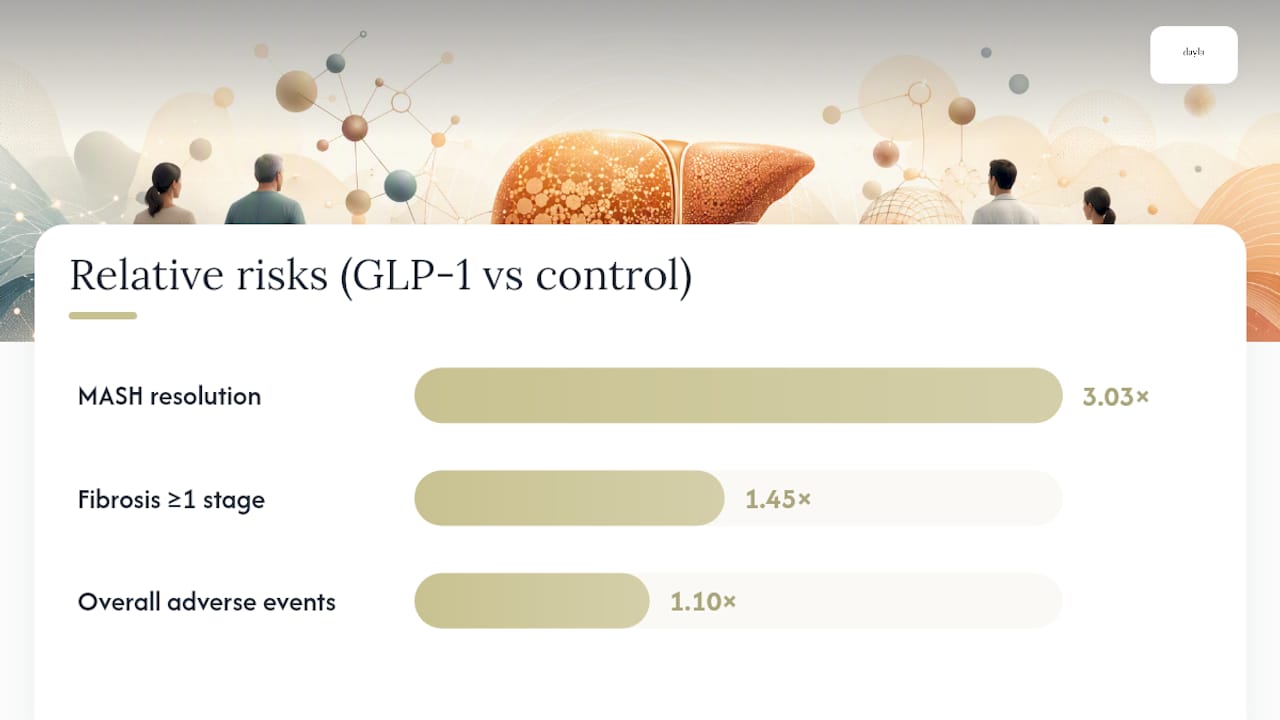
The headline numbers are hard to ignore. A systematic review and meta-analysis found that patients on GLP-1 receptor agonists were three times more likely to achieve MASH resolution than those on placebo or standard care, with a relative risk of 3.03 (p < 0.0001). Fibrosis improvement of at least one stage showed a relative risk of 1.45 (p < 0.00001). Both results cleared conventional statistical thresholds by a wide margin, which is not something you see often in liver disease research, a field usually stuck arguing over marginal effect sizes.
That said, precision matters here. Meta-analyses pool data from trials that differ in dose, duration, and patient mix, and the same review flagged meaningful heterogeneity across the included studies. A relative risk of 3.03 does not mean three out of every three patients get better. It means the odds shift substantially in your favor compared to doing nothing, which is a different (and more honest) way to think about it.
MASH resolution and fibrosis improvement, at a glance:
| Outcome measured | Relative risk | Statistical significance |
|---|---|---|
| MASH resolution | 3.03 | p < 0.0001 |
| Fibrosis improvement (≥1 stage) | 1.45 | p < 0.00001 |
| Overall adverse events | 1.10 | p < 0.00001 |
| Serious adverse events | No significant increase | p = 0.35 |
Statistic Callout: Patients on GLP-1 therapy in the pooled trial data were roughly three times more likely to see their MASH resolve than patients who did not receive it, according to the same meta-analysis.
Real-world data backs up what the controlled trials found, and in some ways adds nuance the randomized studies could not capture. A large semaglutide cohort study published in npj Gut and Liver tracked liver stiffness using elastography over time and found a median stiffness reduction of 0.38 kPa (p < 0.001). That is a meaningful chunk of people moving in the right direction on an objective, noninvasive test rather than a self-reported symptom score.
One detail from that same dataset deserves attention: the change in liver stiffness correlated poorly with the amount of weight a patient lost. Some people saw substantial elastography improvement without dramatic weight change, and vice versa. That pattern, also noted in coverage from Pharmacy Times, suggests the liver benefit may not be purely a byproduct of shedding pounds. Something else is happening at the tissue level, and researchers are still working out exactly what.
A few other patterns show up consistently across the literature:
- Phase 2 trials of semaglutide have shown MASH resolution without worsening fibrosis in a meaningful share of trial participants, according to a clinical review in PMC.
- Benefits cluster most reliably in people who also have obesity or type 2 diabetes.
- Data in people without diabetes remain comparatively thin, so effect sizes there carry wider uncertainty.
- Adverse event rates rose modestly (RR 1.10) but did not translate into more serious complications.
None of this reads as a guarantee. It reads as a genuinely encouraging signal, with real statistical weight behind it, for a disease that has had very few effective medical treatments until recently.
How Do GLP-1 Receptor Agonists Actually Improve Liver Health?
GLP-1 receptor agonists work on two fronts at once, and understanding both helps explain why the liver responds the way it does.
The first is central. These drugs act on receptors in the brain that regulate appetite and satiety, which is why patients report eating less and feeling full sooner. That shift in eating behavior reduces overall caloric intake, and for many patients it also curbs alcohol cravings, an underappreciated side effect that matters for anyone whose liver is already under metabolic strain.
The second front is peripheral, and it is where things get more interesting for liver-specific outcomes. GLP-1 receptor agonists appear to improve insulin sensitivity throughout the body, which reduces the pressure on the liver to store excess fat. A Frontiers review on GLP-1 mechanisms describes activity along several molecular pathways: activation of AMPK (a cellular energy sensor that promotes fat burning), upregulation of PPARα (which supports fatty acid oxidation), and suppression of SREBP-1c, a protein that drives new fat production inside liver cells. Together, these shifts push the liver away from fat accumulation and toward fat clearance.
Here is where the evidence gets murkier, and honestly, more interesting. It is still not fully settled whether GLP-1 receptor agonists act directly on hepatocytes (liver cells) or whether the liver benefit is mostly downstream of improved insulin sensitivity and reduced inflammatory markers elsewhere in the body. Some preclinical models point to direct hepatic signaling. Others suggest the liver is simply responding to a calmer metabolic environment overall. Given the real-world finding that liver stiffness improvement doesn't track tightly with weight loss, a purely systemic explanation may not be the whole story.
What's clear across both models:
- Appetite suppression reduces the raw material (excess calories) available for fat storage in the liver.
- Improved insulin sensitivity lowers de novo lipogenesis, the process by which the liver manufactures new fat from carbohydrates.
- Anti-inflammatory signaling appears to dampen the immune activity that drives fibrosis progression.
- Increased fatty acid oxidation helps the liver burn existing fat stores rather than accumulate more.
The clinical endpoints (MASH resolution, fibrosis staging) are the visible result of these pathways working in combination. The mechanism research is still catching up to the outcome data, which is a common pattern in drug development: you see that something works before you fully understand why.
Who Benefits Most From GLP-1 Therapy for Fatty Liver?
Not every patient with fatty liver disease is an equally good candidate, and the data are fairly specific about who tends to respond best.
Strongest candidates are patients with MASH or NASH who also have obesity or type 2 diabetes. This group shows up repeatedly across trials and real-world cohorts as the population where GLP-1 receptor agonists produce the most consistent liver benefit, a pattern confirmed in the PMC clinical review on GLP-1 and NAFLD. Interestingly, some of the largest absolute improvements in liver stiffness show up in patients who started with more advanced disease, meaning higher baseline fibrosis or stiffness scores. That does not mean advanced disease is a green light, though. It means those patients have more room to improve, and they also need closer specialist supervision while on therapy.
Less certain candidates are patients with fatty liver but without diabetes or significant obesity. The evidence here is thinner, not because the drugs necessarily work worse, but because fewer trials have enrolled enough non-diabetic patients to produce statistically confident results. This is a case where a plausible benefit exists but the data have not caught up yet. Shared decision-making with a clinician matters more here than in the higher-evidence group.
Patients who need hepatology involvement, not just a GLP-1 prescription:
- Anyone with advanced fibrosis or established cirrhosis.
- Patients with a history of portal hypertension or prior liver decompensation.
- Anyone with unexplained abnormal liver enzymes that haven't been fully worked up.
Contraindications and flags that rule out or complicate GLP-1 use:
- Pregnancy.
- A personal or family history of medullary thyroid carcinoma or multiple endocrine neoplasia syndrome type 2 (MEN2).
- Significant renal impairment, which changes dosing and monitoring needs.
Pro Tip: If your fibrosis stage is already advanced, ask your clinician whether a hepatologist should be part of your care team before starting GLP-1 therapy, not after. Baseline elastography or MRI-PDFF gives you a number to measure future progress against, and you'll want that number on record before treatment begins.
Patients managing weight alongside liver concerns often benefit from combining medication with targeted visceral fat reduction strategies, since visceral fat is more metabolically active and more closely tied to liver fat than fat stored elsewhere on the body.
What Are the Safety Risks and Monitoring Needs?
The most common side effects are gastrointestinal, and most patients who discontinue treatment do so because of nausea, vomiting, or general GI discomfort rather than anything more serious. The systematic review quantified this precisely: overall adverse events carried a relative risk of 1.10 compared to control groups, a modest but statistically real increase (p < 0.00001). Critically, that same review found no significant increase in serious adverse events (p = 0.35), which is the number that matters most for anyone worried about long-term safety.
That reassurance comes with caveats. Patients with advanced liver disease, particularly those with cirrhosis or a history of decompensation, need closer supervision because their margin for tolerating any medication side effect is thinner. Rare pancreatitis has been reported with GLP-1 therapy across broader use, and while it is not common, it is worth knowing the symptoms (persistent severe abdominal pain, often radiating to the back).
Drug interactions clinicians watch for:
- Insulin and sulfonylureas often need dose reductions when GLP-1 therapy starts, since the combination raises hypoglycemia risk.
- Oral medications that depend on stomach emptying speed may absorb differently, since GLP-1 receptor agonists slow gastric emptying.
- Other weight-loss or metabolic medications should be reviewed for overlapping mechanisms before combining.
A practical monitoring checklist:
- Baseline liver function tests (ALT, AST) before starting, then periodic rechecks.
- HbA1c tracking, especially in patients with diabetes or prediabetes.
- Renal function panels, since dosing considerations shift with kidney impairment.
- Elastography or MRI-PDFF where accessible, to track fibrosis and fat content objectively rather than relying on symptoms alone.
- Ongoing symptom check-ins for GI tolerance and any signs of pancreatitis.
None of this requires a hospital-level workup. It requires a clinician who checks in regularly and takes lab trends seriously rather than treating GLP-1 therapy as a start-it-and-forget-it prescription.
How Is GLP-1 Therapy Started, and What Results Should You Expect?
Dose escalation is the standard playbook, and it exists for a reason: starting at full dose dramatically increases GI side effects without improving outcomes. Semaglutide trials and real-world protocols typically begin at a low dose and increase gradually over weeks, giving the body time to adjust.
Here's a realistic sequence of what tends to happen, based on trial data and real-world cohort tracking:
- Weeks 1 to 4: Dose escalation begins. Appetite changes and mild GI symptoms are the most noticeable effects; liver enzymes have not meaningfully shifted yet.
- Weeks 4 to 12: Weight loss becomes measurable, and many patients see early improvement in ALT and AST on lab work.
- Months 3 to 6: This is where noninvasive liver markers start to move. Some patients hit the elastography benchmark researchers increasingly treat as clinically meaningful: a 20% or greater reduction in liver stiffness, achieved by roughly 40.8% of patients in the npj Gut and Liver cohort.
- Months 6 to 12 and beyond: Fibrosis stage changes, when they happen, tend to show up in this window. Histologic resolution of MASH on biopsy, the gold standard endpoint used in trials, generally requires this longer horizon to assess.
Statistic Callout: In real-world tracking, a meaningful share of patients on semaglutide moved down an entire fibrosis stage over the study period, according to longitudinal elastography data from a large patient cohort.
Dose matters, too. Real-world data show that patients who reach higher therapeutic doses of semaglutide tend to see better liver-related outcomes than those who stay at lower maintenance doses, though higher doses also come with a higher likelihood of GI side effects early on. It is a genuine tradeoff, not a simple "more is always better" equation.
Clinicians typically judge whether therapy is working by tracking a combination of signals rather than any single test: ALT and AST trend lines, MRI-PDFF where available to quantify liver fat directly, and elastography or FibroScan to track stiffness over repeated visits. If none of these show movement after six months at an adequate dose, that is usually the point to reassess the plan rather than simply waiting longer.
On the access side, it helps to understand the regulatory landscape. GLP-1 receptor agonists carry FDA approval for type 2 diabetes and, in several formulations, for chronic weight management. As the AASLD explains, use specifically for liver disease is still largely off-label, even though the trial evidence supporting that use keeps growing. This does not make the treatment experimental in a concerning sense. It means clinicians are prescribing based on strong emerging evidence for a condition that, until recently, had no approved pharmacologic treatment at all. Patients pursuing this route, whether through a primary care clinician, an endocrinologist, or a general GLP-1 treatment program, should expect an intake evaluation, a clinical decision about whether liver-focused GLP-1 use fits their case, and a monitoring plan that goes beyond a single prescription refill.
What Questions Are Still Unanswered About GLP-1 and Liver Disease?
Current evidence answers the short-term question convincingly: GLP-1 receptor agonists improve MASH resolution rates and fibrosis staging over trial durations, typically 12 to 18 months. What it does not yet answer is what happens over five, ten, or twenty years.
The biggest open questions:
- Does fibrosis improvement hold up long-term, or reverse once treatment stops? Most trials run well under two years; nobody has published multidecade fibrosis regression data yet.
- Does GLP-1 therapy actually reduce hard clinical endpoints like liver decompensation, hepatocellular carcinoma (HCC), or liver-related mortality? Surrogate markers like elastography and biopsy staging are useful proxies, but they are not the same as proof of fewer real-world liver failures.
- Is the hepatic benefit driven by direct receptor activity on liver cells, or is it entirely downstream of systemic metabolic improvement? The mechanism research described earlier has not settled this, and the answer matters for designing more targeted future drugs.
- How well do these drugs work in people without diabetes or obesity? Current trial populations skew heavily toward those with metabolic comorbidities, leaving a real evidence gap for leaner MASH patients.
- How do GLP-1 receptor agonists compare against newer dual and triple agonists that combine GLP-1 activity with GIP or glucagon receptor effects? Head-to-head trials are still limited.
Closing these gaps requires larger, more diverse randomized trials with standardized noninvasive endpoints, so results from one study can be compared cleanly against another. Until then, the current evidence supports genuine optimism, tempered by the honest acknowledgment that "improves markers over 18 months" and "prevents liver failure over 20 years" are two different claims, and only the first one is fully proven.
Our Take on Where GLP-1 Fits in Fatty Liver Care
The evidence here is some of the most encouraging we have seen for a disease that has resisted effective medical treatment for years. But GLP-1 therapy is not a replacement for the fundamentals: nutrition, activity, alcohol reduction, and metabolic monitoring still matter, and the strongest outcomes tend to show up when medication supports those changes rather than substitutes for them.
We think the honest framing is this: GLP-1 receptor agonists deserve serious consideration for patients with MASH plus obesity or diabetes, ideally guided by a clinician who tracks labs and elastography rather than symptoms alone. Some providers connect patients with clinician evaluation, prescription access, and dietitian support so GLP-1 therapy happens inside a monitored plan, not as a standalone purchase. For anyone with advanced fibrosis or cirrhosis, an in-person hepatology relationship should sit alongside any GLP-1 discussion, not behind it.
— Flexible
How Daylahealth Supports Patients Considering GLP-1 for Liver Health
Some online services give patients a direct path to clinician-evaluated GLP-1 care without navigating insurance approvals or long waits for specialist referrals to start the conversation.

That matters most for patients whose fatty liver diagnosis comes bundled with obesity or prediabetes, the exact profile the trial data show responding best. Through Daylahealth's GLP-1 program, you complete an online intake, get evaluated by a clinician, and receive a personalized plan that includes medication, dosing guidance, and ongoing care coaching. Dietitian support is built into the process, which matters given how much the mechanism data point to diet and metabolic improvement working alongside the medication itself, not instead of it.
This path suits patients whose fatty liver is caught early to moderately advanced and who want medical oversight without the friction of a traditional insurance-based system. If your fibrosis is already advanced or you have a history of liver decompensation, an in-person hepatology relationship should come first. Patients navigating Medicare coverage questions around GLP-1 access can also review this Part D bridge program breakdown for context on what's covered and what isn't.
If GLP-1 therapy looks like a fit based on what you've read here, the next step is simple: start the intake process and let a clinician confirm whether it's right for your specific case.
Sources
The clinical picture in this article draws primarily from three sources worth reading in full if you want the underlying data:
- The Effect of GLP-1 Agonists on Patients with Metabolic-Associated Steatotic Liver Disease: A Systematic Review and Meta-Analysis
- Semaglutide is associated with stiffness improvement and broad liver benefits with distinct dose- and weight-linked patterns | npj Gut and Liver
- Real-world semaglutide use linked to lower liver stiffness with benefits beyond weight loss
Bring any of these to your next appointment. A clinician who understands both your labs and this research can tell you far more about your specific case than any general guide can.
This article is general information, not a substitute for advice from a qualified doctor. Consult a qualified healthcare professional about your own circumstances before acting on anything here.