

Yes, adaptogens can be used alongside GLP-1 medications and clinician-prescribed peptides, but only under active clinician supervision with full medication reconciliation, clear timing rules, and a structured monitoring plan. This is not a general wellness question. It is a clinical one, and the answer depends entirely on which adaptogen, which medications, and what your current labs show.
Two rules apply before anything else:
- Avoid high-risk adaptogens (licorice, St. John's Wort, kava) if you take anticoagulants, immunosuppressants, oral contraceptives, or thyroid medications, until your prescriber has reviewed the combination.
- Use timing buffers around GLP-1 dosing. GLP-1 receptor agonists can slow gastric emptying substantially in the post-dose period, which shifts the peak concentration and timing of every oral compound you take.
Daylahealth's clinician-supervised GLP-1 and peptide programs build supplement reconciliation directly into the care model, so you are never navigating this alone.
Table of Contents
- How do GLP-1 medications and adaptogens interact in your body?
- Which adaptogens carry the most risk with GLP-1s and peptides?
- What are the practical timing rules on injection days?
- What labs and follow-up does your clinician need to order?
- How should you prepare for your prescriber visit?
- When should you stop an adaptogen immediately?
- Daylahealth brings clinician oversight to every step of your protocol
- Key Takeaways
- The case for supervised care is stronger than most patients realize
How do GLP-1 medications and adaptogens interact in your body?
The core risk with GLP-1 receptor agonists is physiological, not chemical. These medications reduce Cmax and delay tmax for many orally administered compounds. Overall drug exposure (AUC) is often unchanged, but the timing of peak concentrations shifts, and that matters for narrow-therapeutic-index drugs and time-sensitive supplements.
Four mechanisms drive most interactions:
- Delayed gastric emptying. An acute reduction of roughly 40–45% in gastric emptying rate changes when oral adaptogens reach peak absorption, which can reduce or delay their effective concentration window.
- Additive pharmacodynamic effects. Adaptogens like berberine and holy basil can lower blood glucose or blood pressure independently. Combined with GLP-1 agents, the additive effect can push those values outside a safe range.
- CYP enzyme induction or inhibition. St. John's Wort upregulates CYP3A4, accelerating clearance of statins, oral contraceptives, and certain antidepressants. Berberine inhibits CYP enzymes, which can raise plasma levels of co-administered drugs.
- Mineral absorption competition. Iron, zinc, and copper compete for the same intestinal transporters. High-dose zinc (above 40 mg per day) can block copper absorption, which is clinically relevant for patients using copper-dependent peptides like GHK-Cu.
Supporting your nutrient status during GLP-1 therapy also means accounting for reduced fat intake. GLP-1-induced appetite changes can reduce absorption of fat-soluble vitamins even when you are taking supplements consistently.
Which adaptogens carry the most risk with GLP-1s and peptides?
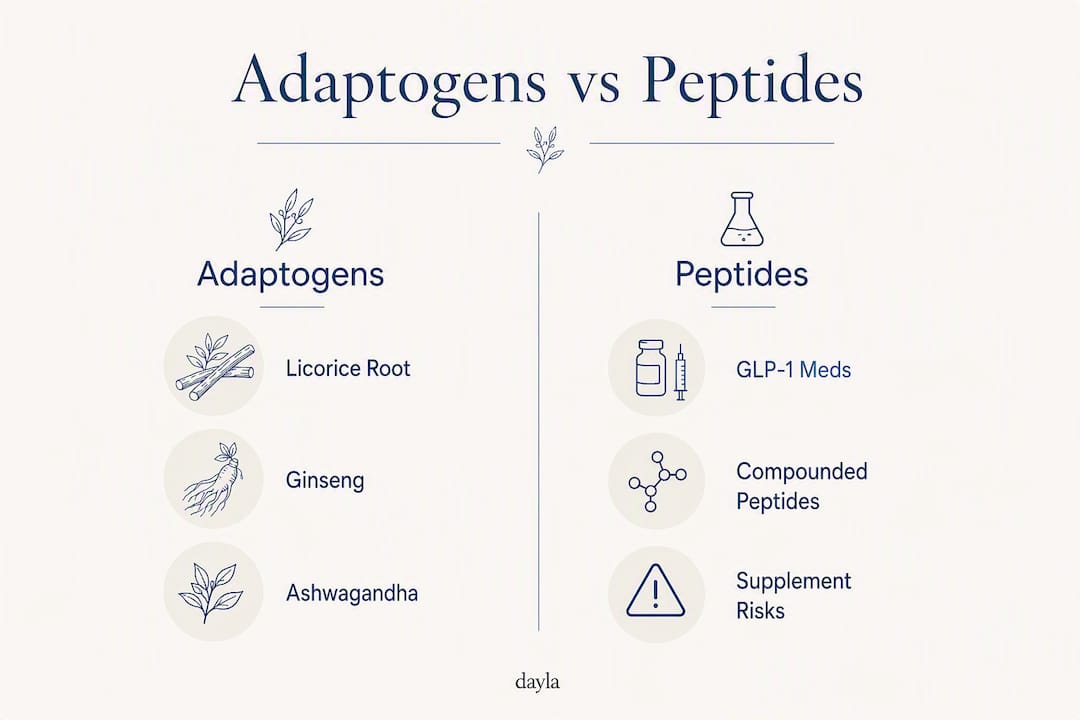
Adaptogens are not a monolithic category. Several have clear, documented interactions with the prescription classes most common in GLP-1 patients, including anticoagulants, thyroid hormone, antihypertensives, and immunosuppressants. Treating them as inert because they are "natural" is the most common clinical error.

| Adaptogen | Risk Level | Primary Clinical Concern |
|---|---|---|
| Licorice root | HIGH | Raises blood pressure, depletes potassium; dangerous with antihypertensives |
| St. John's Wort | HIGH | CYP3A4 induction; reduces efficacy of contraceptives, statins, antidepressants |
| Kava | HIGH | Hepatotoxicity risk; additive sedation with CNS-active medications |
| Panax / American ginseng | MODERATE | Alters INR; avoid with warfarin or anticoagulant therapy |
| Berberine | MODERATE | Additive glucose lowering with GLP-1s; CYP inhibition |
| Ashwagandha | MODERATE | Thyroid-stimulating effects; monitor if on levothyroxine |
| Holy basil | MODERATE | Mild glucose and BP effects; additive with antihypertensives |
| High-dose zinc (>40 mg/day) | MODERATE | Blocks copper absorption; relevant for GHK-Cu peptide users |
| Rhodiola rosea | LOW | Mild stimulant; generally tolerated but monitor BP |
| Eleuthero (Siberian ginseng) | LOW | Mild immunomodulation; caution in transplant patients |
Specific herb-by-medication interaction data confirms that licorice, ginseng, and ashwagandha each carry mechanism-based risks with common prescription classes, not just theoretical concerns.
Pro Tip: Do not start any HIGH-risk adaptogen without explicit prescriber clearance. Bring the product label, dose, and your current medication list to your next telehealth visit before adding it.
What are the practical timing rules on injection days?
Separate critical oral medications from your GLP-1 injection window. The goal is to protect peak absorption for drugs where timing matters, and to reduce the chance of additive pharmacodynamic effects from supplements taken too close to dosing.
- Thyroid medications (levothyroxine): Take 30–60 minutes before your GLP-1 injection, or at a completely separate time of day. Delayed gastric emptying can reduce levothyroxine absorption enough to affect thyroid control.
- Oral contraceptives and warfarin: Avoid co-administration within the injection window. Discuss alternate timing or non-oral options with your prescriber if absorption reliability is a concern.
- Berberine: Separate by 6–8 hours from your GLP-1 dose and monitor glucose closely during the first week of combination. Additive hypoglycemia is a real risk.
- Iron and zinc supplements: Separate from other minerals and medications by at least two hours. Take iron with a small amount of food if GI tolerance is an issue.
- Fat-soluble vitamins (A, D, E, K): Take with the meal that contains the most fat, since reduced fat intake on GLP-1s can otherwise limit absorption.
- Adaptogens (capsule or tincture form): As a general rule, take non-critical supplements at least two hours after your GLP-1 injection to allow the acute gastric emptying effect to subside.
For a broader look at managing side effects and supplement timing during dose escalation, the GLP-1 side effects management plan from Daylahealth covers the full protocol.
What labs and follow-up does your clinician need to order?
Monitoring should be individualized, but a standard framework covers the markers most likely to shift when adaptogens are added to a GLP-1 or peptide regimen. Routine supplement reconciliation integrated into clinical oversight, rather than relying on static safe/unsafe lists, is the standard of care in telehealth weight-loss programs.
| Lab or Vital | Baseline | Recheck Cadence | Flag for Follow-Up |
|---|---|---|---|
| Thyroid panel (TSH, free T4) | Yes | 6–12 weeks if on levothyroxine or ashwagandha | TSH outside reference range |
| CMP (electrolytes, kidney, liver) | Yes | 8–12 weeks | Potassium drop (licorice), elevated creatinine |
| LFTs (liver function) | Yes | 6–8 weeks if using kava or high-dose herbs | ALT/AST >2x upper limit |
| INR / PT | Yes (if on warfarin) | 2–4 weeks after any ginseng addition | INR outside therapeutic range |
| Fasting glucose / HbA1c | Yes | 8–12 weeks | Glucose trending low with berberine |
| Serum copper / zinc | If using GHK-Cu | 8–12 weeks | Copper below reference range |
Follow-up cadence to expect:
- Early check at 2–4 weeks after starting or changing any adaptogen or peptide dose.
- Metabolic labs at 6–12 weeks, timed around dose escalations.
- Telehealth check-ins at each escalation step to review symptoms and reconcile the supplement list.
For guidance on reading your peptide therapy results, Daylahealth's lab results interpretation guide explains what each marker means in the context of your protocol.
How should you prepare for your prescriber visit?
Arrive with a complete, current record. A clinician who has to reconstruct your supplement history during the appointment cannot give you a thorough reconciliation review. Preparation takes ten minutes and makes the visit significantly more productive.
Bring or have ready:
- Full prescription list with doses and timing (include insulin, anticoagulants, thyroid meds, contraceptives).
- All supplements with brand name, dose, and how long you have been taking each.
- Recent lab results or the dates of your last panel.
- A symptom log: dizziness, palpitations, lightheadedness, unusual fatigue, or GI changes.
- Pregnancy status or plans to conceive, if relevant.
A concise way to open the conversation with your clinician:
That framing gives your clinician everything needed to advise you in under two minutes.
When should you stop an adaptogen immediately?
Stop any adaptogen and contact your clinician the same day if you notice blood pressure changes (sudden spike or drop), heart palpitations or arrhythmia, signs of liver injury (yellowing skin or eyes, dark urine, upper-right abdominal pain), severe GI bleeding, or any symptom suggesting your contraceptive may be failing.
Do not combine adaptogens with GLP-1s or peptides without specialist clearance if any of the following apply:
- Pregnancy or active attempt to conceive. Many adaptogens lack adequate pregnancy safety data and should be avoided entirely.
- Current transplant immunosuppression. Several adaptogens have documented immunomodulatory effects that can interfere with anti-rejection medications.
- Unstable cardiovascular disease or uncontrolled hypertension.
- Uncontrolled thyroid disease.
- Active anticoagulation therapy with any herb known to alter INR.
If you experience a severe reaction, follow these steps in order:
- Stop the adaptogen immediately.
- Call your clinician or telehealth service and describe your symptoms.
- Get targeted labs (INR, CMP, thyroid panel) as instructed by your provider.
- Go to the emergency room for syncope, chest pain, severe bleeding, or signs of acute liver failure.
Daylahealth brings clinician oversight to every step of your protocol
Daylahealth's GLP-1 and peptide programs are built around exactly this kind of structured, supervised care. Supplement reconciliation, individualized timing guidance, and routine lab monitoring are part of the subscription model, not add-ons you have to request.
After completing an online intake, a clinician reviews your full medication and supplement list before prescribing. Personalized dosing and timing guidance is provided at the start, with scheduled telehealth check-ins at each dose escalation. Lab ordering support is available throughout, and your medication ships nationwide. If you want to add an adaptogen to your current protocol, that conversation happens with your Daylahealth clinician, not on your own. Start your intake at daylahealth.com to connect with a prescriber who manages this combination safely.
Key Takeaways
Adaptogens can be used selectively with GLP-1 medications and compounded peptides, but only under clinician supervision with clear timing rules, full medication reconciliation, and scheduled lab monitoring.
| Point | Details |
|---|---|
| GLP-1 slows gastric emptying | An acute reduction of roughly 40–45% shifts peak absorption timing for all oral compounds. |
| High-risk adaptogens need clearance | Licorice, St. John's Wort, and kava require prescriber review before use with any prescription medication. |
| Timing buffers protect you | Separate thyroid meds by 30–60 minutes from injection; keep berberine 6–8 hours away and monitor glucose. |
| Labs drive decisions | Baseline and periodic testing (thyroid panel, CMP, LFTs, INR) should be reviewed at 2–12 week intervals. |
| Daylahealth supervises the full protocol | Clinician evaluation, supplement reconciliation, and lab support are built into every GLP-1 and peptide subscription. |
The case for supervised care is stronger than most patients realize
The conventional framing around adaptogens tends to treat them as a low-stakes category, something you add or remove without much consequence. That framing does not hold when you are on a GLP-1 medication that is actively reshaping your gut physiology, or a compounded peptide that depends on precise absorption and metabolic clearance.
What practitioners who work in this space understand is that the risk is rarely dramatic. It is usually subtle: a thyroid value that drifts slightly out of range after ashwagandha is added, a blood pressure reading that climbs with licorice, a contraceptive that becomes less reliable because St. John's Wort is accelerating CYP3A4 clearance. None of these events announce themselves loudly. They show up in labs, in symptoms that seem unrelated, or not at all until something more serious occurs.
The supervised pathway does not eliminate complexity, following holistic PMS management best practices that emphasize multidisciplinary care and integrative approaches. It gives you a clinician who sees the full picture, orders the right labs at the right intervals, and adjusts the protocol when the data changes. For patients combining adaptogens with prescription GLP-1 therapy or clinician-prescribed peptides, that oversight is not a formality. It is the mechanism that makes the combination safe.
This article provides general clinical information and does not constitute medical advice. Confirm current supplement and medication guidance with your prescriber or a qualified healthcare professional before making any changes to your protocol.