

Ipamorelin is a synthetic pentapeptide that selectively activates the ghrelin/GHS-R1a receptor to stimulate pulsatile growth hormone release from the pituitary gland. It is not an exogenous hormone. It works by signaling your body to produce and release its own GH, which is a meaningful distinction from direct HGH replacement.
Quick takeaways:
- Primary uses: Lean muscle support, fat-loss assistance, recovery, sleep quality, and anti-aging protocols
- Key advantage: Cleaner hormonal profile than older GH-releasing peptides, with less impact on cortisol and prolactin
- Regulatory status: Not FDA-approved for general anti-aging or body-composition use; compounded product quality varies and carries real risk
- Bottom line: Ipamorelin is a research-stage peptide with promising pharmacology and limited long-term clinical outcome data; it requires medical supervision
Table of Contents
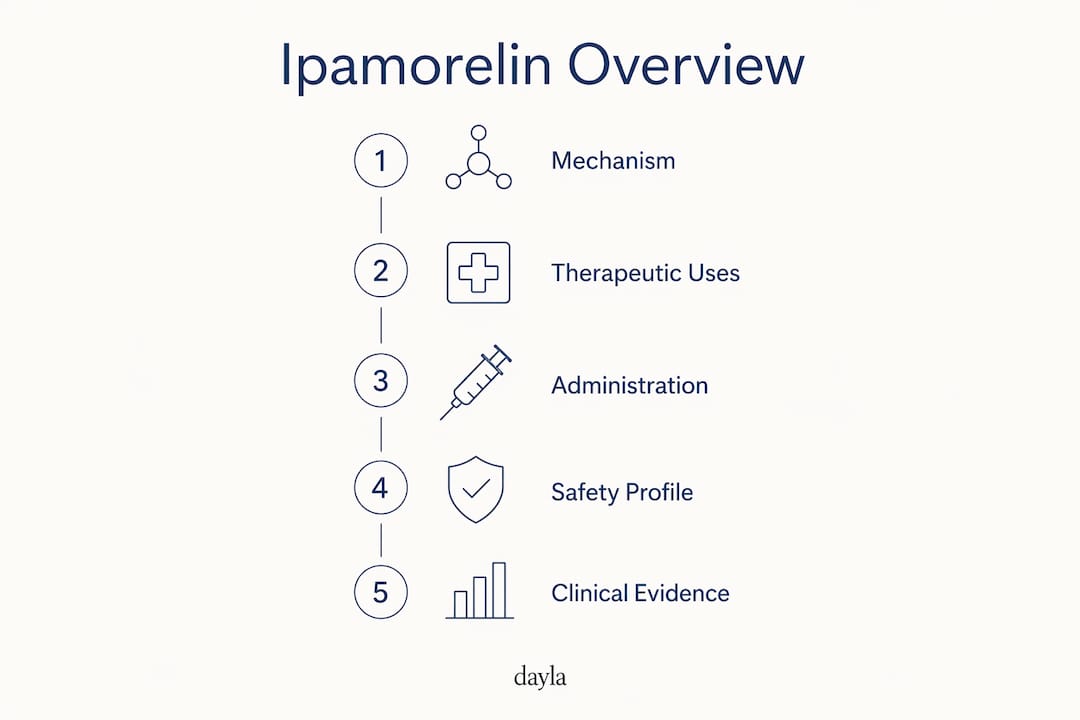
- How does ipamorelin work in the body?
- What are the main benefits and therapeutic uses of ipamorelin?
- How is ipamorelin prescribed and administered?
- What are the side effects, safety risks, and FDA status?
- Who is a good candidate, and what timeline should you expect?
- How does ipamorelin compare with Sermorelin, Tesamorelin, and GHRP-6?
- What does the clinical evidence actually show?
- Key Takeaways
- The case for patience and precision in peptide therapy
- Supervised peptide therapy, evaluated and shipped to you
- Useful sources for further reading
How does ipamorelin work in the body?
Ipamorelin acts as a growth hormone secretagogue, binding the ghrelin/GHS-R1a receptor in the pituitary and hypothalamus to trigger short, pulsatile bursts of endogenous GH. Those pulses then drive downstream IGF-1 production in the liver, which mediates most of the tissue-level effects: protein synthesis, lipolysis, and cellular repair.
Pulsatility matters. Continuous GH elevation, as seen with exogenous HGH, can desensitize receptors and suppress the pituitary's own output over time. Because ipamorelin triggers pulsatile release rather than flooding the system with a constant signal, it preserves more of the pituitary's natural feedback architecture.
Older GH-releasing peptides like GHRP-6 and GHRP-2 also bind the ghrelin receptor, but they tend to co-stimulate ACTH, cortisol, and prolactin alongside GH. Ipamorelin's selectivity for GH release, with minimal ACTH and cortisol stimulation, is what earned it the label "clean" in early pharmacology research. GHRH analogs like Sermorelin and CJC-1295 work through a different receptor entirely, the GHRH-R, and raise GH by amplifying pulse amplitude rather than mimicking ghrelin signaling. The two mechanisms are complementary, which is why combination protocols exist.
Originally developed by Novo Nordisk under the research code NNC 26-0161, ipamorelin advanced into Phase II clinical testing for postoperative ileus before its broader research applications attracted attention in the wellness and longevity space.
What are the main benefits and therapeutic uses of ipamorelin?
The most common clinical applications are lean muscle support, fat-loss assistance, recovery acceleration, improved sleep architecture, and general anti-aging protocols. Each comes with an important evidence caveat.
Lean muscle and body composition. Elevated GH and IGF-1 promote protein synthesis and reduce fat storage, particularly visceral fat. Short-term pharmacology studies confirm the GH rise reliably. What the evidence does not yet confirm is that this biochemical change translates into clinically meaningful strength or body-composition improvements without consistent resistance training and adequate protein intake.
Recovery and tissue repair. GH plays a documented role in collagen synthesis and musculoskeletal repair. Practitioners use ipamorelin in recovery-focused protocols, though controlled trial data specific to ipamorelin in injury recovery is limited. The mechanism is plausible; the clinical proof is still developing.

Sleep quality. GH secretion peaks during slow-wave sleep, and there is a bidirectional relationship: better GH pulsatility can support deeper sleep stages. Dosing ipamorelin before bed is a common clinical strategy for this reason.
Anti-aging and longevity. GH declines with age, and restoring more youthful pulsatile patterns is the conceptual basis for using secretagogues in longevity protocols. The peptide therapy evidence base for hard aging endpoints remains preliminary.
Meaningful outcomes across all these uses require pairing with resistance training, protein-rich nutrition, and consistent sleep. Ipamorelin creates favorable conditions; it does not substitute for the lifestyle inputs.
Pro Tip: Combining ipamorelin with a GHRH analog such as CJC-1295 can increase both pulse amplitude and duration through complementary receptor signaling. This dual-peptide approach is more effective in some protocols than a secretagogue alone, but it requires careful lab monitoring and should only be pursued under direct clinician supervision.
How is ipamorelin prescribed and administered?
Subcutaneous injection is the standard clinical delivery route for ipamorelin. Oral bioavailability for peptides of this class is poor without specialized formulations, so injection preserves the dose-dependent, pulsatile GH response that makes the therapy work. The peptide's approximate half-life of two hours means dosing frequency matters: single daily doses produce a single pulse, while split dosing can produce multiple smaller pulses across the day.
Typical clinical protocols follow a stepwise structure:
- Baseline evaluation. Clinician review, IGF-1, fasting glucose/HbA1c, comprehensive metabolic panel, and thyroid panel before the first dose.
- Starting dose. Clinicians commonly begin at the lower end of the therapeutic range starting at low microgram doses per injection, to assess individual response and tolerability.
- Frequency. One to three injections daily is the typical range, often timed around training sessions or before sleep to align with natural GH secretion patterns.
- Titration. Dose adjustments are made based on IGF-1 response, symptom tolerance, and follow-up labs, not on subjective "feel" alone.
- Reconstitution and storage. Lyophilized (freeze-dried) powder is reconstituted with bacteriostatic water, refrigerated after mixing, and used within the clinician-specified window. Unused reconstituted solution should not be kept beyond that window.
- Needle and disposal. Use a fresh insulin-gauge needle for each injection; dispose of sharps in a proper disposal container.
For readers interested in how peptide therapy protocols are structured more broadly, the monitoring and titration principles apply across most GH secretagogue regimens.
Pro Tip: Always begin under clinician titration with documented baseline labs. Repeat IGF-1 and fasting glucose at 4–8 weeks to confirm your response is within the therapeutic range before any dose increase.
What are the side effects, safety risks, and FDA status?
Ipamorelin is generally described as having a cleaner side-effect profile than older GHRPs, but "cleaner" does not mean risk-free, and safety data from long-term, large-scale human trials is limited.
Regulatory status: Ipamorelin is not FDA-approved for anti-aging, body composition, or general wellness use. It remains a research-stage compound. Compounded injectable peptides are not subject to the same manufacturing standards as FDA-approved drugs, meaning potency, sterility, and purity can vary between compounding pharmacies. This is a legitimate product-quality risk that every prospective patient should weigh carefully.
Common side effects include:
- Injection-site reactions: redness, mild swelling, or discomfort at the injection point
- Transient GH-related symptoms: water retention, mild joint aches, or tingling (paresthesia), particularly at higher doses
- Headache or lightheadedness, usually dose-dependent and transient
- Mild fatigue or nausea at initiation, often resolving within the first week
Potential serious concerns (limited/uncertain evidence):
- Glucose tolerance changes: GH elevation can reduce insulin sensitivity; monitoring fasting glucose and HbA1c is standard practice
- Theoretical cancer risk: GH and IGF-1 are growth signals, and elevated IGF-1 has been associated with certain cancer risks in epidemiological literature; the clinical significance for ipamorelin specifically is uncertain and should be discussed with a clinician
- Pituitary axis effects with long-term use remain understudied
Contraindications: Active malignancy or a history of hormone-sensitive cancers, pregnancy, breastfeeding, and uncontrolled diabetes are standard contraindications. Anyone with a personal or family history of pituitary tumors should consult an endocrinologist before considering any GH secretagogue.
Common peptide therapy misconceptions often understate these regulatory and quality-control realities. The clean hormonal profile is real, but it does not make ipamorelin a low-stakes supplement.
Who is a good candidate, and what timeline should you expect?
Suitable candidates are adults who are medically cleared after baseline labs and a thorough clinician evaluation, have specific goals (body composition, recovery, or longevity support), and are committed to the lifestyle inputs that make the therapy meaningful. Ipamorelin is not appropriate for pregnant or nursing individuals, anyone with active cancer or a history of hormone-sensitive malignancy, or those with uncontrolled metabolic conditions.
Baseline and monitoring labs to expect:
- IGF-1 (primary marker for GH axis activity)
- Fasting glucose and HbA1c (glucose tolerance monitoring)
- Comprehensive metabolic panel (CMP)
- Thyroid panel (TSH, free T3/T4)
- Repeat IGF-1 and fasting glucose at 4–8 weeks, then every 12 weeks while on therapy
Timeline for results:
GH and IGF-1 levels typically rise within days to a few weeks of starting therapy. Measurable body-composition or performance changes commonly take 8–12 weeks or longer when combined with consistent training and nutrition. Expecting visible results in two to three weeks is unrealistic; expecting meaningful changes at three to four months with full lifestyle compliance is reasonable.
Cost considerations vary widely and depend on clinician visit fees, lab testing costs, the compounding pharmacy used, and whether the service is structured as a subscription or per-prescription model. Cash-pay pricing is the norm since insurance does not cover off-label compounded peptides. Understanding the full cost structure before starting, including monitoring labs, is part of responsible candidate evaluation. Guidance on reading peptide therapy lab results can help you interpret what your numbers mean at each monitoring point.
How does ipamorelin compare with Sermorelin, Tesamorelin, and GHRP-6?
Ipamorelin occupies a specific position among GH-related peptides: selective ghrelin receptor agonist with a clean hormonal profile, research-stage regulatory status, and a well-characterized short half-life. The table below shows how it compares with three commonly discussed alternatives.
| Feature | Ipamorelin | Sermorelin | Tesamorelin | GHRP-6 |
|---|---|---|---|---|
| Primary mechanism / receptor | GHS-R1a agonist (ghrelin mimetic) | GHRH-R agonist | GHRH-R agonist (stabilized) | GHS-R1a agonist |
| Typical uses / best-for | Body composition, recovery, sleep, anti-aging | Anti-aging, mild GH support, pediatric GH deficiency | HIV-associated lipodystrophy (FDA-approved indication) | GH stimulation, appetite increase |
| Side-effect profile | Minimal cortisol/prolactin effect; injection-site reactions | Generally mild; antibody formation possible | Site reactions, fluid retention; approved-indication safety data available | Elevated cortisol, prolactin, and appetite stimulation |
| Administration & dosing | Subcutaneous injection, 100–300 mcg, 1–3x daily | Subcutaneous injection, typically once daily at night | Subcutaneous injection, once daily | Subcutaneous injection, multiple daily doses |
| Onset of effects | GH rise within hours; body-composition changes at 8–12+ weeks | Similar GH onset; body changes over weeks to months | Visceral fat reduction documented over 26 weeks in trials | Rapid GH pulse; appetite effects nearly immediate |
| Regulatory status | Research-stage; not FDA-approved for general use | Research-stage; not FDA-approved for general adult use | FDA-approved for HIV lipodystrophy; off-label use is research-stage | Research-stage; not FDA-approved |
Key distinctions in plain terms:
- Ipamorelin offers the cleanest hormonal profile among the GHRPs, with no meaningful cortisol or prolactin co-stimulation, making it the preferred starting point in many supervised protocols.
- Sermorelin works through a different receptor (GHRH-R) and is often used for milder GH support; its longer history in clinical practice gives some practitioners more comfort with it.
- Tesamorelin is the only peptide in this group with an FDA-approved indication, specifically for visceral fat reduction in HIV-associated lipodystrophy. That approval does not extend to general body-composition use.
- GHRP-6 is a first-generation ghrelin receptor agonist with a broader hormonal footprint, including appetite stimulation and cortisol elevation, which limits its appeal in most modern protocols.
What does the clinical evidence actually show?
Short-term pharmacology studies reliably demonstrate that ipamorelin stimulates GH release with high potency and selectivity. The landmark 1998 pharmacology paper established its selectivity for GH over ACTH and cortisol in animal models and early human testing. The NCI Drug Dictionary confirms its classification as a ghrelin mimetic with receptor distribution across brain and peripheral tissues.
What the evidence does not yet provide is high-quality, long-term data on clinical outcomes: strength gains, sustained body-composition changes, or hard longevity endpoints. Most available data comes from small trials, short follow-up periods, and observational reports rather than large randomized controlled trials.
| Evidence type | What it shows | Limitation |
|---|---|---|
| Animal pharmacology | High GH potency, minimal ACTH/cortisol stimulation | Animal-to-human translation not guaranteed |
| Early human pharmacology | Dose-dependent pulsatile GH release; ~2-hour half-life | Small samples, short duration |
| Phase II clinical trial (postoperative ileus) | Proof of concept for clinical use | Indication-specific; not body composition |
| Observational / clinical practice reports | GH and IGF-1 elevation; patient-reported recovery and sleep benefits | No controls, selection bias |
| Long-term outcomes (body composition, strength) | Data gap: not yet established in high-quality trials | Absence of evidence is not evidence of absence |
The practical takeaway: ipamorelin's pharmacology is well-characterized and its short-term safety profile is favorable relative to older GHRPs. The gap is in long-term, controlled outcome data. Treating it as a tool that supports favorable conditions for change, rather than a guaranteed result, is the evidence-consistent framing.
Key Takeaways
Ipamorelin is a selective ghrelin receptor agonist that stimulates pulsatile GH release with a cleaner hormonal profile than older GHRPs, but long-term clinical outcome data remains limited and medical supervision is required.
| Point | Details |
|---|---|
| Mechanism and selectivity | Ipamorelin binds GHS-R1a to trigger pulsatile GH release with minimal cortisol or prolactin co-stimulation. |
| Realistic timeline | GH/IGF-1 rises within days to weeks; body-composition changes typically require 8–12+ weeks with consistent training and nutrition. |
| Regulatory and quality risk | Not FDA-approved for general use; compounded injectable quality varies and requires a vetted, supervised source. |
| Monitoring is non-negotiable | Baseline IGF-1, fasting glucose/HbA1c, CMP, and thyroid panel are standard before starting; repeat labs at 4–8 weeks. |
| Daylahealth supervised access | Daylahealth provides clinician evaluation, baseline labs, compounded peptide prescribing, and ongoing oversight for qualified adults. |
The case for patience and precision in peptide therapy
The most common mistake people make with ipamorelin is treating it like a supplement with a fast feedback loop. It is not. The pharmacology is real, the GH pulse is measurable, and the downstream IGF-1 response is documented. But the distance between "my IGF-1 went up" and "I have meaningfully changed my body composition" is filled with training sessions, protein targets, and sleep hours, not just injections.
What I find underappreciated in most conversations about ipamorelin is the regulatory gap. The clean hormonal profile is genuinely appealing, and it is a real differentiator from GHRP-6. But that profile can create a false sense of safety, particularly when the product being injected comes from a compounding pharmacy with variable quality controls. The peptide itself may be well-characterized; the specific vial in someone's refrigerator may not be. That gap deserves more weight in the decision-making process than it typically gets.
The right candidate for ipamorelin is someone who has had a proper baseline workup, understands that 8–12 weeks is the minimum meaningful window, and is working with a clinician who will actually review their labs and adjust the protocol. The peptide is a tool. The supervision is what makes it a responsible one.
Supervised peptide therapy, evaluated and shipped to you
If you are considering ipamorelin or another growth-hormone peptide, the most important variable is not which peptide you choose. It is whether you have a clinician reviewing your labs, adjusting your protocol, and monitoring your response over time.

Daylahealth offers exactly that: a fully supervised growth hormone peptide program that includes a clinician evaluation, baseline lab review, compounded peptide prescribing where clinically appropriate, and ongoing care oversight, all shipped nationwide without an insurance requirement. You pay directly for a bundled package that covers the clinical work, not just the medication.
Eligibility requires completing an online intake and receiving clinician approval. Outcomes vary by individual and are not guaranteed. If you are ready to find out whether you qualify, start your intake at Daylahealth's peptide therapy page and get a personalized evaluation from a licensed clinician.
Useful sources for further reading
-
Ipamorelin, the first selective growth hormone secretagogue — PubMed (1998). The landmark pharmacology paper establishing ipamorelin's selectivity for GH release over ACTH and cortisol. Essential reading for understanding the original evidence base.
-
Definition of ipamorelin — NCI Drug Dictionary. Authoritative definitional entry from the National Cancer Institute describing ipamorelin as a ghrelin mimetic and its receptor distribution. Useful for verifying classification and terminology.
-
Ipamorelin: Mechanism, Benefits, Evidence & Safety — Peptide Treatments. A clinician-oriented review covering half-life, dosing context, development history, and the evidence gap in long-term outcomes. Useful for practitioners and evidence-seeking readers.
-
Ipamorelin Guide — Peptides Defined. Covers regulatory status, compounded-product quality concerns, and the distinction between a clean hormonal profile and confirmed safety. Useful for understanding the FDA and quality-control landscape.
-
Ipamorelin mechanism overview — Peptides Defined (blog). Explains the secretagogue-versus-hormone-replacement distinction and why pulsatile release matters for pituitary feedback. Recommended for readers who want a deeper mechanistic explanation.
-
Ipamorelin GHRP mechanism and clinical profile — Clinical Peptide. Covers combination protocols with GHRH analogs and the rationale for dual-peptide approaches. Useful for clinicians and patients considering combination therapy.
-
Hormones — MedlinePlus. A foundational reference from the U.S. National Library of Medicine on how peptide hormones function in the body. Useful background for readers new to the biology of growth hormone signaling.