
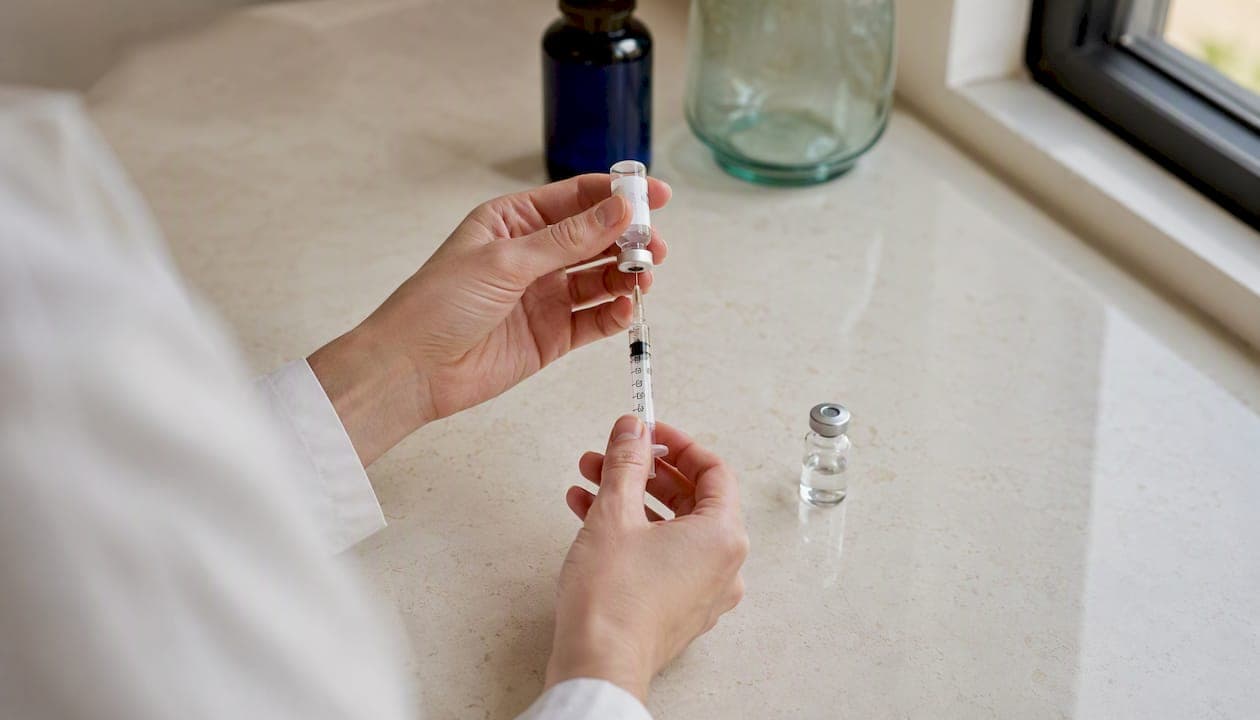
Clinicians in the U.S. most commonly prescribe five categories of compounded peptides for collagen and tissue repair: GHK-Cu (copper peptide), BPC-157, TB-500 (Thymosin Beta-4), growth hormone secretagogue stacks such as ipamorelin/CJC-1295, and longevity-oriented peptides including epitalon and MOTS-c. These are dispensed as injectable, microdose subcutaneous, or needle-free oral formulations through licensed 503A or 503B compounding pharmacies. The single most important caveat before you pursue any of them: compounding status for several of these peptides remains legally unsettled in 2026, and clinician prescription through a regulated pharmacy is not optional.
- GHK-Cu: Injectable or microdose subcutaneous; collagen synthesis and wound healing
- BPC-157: Injectable or oral microdose; soft tissue, GI, and musculoskeletal repair
- TB-500 (Thymosin Beta-4): Injectable; wound healing and tissue remodeling
- Ipamorelin/CJC-1295: Injectable; growth hormone stimulation supporting skin and repair
- Epitalon and MOTS-c: Injectable; longevity and cellular repair pathways
Key Takeaways
Clinician-prescribed compounded peptides for collagen and tissue repair require a licensed prescriber, a named 503A or 503B compounding pharmacy, and a structured monitoring plan before you begin.
| Five main peptide categories | GHK-Cu, BPC-157, TB-500, ipamorelin/CJC-1295, and epitalon/MOTS-c are the most commonly prescribed for collagen and tissue repair. | PCAC vote is nonbinding | July 2026 recommendations do not change compounding legality until formal FDA rulemaking follows. | | Injectable routes preferred | Subcutaneous injection provides more predictable exposure than oral formats for most compounded peptides. | | Verify pharmacy credentials | Confirm 503A/503B status, PCAB accreditation, and request a Certificate of Analysis before accepting any compounded injectable. | | Daylahealth's Vitalia GLP | Provides licensed prescriber visits, named pharmacy, CoA on request, and structured follow-up for collagen-focused peptide protocols. |
Table of Contents
- What this article covers and what it does not
- Which types of collagen-boosting peptides do clinicians prescribe?
- How delivery format affects what you experience
- What the evidence actually shows and where the risks are
- What is the current U.S. regulatory status for these peptides?
- How does a telehealth peptide subscription actually work?
- Questions to ask your clinician before starting peptide therapy
- How this guide was assembled
- A provider perspective on what patients can realistically expect
- Daylahealth's clinician-supervised peptide subscription
- Primary sources and further reading
- Sources
What this article covers and what it does not
This guide uses "types of collagen boosting peptides" to mean one thing specifically: compounded, clinician-prescribed peptide medications intended to support collagen production or tissue repair, dispensed as injectables, microdose subcutaneous, or needle-free oral formulations. It is written for U.S. adults pursuing clinician-supervised therapy through a telehealth subscription and paying cash.
This article does not cover topical cosmetic peptides, over-the-counter collagen supplements, or skincare actives such as palmitoyl tripeptide-5 or copper peptide serums. Those are a separate category with a separate audience. If a source or search result discusses OTC collagen powders or skincare peptides, it is describing a different product class entirely.
Which types of collagen-boosting peptides do clinicians prescribe?
The six peptide categories below represent the most frequently discussed options in U.S. telehealth compounding practice for collagen and tissue repair. Evidence strength varies considerably across them.
GHK-Cu (copper peptide)
GHK-Cu is a naturally occurring tripeptide that has shown activity in collagen synthesis and wound-healing pathways in preclinical and small human studies. Clinicians prescribe it primarily as a compounded injectable or microdose subcutaneous formulation. Topical versions exist in cosmetics, but compounded injectable GHK-Cu is a distinct clinical product. Evidence is largely preclinical; human trial data is limited. Monitoring focuses on local injection-site reactions and sterility of the compounded product. Daylahealth's injectable GHK-Cu peptide protocol follows this clinical pathway.

BPC-157 (Body Protection Compound)
BPC-157 is a synthetic peptide derived from a gastric protein. It is most often prescribed for soft tissue repair, musculoskeletal recovery, and GI healing. Delivery formats include subcutaneous injection and oral microdose capsules. Animal data is substantial; large human clinical trials are absent. The FDA's advisory committee voted in July 2026 to recommend BPC-157 for the 503A bulk drug substances list, though that recommendation is nonbinding. You can explore BPC-157 protocols through Daylahealth's supervised service.
TB-500 (Thymosin Beta-4)
TB-500 is a synthetic fragment of Thymosin Beta-4, prescribed for wound healing and tissue remodeling. It is administered by subcutaneous injection, typically on a weekly or twice-weekly schedule. Preclinical data supports its role in actin regulation and cell migration relevant to repair. Human data is sparse. PCAC also recommended TB-500 for the 503A list in July 2026, with the same nonbinding caveat.
Ipamorelin/CJC-1295 (GH secretagogue stack)
This combination stimulates endogenous growth hormone release, which indirectly supports collagen synthesis, skin quality, and tissue repair. It is one of the most commonly prescribed stacks in telehealth longevity and recovery protocols. Delivery is subcutaneous injection, typically nightly. Clinicians monitor IGF-1 levels to assess response and avoid supraphysiologic GH stimulation. See Daylahealth's growth hormone peptide page for protocol details.
Epitalon and MOTS-c
Epitalon is a tetrapeptide associated with telomere support and cellular aging pathways; MOTS-c is a mitochondrial-derived peptide linked to metabolic and cellular repair signaling. Both are prescribed by injection in longevity-oriented protocols. Human clinical data for both is limited. PCAC recommended both for the 503A list in July 2026. Daylahealth's longevity peptide protocols include these options under clinician supervision.
How delivery format affects what you experience
Injectable routes provide more predictable peptide exposure than oral formulations for most of these compounds. Subcutaneous injection bypasses first-pass metabolism, which matters for peptides that degrade rapidly in the GI tract. Oral and needle-free oral formats are available for some peptides (notably BPC-157 oral microdose), but bioavailability is less certain and dosing is adjusted accordingly.
Typical treatment timelines run 8–16 weeks for an initial protocol, with a clinician check-in at 4–6 weeks to assess response and adjust dosing. GH secretagogue stacks require IGF-1 testing at baseline and at the midpoint of therapy. Sterile compounding standards, specifically USP <797> for injectable preparations, are a non-negotiable safety requirement.
- Confirm your delivery format with your clinician before starting. Injectable protocols require training on sterile technique and proper sharps disposal.
- Ask about storage requirements. Most compounded peptide injectables require refrigeration; some require freezing.
- Request written administration instructions from the compounding pharmacy, not just verbal guidance.
- Understand the monitoring schedule before your first dose, including which labs are required and when.
Pro Tip: Ask your clinician specifically whether the compounding pharmacy uses USP <797>-compliant sterile manufacturing for any injectable peptide you are prescribed. This single standard is the clearest indicator of pharmaceutical-grade safety in a compounded injectable.
What the evidence actually shows and where the risks are
Most collagen-focused compounded peptides have limited or no large-scale human clinical trials supporting the wellness indications they are prescribed for. FDA reviewers flagged this gap explicitly during the July 2026 PCAC meetings. Interest in these peptides is driven by recovery and longevity goals, but the evidence base is predominantly animal studies and small, often uncontrolled human reports.
Known risks and monitoring priorities include:
- Local injection-site reactions: Redness, swelling, and nodule formation are the most common adverse events with subcutaneous peptide injections.
- Infection risk: Non-sterile compounding is a serious hazard. Products from unverified vendors carry significant contamination risk.
- Immunogenicity: Synthetic peptides can theoretically trigger immune responses, particularly with repeated dosing. This is a known concern that clinicians should discuss with patients.
- Off-target hormonal effects: GH secretagogue stacks can elevate IGF-1 beyond intended ranges, with downstream effects on glucose metabolism and fluid retention.
- Evidence gaps: For epitalon and MOTS-c, human safety data at commonly prescribed doses is sparse. Clinicians should document informed consent carefully.
Read more about common peptide therapy misconceptions and what the evidence actually supports before starting a protocol.
What is the current U.S. regulatory status for these peptides?
The FDA's Pharmacy Compounding Advisory Committee met July 23–24, 2026 and voted to recommend adding BPC-157, KPV, TB-500, MOTS-c, epitalon, and semax to the 503A bulk drug substances list. That vote is nonbinding. As legal analysts have noted, compounders and clinicians should not interpret a PCAC recommendation as immediate permission to compound. Formal FDA rulemaking must follow before legal status changes.
Pharmacy verification checklist:
- Confirm the pharmacy is a licensed 503A or 503B facility in your state.
- Ask whether the pharmacy holds PCAB (Pharmacy Compounding Accreditation Board) accreditation.
- Request a Certificate of Analysis (CoA) for each batch, confirming potency and sterility testing.
- Verify the pharmacy performs sterility testing per USP <797> for all injectable preparations.
- Confirm the pharmacy is not selling products labeled "research use only" for human administration.
Daylahealth's FDA Peptide Reclassification 2026 post tracks regulatory developments as they occur and is a reliable reference for status updates.
How does a telehealth peptide subscription actually work?
A legitimate telehealth peptide pathway pairs a licensed prescriber with a named, licensed compounding pharmacy, baseline labs when clinically indicated, and scheduled follow-up visits. Programs that prescribe injectables with no lab work or no named pharmacy are a red flag.
The standard workflow at a reputable service:
- Online intake: Health history, goals, and any relevant prior labs.
- Clinician visit: A licensed prescriber reviews your intake and conducts a live or asynchronous evaluation.
- Baseline labs: IGF-1 for GH secretagogue stacks; metabolic panel for most protocols.
- E-prescription: Sent directly to a named, licensed compounding pharmacy.
- Shipping: Medication shipped to your address with storage and administration instructions.
- Follow-up: Scheduled check-in at 4–6 weeks; lab review where applicable.
On cost: legitimate compounded injectables carry a cost floor driven by pharmaceutical-grade raw materials, sterility testing, and licensed pharmacist labor. Monthly subscription costs for clinician-supervised compounded peptide protocols typically fall within a market-based range, depending on the peptide, dose, and included services. Pricing well below that range is a signal that quality or safety steps are being skipped.
Questions to ask your clinician before starting peptide therapy
Before you commit to a protocol, use this checklist during your consult:
- What is your prescriber license number and which state are you licensed in?
- Which compounding pharmacy will fill my prescription, and what is their 503A/503B status?
- Can I receive a Certificate of Analysis for my specific batch?
- What baseline labs are required before I start?
- What is the follow-up schedule, and how do I report an adverse event?
- Is this peptide on the current 503A bulk drug substances list, or is its compounding status pending?
Red flags that should stop a purchase:
- Injectable peptides sold without a clinician visit or prescription
- Products labeled "research use only" offered for human administration
- No named pharmacy disclosed
- No CoA available on request
- Monthly pricing far below the $150 floor for compounded injectables
- No follow-up plan or adverse-event reporting process
Request and keep copies of your prescription, your CoA, and your signed informed consent document. These protect you if questions arise later. For a broader overview of what supervised therapy involves, see Daylahealth's peptide therapy benefits guide.
How this guide was assembled
This guide prioritized official FDA and PCAC materials (accessed through legal analysis from Holland & Knight and Mondaq), pharmacy policy guidance from Boesen & Snow Law, and clinician telehealth practice references from Peptides.nyc, The Metabolic Journal, and Telehealth Ally. Peptide profiles were included based on clinical relevance to compounded collagen and tissue repair protocols in U.S. telehealth practice.
For ongoing regulatory updates, consult:
- FDA.gov and the official PCAC meeting summaries for compounding status changes
- State pharmacy boards for 503A licensing verification in your state
- PCAB.org for compounding pharmacy accreditation lookup
- Daylahealth's regulatory blog for plain-language summaries of FDA peptide reclassification developments
A provider perspective on what patients can realistically expect
The subscription telehealth model exists because clinician oversight is the variable that separates responsible peptide therapy from unregulated self-experimentation. Named compounding pharmacies, CoAs, and scheduled follow-up visits are not bureaucratic formalities. They are the mechanism by which a clinician can catch a problem before it becomes serious.
Realistic expectations matter here. Collagen and tissue repair outcomes from peptide therapy tend to be gradual. Most patients report meaningful changes in skin quality, recovery speed, or joint comfort over 8–16 weeks of consistent, monitored therapy. No compounded peptide produces dramatic results in days, and any provider claiming otherwise is overpromising. Transparency about the pharmacy, the evidence level, and the monitoring plan is the clearest signal that a telehealth service is operating responsibly.
Daylahealth's clinician-supervised peptide subscription
Daylahealth's Vitalia GLP service gives you direct access to licensed prescribers, a named compounding pharmacy, and structured follow-up, all in one subscription. Your protocol includes a clinician evaluation, baseline labs where indicated, medication shipped from a PCAB-accredited compounding pharmacy, and scheduled check-ins to monitor your response.
CoAs are available on request for every batch. Your prescriber reviews your labs and adjusts your protocol based on actual results, not a static plan. For patients pursuing collagen and tissue repair protocols, Daylahealth offers injectable GHK-Cu, BPC-157, and GH secretagogue stacks under full clinical oversight. Start your intake at Daylahealth to connect with a licensed prescriber today.
Primary sources and further reading
- FDA Advisory Committee Endorses Compounding of Certain Peptides — Holland & Knight legal analysis of the July 2026 PCAC vote; best for regulatory updates.
- FDA's Advisory Committee Votes On Peptides: What It Does And Doesn't Do — Mondaq legal analysis; best for understanding evidence gaps and market consequences.
- Peptides: The Quiet After the PCAC Vote — Boesen & Snow Law; best for compounders and clinicians navigating the post-vote period.
- How to Get a Peptide Prescription via Telehealth — practical telehealth workflow guidance.
- Peptide Therapy Telehealth: How It Actually Works — delivery format and sterility standards reference.
- How to Choose a Peptide Telehealth Provider 2026 — pharmacy verification and pricing red flags.
- FDA Peptide Reclassification 2026 — Daylahealth's ongoing regulatory summary; best for plain-language status updates.
- Skin Health Benefits of Peptide Therapy Explained — Daylahealth clinical context for skin and collagen outcomes.
This article provides general information about clinician-prescribed compounded peptide therapies and is not a substitute for professional medical advice. Confirm current regulatory and compounding status with your prescriber, your state pharmacy board, and the dispensing pharmacy before starting any peptide protocol.
Sources
- FDA Advisory Committee Endorses Compounding of Certain Peptides | Insights | Holland & Knight
- FDA’s Advisory Committee Votes On Peptides: What It Does And Doesn’t Do - Food and Drugs Law - United States
- Peptides: The quiet after the PCAC vote — what compounders should be doing while the FDA makes up its mind
- How to Get a Peptide Prescription via Telehealth (2026 Guide)
- Peptide Therapy Telehealth: How It Actually Works
- How to Choose a Peptide Telehealth Provider 2026 | Telehealth Ally